Becoming a Certified Phlebotomy Technician (CPT) is a straightforward way to enter the healthcare field. With 96% of employers preferring or requiring certification, this credential ensures you’re well-prepared for roles in hospitals, labs, and donation centers. Here’s what you need to know:
- Eligibility: High school diploma/GED, 30 venipunctures, and 10 capillary sticks.
- Training: Complete an accredited program or have 1-2 years of supervised experience.
- Exam: 115 questions, $125 fee, passing score of 560+.
- Career Outlook: Median salary of $43,660; job growth of 6% expected by 2034.
Certification boosts your skills, earning potential, and job opportunities. Start with an approved training program, gain hands-on experience, and pass the national exam to begin a rewarding career in phlebotomy.
sbb-itb-7a67ffa
How to Become a Certified Phlebotomy Technician
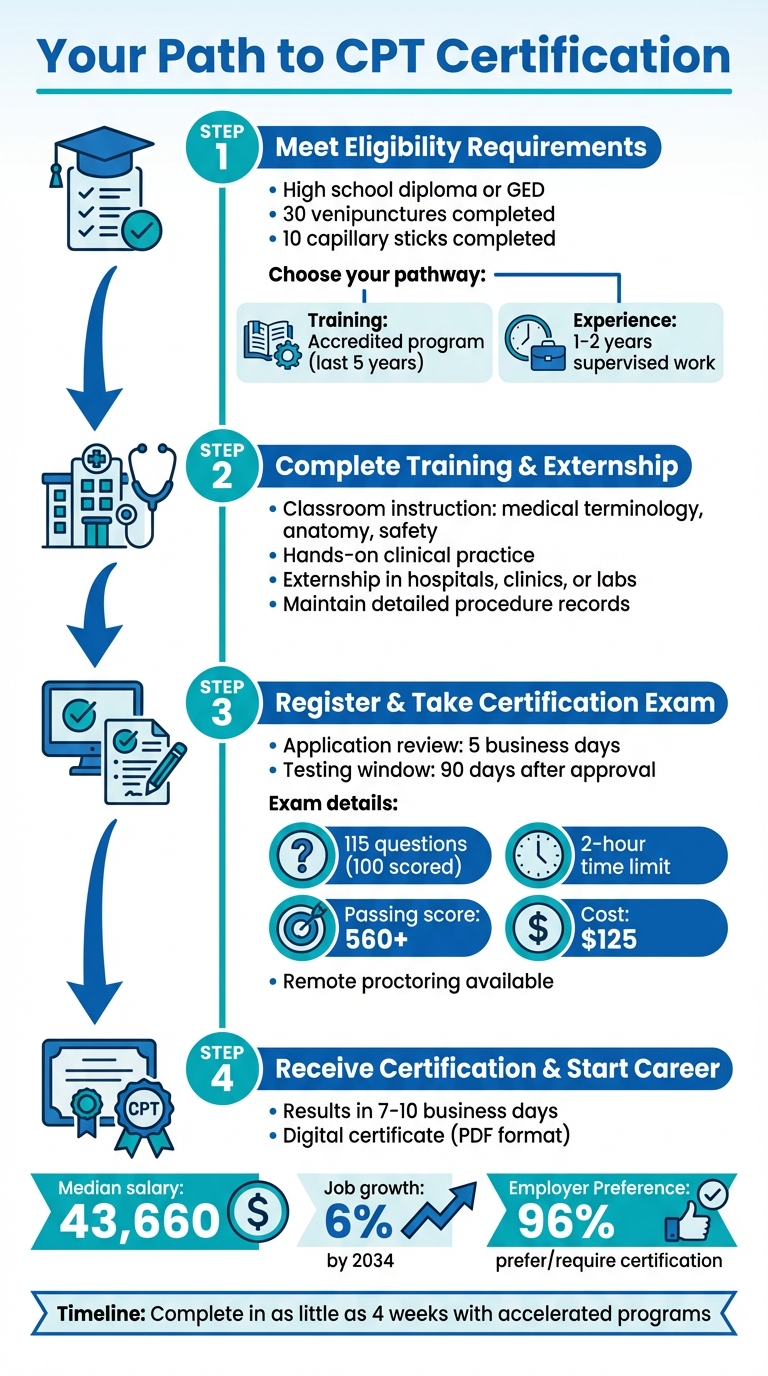
How to Become a Certified Phlebotomy Technician: 4-Step Process
Becoming a Certified Phlebotomy Technician (CPT) is a structured process that ensures you’re well-prepared for the role. It involves meeting eligibility criteria, completing the required training, and passing the certification exam. Typically, this process takes a few months, but each step is crucial for both professional growth and delivering quality care.
Eligibility Requirements
Before you can take the certification exam, you’ll need to meet specific education and clinical experience requirements. At a minimum, you’ll need a high school diploma or GED. If you’re set to graduate within the next 12 months, you may qualify for provisional certification, which becomes full certification once you provide proof of graduation.
Another key requirement is documenting your clinical skills. Certification bodies will review evidence that you’ve successfully completed 30 venipunctures and 10 capillary sticks on live individuals. You can meet the remaining eligibility requirements through one of two pathways:
- Training Pathway: Complete a phlebotomy training program from an accredited or state-recognized provider within the last five years. Military medical training also fulfills this requirement.
- Experience Pathway: Have at least one year of supervised phlebotomy work experience within the last three years, or two years of experience within the last five years.
| Eligibility Component | Requirement Details |
|---|---|
| Basic Education | High school diploma, GED, or proof of upcoming graduation |
| Training Pathway | Accredited program completed within the last 5 years |
| Experience Pathway | 1 year supervised experience (last 3 years) OR 2 years (last 5 years) |
| Clinical Skills | 30 venipunctures and 10 capillary sticks on live individuals |
Training and Externship Requirements
Phlebotomy training programs combine classroom instruction with hands-on clinical practice. The coursework typically covers medical terminology, anatomy, safety protocols, and phlebotomy techniques. This theoretical foundation prepares you for the practical component, where you’ll perform supervised blood draws.
Many programs include externships, which place you in real-world settings like hospitals, clinics, or labs. These externships are essential for completing your required clinical procedures. Before enrolling in any program, confirm its approval with your state’s Board of Higher Education or Board of Private Post-Secondary Education. This ensures your training will count toward certification. Additionally, maintain detailed records of every procedure you perform – these will be needed for your certification application.
Taking the Certification Exam
Once you’ve completed your training and externship, you can register for the certification exam. This process begins online, where you’ll create an account and submit your application. Allow up to 5 business days for your application to be reviewed. After approval, you’ll have 90 days to take the exam, so plan your schedule accordingly.
The exam itself includes 115 questions (100 scored and 15 unscored pretest items) and must be completed within 2 hours. To pass, you’ll need a score of 560 or higher. The test is administered online through live remote proctoring, so you’ll need a desktop, laptop, or Chromebook – mobile devices cannot be used. Don’t forget to have a government-issued photo ID ready for your testing session.
The certification exam fee is $125, and the same fee applies for retakes. If you fail the exam three times, you’ll need to complete remedial training and re-do your clinical procedures before attempting again. Results are typically sent via email within 7–10 business days, and successful candidates receive a digital certificate in PDF format.
CPT Exam Preparation Strategies
Once you’ve completed your certification training and registered for the exam, it’s time to focus on preparation. Success on the CPT certification exam depends on a well-structured study plan that addresses the key content areas. Since the exam emphasizes some topics more heavily than others, knowing where to focus your energy can make all the difference.
Core Exam Topics
The CPT exam is divided into four main sections:
- Phlebotomy Procedures (54%): This includes venipuncture techniques, capillary collection, specimen handling, and selecting the right equipment.
- Safety Protocols (24%): Covers infection control, proper use of personal protective equipment (PPE), handling hazardous materials, and emergency procedures.
- Order and Patient Verification (15%): Focuses on interpreting requisitions, verifying patient identity, and ensuring accurate documentation.
- Communication (7%): Involves interacting professionally with patients, collaborating with healthcare teams, and maintaining sensitivity to diverse patient needs.
Since phlebotomy procedures and safety protocols make up nearly 80% of the exam, dedicate about three-quarters of your study time to these areas. The exam’s content is derived from industry-standard resources like Phlebotomy Essentials (8th edition, 2024) by R.E. McCall and The Complete Textbook of Phlebotomy (6th edition, 2025) by L.B. Hoeltke, so these are excellent references to consult.
With a clear understanding of the exam structure, the next step is to use targeted study tools to address any areas where your knowledge might be lacking.
Study Resources and Tools
Start by downloading the official exam content outline from the certifying organization. This will serve as your roadmap, helping you prioritize the most critical topics. Practice tests are invaluable for assessing your readiness and identifying areas that need extra attention. The NHA offers practice exams and study guides, often bundled together for convenience and cost savings. These practice tests replicate the exam format and provide instant feedback, making them a great way to track your progress.
Interactive tools like flashcard apps are perfect for reinforcing key terms and concepts during short breaks or while commuting. Taking an early practice test is especially helpful – it can highlight strengths, such as proficiency in procedures, while also revealing areas like infection control that may need more review. This method, often called Focused Review®, ensures you spend your time wisely by concentrating on weaker areas instead of rehashing what you already know.
Finally, set your exam date early to allow plenty of time for preparation. If you’re planning to take the test remotely, confirm that your computer, webcam, and internet connection meet the technical requirements well in advance to avoid last-minute issues.
HealthCareer Certs CPT Program
Program Structure and Features
The HealthCareer Certs CPT program is designed to be entirely online and self-paced, allowing participants to complete it in as little as four weeks. You’ll also have access to all course materials for a full year, giving you the flexibility to learn at your own speed. If you need extra support, expert instructors are available for one-on-one guidance.
What sets this program apart is its combination of interactive learning tools and guaranteed clinical externship placements. Through immersive 3D demonstrations, you’ll learn proper phlebotomy techniques in a virtual setting before putting them into practice during your externship. These placements not only provide hands-on experience but also fulfill a critical step for certification eligibility.
Licensed and approved by the New Hampshire Department of Education, the program includes a unique guarantee: if you don’t secure a healthcare job after completing the course, you’re eligible for a 100% tuition refund. The standalone CPT course costs $1,700, or you can bundle it with the Certified Clinical Medical Assistant (CCMA) program for $3,800. This makes it a solid option for those looking to enter the field of phlebotomy.
Exam Preparation Resources
The program’s curriculum is aligned with NHA standards, preparing you for the NCCA-accredited CPT exam. You’ll have access to over 1,400 practice questions and self-assessment tools that mimic the exam format, helping you track your progress and pinpoint areas that need more focus.
To make studying more engaging, the program includes interactive features like animations, games, and simulated patient interactions, which help reinforce key concepts. And with the NHA Mobile app, you can study anywhere using flashcards tailored to your course content.
Career Paths for Certified Phlebotomy Technicians
Where CPTs Work
Getting certified as a phlebotomy technician can open doors to a variety of roles in the healthcare industry. Hospitals employ the largest percentage of phlebotomists, making up 36% of the workforce, followed by medical and diagnostic labs at 32%. Ambulatory healthcare services and physician offices account for 17% and 8% of these positions, respectively. These environments often come with structured schedules and the chance to work alongside diverse medical teams.
Blood donation centers are another common workplace, offering both fixed-location and mobile roles at community events or corporate drives. Some phlebotomists take on home healthcare roles, traveling to patients’ homes or long-term care facilities to collect samples. Research institutions also hire certified phlebotomists for clinical trials and studies, adding even more variety to potential career paths. As the National Healthcareer Association points out, “Phlebotomy technicians are critical team members in hospitals, diagnostic laboratories and blood donor centers”. It’s worth noting that while many positions follow standard daytime hours, hospital and lab roles may require evening, weekend, or holiday shifts. Each setting also offers different opportunities for career growth and compensation.
Salary and Advancement Opportunities
Where you work can significantly impact both your responsibilities and your paycheck. The median annual salary for phlebotomists is $43,660, with most earning between $38,500 and $44,800. However, location also plays a big role. For example, California offers the highest average annual salary at $52,370, with the San Jose-Sunnyvale-Santa Clara metro area leading the nation at $60,600 per year. Outpatient care centers tend to pay the most, with a median wage of $48,450.
Experience is another key factor in salary growth. Entry-level certified phlebotomists typically start around $41,375 per year. With time and advancement, roles like Phlebotomy Supervisor can bring in approximately $59,422 annually. Many certified phlebotomists also use their credentials as a springboard to other healthcare roles. For instance, transitioning to a Medical Laboratory Technician position can boost earnings to an average of $55,426. Other career paths include becoming a Medical Assistant, Respiratory Technician, or even a Registered Nurse.
The job outlook for phlebotomists remains strong, with employment expected to grow by 6% from 2024 to 2034. This growth translates to about 18,400 job openings per year. To stay competitive, it’s crucial to maintain certification by completing 10 continuing education credits every two years, especially since 96% of employers either require or encourage certification.
| Career Stage / Role | Years of Experience | Average Annual Salary |
|---|---|---|
| Certified Phlebotomist | Entry-level | $41,375 |
| Lab Support Clerk | 0-1 years | $42,512 |
| Certified MLT I | 1-3 years | $47,556 |
| Medical/Clinical Laboratory Technician II | 3-5 years | $55,426 |
| Phlebotomy Supervisor | N/A | $59,422 |
These figures highlight how a CPT certification can lead to a rewarding and upwardly mobile career in healthcare.
Conclusion
Earning your CPT certification can open doors to new opportunities in the healthcare field. With 96% of employers either requiring or recommending certification, it’s clear that this credential has become a key to entering and thriving in the industry. By gaining expertise in venipuncture, patient safety, and lab protocols, you not only strengthen your skill set but also build trust with both employers and patients.
The numbers speak for themselves: the demand for skilled CPTs is on the rise, and certification proves your readiness for this competitive field. This guide has covered essential tips, from exam preparation to training programs, to help you succeed in earning your credential.
To achieve certification, you’ll need to complete an accredited training program and pass a national exam. Maintaining your certification involves earning 6 to 10 continuing education credits every two years, ensuring you stay updated on the latest practices and standards.
Whether you’re starting fresh or looking to formalize your experience, CPT certification equips you for roles in hospitals, diagnostic labs, and blood donor centers. With strong job growth, competitive pay, and clear pathways for advancement, this credential sets the stage for a fulfilling career in healthcare. Take the next step and join the growing ranks of certified professionals making a difference every day.
FAQs
What are the advantages of earning a Certified Phlebotomy Technician (CPT) certification?
Earning a Certified Phlebotomy Technician (CPT) certification can make a real difference for healthcare professionals. For starters, it boosts your employability and credibility by proving you’ve mastered blood collection techniques and meet industry standards. Many healthcare facilities actively seek certified professionals, giving you a competitive edge in the job market.
On top of that, certification often comes with the perk of higher earning potential and opportunities for career advancement. It highlights your commitment to professional growth, which employers value. Plus, the process of becoming certified – through training, exams, and ongoing education – keeps you up-to-date with best practices. This not only improves patient care and safety but also prepares you to navigate the ever-changing healthcare landscape. If you’re aiming to build a strong career in phlebotomy, certification is a smart move.
What’s the best way to prepare for the Certified Phlebotomy Technician (CPT) exam?
To get ready for the Certified Phlebotomy Technician (CPT) exam, it’s important to focus on both mastering the material and sharpening your practical skills. Make sure to study key topics like safety protocols, patient preparation, blood collection techniques (both routine and specialized), and sample processing procedures. It’s also a good idea to brush up on medical terminology and the components of blood.
Practice plays a huge role in your preparation. Use study guides, tackle practice questions under timed conditions, and stick to a study schedule that ensures you cover all the material. You might also want to explore online courses or training programs to deepen your understanding. Regular review and hands-on practice will help you approach exam day with confidence.
What job opportunities can I explore as a Certified Phlebotomy Technician (CPT)?
As a Certified Phlebotomy Technician (CPT), you have access to a range of opportunities in the healthcare field. The most common role for CPTs is working as a phlebotomist, where you’ll be responsible for drawing blood for lab tests, transfusions, or donations. These roles are typically found in settings like hospitals, clinics, blood banks, diagnostic labs, and urgent care centers.
With time and experience, you might move into more specialized positions, such as becoming a Lead Phlebotomy Technician or taking on supervisory responsibilities. Some CPTs choose to shift into education, training the next generation of phlebotomists, or assisting healthcare organizations in creating certification programs. Staying certified through continuing education is key to unlocking new career paths and advancing in this field.