The Certified Patient Care Technician (CPCT) role addresses the growing demand for skilled healthcare workers, especially as hospitals face shortages of Licensed Practical Nurses (LPNs). CPCTs perform both basic and advanced clinical tasks, such as monitoring vital signs, assisting with daily activities, performing EKGs, and drawing blood. Certification, offered by the National Healthcareer Association (NHA), ensures that professionals meet industry standards, with 96% of employers requiring or recommending it.
Here’s what you need to know about CPCT certification:
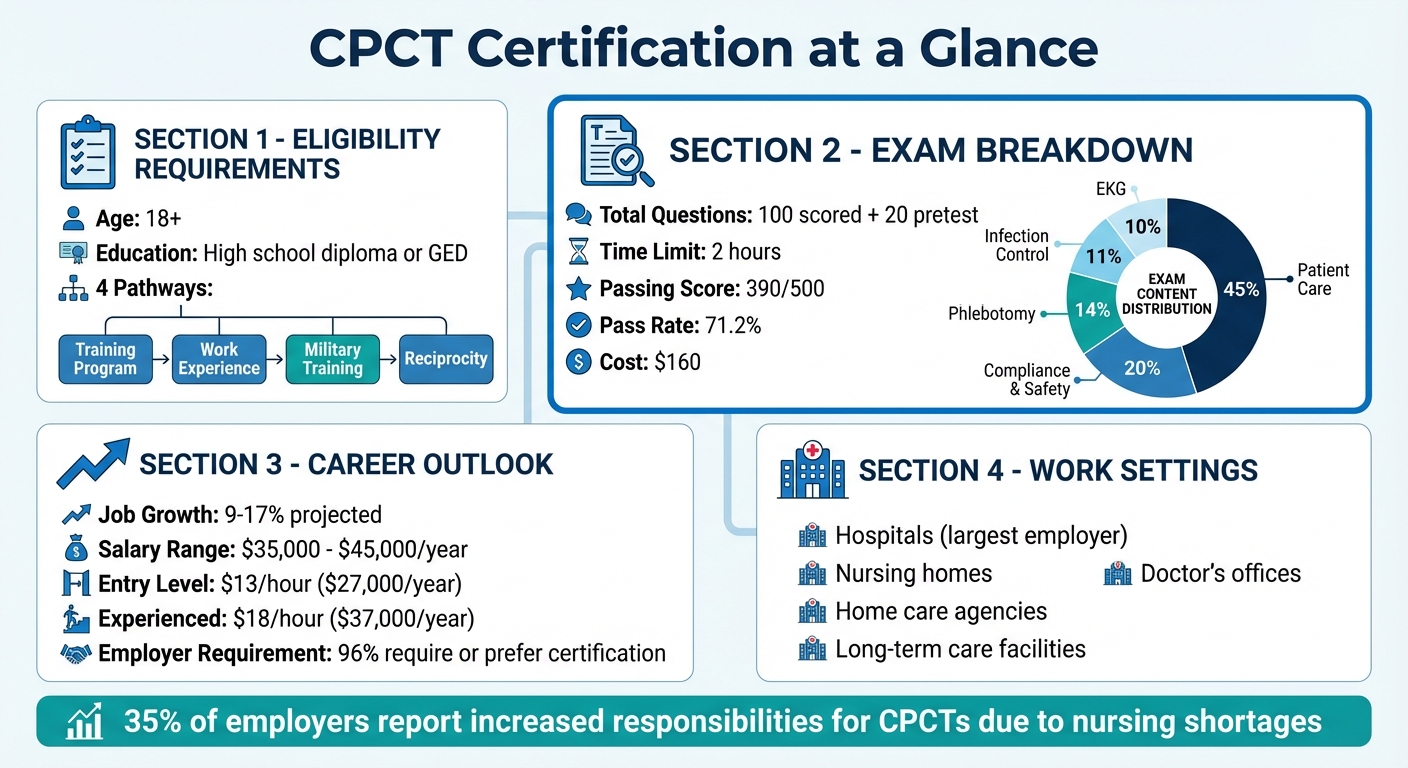
- Eligibility: Must be 18+ with a high school diploma or GED. Pathways include formal training, work experience, military training, or reciprocity.
- Exam Details: 100 scored questions, 20 pretest items, 2 hours to complete. Key areas: Patient Care (45%), Compliance & Safety (20%), Phlebotomy (14%), Infection Control (11%), EKG (10%). Passing score: 390/500.
- Cost: Around $160 for the exam.
- Demand: Job growth projected at 9% with salaries ranging from $35,000 to $45,000 annually. Certification boosts employability and flexibility across states.
Preparation programs like HealthCareer Certs offer study tools, externships, and exam fee coverage, helping candidates succeed in this growing field.
CPCT Certification Quick Reference Guide: Exam Breakdown, Salary & Requirements
Eligibility Requirements for the CPCT Exam
Main Eligibility Criteria
To qualify for the CPCT exam, candidates must meet a few basic requirements. You need to be at least 18 years old and have either a high school diploma or a GED. However, the National Healthcareer Association (NHA) offers some flexibility for current students – you can take the exam up to 12 months before your expected graduation date. In this case, you’ll receive a provisional certification, which becomes permanent once you submit proof of your diploma.
After meeting these initial requirements, you can qualify through one of the following pathways:
- Training Pathway: Complete an accredited patient care technician program within the last five years.
- Work Experience Pathway: Gain supervised employment experience. For example, the NHA requires one year of experience within the past three years (or two years within the past five years). Similarly, NCCT and American Allied Health (AAH) require one year of full-time, verifiable experience within the last five years.
- Military Pathway: Complete relevant medical service training in the U.S. Armed Forces within the last five years.
- Reciprocity Pathway: Already hold certification from another recognized agency.
Once you’ve determined your pathway, you’ll need to gather specific documents to complete your application.
Required Documentation
The documentation you’ll need depends on the pathway you’re using to qualify:
- Education Route: Provide a copy of your high school diploma, GED, or official transcripts from your training program.
- Work Experience: Submit a formal letter from your employer verifying your job title, employment dates, or recent pay stubs showing your hire date and role.
- Military Pathway: Include a DD Form 214 or a SMART transcript to confirm your medical training.
- Reciprocity Pathway: Provide a copy of your Member ID or certificate from your previous certifying agency.
For most certifying bodies, you’ll upload these documents directly to your online account during registration. The review process usually takes one to two business days, so it’s smart to gather everything ahead of time. If you’re using a training program to qualify for the NCCT exam, make sure your school is NCCT-authorized. Submitting documents from an unapproved program could lead to your application being rejected.
sbb-itb-7a67ffa
What to Expect on the CPCT Exam
Exam Topics and Skills Tested
The CPCT exam, offered by the National Healthcareer Association (NHA), measures your ability to handle key patient care responsibilities. It focuses on five main areas: Patient Care (45%), Compliance, Safety, and Professional Responsibility (20%), Phlebotomy (14%), Infection Control (11%), and EKG (10%).
- Patient Care: This section covers tasks like bathing, feeding, catheter care, monitoring vital signs, and assisting with range of motion exercises.
- Compliance, Safety, and Professional Responsibility: You’ll need to understand HIPAA rules, OSHA guidelines, abuse reporting, and medical ethics.
- Phlebotomy: This involves venipuncture, capillary sticks, following the correct order of draw, and handling specimens properly.
- Infection Control: Focus areas include aseptic techniques, using personal protective equipment (PPE), and disposing of biohazard materials.
- EKG: You’ll be tested on placing electrodes correctly, operating EKG machines, and identifying irregular heart rhythms.
The exam also evaluates soft skills like therapeutic communication and offering emotional support to grieving families, emphasizing the importance of compassionate patient care.
Exam Format and Structure
The CPCT exam uses a scenario-based, practical approach to test your knowledge. It includes 100 scored multiple-choice questions and 20 pretest questions, all to be completed within 2 hours. These questions are designed to reflect real-life clinical situations, such as responding to phlebotomy complications or addressing EKG artifacts.
To pass, you’ll need a scaled score of 390 or higher on a scale ranging from 200 to 500. The national pass rate hovers around 71.2%. The exam can be taken at your school, a PSI testing center, or remotely with live proctoring. Results are typically available in your NHA account within two days. If you don’t pass, you must wait 30 days to retake the exam and pay a $160 fee.
This format ensures that certified CPCTs are ready for the hands-on demands of clinical work, equipping them to deliver effective and safe patient care.
| Exam Domain | Weight | Key Skills Tested |
|---|---|---|
| Patient Care | 45% | Bathing, feeding, catheter care, vital signs, range of motion, and daily living activities |
| Compliance, Safety, & Professional Responsibility | 20% | HIPAA, OSHA, abuse reporting, and medical ethics |
| Phlebotomy | 14% | Venipuncture, capillary sticks, order of draw, and specimen handling |
| Infection Control | 11% | Aseptic techniques, PPE usage, and biohazard disposal |
| EKG | 10% | Electrode placement, operating EKG machines, and identifying dysrhythmias |
How to Prepare for the CPCT Exam
Study Plans and Tools
Divide the curriculum into sections that align with the five exam domains, and allocate your study time based on their weightings. For example, since Patient Care makes up 45% of the exam, spend nearly half your study time mastering essential skills like bathing, feeding, and assisting with mobility.
Use interactive tools like simulations and 3D animations to bridge the gap between theory and practice. These resources let you virtually practice critical skills, such as selecting venipuncture sites, placing electrodes for a 12-lead EKG, and correctly using personal protective equipment.
Don’t skip practice exams – taking at least three full-length tests will help you build the stamina needed for the 2-hour exam while pinpointing areas where you need improvement. Mobile-friendly tools, like flashcards, are great for squeezing in quick review sessions during lunch breaks or commutes, helping you maintain a steady study routine.
For a structured approach, consider the HealthCareer Certs CPCT Prep Program, which offers a detailed and guided study plan.
HealthCareer Certs CPCT Prep Program
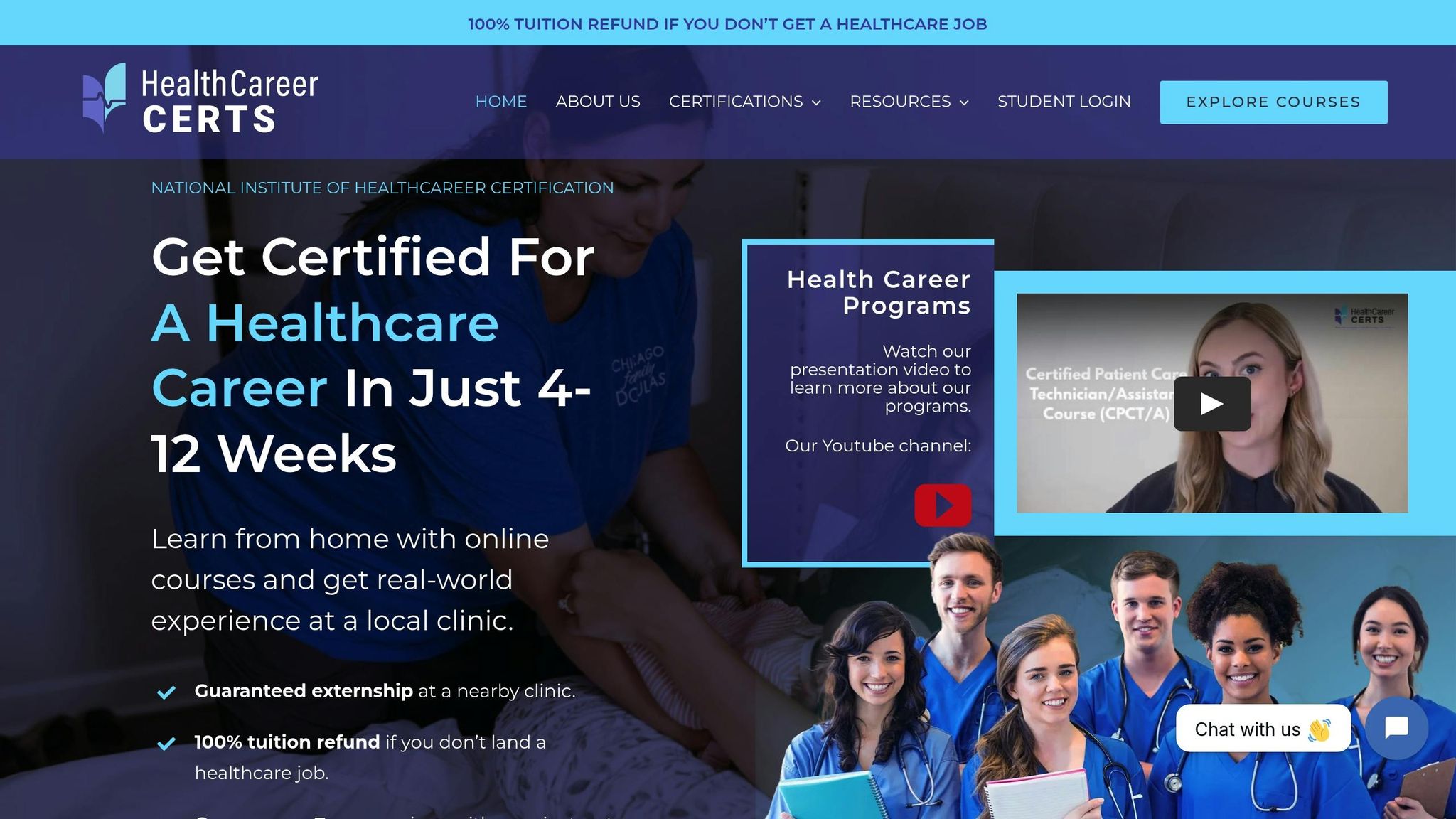
The HealthCareer Certs CPCT Prep Program provides a 16-module curriculum that covers Fundamental Knowledge, Professional Skills, and Clinical Patient Care Skills. Priced at $2,400 (or $430 monthly), the program includes 154 lessons, 12 hours of video content, six competency assessments, and even covers your exam fee. You can complete the program in as little as four weeks or stretch it out over 12 months, with 24/7 access to all materials.
The program also connects you with personal advisors via Zoom, text, or email to help with challenging topics like EKG rhythm recognition or HIPAA regulations. You’ll get hands-on experience through Electronic Health Record simulations and lab exercises, which prepare you for real-world clinical documentation. Plus, the program guarantees an externship placement, pairing you with approved clinical sites to gain practical patient care experience before taking the exam.
"At HealthCareer Certs you will be fully prepared to successfully pass the national exam and find your way into the job market. We have provided a comprehensive training program with many practice opportunities for you to feel comfortable with the exam."
FREE PCT Practice Test (NEW 2026) Patient Care Technician Exam 50 Questions Answers
Career Opportunities with CPCT Certification
Once you’ve completed your preparation and earned your CPCT certification, a variety of career paths in healthcare open up for you.
Job Roles and Work Settings
With CPCT certification, you qualify for roles like Patient Care Technician, Patient Care Associate, Patient Care Assistant, or Nurse Technician. While job titles may differ by employer, the responsibilities often include basic patient care – such as assisting with bathing and feeding, monitoring vital signs, performing EKG tests, drawing blood, and providing emotional support.
Hospitals employ the largest number of CPCTs, but opportunities also exist in home care agencies, nursing homes, long-term care facilities, and doctor’s offices. The certification also meets or surpasses the requirements for positions like Certified Nursing Assistants (CNA), Home Health Aides, and Home Health Assistants. If you pursue additional credentials, such as Certified Phlebotomy Technician (CPT) or Certified EKG Technician (CET), you can specialize in areas like phlebotomy or EKG testing.
The demand for certified professionals is strong: 96% of employers either require or prefer certification for patient care technicians, and 78% list it as a hiring requirement.
Salary Expectations and Job Growth
Patient Care Technicians generally earn between $35,000 and $45,000 annually. Entry-level roles might start at $13 per hour (about $27,000 per year), while experienced professionals with 10–20 years in the field can earn $18 per hour (around $37,000 annually). Specialized roles, such as Dialysis Patient Care Technicians or Lead Patient Care Technicians, offer higher salaries, averaging $37,000 and $45,000 respectively.
Employers offering competitive pay include U.S. Renal Care (approximately $24 per hour), Memorial Sloan Kettering Cancer Center (around $23 per hour), and Texas Children’s Hospital (also about $23 per hour). The field is expanding quickly, with job growth for certified patient care technicians projected at 17% over the next decade. Additionally, 37% of employers report an increase in responsibilities for patient care technicians due to nursing shortages.
| Role | Average Annual Salary | Key Duties |
|---|---|---|
| Patient Care Technician | $35,000 – $45,000 | Monitoring vital signs, performing EKGs and phlebotomy, providing basic nursing care, and offering emotional support |
| Phlebotomist | $43,660 | Drawing blood and collecting lab specimens |
| Certified Nursing Assistant | $39,430 | Assisting with daily living activities, delivering basic patient care, and monitoring patients |
Career Advancement Options
Your CPCT certification can be a launchpad for more advanced roles in healthcare. Many professionals use it as a foundation to pursue careers like Surgical Technologist or Anesthesia Technician, or to move toward LPN or RN degrees. Adding certifications like CPT (Phlebotomy) or CET (EKG) can further expand your clinical skills and boost earning potential.
Hands-on externship opportunities, such as those provided by the HealthCareer Certs program, allow you to gain practical experience at approved clinical sites. These placements not only prepare you for the certification exam but also help you build professional networks that may lead to job offers. In 2020, 35% of employers noted that patient care technicians were taking on more responsibilities compared to the previous year, reflecting the growing importance of this role.
Conclusion
Earning your CPCT certification lays the groundwork for a fulfilling career in healthcare. With 96% of employers either requiring or recommending certification, this credential confirms your expertise in essential skills like EKG monitoring, phlebotomy, and patient care – making you a sought-after candidate in a field that’s expanding rapidly. Over the next decade, the healthcare sector is expected to grow by about 1.9 million jobs, placing patient care technicians in a vital position within this growth.
Success on the CPCT exam requires thorough preparation. With a pass rate of roughly 71.2%, investing time in focused study and practical experience can significantly improve your chances. Programs like HealthCareer Certs are designed to help you succeed, offering tools like 3D animations, interactive lessons, and guaranteed externships. At $2,400 – which includes exam fees and the externship – this program not only enhances your clinical skills but also strengthens your professional network and readiness for the workforce.
Achieving CPCT certification doesn’t just lead to immediate job opportunities with competitive salaries (averaging $39,000 per year) but also paves the way for advancement into roles like Licensed Practical Nurse or Registered Nurse. With 35% of employers reporting increased responsibilities for patient care technicians due to nursing shortages, certified professionals are in greater demand than ever. By dedicating yourself to preparation and utilizing targeted resources, you’ll be well-positioned for a stable and growing career in this essential industry.
FAQs
What are the main benefits of earning a Certified Patient Care Technician (CPCT) certification?
Earning a Certified Patient Care Technician (CPCT) certification can open doors to better opportunities in the healthcare field. This credential showcases your skills and professionalism, making you a more attractive candidate to employers. In fact, many employers prefer hiring certified technicians, which can lead to roles in diverse settings like hospitals, long-term care facilities, and dialysis centers. Plus, certification often comes with the perk of higher earning potential.
Beyond the job market advantages, certification helps build your confidence by providing thorough training and exam preparation. It’s a way to validate your abilities and demonstrate your commitment to excellence. In a competitive and constantly changing healthcare industry, being certified not only supports career growth but also enhances your job stability and recognition. It’s a step toward advancing your career and securing a stronger foothold in the profession.
What are the best ways to prepare for the CPCT exam and improve my chances of passing?
To get ready for the CPCT exam, start by diving into the main topics you’ll be tested on: medical terminology, basic patient care, safety procedures, EKG readings, and phlebotomy techniques. A solid understanding of these subjects will give you the confidence you need when exam day arrives.
Taking practice exams can be a game-changer. They not only familiarize you with the 100 multiple-choice questions and the 2-hour time limit but also help you identify areas where you might need extra focus. Pair these with study resources like guides, online courses, or interactive tools to strengthen your grasp on key concepts. Look for programs that include practice tests and allow you to learn at your own pace.
If you can, set aside time for hands-on practice to reinforce your skills. Regularly review topics where you’re less confident, and double-check that you meet all the eligibility requirements before scheduling your test. Staying consistent and focused in your preparation can make a big difference in your performance.
What career opportunities can I pursue after earning my CPCT certification?
Earning a Certified Patient Care Technician (CPCT) certification can unlock a range of career opportunities in healthcare. This credential qualifies you for roles like senior patient care technician, healthcare technician, or specialized nursing support. These positions are available in settings such as hospitals, nursing homes, and home care environments.
Beyond immediate job prospects, the CPCT certification can act as a stepping stone for further certifications in fields like medical assisting, phlebotomy, or pharmacy technology. These additional qualifications can broaden your skills, boost your earning potential, and open doors to more specialized areas within healthcare. In short, this certification not only helps you secure employment but also lays the groundwork for long-term career advancement.