Switching careers into healthcare can feel overwhelming, especially when clinical experience is often a must-have. Externships offer a direct solution by providing hands-on training in real healthcare settings. These short-term programs help you gain practical skills, improve your resume, and build connections with healthcare professionals.
Here’s why externships are a game-changer for career changers:
- Gain Clinical Experience: Practice tasks like taking vital signs, drawing blood, and using electronic health records under supervision.
- Boost Your Resume: Add verified clinical hours to stand out to employers.
- Network with Professionals: Build relationships that can lead to job opportunities.
- Test Career Fit: Experience different healthcare environments before committing to a full-time role.
Programs like HealthCareer Certs make the process easier by combining online certifications with guaranteed externship placements, helping you transition smoothly into healthcare.
Externships bridge the gap between education and practice, giving you the confidence and experience to succeed in this growing field.
Common Barriers Career Changers Face in Healthcare
Switching into healthcare from a different industry comes with three primary obstacles that make it tough for career changers to land their first role in the field.
Missing Clinical Experience
One of the biggest hurdles is the lack of hands-on clinical experience. While classroom learning and non-clinical roles provide some foundation, they don’t prepare you for the unpredictable and often intense nature of real hospital settings. Externships fill this gap by offering practical exposure, where you can perform tasks like drawing blood and taking vital signs in a professional environment.
"Although nursing education provides students with a basis for practice, school alone cannot prepare them for actual practice in the hospital setting." – Debra Shipman, PhD, RN, Federal Practitioner
Without this experience, many career changers face "transition shock" – a mix of anxiety and uncertainty about performing clinical tasks without sufficient practice. To put things into perspective, Physician Assistant programs often require 1,000 to 2,000+ hours of direct clinical experience, while medical schools expect applicants to log 150 to 200 hours just to show they understand the day-to-day realities of a medical career.
No Healthcare Background on Resume
Another challenge is the absence of healthcare experience on your resume. Many job postings either "prefer" or outright require prior experience in a medical setting, which can make career changers feel like they’re starting at a disadvantage. Hiring managers often skim for specific healthcare-related keywords and documented clinical hours. Without these, you’re competing against candidates who already have proven experience in the field.
The issue goes beyond what’s missing – it’s also about what employers can’t see. While transferable skills are important, they don’t prove your ability to handle patient care. Statistics show that 71% of interns receive job offers from their host organizations, underscoring how much employers value directly observing a candidate’s clinical skills before making a hiring decision. This lack of visible experience heightens concerns for hiring managers, which leads to the next barrier.
Hiring Manager Concerns About Career Switchers
Healthcare employers often worry about the "theory-practice gap" – the disconnect between what you’ve learned in the classroom and how well you can apply it in real-world clinical settings. Their concerns aren’t unfounded. Studies show that 35% to 69% of new graduate nurses leave their first job within a year, often because they feel overwhelmed by the complexity of the work environment.
Employers want to see evidence of workplace readiness – traits like punctuality, reliability under pressure, and the ability to interact appropriately with patients. These qualities are hard to evaluate from a resume alone. That’s why 96% of healthcare employers say hosting an intern or extern is worth the investment. Externships allow you to demonstrate your ability to handle real-world challenges, reassuring employers about your readiness to bridge the gap between theory and practice.
What Externships Are and How They Help Career Changers
An externship is a short-term, supervised learning opportunity within a real-world healthcare setting. It bridges the gap between academic knowledge and clinical practice. Unlike internships, which often emphasize hands-on work, externships are designed to be more observational and educational. They allow you to see how healthcare teams operate before you’re expected to take on independent responsibilities. Let’s dive into what happens during an externship and how it addresses the challenges faced by career changers.
What Happens During an Externship
Externships are primarily about shadowing experienced healthcare professionals. You get to observe how they manage daily tasks, interact with patients, and handle clinical procedures. This is your chance to watch and learn how teams collaborate and tackle challenges in real-time. Asking questions and taking notes can deepen your understanding of the dynamics within a healthcare setting.
As you gain familiarity, you may have opportunities to practice essential skills under direct supervision. Tasks might include taking vital signs, working with electronic health records, checking blood glucose levels, or assisting with basic patient care. What sets externships apart from regular jobs is the constant presence of a supervisor. They guide you through each step, ensuring you learn safely and effectively. This blend of observation and supervised practice helps career changers overcome the hurdle of clinical inexperience. Externships typically last anywhere from a single day to several weeks and are unpaid, purely educational experiences.
How Externships Fill Experience Gaps
Externships are a practical way to address the experience gap that many career changers face. They take you beyond the classroom and into real clinical environments, where you can develop critical thinking and communication skills – things you can’t fully grasp from textbooks. You’ll learn how to juggle tasks during busy shifts, handle unexpected patient scenarios, and work effectively with diverse healthcare teams.
Beyond skill-building, externships give you a chance to test the waters. Whether it’s the fast pace of a hospital or the quieter setting of a private clinic, you’ll gain clarity about what suits your career goals before committing to a full-time role. This exposure not only boosts your confidence but also provides strong talking points for job interviews. By showcasing real-world clinical experience, you can transform a resume that might lack healthcare credentials into one that highlights meaningful, hands-on learning.
How Externships Help People Enter Healthcare
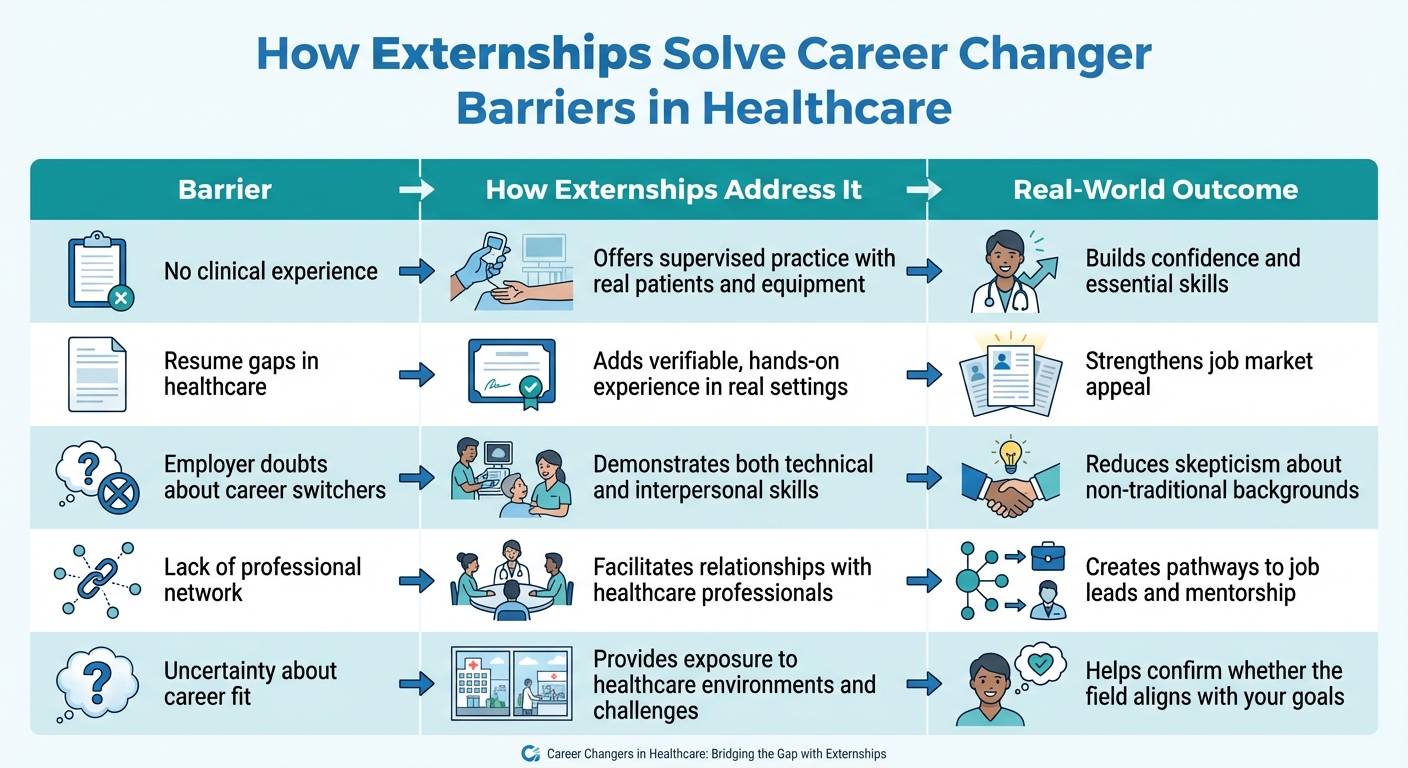
How Externships Solve Career Changer Barriers in Healthcare
Externships connect classroom learning to hands-on healthcare practice, making them a vital stepping stone for those transitioning into the industry. They offer the chance to develop practical skills, enhance resumes, and build meaningful professional relationships. Here’s a closer look at how externships can make a difference.
Developing Hands-On Skills
Externships provide a safe, supervised environment to practice essential clinical tasks, such as measuring vital signs, drawing blood, and navigating EHR systems. Beyond technical skills, they help you refine patient interaction techniques and teamwork within healthcare settings. For instance, the Veterans Affairs Learning Opportunity Residency (VALOR) program allows participants to gain up to 800 hours of hospital-based experience, equipping them with the confidence and readiness to handle demanding roles. This structured environment encourages curiosity, enabling you to ask questions, receive feedback, and prepare for the fast-paced realities of healthcare, including rotating shifts and high patient volumes.
Strengthening Your Resume
Adding an externship to your resume demonstrates verifiable clinical experience, which is particularly valuable for career changers. Be specific when listing externship details – include the number of hours completed (e.g., 160 hours in a Clinical Medical Assistant program or 90 hours in Medical Office Administration), the facility name, and the skills you practiced. These details provide tangible proof of your qualifications. Some hospitals even report that prelicensure nurse externships result in recruitment rates of 50% to 79%, showcasing the career opportunities externships can unlock.
Connecting With Healthcare Professionals
Externships are also a powerful networking tool. Working alongside nurses, physicians, medical assistants, and administrative staff gives you the chance to establish relationships that could lead to future opportunities. As Ross Medical Education Center puts it:
"The externs who stay in touch and network are the ones most likely to be remembered."
Even if a facility isn’t hiring immediately, maintaining these connections can pay off down the line. Programs like VALOR highlight this potential, with 38% of participants securing employment directly through their externship experience.
Comparison: How Externships Solve Career Changer Problems
Externships address common barriers faced by career changers, bridging gaps in experience, networks, and confidence. Here’s a summary of how they help:
| Barrier | How Externships Address It | Real-World Outcome |
|---|---|---|
| No clinical experience | Offers supervised practice with real patients and equipment | Builds confidence and essential skills |
| Resume gaps in healthcare | Adds verifiable, hands-on experience in real settings | Strengthens job market appeal |
| Employer doubts about career switchers | Demonstrates both technical and interpersonal skills | Reduces skepticism about non-traditional backgrounds |
| Lack of professional network | Facilitates relationships with healthcare professionals | Creates pathways to job leads and mentorship |
| Uncertainty about career fit | Provides exposure to healthcare environments and challenges | Helps confirm whether the field aligns with your goals |
sbb-itb-7a67ffa
How HealthCareer Certs Combines Certification With Externships
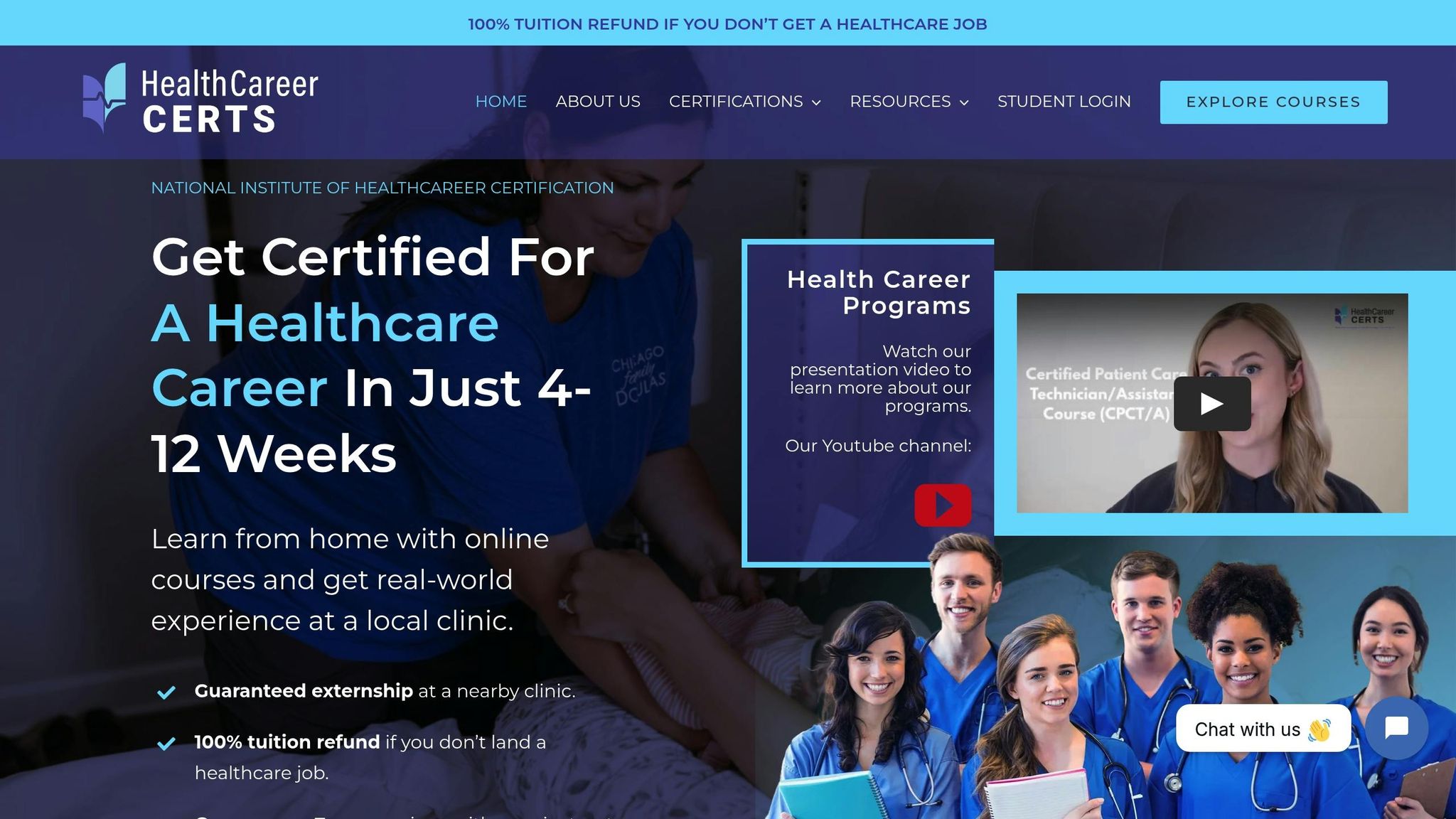
HealthCareer Certs simplifies the process of transitioning into a healthcare career by integrating certification programs with guaranteed externship placements. For those changing careers, finding both comprehensive certification training and practical clinical experience often feels overwhelming. HealthCareer Certs eliminates this challenge by offering entirely online certification courses paired with hands-on externships, creating a straightforward pathway from learning to practice. Here’s how their program addresses key hurdles for career changers.
Guaranteed Externship After Completing Certification
After finishing your online coursework, HealthCareer Certs ensures you get placed in a local externship – completely free of charge. Their dedicated placement team works through a network of healthcare partners across the country, so you won’t need to spend time searching for opportunities. This system has already helped over 5,000 students gain the clinical experience they need to transition into healthcare roles.
Self-Paced Online Programs
The certification programs are designed with flexibility in mind, making them ideal for busy individuals. You can access your coursework anytime, on any device, and progress at your own pace. For example, the Certified Clinical Medical Assistant (CCMA) program can be completed in as little as six weeks, while the Certified Phlebotomy Technician (CPT) program takes just four weeks. To support your learning, the program includes one-on-one Zoom sessions with instructors and interactive tools like 3D demos, flashcards, and over 1,400 practice questions to prepare you for national exams.
Certifications for In-Demand Healthcare Jobs
HealthCareer Certs focuses on certifications for roles that are in high demand within healthcare facilities. The CCMA program equips you with skills like assisting in patient exams, taking vital signs, administering injections, performing EKGs, and managing Electronic Health Records. Meanwhile, the CPT program trains you in blood draws, aseptic techniques, and lab procedures. Both certifications are recognized by the National Healthcareer Association and the New Hampshire Department of Education and even earn ACE college credits – five for CCMA and two for CPT.
To further reduce financial risk, HealthCareer Certs offers a 100% tuition refund guarantee. If you don’t secure a healthcare job within six months of completing both your certification and externship – and you’ve actively searched while staying in touch with the externship department – you’ll get your tuition back.
How to Get and Succeed in an Externship
Let’s dive into how you can secure an externship and make the most of the opportunity.
Get Certified First
Before starting an externship, healthcare facilities usually require certifications like Certified Clinical Medical Assistant (CCMA) or Certified Phlebotomy Technician (CPT). These programs equip you with essential skills in medical terminology, infection control, and basic clinical procedures – foundational knowledge needed to work in a clinical setting. Educators often recommend externships as a way to boost your job prospects. Certification shows potential facilities that you’re prepared to observe and assist in patient care.
Use Programs That Guarantee Externship Placements
Finding an externship on your own can be a daunting task, especially if you’re just starting out. Luckily, many training programs include externships as part of their curriculum or provide guaranteed placement assistance. For example, HealthCareer Certs ensures externship placement once you finish their courses. With both certification and a secured placement, you can focus your energy on gaining hands-on experience without worrying about the logistics.
Make the Most of Your Externship
Think of your externship as an extended job interview. Show initiative by arriving early, maintaining impeccable attendance, and volunteering for tasks whenever possible. Graham Nott, Vice President of Academic Affairs at Concorde Career Colleges, emphasizes the importance of externships:
"Externships really serve a dual purpose… it allows students to practice the skills they have learned… [and] to show off their teamwork, professionalism and health care skills to potential employers".
Take notes on key procedures, terminology, and any feedback you receive. Don’t hesitate to ask for guidance – it shows you’re eager to learn. By being dependable and maintaining a positive attitude, you can turn your externship into a stepping stone for immediate job opportunities. This hands-on experience helps bridge the gap between classroom learning and actual clinical practice.
Conclusion
Switching to a healthcare career can feel overwhelming, especially if you don’t have clinical experience. That’s where externships come in – they bridge the gap by offering supervised, hands-on practice. Whether it’s working with medical equipment, navigating electronic health records, or interacting with patients, this real-world exposure builds confidence and prepares you for the workplace. Even without a traditional healthcare background, this experience makes your resume stand out and positions you as a strong candidate.
Externships also open doors to valuable connections. Many participants land job offers during their externship, sometimes even before they’ve officially applied. Think of it as an extended interview – arriving early, asking smart questions, and proving your reliability can leave a lasting impression on potential employers.
Programs like HealthCareer Certs simplify the process by combining certification with guaranteed externship placement. Once you complete your Certified Clinical Medical Assistant (CCMA) or Certified Phlebotomy Technician (CPT) coursework, your externship site is already secured. This eliminates the stress of finding a clinical placement on your own, allowing you to focus on gaining experience and building relationships in the field.
Pairing certification with an externship creates a powerful combination. It blends theoretical knowledge, practical skills, and professional networking into one cohesive package. By addressing both clinical experience and connections, externships transform the challenges of switching careers into opportunities for growth and success.
FAQs
How can externships help career changers transition into healthcare?
Externships offer a fantastic opportunity for career changers to dive into the healthcare field with practical, hands-on experience. They give individuals the chance to observe seasoned professionals, refine clinical skills under supervision, and see how classroom knowledge translates into real-world patient care. This kind of exposure not only helps build confidence but also bridges the gap between theory and practice.
For those making the leap into healthcare, externships are also a great way to connect with industry professionals, get familiar with the workflows of healthcare settings, and strengthen their resumes with real-world experience. These programs don’t just enhance skills – they also make career changers stand out when applying for roles in the healthcare industry.
How can an externship help me transition into a healthcare career?
An externship is an important step for anyone transitioning into a healthcare career. It gives you practical, hands-on experience in real clinical settings, where you can put your knowledge into action. During this time, you’ll get to observe healthcare professionals in their daily roles, sharpen critical skills, and build confidence as you handle real tasks.
Another key benefit of externships is the chance to connect with industry professionals. These connections can play a big role in helping you secure a job once you’ve completed your certification. By bridging the gap between classroom learning and on-the-job practice, externships equip you with both the experience and professional network needed to make a successful move into healthcare.
How do externships help career changers gain healthcare experience and strengthen their resumes?
Externships offer career changers a chance to gain practical experience in actual healthcare environments. These opportunities allow individuals to build essential skills while getting firsthand exposure to clinical workflows, patient care, and medical procedures. This type of hands-on learning not only boosts their understanding of the field but also highlights their dedication and willingness to adapt – key traits for anyone transitioning into healthcare without prior experience.
By connecting classroom knowledge with real-world application, externships help fill gaps in a resume with relevant clinical experience. This makes candidates more attractive to employers who value on-the-job training. For those shifting careers, externships can be a great way to build confidence, demonstrate abilities, and stand out in the competitive healthcare job market.