If you’re pursuing a career as a Certified Clinical Medical Assistant (CCMA) or Certified Phlebotomy Technician (CPT), understanding state-specific accreditation is essential. Here’s what you should know:
- Certification Requirements Vary by State: While some states like Washington require state-issued credentials, others like Texas and South Carolina rely on employer discretion or delegation models.
- National Certifications Are Widely Recognized: Credentials from organizations like the National Healthcareer Association (NHA) are accepted across most states and valued by over 90% of employers.
- State-Specific Rules for CCMA: States like California mandate additional training for tasks like injections, while Washington requires a state license for medical assistants.
- State-Specific Rules for CPT: Only four states – California, Louisiana, Nevada, and Washington – require state-level licensure for phlebotomists.
- Employer Preferences: Even in states without legal certification requirements, most employers prefer or require national certifications to ensure competency and reduce liability.
Quick Overview
- Washington: State license mandatory for medical assistants and phlebotomists.
- California: Certification required for specific clinical tasks like injections and phlebotomy.
- Texas: No state mandates, but employers favor certified candidates.
- Florida: Phlebotomists must meet state and national requirements.
Why It Matters
Certification isn’t just about meeting legal requirements – it directly impacts your employability. With over 90% of employers requiring certification and healthcare jobs projected to grow by 12% between 2024 and 2034, aligning your training with both state and national standards is crucial for career success.
For more detailed state-specific requirements and certification options, read on.
National Certification Bodies for CCMA and CPT
The National Healthcareer Association (NHA) stands out as the largest allied health certification agency in the U.S., having awarded over 1 million certifications since 1989. Among its offerings are the Certified Clinical Medical Assistant (CCMA) and Certified Phlebotomy Technician (CPT) credentials, both widely recognized by employers across the country. These certifications are accredited by the National Commission for Certifying Agencies (NCCA), the authority responsible for ensuring that certification programs meet strict industry standards. While these national credentials provide a solid foundation, understanding state-specific accreditation requirements is equally important.
One of the key advantages of national certifications is their portability. They allow professionals to work in multiple states without the need to retake exams. For example, Washington state mandates passing an approved national exam as part of its registration process.
Employers place significant value on these credentials. Surveys show that between 84% and 98% of employers either require or prefer certification for allied health roles. Additionally, 70% of employers report offering higher pay to employees who earn professional certifications. Maintaining an NHA certification involves completing 10 continuing education credits every two years, costing around $8 per month. Current certification holders can access these courses for free through NHA.
Other national organizations also provide certification options. The American Association of Medical Assistants (AAMA) offers the CMA credential for approximately $125, while the American Medical Technologists (AMT) provides the RMA credential for about $150. With over 315 NCCA-accredited programs available from more than 130 organizations, there are numerous pathways to certification. While these national credentials are robust, ensuring they align with your state’s specific requirements is crucial for a seamless professional journey.
sbb-itb-7a67ffa
State Accreditation Requirements for CCMA
CCMA certification requirements differ widely across the United States. Most states use a delegation model, where a supervising physician decides which tasks a medical assistant can perform based on their demonstrated skills. However, some states impose additional regulations beyond national certification standards. It’s essential to check your specific state’s requirements, as extra training, documentation, or registration might be necessary.
California CCMA Requirements
In California, certification isn’t legally required, but the Medical Board mandates approved certification for training purposes or for performing technical procedures like injections and skin tests. The state requires medical assistants to complete 10 hours of specialized injection training, documented with a "Statement of Proficiency" signed by a qualified instructor or supervising physician. California also places limits on the scope of practice, prohibiting medical assistants from interpreting test results, using lasers, or performing IV therapy. For those pursuing a California-specific CCMA credential, study materials include a review guide, practice test booklet, and a medical math workbook. Recertification every five years requires 60 continuing education units, including mandatory HIPAA and Cultural Competency training.
Washington CCMA Restrictions
Washington stands out as the only state requiring all medical assistants to obtain a state-issued credential before performing clinical duties. The state offers two credential types: Medical Assistant-Certified (MA-C), which allows for a broader scope of practice, and Medical Assistant-Registered (MA-R), which has a more limited scope and does not permit phlebotomy without additional credentials. To earn an MA-C credential, candidates must pass one of five approved national exams, such as the NHA CCMA exam. Non-accredited applicants must complete 720 training hours and a 160-hour externship. Washington also offers an interim certification, allowing applicants to work for up to one year while waiting for national exam results. However, this certification is non-renewable. Credentials in Washington must be renewed every two years on the holder’s birthday. The state also differentiates between immediate (on-premises) and direct visual (in-sight) supervision requirements.
Tennessee CCMA Guidelines
Tennessee follows a delegation model, permitting certified medical assistants to administer vaccines and medications under direct orders from a physician or nurse practitioner. The state emphasizes physician oversight, with the supervising physician determining the scope of practice based on the assistant’s training. While Tennessee does not enforce specific training hour requirements like Washington, most employers prefer or require national certification, such as the CCMA, to reduce liability risks.
South Carolina CCMA Limitations
In South Carolina, certification is not legally required, but employers generally favor certified medical assistants. The state restricts medical assistants from performing IV-related tasks and requires close physician supervision for clinical duties. Under its delegation model, certified medical assistants may perform certain clinical nursing tasks, but the supervising physician ultimately decides which responsibilities are appropriate based on the assistant’s training.
State Accreditation Requirements for CPT
Phlebotomy certification rules differ significantly by state. As of 2024, only four states – California, Louisiana, Nevada, and Washington – require state-level licensure. The other 46 states don’t have legal certification requirements. However, this has led to national certification becoming the go-to standard, even in states without specific regulations. Here’s a closer look at state-specific guidelines.
New York CPT Standards
New York does not have a state-specific phlebotomy license. Instead, it requires formal training through programs approved by either the New York State Education Department (NYSED) or the Department of Health. While certification isn’t legally required, most employers insist on national certification from organizations like the NHA, ASCP, or AMT. This is primarily to ensure a candidate’s skills and minimize workplace liability. So, while working without certification is technically possible, it’s rare in practice.
Texas CPT Regulations
Texas takes a middle-ground approach. The state doesn’t require a specific license for phlebotomists, but candidates must complete a training program approved by the Texas Department of State Health Services (DSHS) and pass a national certification exam. Employers in Texas often look for additional qualifications, such as proof of clinical experience and ongoing education credits, to maintain certification.
Florida CPT Approval Process
Florida adds a layer of state oversight. Phlebotomists must obtain certification through the Florida Department of Health (DOH). This involves completing a DOH-approved training program and passing a national certification exam. Florida’s requirements blend state-level regulations with national standards, creating a more structured process.
States Without CPT Mandates
Many states, such as Alabama, Alaska, Illinois, North Carolina, and Texas, don’t require state-level certification or licensure for phlebotomists. For example, North Carolina adheres to federal CLIA regulations without adding extra state requirements. Illinois mandates a high school diploma and completion of a formal training program but does not require certification. While certification in these states is technically optional, it is often a must for employment. National certifications not only boost employability but also provide flexibility for working across state lines.
State Requirements Comparison for CCMA and CPT
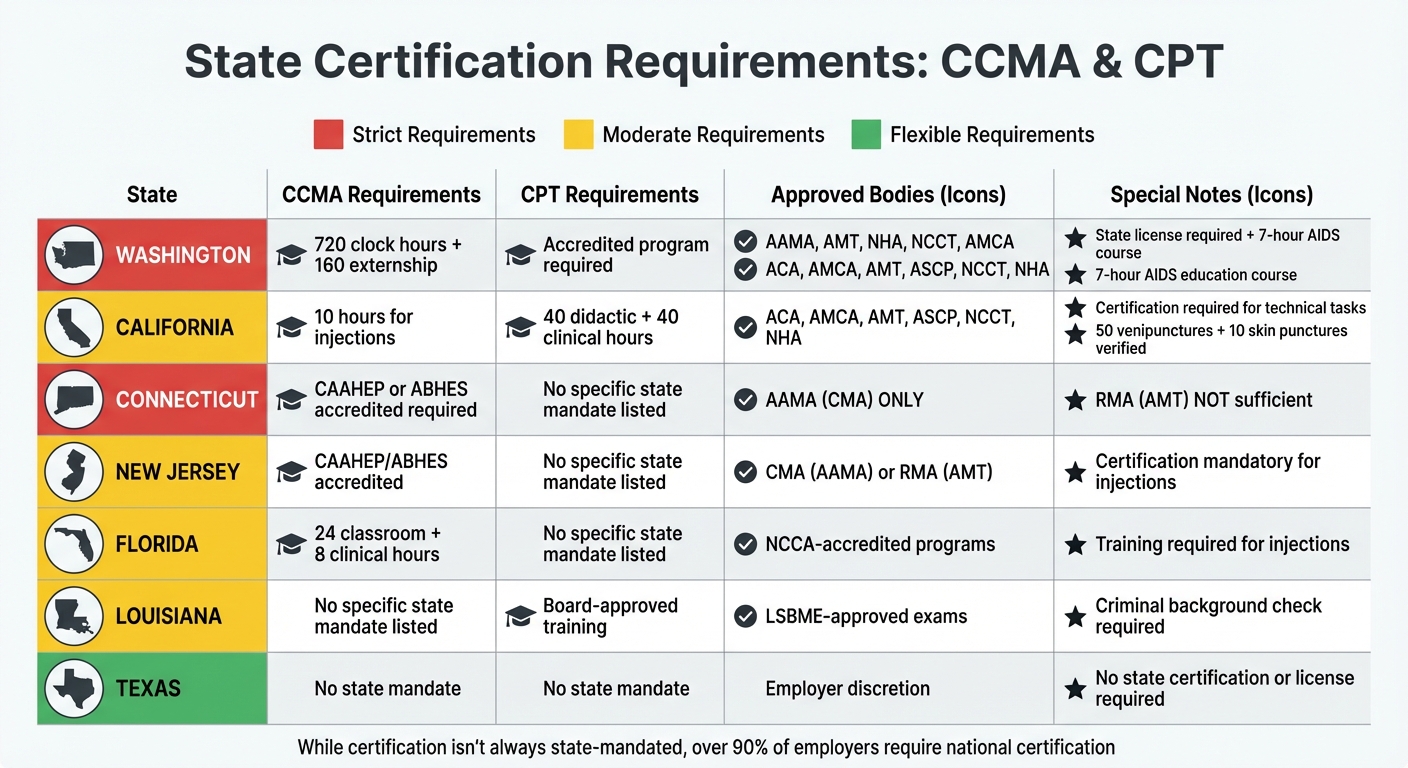
State-by-State CCMA and CPT Certification Requirements Comparison
When it comes to CCMA (Certified Clinical Medical Assistant) and CPT (Certified Phlebotomy Technician) certifications, state requirements can vary a lot. Some states enforce strict licensing and training hour rules, while others leave much of the decision-making to the supervising physician. It’s essential to understand these differences before choosing a program or applying for certification.
For example, Washington stands out by requiring state credentials for all medical assistants. California has licensing requirements specifically for phlebotomists, while Connecticut only recognizes the CMA (AAMA) certification for state-recognized status. The table below highlights key differences across states.
| State | Certification Type | Required Training Hours | Approved Bodies | Special Requirements |
|---|---|---|---|---|
| Washington | MA-C (Med. Asst.) | 720 clock + 160 externship | AAMA, AMT, NHA, NCCT, AMCA | Must apply for state license; complete a 7-hour AIDS course |
| Washington | MA-P (Phlebotomy) | Accredited program or verified | ACA, AMCA, AMT, ASCP, NCCT, NHA | 7-hour AIDS education course required |
| California | CPT I (Phlebotomy) | 40 didactic + 40 clinical | ACA, AMCA, AMT, ASCP, NCCT, NHA | 50 venipunctures + 10 skin punctures verified |
| California | CCMA (Med. Asst.) | 10 hours (for injections) | Board-approved boards | Certification required to train others or perform technical tasks |
| Connecticut | CCMA (Med. Asst.) | CAAHEP or ABHES accredited | AAMA (CMA) only | RMA (AMT) is explicitly not sufficient |
| New Jersey | CCMA (Med. Asst.) | CAAHEP/ABHES accredited | CMA (AAMA) or RMA (AMT) | Certification mandatory for delegated tasks like injections |
| Florida | CCMA (Med. Asst.) | 24 classroom + 8 clinical | NCCA-accredited programs | Training hours specifically required for giving injections |
| Louisiana | CPT (Phlebotomy) | Board-approved training | LSBME-approved exams | Criminal background check; scores sent directly to Board |
| Texas | CCMA / CPT | No state mandate | Employer discretion | No state-level certification or license required |
While certification isn’t always mandated by states, it is widely regarded as the industry standard. Employers often prefer or require national certification, making it a critical step for securing job opportunities in most areas.
It’s also important to carefully review state guidelines to ensure your chosen certification program aligns with local requirements. For example, programs accredited by CAAHEP or ABHES are often necessary to qualify for state credentials. Graduating from a non-accredited program can disqualify you from credentials in certain states, like New Jersey, or make you ineligible for the CMA (AAMA) exam. Washington even offers an "interim certification", valid for one year while awaiting national exam results, though it cannot be renewed.
Understanding these state-by-state differences ensures you’re on the right path to meeting both state and national standards.
HealthCareer Certs Programs and State Compliance
HealthCareer Certs ensures its programs align with state-specific mandates, offering 100% online CCMA (Certified Clinical Medical Assistant) and CPT (Certified Phlebotomy Technician) programs that meet accreditation requirements. Licensed and approved by the New Hampshire Department of Education, these programs comply with regulatory standards and prepare students for the National Healthcareer Association (NHA) exams. These exams, accredited by the National Commission for Certifying Agencies (NCCA), are essential credentials in states like Florida and Arizona.
One standout feature is the guaranteed externship placement, which fulfills strict state requirements. For example, Washington state mandates a minimum of 160 hours of clinical externship for Medical Assistant-Certified (MA-C) credentials. HealthCareer Certs ensures all qualified students receive hands-on clinical training and even offers an externship scholarship of up to $2,000. This commitment to practical experience supports the high standards needed for state recognition.
In March 2019, the Arizona Medical Board officially recognized the NHA’s CCMA certification, affirming that NCCA accreditation meets the rigorous standards for medical assistant training. Jessica Langley from NHA elaborates:
"Proper accreditation indicates that the certification program adheres to rigorous guidelines surrounding examination design and development, psychometric defensibility, exam administration, and item security".
The programs also stand out for their flexible, self-paced online format, allowing students to complete theoretical coursework before starting their clinical externship. This structure is especially beneficial in states like Texas and California, where employers value NHA certification for liability protection and competency assurance, even when state-level certification isn’t required.
| State Requirement | HealthCareer Certs Compliance Feature |
|---|---|
| Washington (160-hour externship + NHA exam) | Guaranteed externship placement and NHA-aligned curriculum |
| Florida (NCCA-accredited certification) | Prepares students for NHA exams, which are NCCA-accredited |
| California (Approved certification to train others) | Provides NHA certification recognized by the Medical Board of California |
How to Verify State Accreditation for Your Certification
Before starting your career as a CCMA or CPT, it’s crucial to ensure your certification meets the specific requirements set by your state. These guidelines can vary widely, so it’s always best to verify directly with the appropriate state authorities.
First, find out if your state requires a state-issued credential, like Washington does, or if it follows a delegation model. Under the delegation model, a supervising physician determines your responsibilities based on your competency. To clarify which system applies, contact your state’s Department of Health, Medical Board, or Board of Nursing.
Next, confirm the accreditation status of your training program. Many states mandate that you graduate from programs accredited by the Commission on Accreditation of Allied Health Education Programs (CAAHEP) or the Accrediting Bureau of Health Education Schools (ABHES). Don’t rely solely on promotional materials; instead, use the official CAAHEP or ABHES searchable databases to verify your program’s accreditation. If you’re pursuing phlebotomy certification in California, check that your program is listed on the California Department of Public Health (CDPH) approved schools list. This step ensures your training aligns with state credentialing standards.
It’s also essential to verify that your certifying body is recognized by your state. For example, Washington accepts CCMA credentials from the National Healthcareer Association (NHA), as well as certifications from AAMA, AMT, NCCT, and AMCA. In most cases, states and employers prefer certifications accredited by the National Commission for Certifying Agencies (NCCA), as this accreditation helps reduce liability risks. Having this foundation in place makes it easier to confirm the latest state-specific requirements.
Since certification and employment regulations can change frequently, always check with your state’s health or labor department for the most current information.
For state-specific verification, reach out to the relevant agency. For instance, contact the Medical Board of California for questions about medical assistant certification or CDPH Laboratory Field Services for phlebotomy certification inquiries. In North Dakota, you might need to register as a Medication Assistant III with the Board of Nursing, depending on your role. Additionally, be aware of any scheduled system downtimes – for example, Washington’s licensing system will be unavailable from March 18 to March 24, 2026, due to an upgrade. Direct communication with official agencies is the best way to ensure your credentials comply with state requirements and minimize risks of non-compliance.
Conclusion
Navigating state accreditation for CCMA and CPT certifications requires a clear understanding of varying state regulations. For example, Washington uniquely mandates a state-issued credential for all medical assistants before they can perform clinical tasks. Meanwhile, states like California, Nevada, and Louisiana have specific licensure requirements for phlebotomy. Most other states follow a delegation model, allowing physicians to define the scope of practice based on an individual’s demonstrated competency. This patchwork of rules means your ability to transfer credentials across states hinges on knowing the specific requirements where you plan to work.
Even in states without strict legal mandates, certification remains crucial. Across the country, over 90% of employers require certifications, as they provide liability protection and confirm that candidates possess essential, job-ready skills. This emphasis on certification translates into real financial advantages. As of May 2024, the median annual wage for medical assistants was $44,200, with top earners in Washington making $53,780 and some California metro areas reaching $66,590.
State guidelines not only shape credential portability but also impact career opportunities. Healthcare support roles are projected to grow by 15.2% between 2023 and 2033, with medical assistant positions expected to increase by approximately 101,200 jobs by 2034. Choosing the right training program can significantly boost both career flexibility and earning potential.
Before committing to a program, confirm its accreditation through the official CAAHEP or ABHES databases. Graduating from a non-accredited program can limit your eligibility for national certification exams and restrict employment options in states with stringent education requirements, such as New Jersey or Washington.
FAQs
Will my CCMA or CPT certification transfer if I move to another state?
Your CCMA (Certified Clinical Medical Assistant) or CPT (Certified Phlebotomy Technician) certification is typically recognized across states. However, the specific requirements or recognition can vary depending on where you’re moving. It’s always a good idea to check with the local licensing or certifying authorities in your new state. This ensures you meet any state-specific guidelines and avoid potential complications with your certification.
How can I confirm if my program is accredited by CAAHEP or ABHES?
To find out if your program is accredited by CAAHEP or ABHES, start by visiting the program’s official website or reaching out to the institution directly. Accreditation details are usually listed on their site or provided upon request. Another option is to check the official directories on the CAAHEP or ABHES websites. These organizations assess programs based on specific standards to ensure they meet quality benchmarks in health education.
What’s the fastest way to check my state’s CCMA or CPT licensing rules?
The fastest way to find out your state’s licensing requirements for CCMA (Certified Clinical Medical Assistant) or CPT (Certified Phlebotomy Technician) certifications is to visit the official websites of your state’s health department or trusted healthcare regulation resources. These sites offer the most accurate and current details, saving you time and effort. Be sure to check for state-specific rules regarding qualifications and regulations for medical assistants and phlebotomists to stay aligned with local standards.