Becoming a Certified Clinical Medical Assistant (CCMA) in Georgia involves these key steps:
- Eligibility:
- Hold a high school diploma or GED.
- Choose between two pathways:
- Education: Complete a medical assistant training program within the last 5 years (with at least 80 clinical hours).
- Work Experience: 1 year of supervised medical assisting in the past 3 years or 2 years in the last 5 years.
- Training:
- Enroll in programs like HealthCareer Certs, which offer self-paced, online courses.
- Gain practical experience through externships, which may include optional scholarships.
- Exam Preparation:
- Study using resources like NHA’s practice questions, flashcards, and mobile app.
- Focus on clinical and administrative skills, such as EKGs, phlebotomy, and managing electronic health records.
- Scheduling the Exam:
- Register at nhanow.com.
- Choose to test at a PSI center, an approved school, or online with live remote proctoring.
- Certification Maintenance:
- Renew every 2 years by completing 10 continuing education (CE) credits.
- Use NHA’s CE library or upload external credits.
In Georgia, CCMA certification enhances job prospects as 89% of employers prefer or require it. Medical assistants earn an average of $40,890 annually, with the field expected to grow by 14% nationally by 2032. Programs like HealthCareer Certs simplify the process with flexible training and exam preparation, making it easier to start or advance your career.
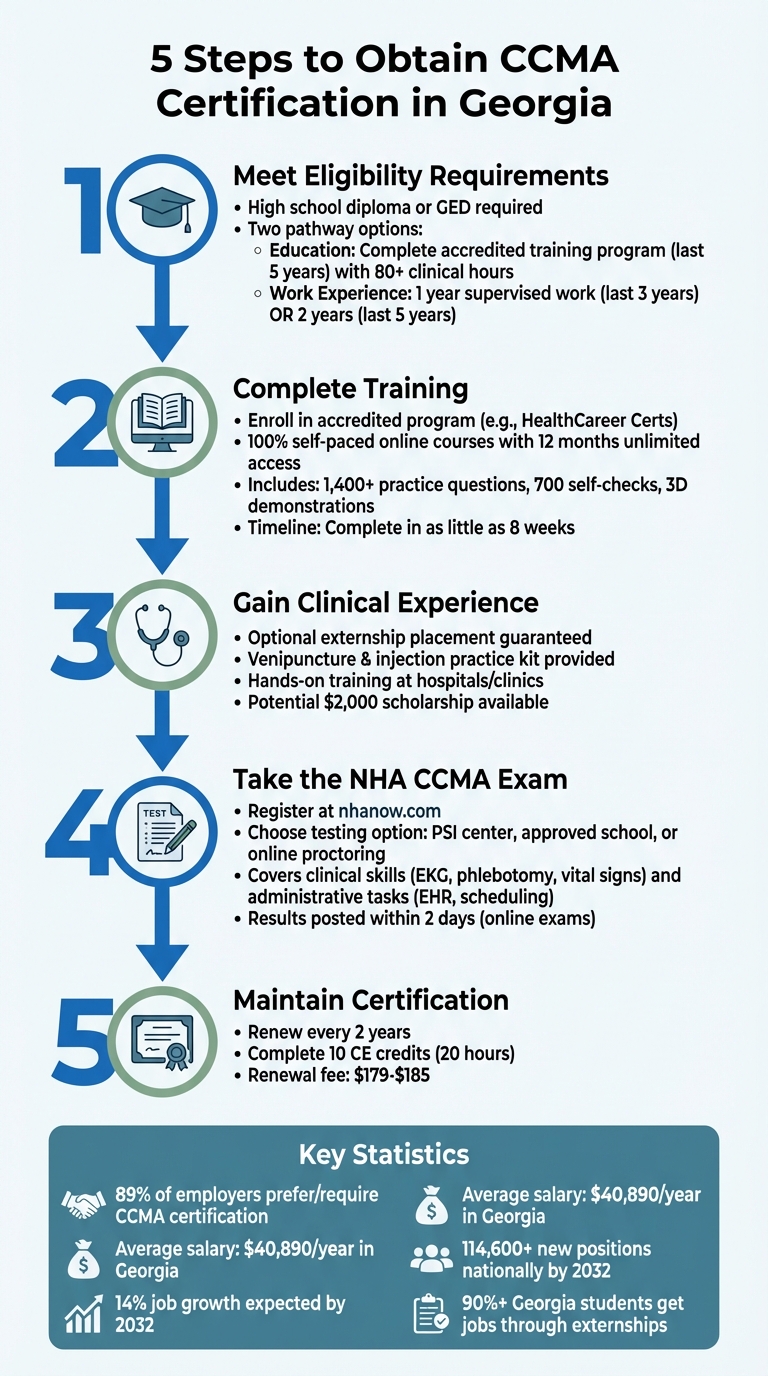
5 Steps to Get CCMA Certification in Georgia
NHA Certified Clinical Medical Assistant (CCMA) Study Guide Overview
sbb-itb-7a67ffa
CCMA Certification Eligibility Requirements in Georgia
To qualify for the CCMA exam in Georgia, you’ll need to meet the National Healthcareer Association‘s (NHA) eligibility criteria. Below is an overview of the key requirements to help you prepare.
Education Requirements
A high school diploma or GED is essential to take the CCMA exam. If you’re a high school health science student, you may still qualify if you’re on track to earn your diploma or GED within the next 12 months. Be sure to have documentation – like your diploma, GED, or proof of pending completion – ready when applying.
Training Program Requirements
There are two main pathways to eligibility:
- Education Pathway: Complete a medical assistant training program within the last five years. For programs in the Atlanta area, this typically includes at least 80 clinical hours or an externship.
- Work Experience Pathway: Alternatively, you can qualify with relevant work experience. This requires at least one year of supervised medical assisting experience in the last three years, or two years within the last five years.
| Eligibility Pathway | Education Requirement | Training/Experience Requirement |
|---|---|---|
| Education Pathway | HS Diploma or GED (or within 12 months) | Completion of training program in the last 5 years |
| Work Experience Pathway | HS Diploma or GED | 1 year of supervised experience (last 3 years) OR 2 years (last 5 years) |
| Georgia/Atlanta Specific | HS Diploma or GED | Completion of program with at least 80 clinical hours |
Georgia-Specific Requirements
Although the CCMA certification standards are national, Georgia has additional requirements for clinical sites. These include a criminal background check, drug screening, and up-to-date immunization records. To avoid delays, gather your vaccination records and complete any necessary checks well in advance of starting clinical rotations or applying for jobs.
How to Complete CCMA Training with HealthCareer Certs
How to Enroll in the Program
To get started, head over to HealthCareer Certs and click on "Enroll Now" to register online. The program is designed to be 100% self-paced, so you can dive in right away and progress through the material on your own schedule – no deadlines to worry about. Once you’re enrolled, you’ll have unlimited access for 12 months to all the course materials, including instructional and lab content, through a mobile- and tablet-friendly student portal that’s available 24/7. The tuition covers everything you need: textbooks, materials, and even the exam fee. You can choose to pay the full amount upfront or opt for flexible installment plans to spread out the cost. Not ready to commit? Check out the free preview on the website to explore the curriculum before making your decision.
Completing Self-Paced Learning Modules
The program includes a variety of interactive tools to help you build essential clinical skills. You’ll have access to 3D demonstrations, interactive skill-building activities, and digital flashcards. To prepare for the certification exam, there are over 1,400 practice questions and 700 self-checks to track your progress. While some students finish the program in as little as 8 weeks, you have a full year to complete it at your own pace. Need extra guidance? Schedule a one-on-one Zoom session with an instructor for personalized support. Juliana J., a former student, shared:
"I passed my certification exam on the first try because of them! … everything is self-paced online".
Getting Hands-On Clinical Experience
Once you’ve completed the online modules, you’ll have the chance to gain practical experience. HealthCareer Certs guarantees externship placement for qualified students, arranging opportunities at hospitals or clinics that are convenient for you. Before starting your externship, you’ll receive a venipuncture and injection practice kit delivered to your home. This kit allows you to complete hands-on clinical simulations while still working through the online coursework. The externship itself is optional and unpaid but provides valuable experience to enhance your resume. Additionally, students who meet program requirements may qualify for an externship scholarship of up to $2,000 to help cover clinical training expenses. For questions about placements or scheduling, you can reach out to externship@healthcareercerts.org.
How to Prepare for and Schedule the NHA CCMA Exam
Study Tips for the CCMA Exam
Start your preparation by downloading the free CCMA Test Plan from NHA. This document outlines the key concepts covered on the exam, giving you a clear starting point for your studies. To simulate the exam experience and identify areas for improvement, take advantage of the 1,400+ practice questions and 700 self-checks provided by NHA.
After completing a practice test, use the Focused Review® tool to zero in on topics where you need extra practice. This tool helps you concentrate on weak points instead of revisiting material you already know. For on-the-go studying, the NHA Mobile app offers flashcards that track your progress and help reinforce your knowledge. If you’re looking for a more comprehensive prep option, the CCMA Preparation Package, which includes a study guide and practice tests, is available for $94.
Once your study plan is in place, take time to familiarize yourself with the exam format so you know what to expect on test day.
What to Expect on the NHA CCMA Exam
The NHA CCMA exam evaluates both clinical and administrative skills. Clinical tasks include taking vital signs, assisting with medical exams, administering injections, and performing EKG and phlebotomy procedures. On the administrative side, you’ll encounter questions about updating Electronic Health Records (EHR), patient registration, scheduling, and managing electronic referrals or preauthorizations.
Additionally, the exam emphasizes soft skills like professionalism, critical thinking, emotional intelligence, and dependability – qualities that 96% of employers look for in candidates. If you take the exam online, your results are generally posted to your NHA account within two days.
How to Schedule Your Exam in Georgia
Once you’ve completed your training, scheduling your exam is straightforward. Start by creating a free account at nhanow.com and applying for the exam through the portal. During the process, you’ll select a test date and location. In Georgia, candidates can choose from three options: testing at a PSI testing center, taking the exam at an approved school site, or using live remote proctoring (LRP) to test from home.
If you opt for remote testing, ensure you have a computer with a camera, microphone, and a stable internet connection. Keep in mind that Chromebooks aren’t compatible with the proctoring software. You’ll also need to pay the exam fee during the scheduling process.
How to Maintain Your CCMA Certification in Georgia
Continuing Education Requirements
Your CCMA certification remains valid for two years and must be renewed after that period [10, 24]. To keep your certification active, you need to complete 10 continuing education (CE) credits within those two years. Each CE credit represents two hours of instruction, meaning you’ll need a total of 20 hours of educational coursework [24, 25].
Here’s what happens if your certification expires:
- Less than one year expired: You’ll need to complete 15 CE credits and pay a $99 reinstatement fee in addition to the standard renewal fee.
- More than one year expired: You’ll have to retake the full CCMA exam [24, 25].
If you’re an NHA member, you can access a comprehensive CE library for free through your nhanow.com account. This library offers courses focused on updated healthcare protocols and best practices, developed by field experts. To earn credit, you’ll need to score at least 70% on the course exams.
For CE credits obtained outside the NHA platform, you can upload supporting documents using the "Add External CE Items" feature in your NHA portal. The convenience of the CE library makes it a popular choice – over 83% of NHA-certified professionals rely on it for their continuing education needs.
How to Renew Your Certification
You can renew your certification through your NHA account at nhanow.com [25, 26]. Once logged in, click on "Renew Certifications" to check your expiration date and see how many credits you still need. The renewal fee typically ranges from $179 to $185 every two years. However, if you’re an NHA member, the $8 monthly membership fee provides free access to CE courses, which can effectively offset the renewal cost after about 20 months [10, 25].
Renewing early is an option and comes with no penalties. Doing so ensures you avoid any gaps that might affect your employment eligibility [10, 26]. If you hold multiple NHA certifications, the good news is that you only need 10 total CE credits to renew all of them at once [25, 26].
While Georgia does not have specific renewal requirements beyond the NHA guidelines, it’s always a good idea to double-check with the Georgia Composite Medical Board to confirm if there are any additional local registration requirements for medical assistants.
Start Your Healthcare Career with CCMA Certification
Earning your CCMA certification in Georgia opens the door to exciting opportunities in the healthcare field. By meeting the eligibility and training requirements, you can take a significant step toward a rewarding career. This certification not only confirms your skills but also positions you for success in Georgia’s healthcare industry.
The demand for medical assistants is on the rise, with a projected 14% job growth and over 114,600 new positions expected by 2032. In Georgia, more than 90% of students in local training programs secure jobs through their externship sites. As of December 2023, certified medical assistants in the U.S. earned an average annual salary of $45,061.
Once your training is complete, the next step is turning your knowledge into career success. HealthCareer Certs offers a 100% online, self-paced program designed to prepare you for the NHA CCMA exam. This program focuses on essential clinical and administrative skills, including phlebotomy, EKG, and EHR management. This is particularly useful in Georgia, where medical assistants are permitted to perform phlebotomy without needing a separate license.
"My NHA certification has helped me financially advance my career. Most importantly it has given me opportunity to get a job that allows me to be a better mom by being home in the evenings and on the weekends."
– Jessica Aponte, CCMA
A CCMA certification not only validates your expertise but also lays the groundwork for moving into advanced roles, such as Registered Nurse or Physician Assistant. With flexible online training options, you can start your healthcare career on your own schedule while gaining the skills that Georgia employers value. Pursuing this path sets you up for success in Georgia’s rapidly expanding healthcare sector.
FAQs
How long does it take to get CCMA certified in Georgia?
Obtaining a CCMA certification in Georgia usually takes about 14 weeks, though this can vary depending on the training program. Many programs, like a 14-week Medical Assistant Program, are structured to fit within this timeframe. Once the coursework is finished, candidates need to pass the certification exam, which is typically scheduled after completing the program. The exact timeline hinges on the length of the training and when the exam is taken.
What documents do I need for eligibility and clinical sites in Georgia?
To earn CCMA certification in Georgia, you’ll need a high school diploma or its equivalent and must complete an accredited medical assisting program. These programs cover key areas such as anatomy and clinical procedures, ensuring you gain the necessary knowledge. Additionally, hands-on experience through internships or practicums is a critical part of the process.
When it comes to clinical sites, most employers require proof that you’ve graduated from an accredited program. They also typically ask for documentation showing you have relevant clinical experience in medical assisting.
What happens if my CCMA certification expires in Georgia?
If your CCMA certification lapses in Georgia, you’ll need to renew or recertify to keep your credential active. While Georgia doesn’t legally require national certification, most employers do. Depending on the certifying organization, you might need to retake the exam or fulfill specific recertification requirements, like completing continuing education courses. Make sure to stay informed about your certifying body’s guidelines to regain your credential and stay competitive in the job market.