Becoming a Certified Clinical Medical Assistant (CCMA) in Florida can boost your career in the healthcare industry. While certification isn’t required by state law, most employers prefer or demand it. Here’s a quick overview of what you need to know:
- Eligibility: You must be at least 17 years old, have a high school diploma or GED, and meet one of two pathways:
- Complete an NHA-approved medical assistant program within the last 5 years.
- Have 1–2 years of supervised work experience within the last 3–5 years.
- Training: Enroll in an NHA-approved program. Options include online, hybrid, or in-person formats, with costs ranging from $2,295 to $6,700. Many programs include externships and exam vouchers.
- Exam: The CCMA exam costs $160, has 180 questions, and requires a passing score of 390/500. Preparation materials like study guides and practice tests are available.
- Certification Maintenance: Renew every 2 years by earning 10 Continuing Education (CE) credits and paying a $179 renewal fee.
Certification can increase your earning potential, with certified medical assistants in Florida earning $40,530–$42,970 annually on average. Ready to start? Choose a program, prepare for the exam, and take the first step toward a rewarding career.
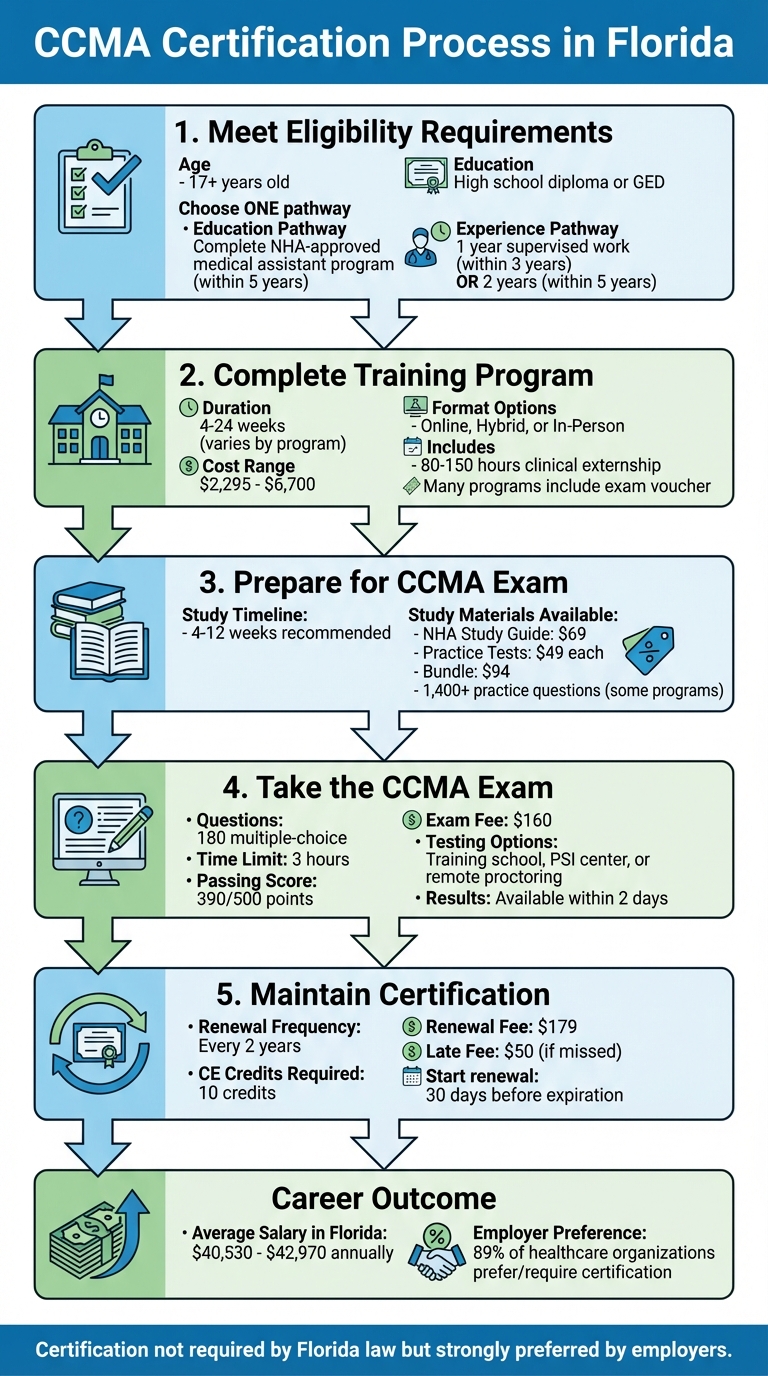
Steps to Get CCMA Certification in Florida
CCMA Certification Requirements and Eligibility
What Is CCMA Certification?
The Certified Clinical Medical Assistant (CCMA) credential, issued by the National Healthcareer Association (NHA), demonstrates a professional’s ability to handle both clinical and administrative responsibilities in healthcare settings. This includes tasks like taking vital signs, performing EKGs, conducting phlebotomy, managing electronic health records, and coordinating patient care. Accredited by the National Commission for Certifying Agencies (NCCA), the CCMA exam meets rigorous national certification standards. Understanding the scope of this credential helps clarify the pathways available for those looking to enter the medical assisting field.
Basic Eligibility Requirements
To sit for the CCMA exam, you need to be at least 17 years old and have a high school diploma or GED. The NHA provides two main eligibility pathways:
- Education Pathway: Completion of an NHA-approved medical assistant training program within the past five years.
- Experience Pathway: At least one year of supervised medical assisting experience within the last three years, or two years of experience within the last five years.
You’ll need to document these qualifications when applying. Also, keep in mind there’s a mandatory 10-day waiting period after registration before you can schedule your exam.
| Eligibility Pathway | Requirements |
|---|---|
| Education Pathway | High school diploma or GED + completion of a medical assistant program (within 5 years) |
| Experience Pathway | High school diploma or GED + 1 year of supervised work (within 3 years) or 2 years (within 5 years) |
These requirements provide the foundation for understanding how national standards align with state-specific expectations, like those in Florida.
Florida Requirements for Medical Assistants
In Florida, while medical assistants are not required by law to hold a state license or certification, most employers strongly prefer or even require it. Approximately 89% of healthcare organizations in the state favor candidates with certification. Medical assistants in Florida work under the supervision of licensed physicians, and training can be gained either through formal programs or hands-on instruction provided by healthcare providers. The Florida Board of Medicine supports both approaches.
As the Florida Health Care Academy notes:
"In Florida, medical assistants are not required by state law to hold a license or certification in order to work… However, most employers strongly prefer, or even require, national certification".
Given the competitive nature of Florida’s healthcare job market, earning the CCMA credential significantly enhances employability. While not legally mandated, certification often becomes a key factor in securing desirable roles within the state.
sbb-itb-7a67ffa
Choosing and Enrolling in a Training Program
Finding NHA-Approved Programs
The National Healthcareer Association (NHA) website is a great resource for finding partner schools and businesses offering approved CCMA training programs. When evaluating options, consider factors like format, cost, duration, and whether the program includes an exam voucher. Programs that bundle exam vouchers can save you the hassle and cost of paying separately for the certification exam.
Look for programs that include clinical externships ranging from 80 to 150 hours. These externships provide crucial hands-on experience and can also serve as a way to build professional references. Many high-quality programs also offer additional support, such as practice tests and job placement assistance, to help you succeed. Before enrolling, make sure you meet the basic requirements, which typically include a high school diploma or GED, a valid ID, and a clear background check.
It’s also worth prioritizing a program that balances flexibility with strong exam preparation resources.
HealthCareer Certs CCMA Program
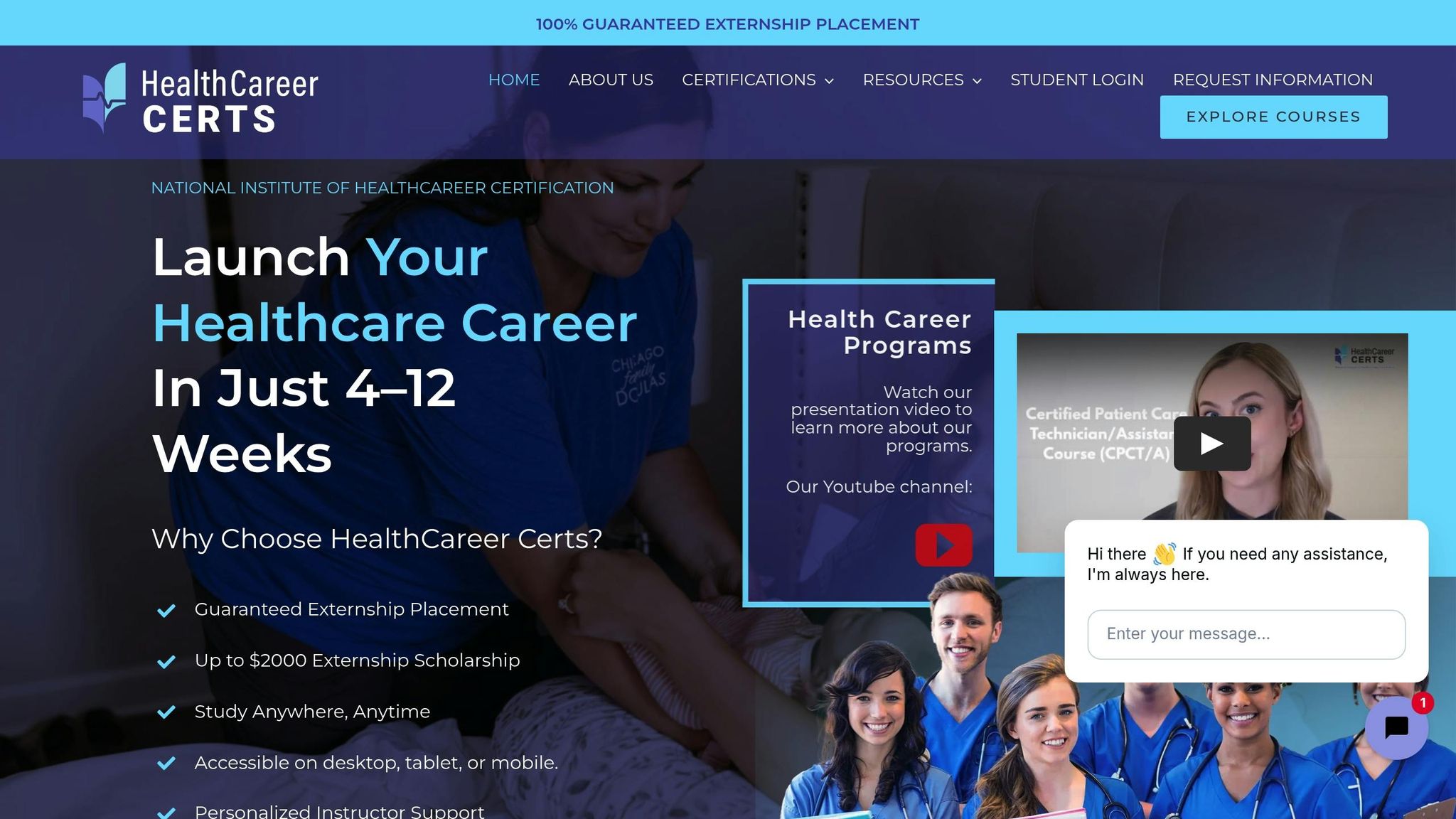
If flexibility is a priority, HealthCareer Certs offers a 100% online, self-paced CCMA program that’s ideal for students juggling work or family commitments. The program includes one-on-one Zoom sessions with instructors, interactive 3D demonstrations, over 1,400 practice questions, and 700 self-check exercises to reinforce your learning. Plus, they guarantee externship placements, giving students the opportunity to complete the required clinical hours in Florida healthcare settings.
The program’s timeline ranges from 4 to 12 weeks, depending on your pace, and it comes with extensive exam preparation materials. HealthCareer Certs also offers a standout perk: a 100% tuition refund if you don’t secure a healthcare job after earning your certification. This policy minimizes the financial risk of pursuing your education.
Other Accredited Programs in Florida
Florida offers a variety of additional accredited programs tailored to different learning styles and budgets. For instance, the University of West Florida provides a 16-week hybrid program for $4,500, which includes an 80-hour externship and boasts a 100% exam pass rate. Meanwhile, Florida International University and Florida Institute of Technology both offer fully online, self-paced programs for $2,295, with the added benefit of including the exam voucher.
For those who prefer in-person learning, Florida Health Care Academy offers a 12–24 week program for $6,700. This program includes uniforms, lab supplies, and one exam attempt, with 83% of graduates finding employment after completing the course. Alternatively, Pasco-Hernando State College provides an online program for $2,395, which bundles the CCMA exam voucher with CPR certification. Program lengths vary, with options ranging from accelerated 12-week courses to more flexible 12-month self-paced formats, allowing you to choose what works best for your schedule and learning preferences.
Preparing for the NHA CCMA Exam
CCMA Exam Format and Content
The NHA CCMA exam is a computer-based test featuring 180 multiple-choice questions, which you’ll need to complete within a 3-hour window. You can take the exam at your training school, a PSI testing center, or even through live remote proctoring. To pass, you’ll need a score of 390 out of a possible 500 points.
The test is divided into five key areas. The largest portion, Clinical Patient Care, makes up 56% of the exam. The other sections include Foundational Knowledge & Basic Science (10%), Patient Care Coordination & Education (8%), Administrative Assisting (8%), and Communication & Customer Service (8%). Topics range from taking vitals and assisting with procedures to EKGs, phlebotomy, and managing electronic health records.
In January 2024, NHA introduced CCMA 3.0, an updated version of the exam designed to reflect the evolving role of medical assistants in healthcare. This version includes EHR simulations for tasks like medication reconciliation and vital sign documentation. Understanding the format and focus areas of the exam will help you create a study plan that sets you up for success.
Study Materials and Preparation Timeline
Since the exam emphasizes clinical patient care and foundational knowledge, using targeted study guides and practice tests is crucial. Most candidates dedicate 4–12 weeks to preparation. The NHA offers a variety of official resources, including an online study guide priced at $69. This guide includes interactive games, quizzes, flashcards, and an audio reader. Additionally, you can purchase three practice tests for $49 each (with two attempts per test) or opt for a bundle that combines the study guide and practice tests for $94.
For on-the-go studying, the NHA Mobile app provides flashcards that incorporate active recall tracking to reinforce your knowledge. The updated CCMA 3.0 study materials also feature EHR simulations for tasks like patient registration, scheduling, and lab orders, along with videos on patient experience and professionalism tips.
Another option is HealthCareer Certs, which offers over 1,400 practice questions and 700 self-check exercises, reducing the need for additional resources. Some training programs, like those in Florida, include mock exams and guidebooks as part of their tuition. For example, the Florida Health Care Academy provides these tools as part of their program. Before purchasing extra materials, check if your training program already includes similar resources.
Exam Registration and Costs
Once you feel prepared, it’s time to register and schedule your exam. Start by creating a free NHA account, completing the application, and paying the $160 registration fee. After payment, you can schedule your test date and location. Keep in mind that your earliest exam date depends on when you submit your application. Applications submitted between the 1st and 14th of the month allow testing as early as the 1st of the following month. If you apply between the 15th and the end of the month, the earliest available date will be the 15th of the next month.
Some programs bundle exam fees into their tuition, so check with your training provider to see if this cost is already covered. For instance, the Florida Health Care Academy includes one exam attempt in its $6,700 tuition fee. Once you’ve taken the test, you can expect to see your results in your NHA account within two days.
Maintaining Your CCMA Certification
Renewal Requirements and Timeline
If you’re a Certified Clinical Medical Assistant (CCMA), your certification needs to be renewed every two years, requiring 10 Continuing Education (CE) credits. Unlike some healthcare roles in Florida, medical assistants aren’t overseen by a state licensing board. Instead, your renewal requirements come from the National Healthcareer Association (NHA).
To stay ahead, start your renewal process at least 30 days before your certification expires. This gives you time to submit your CE credits and any required documentation. The NHA offers an online portal to help track your progress. Each certificate of completion should clearly display your name, the provider’s name, the course title, the date of completion, and the number of contact hours.
"Credential renewal is an individual responsibility." – Florida Certification Board
Keeping these requirements in mind ensures you’re prepared to meet deadlines and avoid any interruptions in your certification.
Renewal Fees and Deadlines
Timely fee payment is just as crucial as earning your CE credits. The renewal fee for your CCMA certification is $179. Missing your expiration date could result in a $50 late fee, and your credential may be placed on inactive status. A lapsed certification might even require additional reinstatement fees or reexamination.
To avoid this hassle, consider setting reminders in your calendar. While the NHA typically sends official renewal notices about 90 days before your expiration date, it’s best not to depend solely on them. Keeping a dedicated folder – whether digital or physical – for your CE certificates can help you stay organized and ready when it’s time to renew.
CCMA Test Training Tips 2026 Certified Clinical Medical Assistant Exam – ALL You Need to Know
Conclusion
To earn your CCMA certification in Florida, you’ll need to meet basic eligibility requirements, complete an NHA-approved training program, pass the certification exam, and renew your credential periodically. While Florida law doesn’t require state licensure for medical assistants, most healthcare employers prefer candidates with professional certification. This makes obtaining your CCMA a key step toward landing competitive roles in the field.
Florida’s healthcare industry is growing rapidly, making this an ideal time to pursue your certification.
If you’re ready to start, HealthCareer Certs offers a fully online, self-paced training program designed to fit your schedule. With guaranteed externships and direct support from instructors, you’ll have the tools to meet every certification requirement. Whether you opt for a 12-week intensive course or a longer timeline, the most important step is getting started today.
"Earning a certification such as the CCMA establishes a medical assistant as a caring, responsible professional who has undergone a study and assessment program to validate their credentials." – University of North Florida
This quote highlights how completing the certification process not only enhances your skills but also builds your professional credibility. The path to becoming a certified clinical medical assistant in Florida is straightforward and within reach. Take the first step: apply, enroll in an accredited program, and begin building your career in this growing field.
FAQs
Which CCMA eligibility path should I choose in Florida?
In Florida, you’ll need to follow an eligibility path that involves completing a state-approved training program and meeting some basic requirements, like holding a high school diploma or GED. Accredited programs are available through institutions such as Broward College, Florida State College at Jacksonville, and the University of Florida. These programs not only prepare you for the CCMA exam but also ensure you fulfill the necessary educational criteria.
How do I schedule the CCMA exam after I register?
After signing up for the CCMA exam, keep an eye out for an approval email. This email will confirm your application and include your unique Exam Access Code. Once you’ve received it and completed all necessary payments, follow the instructions provided in the email to book your exam. Keep in mind that Exam Access Codes are time-sensitive and are tied to the specific exam mentioned in the email.
What happens if my CCMA certification expires?
If your CCMA certification lapses, you’ll need to retake and pass the certification exam to restore it. However, if it’s been expired for less than a year, you might be eligible for reinstatement by completing 15 continuing education (CE) credits and paying the necessary fees. Letting your certification expire without renewal or reinstatement could mean losing your credential, potentially impacting your ability to work as a certified medical assistant in Florida.