Becoming a certified medical assistant in Illinois can boost your job prospects and salary. While certification isn’t legally required, 87% of healthcare employers prefer hiring certified candidates. Here’s what you need to know:
- Job Market: Illinois employs over 21,000 medical assistants, with demand expected to grow 11.1% by 2031, adding nearly 3,000 job openings yearly.
- Salary: Medical assistants in Illinois earn an average of $42,790 annually ($20.57/hour). In Chicago, salaries average $48,560.
- Certification Options: The most recognized certifications are:
- CMA (AAMA): Requires an accredited program and focuses on clinical and administrative skills.
- RMA (AMT): Offers flexible eligibility, including work experience or military training.
- CCMA (NHA): Focuses on clinical procedures; allows work experience as eligibility.
- Steps to Certification:
- Earn a high school diploma or GED.
- Enroll in a CAAHEP- or ABHES-accredited program (27 options in Illinois).
- Complete clinical externship hours (usually 160 hours).
- Pass a national certification exam (fees range from $120–$250).
Certification increases earning potential, opens doors to specialized roles, and aligns with employer preferences. Programs like HealthCareer Certs offer flexible, online training tailored to Illinois students, including externship placement and exam preparation.
Bottom Line: Certification is a smart move for anyone pursuing a stable, well-paying healthcare career in Illinois.
Illinois Medical Assistant Requirements
Basic Eligibility Requirements
To start your career as a medical assistant in Illinois, you’ll need a high school diploma or GED equivalent. Most employers also prefer candidates who are at least 17 years old.
While Illinois does not legally require medical assistants to hold a license or certification, their role is classified as unlicensed. Supervising physicians assign responsibilities based on the assistant’s training and experience. As First Institute explains:
"While Illinois does not legally require certification for medical assistants, most employers strongly prefer or require nationally recognized credentials."
Even though certification isn’t mandated by law, many employers – especially those working with Medicaid patients – either require or favor certified medical assistants. With 27 accredited medical assistant programs available in Illinois, there are plenty of opportunities to align with employer expectations.
Types of Certification Available
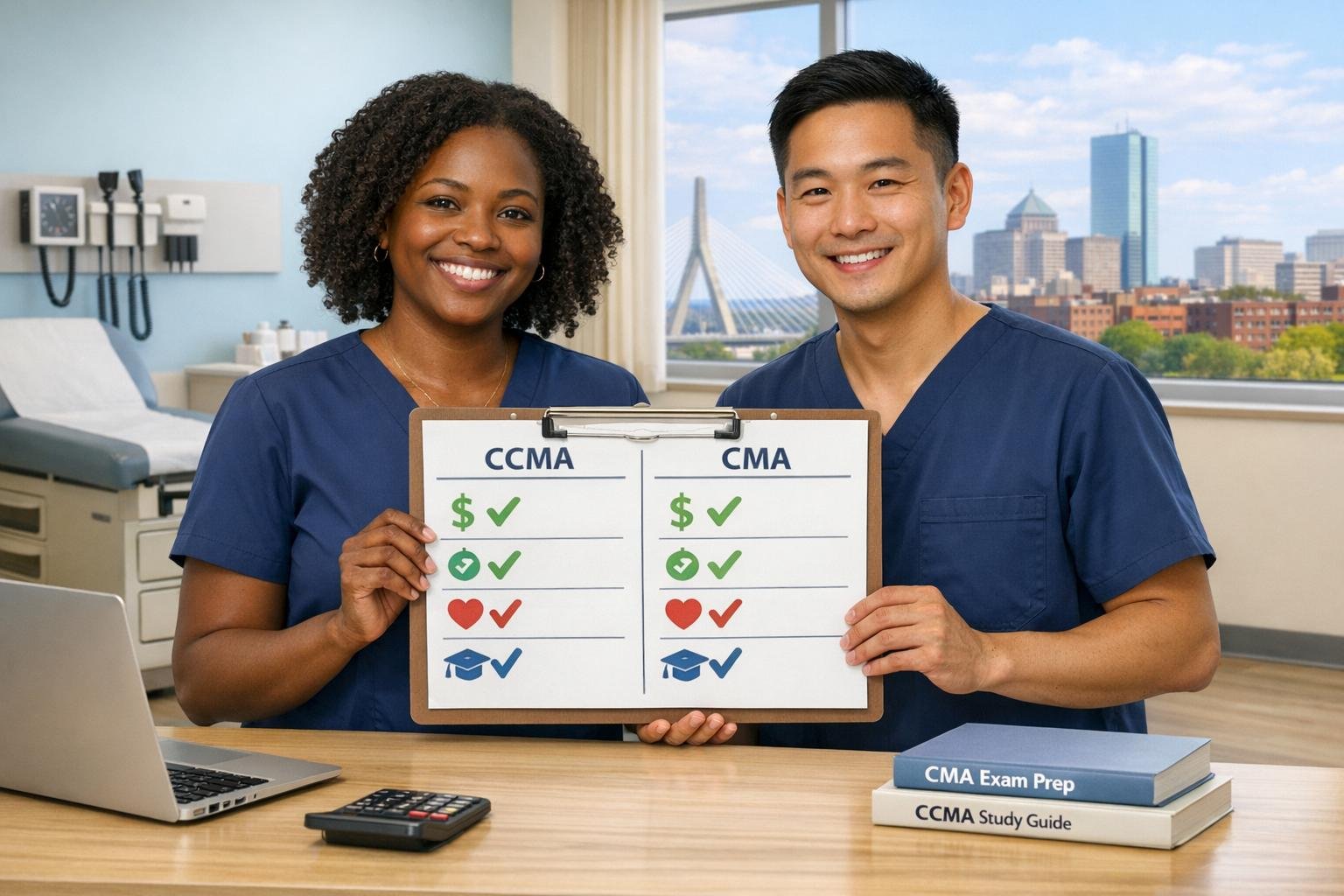
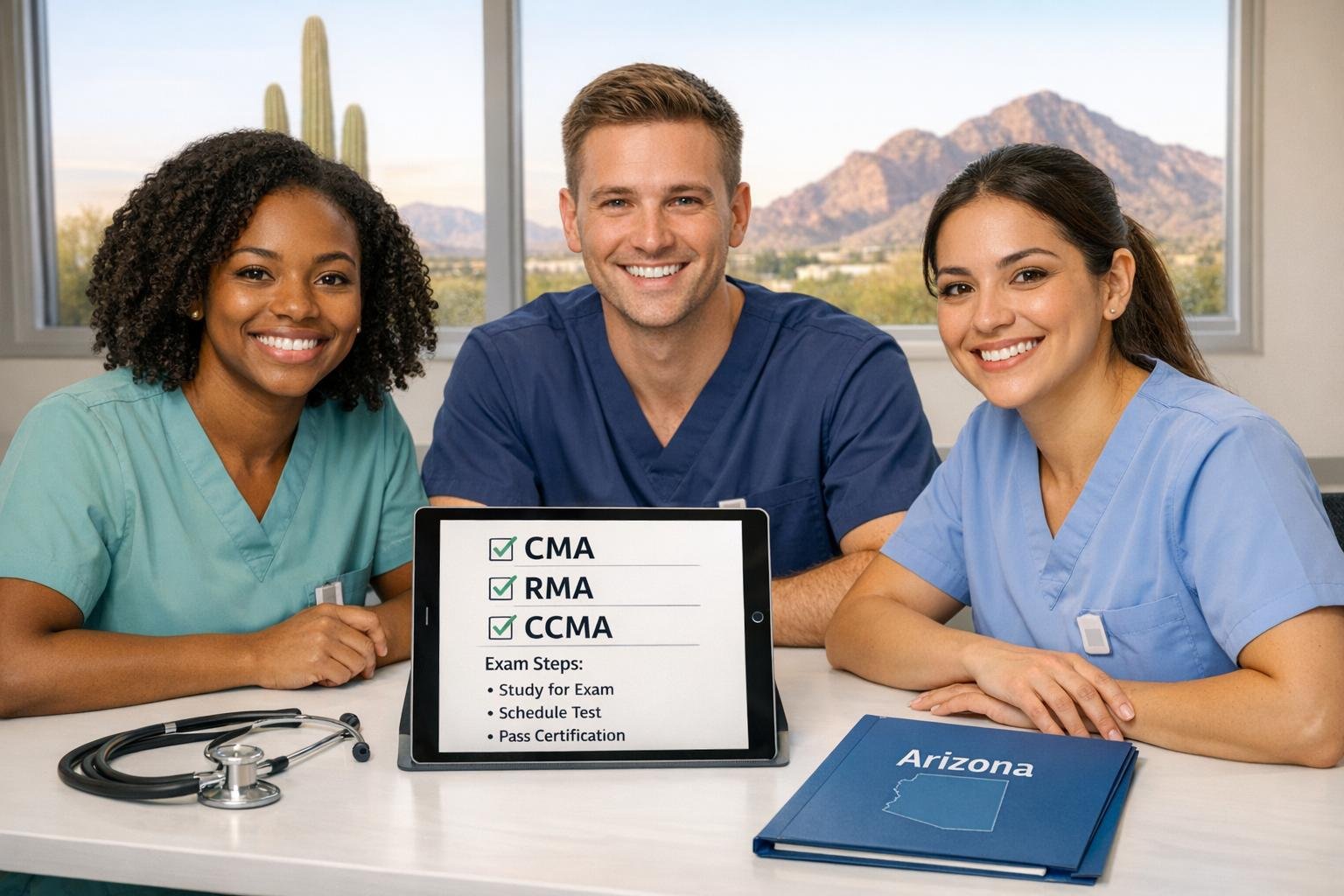
Choosing the right certification is an important step in building your career in Illinois. The three most commonly recognized certifications in the state are CMA (AAMA), RMA (AMT), and CCMA (NHA).
- CMA (AAMA): Requires completion of a CAAHEP or ABHES-accredited program and provides balanced training in clinical and administrative skills.
- RMA (AMT): Offers more flexible eligibility options, including graduation from an accredited program, military training, or at least three years of work experience. This certification emphasizes clinical and technical skills.
- CCMA (NHA): Open to those who complete a training program or have one year of work experience, with a focus on clinical procedures.
Additionally, many Illinois programs now include optional certifications in Phlebotomy (CPT) or EKG (CET) alongside medical assistant training. These extra credentials can make you more competitive in the job market and even increase your earning potential, which averages $42,790 annually in Illinois.
Next, we’ll explore the step-by-step process to help you achieve the certification that best fits your career goals.
sbb-itb-7a67ffa
How To Become a Certified Medical Assistant
How to Get Certified: Step-by-Step Process
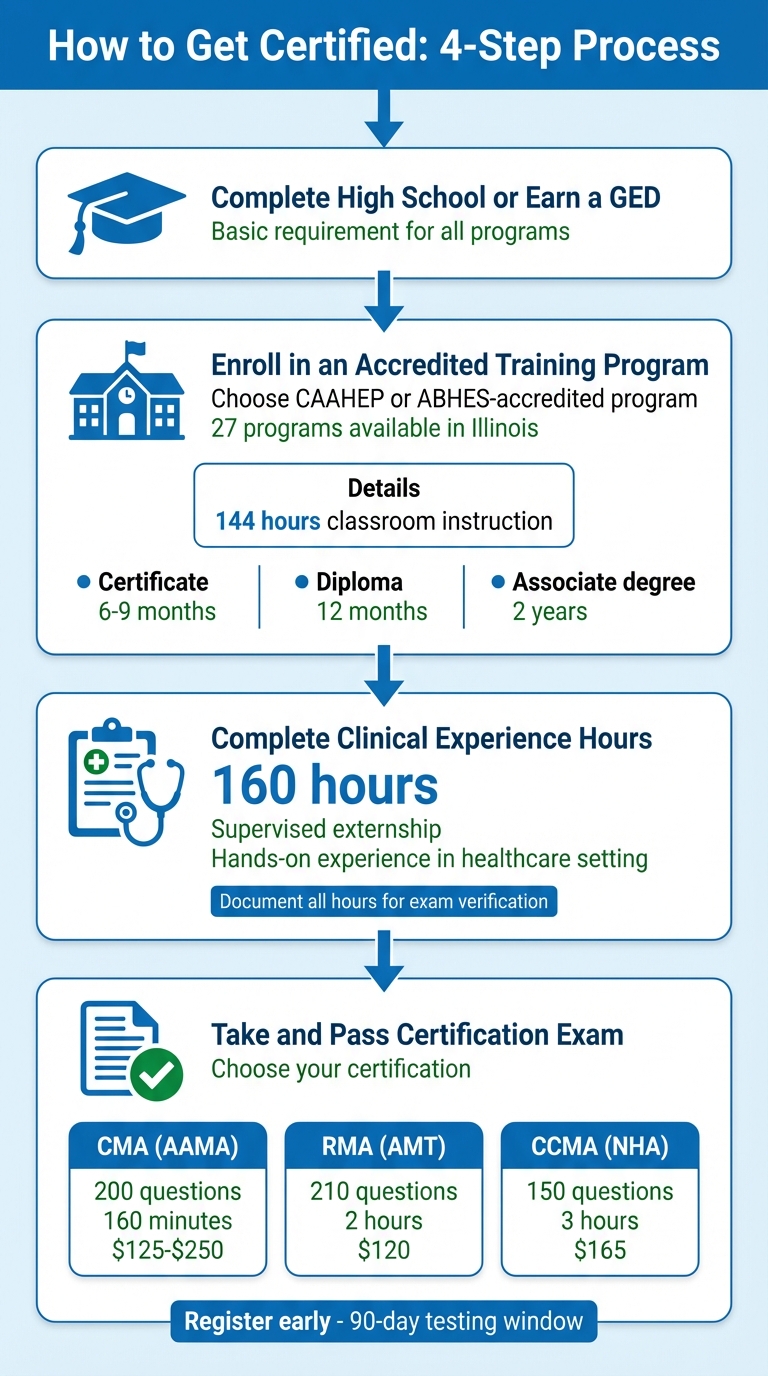
4 Steps to Become a Certified Medical Assistant in Illinois
Step 1: Complete High School or Earn a GED
To start, you’ll need a high school diploma or GED. This is a basic requirement for enrolling in any accredited medical assistant training program in Illinois.
Step 2: Enroll in an Accredited Training Program
Next, sign up for a training program accredited by the Commission on Accreditation of Allied Health Education Programs (CAAHEP) or the Accrediting Bureau of Health Education Schools (ABHES). Illinois offers 27 accredited programs to choose from. These programs typically include about 144 hours of classroom instruction covering topics like anatomy, phlebotomy, EKG, medical terminology, and pharmacology.
You can opt for:
- Certificate programs (6–9 months)
- Diploma programs (about 12 months)
- Associate degrees (2 years)
Costs vary, so compare tuition and fees carefully. Some programs include the CCMA exam fee in their tuition. Don’t forget to factor in additional costs for background checks, drug screenings, immunizations (MMR, Varicella, Hepatitis B, TDAP, TB test, and flu shot), and scrubs.
Step 3: Complete Clinical Experience Hours
As part of your training, you’ll complete a supervised externship, usually totaling 160 hours of hands-on experience in a healthcare setting. During this unpaid clinical practicum, you’ll practice tasks like taking vital signs, giving injections, and assisting with minor procedures under the guidance of licensed healthcare professionals. Be sure to document all your clinical hours accurately, as this is required for exam verification. This real-world experience will prepare you for the certification exam.
Step 4: Take and Pass the Certification Exam
Once you’ve finished your training and externship, you’re ready for a national certification exam. You have three main options:
- CMA (AAMA): Exam fees range from $125 to $250
- RMA (AMT): Costs about $120
- CCMA (NHA): Priced at roughly $165
Here’s a quick breakdown of the exams:
- The CMA exam has 200 multiple-choice questions to be completed in 160 minutes, divided into four 40-minute sections.
- The RMA exam includes 210 questions with a 2-hour time limit.
- The CCMA exam features 150 scored questions and allows for 3 hours of testing.
Be sure to track the 90-day testing window and register early to secure your spot.
Main Certifying Organizations for Illinois
After completing your training, you’ll need to select a national certifying organization to validate your skills. While certification isn’t legally required in Illinois, it’s highly valued by employers and can increase your earnings by 5% to 10%. Among the options available, the American Association of Medical Assistants (AAMA) and the National Healthcareer Association (NHA) are the most widely recognized. Major healthcare systems like Rush University Medical Center, Advocate Aurora Health, and University of Chicago Medicine prefer hiring certified medical assistants.
American Association of Medical Assistants (AAMA)
The AAMA offers the Certified Medical Assistant (CMA) credential, one of the most respected in the field. Headquartered in Chicago, Illinois, this organization requires candidates to graduate from a medical assisting program accredited by CAAHEP or ABHES to qualify for the CMA exam. There are alternative eligibility paths, such as one for educators with at least 1,000 hours of teaching experience.
The CMA exam evaluates both clinical and administrative skills, with a passing score set at 405 on a scale of 200 to 800.
"The CMA (AAMA) credential unlocks new opportunities, higher earnings, and improved job security."
– American Association of Medical Assistants
Candidates must apply for the exam within 60 months of completing their accredited program. Once earned, the credential requires renewal every 60 months, either through 60 continuing education points or by retaking the exam. If you don’t pass, you’re allowed to retake the test up to six times a year, but each attempt requires a new application and fee.
This certification is widely recognized by Illinois healthcare employers, including Rush University Medical Center and Advocate Aurora Health. The Illinois Society of Medical Assistants (ISMA), the state affiliate of AAMA, offers additional networking opportunities and resources through its nine local chapters.
For those seeking a different path, the NHA offers another popular certification option.
National Healthcareer Association (NHA)
The NHA provides the Certified Clinical Medical Assistant (CCMA) credential, accredited by the National Commission for Certifying Agencies (NCCA). This certification is growing in popularity, particularly among vocational training programs, and is often requested by major Illinois employers like Rush University Medical Center. Unlike the AAMA, the NHA allows candidates to qualify through training programs or relevant work experience, without requiring graduation from a CAAHEP or ABHES-accredited program.
The CCMA exam emphasizes clinical skills and offers the convenience of online proctored testing. After completing the test, candidates receive detailed score reports to help identify strengths and areas for improvement. To maintain the CCMA credential, you’ll need to renew it every two years with 10 continuing education credits.
This certification is also highly regarded by Illinois healthcare systems, including Rush University Medical Center and Advocate Aurora Health. With approximately 22,990 medical assistants employed in Illinois and an 11.1% projected job growth through 2031, earning certification from either the AAMA or NHA can open doors to advanced positions like lead medical assistant or clinical supervisor.
HealthCareer Certs CCMA Program for Illinois Students
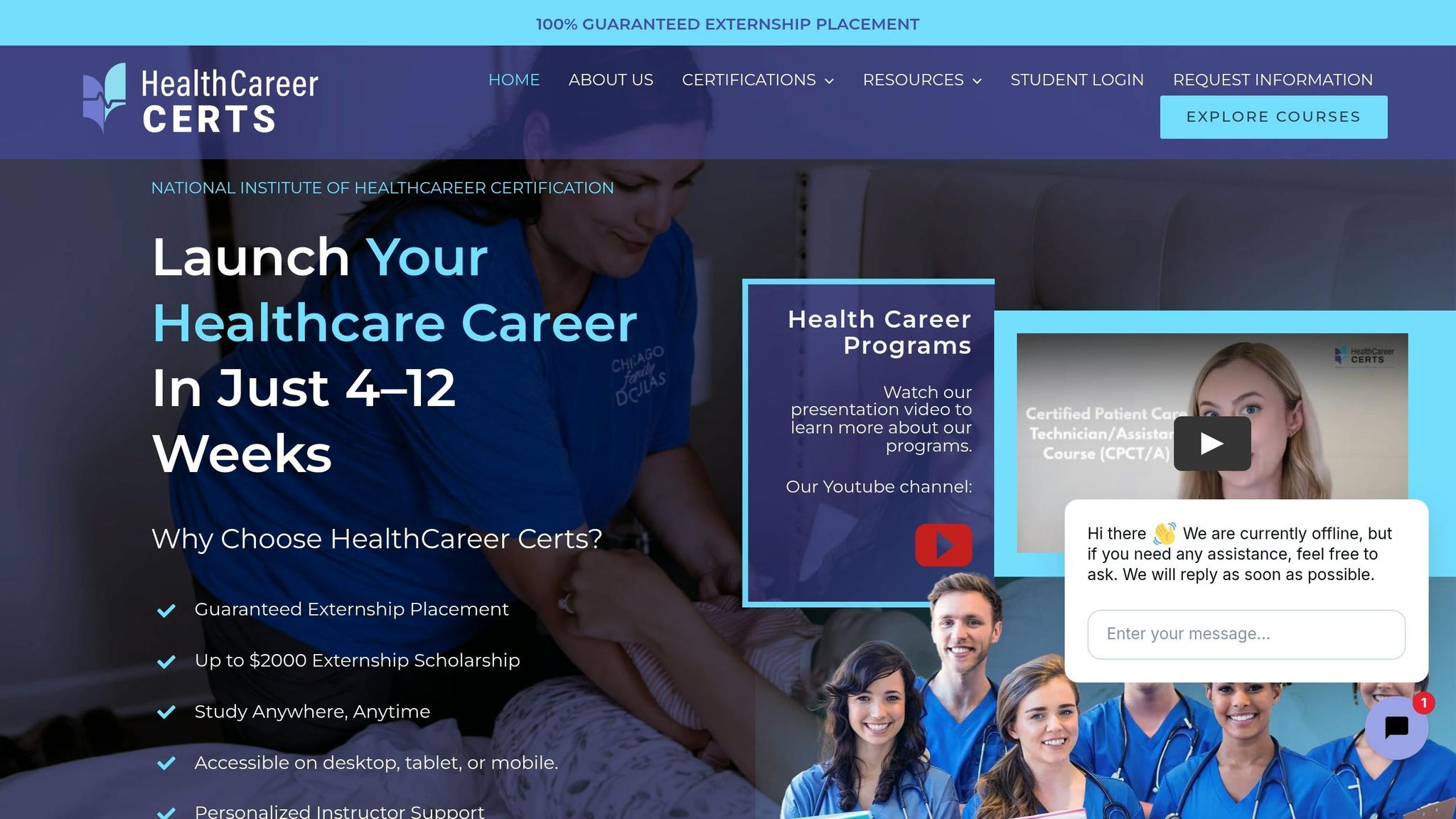
HealthCareer Certs offers a fully online Certified Clinical Medical Assistant (CCMA) program tailored to meet Illinois’ certification requirements. This program is designed to prepare students for nationally recognized credentials, aligning with the needs of employers in the state. With 12-month access to course materials and an accelerated 8-week option, it’s ideal for those juggling work, family, or other commitments while pursuing a healthcare career.
What the Program Includes
The program consists of 18 instructional modules covering both clinical and administrative skills, along with essential training in OSHA and HIPAA compliance – key for working in Illinois medical facilities. Students benefit from over 1,400 practice questions, six practice tests, and an exam voucher included in the program fee. Personalized support is available through one-on-one Zoom sessions with instructors, and guaranteed externship placement ensures hands-on experience near the student’s location. Passing the CCMA exam also earns participants five ACE college credits, recognized by more than 2,000 institutions.
"I was able to get certified and pass the NHA exam on the first try in only 6 weeks, and I appreciated the ease of the entire process/course."
– Olivia, Graduate
With a perfect 5/5 rating from over 5,000 student reviews, graduates consistently praise the program’s instructor support and exam preparation resources. To further reduce financial risk, the program includes a 24-hour money-back guarantee. These features ensure that students are well-prepared for certification and the practical advantages it offers.
Benefits for Illinois Students
This program is especially beneficial for Illinois students, offering a cost-effective alternative to local campus-based programs at just $2,700. In a field where medical assistants earn between $34,000 and $46,000 annually, this affordability is a significant advantage. The online format also provides flexibility for those in rural areas or facing transportation challenges.
The curriculum is designed to meet the specific needs of Illinois employers, equipping students to perform clinical tasks like drawing blood, administering medication, and conducting EKGs under the supervision of licensed providers. Holding a CCMA credential opens doors to opportunities in major healthcare systems actively seeking certified professionals in the state.
How to Prepare for Your Certification Exam
Study Materials and Resources
Once you’ve completed your training and registered for the exam, it’s time to dive into focused preparation. Pay special attention to Clinical Patient Care, which makes up 55% of the CCMA exam and 59% of the CMA (AAMA) exam. High-priority topics like vital signs, sterile fields, EKG lead placement, phlebotomy order of draw, and infection control procedures should be at the top of your study list.
Practice exams are a must-have resource. The AAMA offers a 200-question practice test for $30, giving you 90 days of access. If you’re preparing for the CCMA exam, the NHA provides materials designed to mimic the real test format. Both exams stick to multiple-choice questions, but their structures differ slightly: the CCMA exam includes 150 scored questions over 3 hours, while the CMA (AAMA) exam features 200 questions to be completed in 160 minutes.
Flashcards can be a quick and effective way to master medical terminology. Focus on prefixes, suffixes, medication routes, injection angles, and normal vital sign ranges. If you’re using the HealthCareer Certs CCMA program, you’ll have access to over 1,400 practice questions, six full-length tests, and 3D clinical skills demonstrations to help you visualize the procedures you’ll encounter in your career. With these tools and a focus on key topics, you’ll be well-equipped for exam day.
Study Tips and Time Management
After gathering your study materials, creating a disciplined study routine is your next step. For candidates in Illinois preparing for the CCMA or CMA (AAMA) exams, the timeline can vary. Recent graduates often need 2–3 weeks of focused review, while those revisiting older material may require 4–6 weeks. Sticking to the same study schedule each day can help reinforce habits and improve memory retention.
"Consistency and discipline will ultimately yield better results than sporadic, last-minute sessions." – Health Tech Academy
Set a goal to score at least 80% on your practice exams before scheduling your test. When you miss a question, rewrite it with a brief explanation of the correct answer to reinforce your understanding. Practice managing your time by limiting yourself to 60 seconds per question during timed sessions. This strategy will help you build the endurance needed for the real exam.
The pass rates for these exams highlight the challenge: the CCMA exam has a 77% pass rate, while the CMA (AAMA) exam sits at 67%. To pass, you’ll need a score of 390 or higher on the CCMA and at least 430 on a scale of 200 to 800 for the CMA (AAMA). If you’re studying in Illinois, programs at schools like Lincoln Land Community College often include exam prep materials and vouchers in their tuition, which typically ranges from $2,149 to $4,490.
Job Opportunities for Certified Medical Assistants in Illinois
Where Medical Assistants Work
In Illinois, certified medical assistants have opportunities to work in a variety of healthcare settings. These include physician offices, hospitals, clinics, specialty practices, urgent care centers, nursing homes, rehabilitation facilities, and laboratories. Major employers in the state include Advocate Aurora Health, which operates more than 500 facilities, Erie Family Health Centers, known for serving underserved communities, Northwestern Memorial Hospital, and Loyola University Medical Center.
The day-to-day tasks for medical assistants depend on the workplace. On the clinical side, duties might include taking vital signs, assisting with medical procedures, drawing blood, performing EKGs, administering medications, and preparing lab samples. On the administrative side, responsibilities often involve managing electronic health records, scheduling appointments, processing insurance claims, handling billing, and coordinating patient admissions. The variety in work settings, combined with the potential for career growth and competitive pay, makes certification an attractive option for aspiring medical assistants.
Salary Ranges and Job Growth
Becoming certified can open up better job opportunities and higher pay. As of March 2026, certified medical assistants in Illinois earn an average annual salary of $46,767, which breaks down to about $22 per hour. Salaries typically range between $42,043 (25th percentile) and $51,108 (75th percentile), with top earners in the 90th percentile making up to $55,060 annually.
Regional differences play a role in pay. For example, the median salary in Lake County is around $48,733, while Cook County follows closely at $48,451. In contrast, Springfield reports a median of $41,888, and Northwest Illinois comes in lower at $37,903. Entry-level medical assistants earn approximately $46,414, while those with over eight years of experience average $48,192 annually.
The career outlook for medical assistants in Illinois is promising. Employment in this field is expected to grow by 11.1% through 2031, with an estimated 3,144 job openings each year. This demand is fueled by an aging population and overall growth in the healthcare industry. Although Illinois does not require state licensing for medical assistants, most employers prefer or require national certifications like CMA, RMA, or CCMA. Full-time positions often come with benefits such as health insurance, paid time off, and retirement plans.
Conclusion
Getting certified as a medical assistant in Illinois can lead to better job prospects and higher pay. While certification isn’t legally required in the state, 87% of healthcare employers prefer hiring certified medical assistants. Certification serves as proof of your skills and dedication, showing that you meet nationally recognized standards. It often means higher starting salaries, more opportunities at Medicaid-serving facilities, and a stepping stone toward roles like nursing or medical lab technology.
The demand for medical assistants is on the rise, with national employment expected to grow by 15% between 2023 and 2033. In Illinois alone, there are projected to be about 3,000 job openings annually through 2030. To ensure your training meets industry standards, choose a program accredited by CAAHEP or ABHES and make sure it includes the required clinical externship hours. Keep in mind that certifications need to be renewed every 2 to 5 years through continuing education credits.
For an efficient path to certification, consider HealthCareer Certs’ 100% online CCMA program. Designed for aspiring medical assistants, this program offers self-paced learning, personalized instructor support, interactive tools with over 1,400 practice questions, and guaranteed externship placements. You can complete the program in just 4 to 12 weeks, all while managing other responsibilities. Plus, it’s mobile-friendly and comes with a tuition refund guarantee if you don’t land a healthcare job after certification.
Earning your certification is a step toward a stable and well-paying career in Illinois’ healthcare industry. Whether you’re just starting out or looking to formalize your experience, certification gives you the credentials employers value and the confidence to thrive in this fulfilling field. Take the first step toward your healthcare career today!
FAQs
Which certification should I choose in Illinois: CMA, RMA, or CCMA?
In Illinois, deciding between CMA, RMA, or CCMA certification depends on your career aspirations and what employers in your area value most. The CMA (Certified Medical Assistant) credential, offered by the AAMA, and the RMA (Registered Medical Assistant) from AMT are both highly regarded, particularly for graduates of accredited programs. On the other hand, the CCMA (Certified Clinical Medical Assistant) from NHA is gaining traction, especially for roles that focus heavily on clinical tasks. While certification isn’t mandatory, it can significantly boost your job opportunities and open doors for career growth.
Do Illinois employers accept online medical assistant training?
Yes, employers in Illinois recognize online medical assistant training programs, especially those designed to prepare students for certification exams such as the NHA CCMA. These programs usually offer online coursework but also require in-person clinical hours to ensure students meet the necessary certification requirements.
What can delay my externship or exam date in Illinois?
Delays in your externship or exam date in Illinois can occur for several reasons. These might include incomplete coursework, a lack of program approval, or problems with processing your certification application. Scheduling conflicts can also play a role. To avoid these setbacks, ensure you’ve met all the necessary prerequisites and stay in regular contact with your program for updates and guidance.