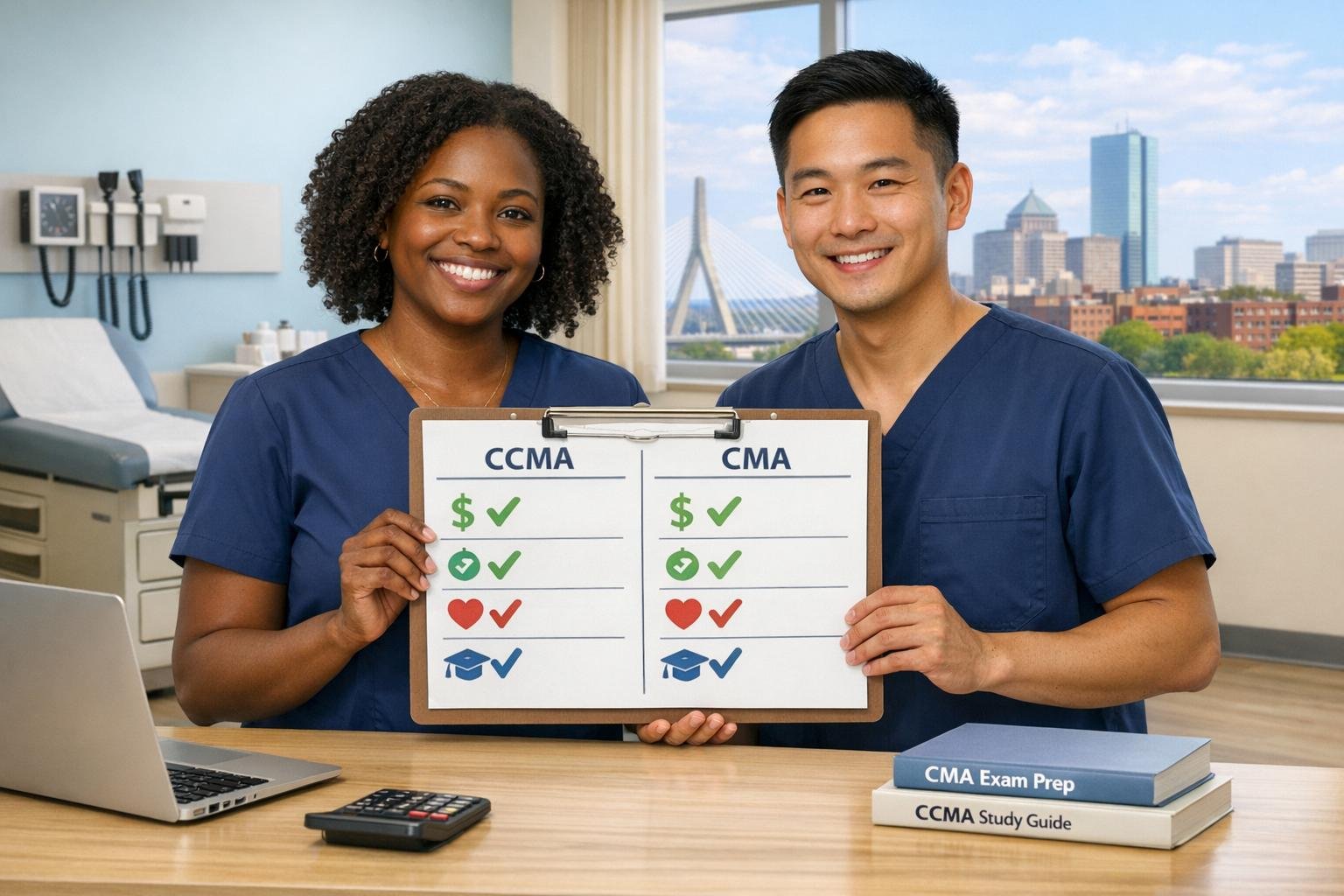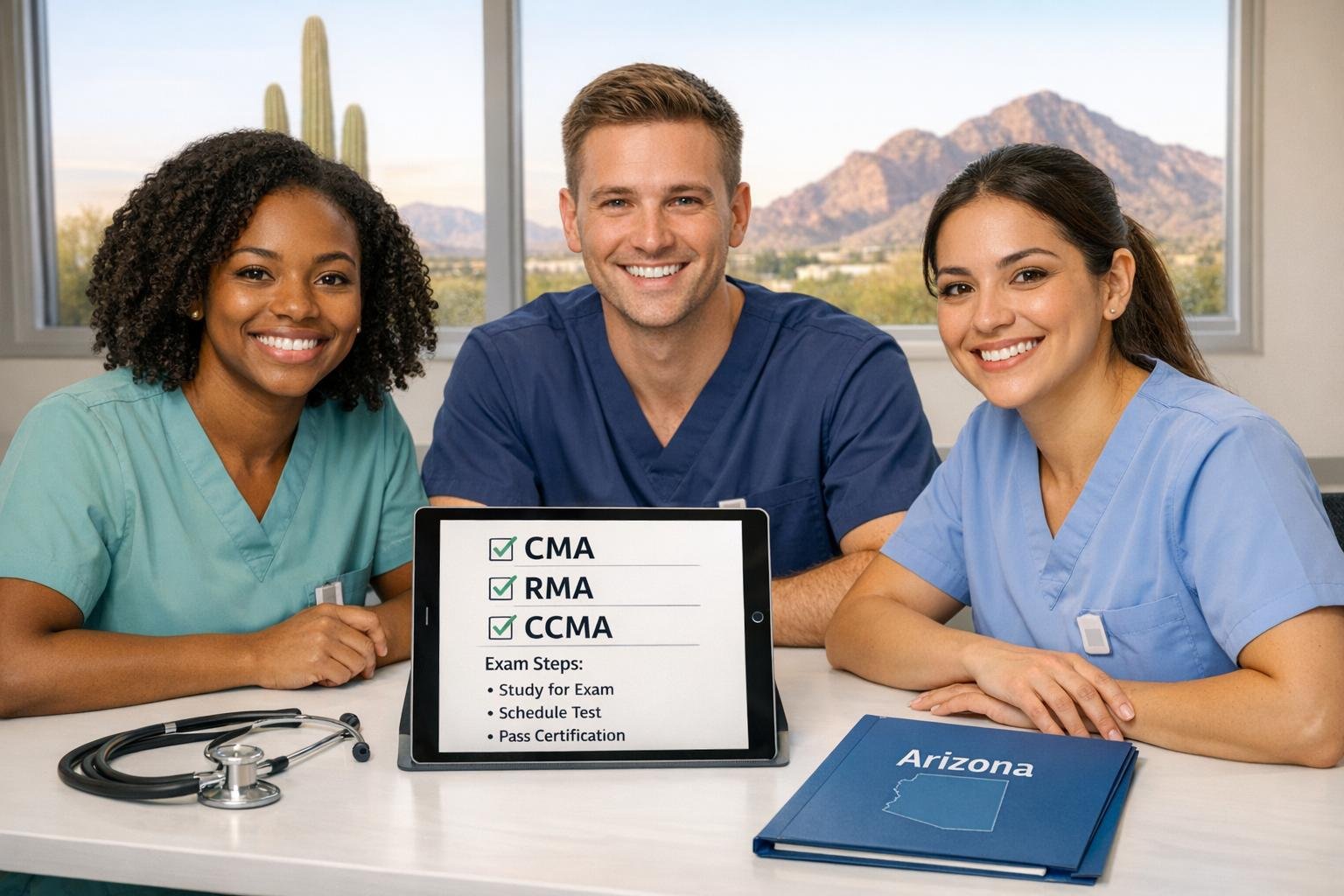
Medical assistant certification proves your skills in clinical and administrative healthcare tasks, making you more competitive in a fast-growing field. Certified medical assistants (CMAs) earn higher salaries (up to $45,877 annually) and qualify for advanced roles, with 96% of employers preferring or requiring certification. Here’s what you need to know:
- Certification Options: The Certified Clinical Medical Assistant (CCMA) from the National Healthcareer Association (NHA) is widely recognized.
- Eligibility: Requires being 18+, having a high school diploma or GED, and completing training or work experience.
- Exam Details: 180 questions, a $155 fee, and a passing score of 78%.
- Renewal: Every two years, with 10 continuing education credits and a $179 fee.
Certification opens doors to better pay, more responsibilities, and career growth in healthcare settings like hospitals, outpatient centers, and specialty clinics.
sbb-itb-7a67ffa
Eligibility Requirements for CCMA Certification
To take the CCMA exam, you’ll need to meet specific standards set by the National Healthcareer Association. These requirements are in place to ensure you have the necessary knowledge and skills to succeed. Below, we’ll break down the age, education, training, and health documentation needed to qualify.
Educational and Age Requirements
To apply for CCMA certification, you must be at least 18 years old. Additionally, you’ll need a high school diploma or GED. If you’re still working toward your diploma or GED, you can take the exam as long as it’s within 12 months of your expected graduation date.
Make sure to have a valid U.S. government-issued photo ID with a signature that matches your application. Having this documentation ready will help streamline your registration process.
Training and Practical Experience
There are two primary ways to qualify for the CCMA exam through the NHA. The first is by completing a medical assistant training program within the last five years. These programs are typically available at community colleges, vocational schools, or online institutions. If you’ve completed medical assistant training through the U.S. Military, or a registered apprenticeship program with the U.S. Department of Labor, you also meet the requirements.
The second pathway is based on work experience. If you’ve been working as a medical assistant without formal training, you can qualify by documenting one year of supervised experience within the last three years or two years of experience within the last five years. Be sure to keep accurate records of your work hours for verification purposes. Additionally, confirm that your training program is accredited by an organization recognized by the Council for Higher Education Accreditation (CHEA) or the U.S. Department of Education.
Health and Background Checks
While the CCMA exam itself doesn’t require health or criminal background checks, most employers and clinical sites will ask for immunization records and may conduct background screenings. You should be ready to provide proof of vaccinations, including Hepatitis B and TB screenings, when entering the workforce.
One essential requirement before applying is current CPR certification, particularly if you’re pursuing certification through the California Certifying Board for Medical Assistants (CCBMA). California applicants must also submit a statement of proficiency for clinical skills like injections and venipuncture, signed by an instructor or employer. Having your CPR certificate and clinical proficiency documentation ready will help you avoid delays in the process.
Step-by-Step Certification Process
Application and Exam Registration
To begin, create a free account on the National Healthcareer Association (NHA) website and link it to your affiliated institution. Once your account is set up, you can submit your CCMA exam application directly through the online portal.
Next, schedule your exam by selecting a date and location that works for you. You have three options: take the exam at your school, at a PSI testing center, or from home using live remote proctoring (LRP). Finalize your registration by paying the $155 exam fee. According to the 2025 Industry Outlook, 96% of employers either require or encourage certification, making this an important step for advancing your career.
Once you’ve registered, it’s time to prepare for and take the exam.
Taking the CCMA Exam
The CCMA exam includes 180 multiple-choice questions and has a 3-hour time limit. While taking the test, you may take two breaks, but keep in mind that break time counts toward the total exam time. Make sure to arrive at least 30 minutes early for check-in, which may involve a palm scan and an electronic signature.
On exam day, bring a valid photo ID, a secondary form of identification, and your printed exam admission ticket. To pass, you’ll need a minimum score of 78%, which translates to 390 out of 500 points. If you’re taking the exam online, NHA typically releases official results within two days. If you don’t pass on your first try, you can retake the exam after a 30-day waiting period, but you’ll need to pay the exam fee again.
Once you’ve passed, you’ll need to keep your certification active by following the renewal guidelines.
Certification Renewal Requirements
After earning your CCMA certification, you’ll need to renew it every two years to keep it valid. Renewal involves completing 10 continuing education credits and paying a $179 recertification fee. To make this easier, NHA provides a free, 24/7 continuing education library for certified members. There’s no penalty for renewing early, so it’s a good idea to complete your credits before your certification expires.
"Keeping your certification current is a small investment (just $8 per month!) that can help you achieve your healthcare career goals."
- National Healthcareer Association
If your certification does expire, you have a one-year grace period to reinstate it. Simply complete your continuing education credits, pay the renewal fee, and submit your request through the NHA portal to reactivate your credentials.
Exam Content and Preparation Strategies
CCMA Exam Content Overview
The CCMA exam includes 180 multiple-choice questions, with 150 scored and 30 pretest questions used for future exam development. You’ll have three hours to complete the exam, which averages out to about one minute per question. The largest portion of the exam, Clinical Patient Care, makes up 54–56% of the scored questions. This section tests vital clinical skills like taking vital signs, performing phlebotomy (including the correct order of draw), EKG lead placement, administering injections (intramuscular, subcutaneous, and intradermal), and maintaining sterile technique.
Administrative skills account for 8–12% of the exam and cover areas such as EHR documentation, insurance billing terminology, and patient scheduling. The remaining areas include foundational knowledge (10%), anatomy and physiology (5–10%), patient care coordination (5–8%), communication and customer service (5–8%), and medical law and ethics (5%).
To pass, you need a score of 390 out of 500 points, roughly 78%. In 2024, the exam had an 81.38% pass rate from 78,681 test-takers, with 233,190 active certifications by the end of the year. Knowing the exam’s structure is key to choosing effective study tools.
Recommended Study Materials and Tools
The National Healthcareer Association (NHA) provides several official resources to prepare for the exam:
- Interactive Online Study Guide ($69): Includes games, quizzes, and flashcards.
- Practice Tests ($49 each): Simulate the exam experience.
- Preparation Bundle ($94): Combines the study guide and practice tests.
- NHA Mobile App: Offers flashcards that align with exam content for on-the-go review.
HealthCareer Certs offers additional preparation tools, including over 1,400 practice questions, 700 self-checks, interactive 3D demos, and one-on-one Zoom sessions with instructors. These resources support hands-on learning for both clinical and administrative topics.
Many students also find success with external materials like medical assisting exam review books and digital flashcard platforms. Before purchasing any study tools, download the free NHA CCMA Test Plan from the NHA website to ensure your materials cover all exam topics.
Developing an Effective Study Plan
Once you’re familiar with the exam content and available study aids, it’s time to create a study plan. Start by taking a practice test to identify areas where you need more focus. Build a strong foundation across all sections and revisit challenging topics in greater depth. Since Clinical Patient Care dominates the exam, allocate extra study time to this domain. Plan to study for 1–3 months, depending on your prior clinical experience.
Consistency is key. Set a regular study schedule instead of cramming. Practice taking full-length exams under timed conditions to build stamina and get comfortable with the pace of one question per minute.
To strengthen your medical terminology, focus on learning common prefixes and suffixes. This can help you break down unfamiliar terms during the exam. For questions you miss on practice tests, use the "rewrite method": write the question, the correct answer, and a brief explanation. This technique can improve your memory and understanding.
"The CCMA exam is challenging, but with the right study plan, you CAN pass it on the first attempt."
Career Benefits and Opportunities
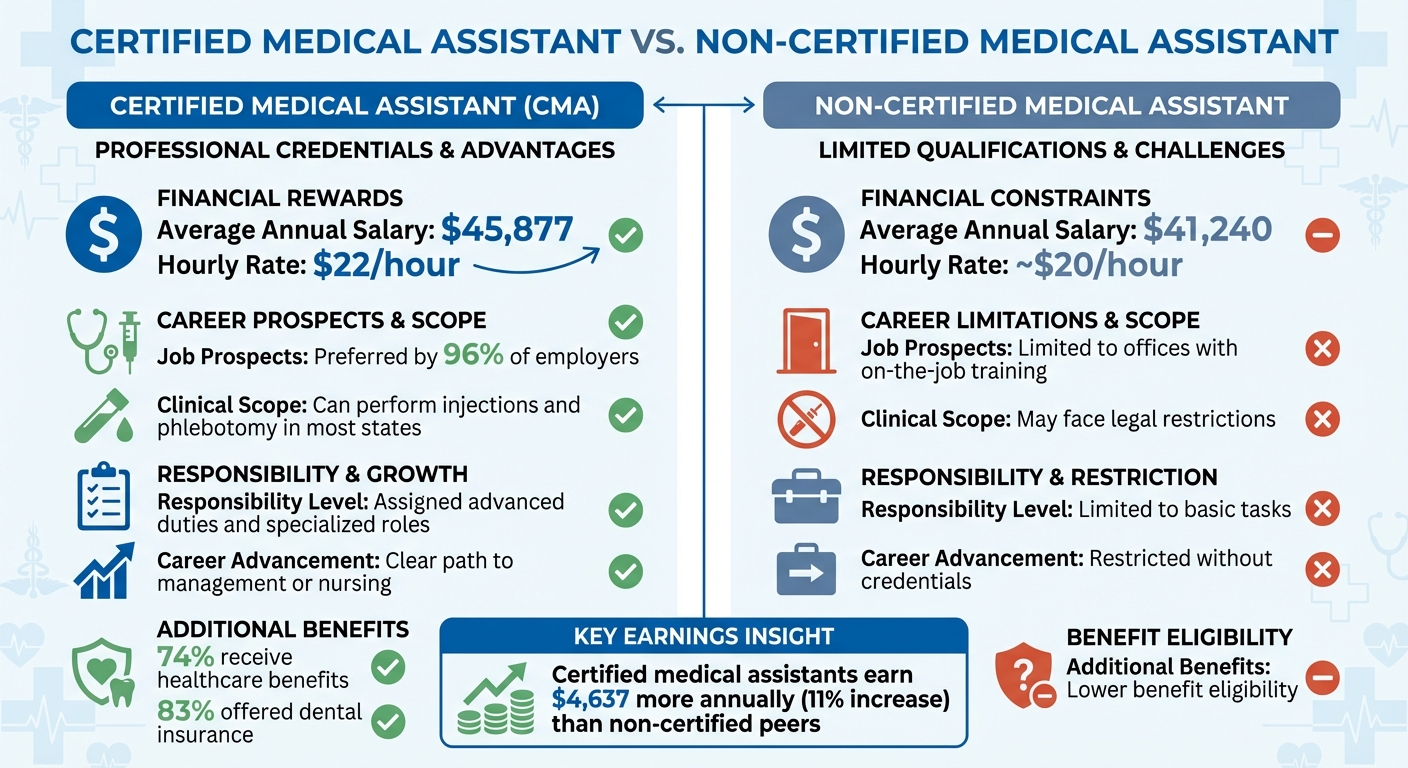
Certified vs Non-Certified Medical Assistant Salary and Benefits Comparison
Understanding the perks of becoming a certified medical assistant can provide clarity on how certification impacts your career. Beyond passing exams and maintaining credentials, certification opens the door to improved salaries, diverse job roles, and long-term career growth.
Salary Expectations for Certified Medical Assistants
As of February 2026, the average annual salary for a Certified Medical Assistant (CMA) in the U.S. is $45,877 – approximately $22 per hour. While the median wage for medical assistants sits at $44,200, certified professionals typically earn more, with top earners reaching $57,830. Entry-level CMAs can expect to start around $45,500.
The financial benefits of certification are clear. Certified medical assistants earn an average of $4,637 more annually than their non-certified peers, representing an 11% increase in earning potential. Geographic location also has a major impact on pay. Cities like San Jose, CA ($57,865) and San Francisco, CA ($57,296) top the charts, while states such as the District of Columbia ($50,795), California ($50,602), and Massachusetts ($49,928) offer some of the highest average salaries.
Experience and specialized skills can further boost earnings. Mid-level professionals with 2–4 years of experience average $46,956, while those with over 8 years earn around $47,273 annually. Additionally, expertise in areas like Basic Life Support (BLS) and patient flow management can increase pay. Even soft skills, such as strong listening and organizational abilities, can enhance salaries by 5% and 4%, respectively.
Job Roles and Work Environments
Certified medical assistants find opportunities in a variety of healthcare settings, offering flexibility and room for specialization. Most CMAs (57%) work in physicians’ offices, while others are employed in hospitals (17%), outpatient care centers (10%), and specialty clinics such as dermatology, podiatry, or chiropractic offices.
Among these environments, outpatient care centers offer the highest median wages at $47,560, followed by hospitals at $45,930 and physicians’ offices at $43,880. Certified medical assistants can also branch out into specialized fields like cardiology, pediatrics, oncology, or OB/GYN. Beyond clinical roles, some transition into administrative positions, medical billing and coding, office management, EKG technology, or phlebotomy.
The demand for medical assistants is growing quickly. Employment in this field is projected to rise by 12% between 2024 and 2034, adding around 112,300 job openings annually. For those looking to advance, medical assisting also serves as a stepping stone to roles in nursing, healthcare administration, or even as a physician assistant.
Certified vs. Non-Certified Medical Assistants
The advantages of certification go beyond just salary. Certification significantly boosts job prospects, with 96% of healthcare employers either requiring or strongly preferring certified candidates. In some states, certification is a legal requirement. For instance, Washington mandates certification for all medical assistants, while states like New Jersey and South Dakota require it for specific tasks such as administering injections.
| Feature | Certified Medical Assistant | Non-Certified Medical Assistant |
|---|---|---|
| Average Annual Salary | $45,877 | $41,240 |
| Hourly Rate | $22 | ~$20 |
| Job Prospects | Preferred by 96% of employers | Limited to offices with on-the-job training |
| Clinical Scope | Can perform injections and phlebotomy in most states | May face legal restrictions |
| Responsibility Level | Assigned advanced duties and specialized roles | Limited to basic tasks |
| Career Advancement | Clear path to management or nursing | Restricted without credentials |
Certified medical assistants are often entrusted with more responsibilities. In fact, 35% of employers report that medical assistants are taking on greater duties compared to the previous year, with certified professionals more likely to handle advanced tasks.
Jessica Aponte, a CCMA, shared how certification transformed her career:
"My NHA certification has helped me financially advance my career. Most importantly it has given me the opportunity to get a job that allows me to be a better mom by being home in the evenings and on the weekends".
In addition to better job opportunities, 74% of full-time certified medical assistants receive healthcare benefits, and 83% are offered dental insurance. Certification is more than an investment in your skills – it’s a gateway to better pay, expanded roles, and long-term career success.
Conclusion
Earning a medical assistant certification is an excellent step for anyone looking to thrive in today’s competitive healthcare job market. With demand for certified professionals on the rise, this credential not only increases earning potential but also opens the door to better job opportunities.
The process to become certified is straightforward: you’ll need a high school diploma or GED, complete an accredited training program, and pass an exam like the CCMA. Keep in mind, maintaining your certification requires renewal every two years, which involves continuing education to ensure you stay up-to-date in this ever-changing field.
Certification also expands your career options. Whether you prefer working in specialty clinics like cardiology or pediatrics, hospitals, or outpatient care centers, the credential qualifies you for advanced clinical tasks and leadership roles. It’s also a great stepping stone for further growth in areas like nursing, healthcare administration, or specialized medical technology.
Training programs make this journey even more accessible. For example, HealthCareer Certs offers a 100% online, self-paced CCMA program tailored to fit busy schedules. Their program includes externship placements, one-on-one instructor support, and a 100% tuition refund guarantee if you don’t land a healthcare job – providing the tools and confidence you need to succeed.
With proper training, commitment, and certification, you’ll be well-equipped to contribute to patient care and build a fulfilling career in healthcare.
FAQs
What are the main benefits of earning a medical assistant certification?
Becoming a certified medical assistant comes with some standout perks. For starters, it often leads to better job prospects, as many employers either prefer or require certification. Plus, certification can mean higher pay compared to those without it, along with stronger job stability in an ever-expanding healthcare field.
On top of that, earning your certification shows your commitment and professionalism, helping you stand out to both employers and patients. It also gives you the skills and confidence needed to thrive in a healthcare environment.
What’s the best way to prepare for the CCMA exam?
To get ready for the CCMA exam, focus on understanding the core topics: anatomy and physiology, clinical patient care, and administrative responsibilities. Combine resources like study guides, practice tests, and online courses to strengthen your knowledge and become familiar with the exam’s structure.
Ensure you meet the basic eligibility criteria, such as holding a high school diploma or GED and completing an accredited medical assistant training program. Regularly go over the exam material, take practice exams to gauge your progress, and pinpoint areas where you need extra work. This strategy can boost your confidence and set you up for success on your first attempt.
What job opportunities can I pursue with a medical assistant certification?
Obtaining a medical assistant certification can lead to a range of opportunities within the healthcare industry. Certified medical assistants are sought after in various settings, including physicians’ offices, hospitals, outpatient clinics, and specialized areas like pediatrics or cardiology.
Earning this credential can make you eligible for roles that come with better pay, more job security, and broader responsibilities. These responsibilities often include assisting with patient care, managing administrative tasks, and performing clinical duties. Beyond boosting your resume, certification signals your dedication to delivering excellent care in a professional healthcare setting.