Becoming a certified medical assistant (CMA) in South Carolina can boost your career prospects, as most employers prefer or require certification. Here’s what you need to know:
- Certification isn’t legally required but is highly valued by employers. In 2024, 78% of employers required certification, and 83% preferred certified candidates.
- Job growth is strong: South Carolina expects a 23.9% increase in medical assistant jobs from 2022 to 2032, with 1,810 openings annually.
- Average salary: Medical assistants in South Carolina earn $40,070 per year.
- Pathway to certification: Complete an accredited program, gain clinical experience, and pass a national exam (e.g., CMA, RMA, CCMA).
- New laws: By July 15, 2026, medical assistants performing advanced tasks must meet updated education and certification requirements.
Programs are available online and on-campus, with options like Greenville Technical College and Herzing University. Certification exams cost $120–$250, and credentials must be renewed every 2–5 years. Certified medical assistants can handle advanced tasks like administering medications, making certification a valuable career step.
Certification Requirements in South Carolina
Education and Clinical Training Requirements
To begin a medical assistant training program in South Carolina, you’ll need at least a high school diploma or GED. After that, you must complete a post-secondary medical assisting program accredited by CAAHEP, ABHES, or another agency recognized by the U.S. Department of Education. Under South Carolina Act 209, which takes effect in May 2024, these programs are required to include coursework in anatomy and physiology, medical terminology, pharmacology, medical laboratory techniques, and hands-on clinical experience. This practical experience can be achieved through a practicum or relevant work experience with a healthcare employer.
"The accredited post-secondary medical assisting education program must include courses in anatomy and physiology, medical terminology, pharmacology, medical laboratory techniques, and clinical experience."
- South Carolina General Assembly, Act 209
Act 209 also broadens the pathways to qualification. In addition to traditional programs, you can meet the requirements through Career and Technical Education Health Sciences Programs approved by the South Carolina Department of Education, U.S. military medical assisting training, Department of Labor–approved Registered Apprenticeships, or employer-led training programs that align with nationally recognized certification exams. Currently, South Carolina offers 16 accredited medical assistant programs.
Next, let’s explore how certification and legal regulations shape medical assisting in the state.
South Carolina Legal and Regulatory Requirements
In South Carolina, a "Certified Medical Assistant" (CMA) is defined as someone who has completed an approved education program and holds current certification from a recognized national organization. Certifying bodies must be accredited by the National Commission for Certifying Agencies or another authority approved by the Board of Medical Examiners. Recognized organizations include the AAMA, AMT, NHA, NCCT, and NCMA. While certification is not mandatory for working as unlicensed assistive personnel, it is required for performing advanced clinical tasks like administering medications or taking vital signs under delegation.
If you’re already working as a medical assistant but don’t meet the updated education or certification standards, you have until July 15, 2026 to comply with the new law. Certified medical assistants must also work in "close proximity" to their supervising physician, PA, or APRN, ensuring immediate availability if their assistance is needed. Additionally, South Carolina law requires medical assistants to wear a clearly labeled badge identifying their professional status when interacting with patients.
"An individual employed in that role now has until July 15, 2026 to meet the requirements of the law."
- Shannon V. Lipham and Sara S. Rogers, Attorneys, Maynard Nexsen
sbb-itb-7a67ffa
Medical Assistant Certification Exam Breakdown
This video covers the core competencies required for the Certified Clinical Medical Assistant (CCMA) exam, which is a popular choice for South Carolina students.
Medical Assistant Certification Options
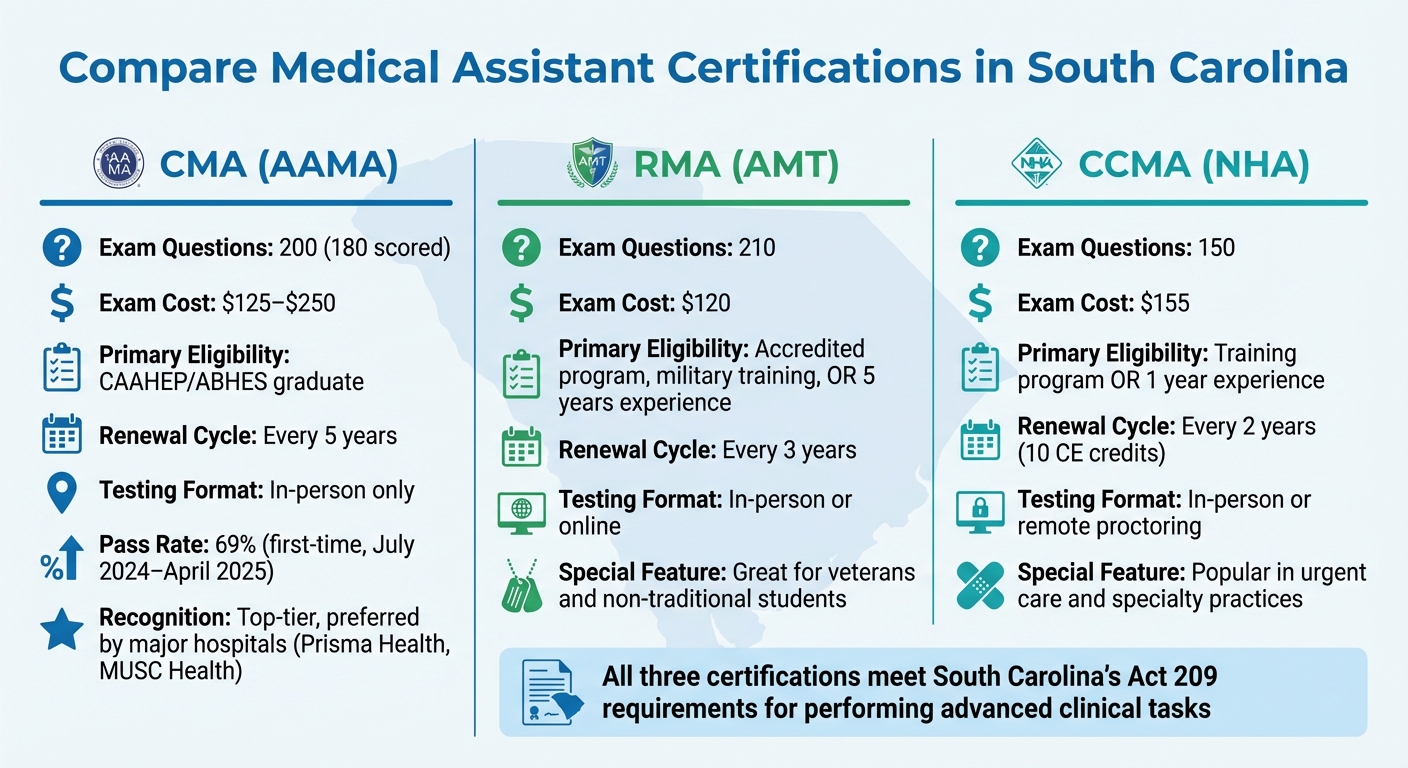
South Carolina Medical Assistant Certification Comparison: CMA vs RMA vs CCMA
South Carolina offers several national certifications for medical assistants, giving you the flexibility to choose one that aligns with your educational background and career aspirations. Below are the three main certification pathways available, each catering to different needs and goals.
Certified Clinical Medical Assistant (CCMA)
The Certified Clinical Medical Assistant (CCMA) credential, provided by the National Healthcareer Association (NHA), emphasizes clinical skills. It’s especially favored in urgent care centers and specialty practices across South Carolina. Eligibility is flexible: you’ll need a high school diploma or GED, plus either completion of a medical assistant training program within the last five years or one year of supervised work experience in the last three years.
The CCMA exam includes 150 questions and costs $155. Candidates can take the test in-person or via remote proctoring, which is particularly helpful for those in rural areas. Certification renewal is required every two years, with 10 continuing education credits. Jessica Aponte, a CCMA-certified professional, shared how this credential impacted her:
"My NHA certification has helped me financially advance my career. Most importantly it has given me opportunity to get a job that allows me to be a better mom by being home in the evenings and on the weekends".
Certified Medical Assistant (CMA)
The Certified Medical Assistant (CMA), offered by the American Association of Medical Assistants (AAMA), is often regarded as a top-tier certification in the field. Major healthcare providers in South Carolina, such as Prisma Health and MUSC Health, recognize this credential. However, eligibility is more specific – you must graduate from a CAAHEP or ABHES-accredited program, though educators with 1,000 hours of teaching experience may also qualify.
The CMA exam consists of 200 questions (180 scored) and costs $125 for AAMA members or recent graduates, or $250 for non-members. Between July 2024 and April 2025, the first-time pass rate was 69%. As of early 2026, there were 68,495 active CMAs nationwide. Recertification is required every five years, either by retaking the exam or completing 60 continuing education points. Testing is conducted in-person at Prometric centers.
Registered Medical Assistant (RMA)
The Registered Medical Assistant (RMA) certification, offered by American Medical Technologists (AMT), provides broad eligibility options. This pathway is particularly appealing to veterans and non-traditional students in South Carolina. You can qualify by graduating from an accredited program, completing military medical training, or having five years of relevant work experience.
The RMA exam includes 210 questions and costs $120. Testing is available both in-person and online, offering flexibility. Renewal is required every three years through AMT’s Continuing Competency Program (CCP). This makes the RMA a good choice for those transitioning from military service or with extensive healthcare experience but no formal certification.
| Feature | CMA (AAMA) | RMA (AMT) | CCMA (NHA) |
|---|---|---|---|
| Exam Questions | 200 (180 scored) | 210 | 150 |
| Exam Cost | $125–$250 | $120 | $155 |
| Primary Eligibility | CAAHEP/ABHES graduate | Accredited program, military, or 5 years experience | Training program or 1 year experience |
| Renewal Cycle | Every 5 years | Every 3 years | Every 2 years |
| Testing Format | In-person only | In-person or online | In-person or remote |
Training Programs and Online Learning
South Carolina provides a variety of accredited training programs, ranging from certificates to associate degrees, with durations spanning 6 to 21 months. Selecting an accredited program is a key step toward meeting the state’s certification requirements. Accreditation plays a significant role in determining eligibility for certifications like the CMA (AAMA). On the other hand, non-accredited programs typically prepare students for exams such as the CCMA (NHA) or RMA (AMT). The average cost for a health professions certificate is around $19,000 annually for full-time students, while online program costs range between $2,799 and $3,295.
For those seeking traditional campus-based programs, options include Greenville Technical College, Midlands Technical College, and Trident Technical College. Meanwhile, hybrid and online programs offer flexibility, especially for working adults or individuals in rural areas. Among these, HealthCareer Certs stands out with its adaptable online CCMA program.
HealthCareer Certs CCMA Program
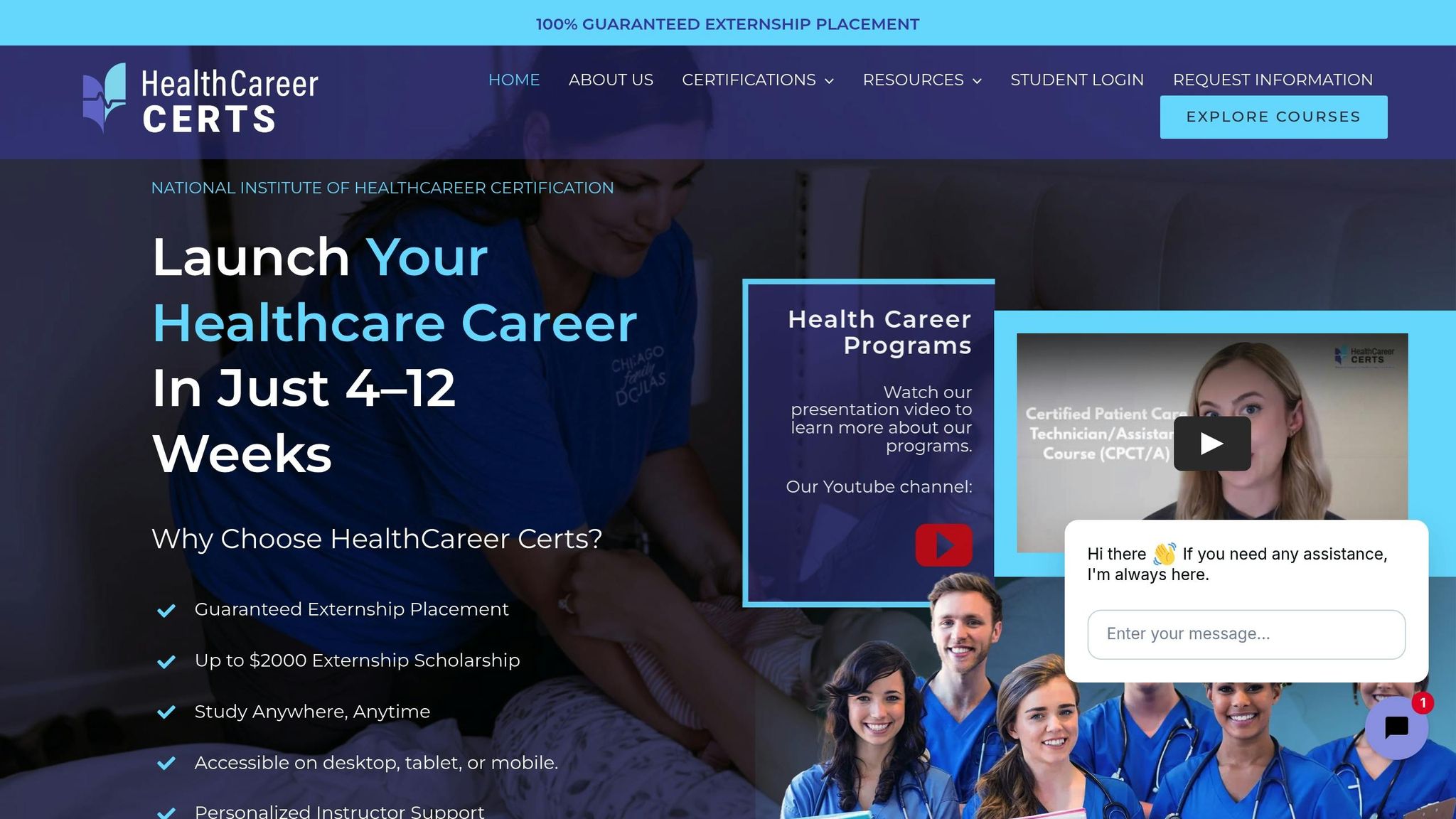
HealthCareer Certs offers a fully online CCMA program designed for flexible and fast-paced learning. Highlights of the program include:
- Self-paced structure, allowing students to complete it in 4 to 12 weeks
- One-on-one instructor support through Zoom sessions
- Access to 1,400+ practice questions and interactive 3D demos
- Externship placement assistance for required clinical hours
- Comprehensive preparation for the NHA CCMA exam
- A tuition refund guarantee if graduates don’t land a healthcare job after certification
This program is particularly beneficial for rural students with limited access to campus-based education. Its mobile-friendly coursework lets students balance studying with work or family responsibilities.
CAAHEP and ABHES Accredited Programs
Programs accredited by CAAHEP and ABHES adhere to strict curriculum standards, requiring 160 to 180 hours of in-person externship, regardless of whether the program is online or in-person. Campus-based programs offer hands-on lab experiences and direct instruction, while hybrid options, such as Fortis College in Columbia, combine online administrative coursework with in-person clinical labs.
Herzing University provides an online diploma (10 months) and an associate degree (16 months) for South Carolina residents, both requiring a 180-hour in-person externship. According to their 2024 Graduate Survey, over 90% of students reported satisfaction with the program. Some schools bundle the cost of the first certification exam into tuition, while others require it to be paid separately. South Carolina residents should also explore financial aid opportunities like the Palmetto Fellows Scholarship and the LIFE Scholarship.
| Institution | Location | Degree Type | Duration | Format |
|---|---|---|---|---|
| Aiken Technical College | Aiken | Certificate | 6–12 months | Campus |
| Greenville Technical College | Greenville | Certificate | 6–12 months | Campus |
| Fortis College | Columbia | Diploma | 10–12 months | Hybrid |
| Herzing University | Online | Diploma/Associate | 10–16 months | Online + Local Clinicals |
| South University | Columbia | Associate | 16–21 months | Campus |
Once training is completed, the next step is navigating the certification process.
How to Get Certified: Step-by-Step
Follow these steps to meet South Carolina’s certification requirements for medical assistants.
Complete Your Education and Clinical Hours
Start with a high school diploma or GED. Then, enroll in a program accredited by either CAAHEP or ABHES. South Carolina has 16 accredited options available. These programs cover key areas like anatomy, physiology, medical terminology, pharmacology, lab techniques, and clinical training.
Clinical training is a must. For the CMA (AAMA) certification, you’ll need supervised, unpaid experience in an ambulatory healthcare setting. If you’re pursuing the RMA (AMT) credential, the requirement includes 720 hours of instruction, with at least 160 hours dedicated to an externship. Prior healthcare work experience may also count toward these clinical requirements.
If you’re in an accredited program, you can take the CMA exam as early as 30 days before finishing your practicum. However, you must pass the exam within 60 months of graduating. Once you’ve completed your education and clinical hours, you’re ready to register for the certification exam.
Register and Prepare for Your Certification Exam
After finishing your training, register online through the appropriate portal. Use the AAMA website for the CMA exam, the AMT portal for the RMA exam, or the NHA website for the CCMA exam . Make sure you meet all eligibility requirements and have documentation, such as transcripts, proof of clinical hours, and, for the RMA, a valid CPR card .
Exam fees vary depending on the certification. The CMA exam costs $125 for AAMA members and $250 for non-members . RMA fees typically range from $120 to $135 , while the CCMA fee is often included in the program’s overall cost.
Prepare using official study resources. NHA offers a mobile app with flashcards, and both AAMA and AMT provide detailed content outlines . CCMA exams can be taken at your school, a PSI testing center, or via remote proctoring .
Once you’ve passed the exam, it’s time to focus on maintaining your certification.
Maintain Your Certification
To perform advanced clinical tasks in South Carolina, certified medical assistants must keep their credentials current . The CMA (AAMA) credential requires renewal every 60 months. You can renew by earning 60 continuing education credits or retaking the exam. For the RMA (AMT), compliance with the Certification Continuation Program is required every three years.
"A certified medical assistant must maintain current certification from the certifying board of the American Association of Medical Assistants, the National Center for Competency Testing, the National Certification Medical Association, American Medical Technologists, or any other recognized certifying body approved by the Board of Medical Examiners."
- South Carolina General Assembly, Bill 5183
Keep track of your certification’s expiration date and ensure your continuing education credits cover approved topics like medical terminology, pharmacology, or clinical techniques . If you were employed as a medical assistant before the law changed, you have until July 15, 2026, to fully comply with these requirements .
Conclusion
Earning a certification opens doors to numerous career opportunities in South Carolina. With employment expected to grow by 23.9% between 2022 and 2032, there will be around 1,810 job openings annually across the state. This career path not only offers steady growth but also aligns with what employers are actively seeking – certified professionals are in high demand.
Cities such as Rock Hill, Charleston, and Columbia stand out for competitive pay, with Rock Hill offering an average salary of $44,212 per year.
"Medical assistants serve as the backbone of health care practices across South Carolina, skillfully managing both clinical procedures and administrative responsibilities." – HealthJob Editors
Top employers like Prisma Health, MUSC Health, Lexington Medical Center, and Spartanburg Medical Center are consistently on the lookout for certified professionals. Whether you pursue the CMA, RMA, or CCMA credential, your certification not only demonstrates your expertise but also broadens your scope of practice under South Carolina’s Act 171 and Act 209.
With strong job prospects, competitive salaries, and state regulations backing certified professionals, this is a career move that pays off. Take the first step by enrolling in an accredited program, completing your clinical hours, and preparing for your certification exam. South Carolina’s healthcare industry is growing, and it’s ready for skilled individuals like you to make an impact.
FAQs
Which certification should I choose: CMA, RMA, or CCMA?
In South Carolina, you don’t need certification to work as a medical assistant, but most employers tend to favor candidates who have it. Among the options, the CMA (AAMA) is highly recognized and often the top choice for employers in the state. Other respected certifications include the RMA (AMT) and CCMA (NHA). The CMA (AAMA) stands out as the most established credential in South Carolina, so your decision should depend on your career aspirations and what employers in your area are looking for.
What tasks in South Carolina require certification after July 15, 2026?
Starting July 15, 2026, certified medical assistants in South Carolina will have the authority to take on extra nursing responsibilities. This update comes as part of legislation such as Act 209 and Bill 5183, which not only revise certification requirements but also broaden the range of tasks that can be delegated to these professionals.
How can I get clinical hours if I’m in an online program?
If you’re enrolled in an online medical assistant program in South Carolina, it’s important to choose one that’s accredited and includes clinical training. Many programs offer externships or practicum hours at nearby healthcare facilities, giving you essential hands-on experience. For instance, some programs incorporate 4–6 months of clinical practice in places like clinics, hospitals, or physician’s offices. These collaborations not only meet certification requirements but also give you real-world training.