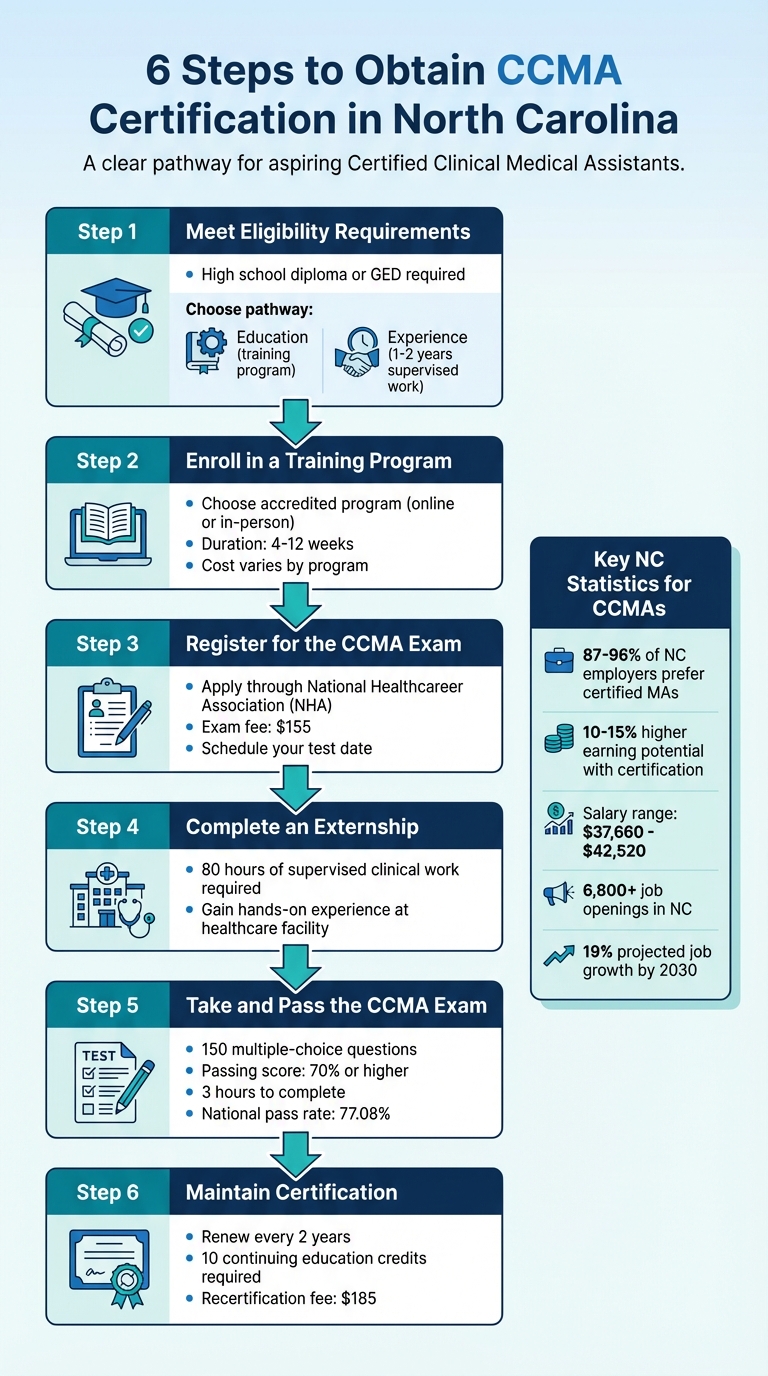
To become a Certified Clinical Medical Assistant (CCMA) in North Carolina, follow these steps:
- Meet Eligibility Requirements:
- Have a high school diploma or GED.
- Qualify through either education (complete a medical assistant training program) or experience (1–2 years of supervised medical assisting work).
- Enroll in a Training Program:
- Choose an accredited program, such as HealthCareer Certs or local community colleges.
- Online or in-person options are available, typically taking 4–12 weeks to complete.
- Register for the CCMA Exam:
- Apply through the National Healthcareer Association (NHA).
- Pay the $155 exam fee and schedule your test.
- Complete an Externship:
- Gain hands-on experience at a healthcare facility.
- Most programs require 80 hours of supervised clinical work.
- Take and Pass the CCMA Exam:
- The exam includes 150 multiple-choice questions.
- A passing score is 70% or higher.
- Maintain Certification:
- Renew every two years with 10 continuing education credits.
- Recertification costs $185.
Why Get Certified?
- Employers in North Carolina strongly prefer certified medical assistants (87%–96%).
- Certification increases earning potential by 10%–15%, with salaries ranging from $37,660 to $42,520.
- Opportunities are abundant, with over 6,800 job openings in the state and a projected 19% job growth by 2030.
Start your healthcare career today by enrolling in a CCMA training program and preparing for certification.
6 Steps to Get CCMA Certified in North Carolina
Eligibility and Requirements for CCMA Certification
Who Can Apply?
The National Healthcareer Association (NHA) outlines specific criteria for those pursuing CCMA certification. To apply, you need a high school diploma or GED – students expecting to graduate within 12 months are also eligible. While there’s no national age standard, many training programs in North Carolina require applicants to be at least 17 or 18 years old, as a high school diploma is a prerequisite.
After meeting the education requirement, you can qualify through one of two pathways. The Education Pathway requires completing a medical assistant training program within the last five years. Accredited programs, such as those at Central Piedmont Community College in North Carolina, meet this requirement. Alternatively, the Experience Pathway is an option for those with work experience. This includes one year of supervised medical assisting experience within the last three years or two years of supervised experience within the last five years. This route is ideal for uncertified medical assistants looking to formalize their credentials.
Once you meet the eligibility criteria, the next step is gathering the required documentation.
Required Documents and Information
Before applying, make sure you have the following documents ready. First, you’ll need proof of your high school diploma or GED. If you’re using the education pathway, include your certificate or transcript from an accredited program completed within the last five years. For the experience pathway, your employer must provide verifiable documentation of your supervised work experience.
Additionally, a valid government-issued ID is required on exam day. To start the process, create a free account on the NHA website. This account allows you to submit your CCMA exam application and access study materials. The NHA also offers a "Check Your Eligibility" tool to help you determine the best pathway for your background before applying.
The exam fee is $155, and a recertification fee of $179 is required every two years to maintain your certification. With 96% of employers either requiring or strongly encouraging certification, as highlighted in the 2025 Industry Outlook, having these documents ready can help you succeed in North Carolina’s competitive healthcare landscape.
sbb-itb-7a67ffa
CCMA Certification – Everything You Need To Know
How to Get CCMA Certified: Step-by-Step Process
Earning your CCMA certification in North Carolina involves four key steps. Here’s how to navigate the process.
Step 1: Enroll in a Training Program
Start by choosing an NHA-accredited training program. In North Carolina, a notable 87% of healthcare organizations prefer hiring certified medical assistants. Picking the right program can make a big difference in your career.
HealthCareer Certs offers a fully online CCMA program designed to be flexible and self-paced. You can complete the coursework in as little as 4 to 12 weeks. The program includes interactive tools like 3D demonstrations, over 1,400 practice questions, and 700 self-checks to help you master the material. Additionally, one-on-one Zoom sessions with experienced instructors cover topics such as anatomy, physiology, and medical terminology. Before applying, ensure you have your high school diploma or GED ready.
Once you’ve started your training, you’ll need to move on to exam registration.
Step 2: Register for the CCMA Exam
After enrollment, head to the NHA website to register for the CCMA exam. You’ll need to submit your application, pay a $155 exam fee, and choose your testing option.
In North Carolina, you can take the exam at a PSI testing center, at your school, or from home using live remote proctoring (LRP). After applying, select your exam date and location. If your program sponsors the exam, make sure to link your account to your organization to access any pre-purchased materials or discounts. For online exams, results are typically available in your NHA account within two days.
Step 3: Complete Your Externship
Hands-on clinical experience is a vital part of the certification process. Most programs require about 80 hours of supervised work in healthcare settings like hospitals or clinics. During your externship, you’ll practice key skills such as patient intake, phlebotomy, EKG testing, and infection control under professional supervision.
HealthCareer Certs simplifies this step by guaranteeing externship placements. Popular placement sites in North Carolina include Duke University in Durham, ECU Health in Eastern North Carolina, and Novant Health Forsyth Medical Center in Winston-Salem. To help you prepare, the program also provides a Clinical Kit with tools like a venipuncture trainer arm and stethoscope for at-home practice before your externship begins.
Once you’ve completed your externship, you’ll be ready for the final step: taking the CCMA exam.
Step 4: Take the CCMA Exam
On exam day, bring a valid government-issued ID and arrive at least 15 minutes early for check-in. The CCMA exam consists of 150 multiple-choice questions covering clinical skills, patient care, and administrative tasks. In 2021, the national pass rate was 77.08%, so thorough preparation is essential.
If you’re taking the exam from home via live remote proctoring, make sure your workspace is quiet, your desk is clear, and your internet connection is reliable. Online exam results are usually posted within two days.
Once you pass, your CCMA certification is valid for two years. To maintain it, you’ll need to earn 10 continuing education credits and pay a $169 recertification fee.
How to Prepare for the CCMA Exam
A solid study plan is your best ally when transitioning from training to passing the CCMA exam with confidence.
Study Materials and Resources
The National Healthcareer Association (NHA) updated its CCMA 3.0 study materials in 2024, adding interactive practice activities and EHR simulations to help candidates prepare effectively. A great starting point is downloading the free CCMA Test Plan from the NHA website, which outlines the key concepts covered in the exam.
For a more comprehensive prep, the NHA Online Study Guide ($69) offers interactive games, quizzes, flashcards, and an audio reader. If you’d like to bundle your resources, the CCMA Preparation Package ($94) includes both the study guide and simulated practice tests.
On-the-go learners can benefit from the NHA Mobile App, which features flashcards aligned with the course curriculum and tracks your progress. After completing practice tests, use the Focused Review tool to zero in on areas where you need improvement.
The study materials also emphasize practical skills, with EHR simulations covering tasks like patient registration, documenting vital signs, and medication reconciliation. With these tools, you can prepare for the exam while becoming familiar with its structure.
CCMA Exam Format and Content Areas
The CCMA 3.0 exam, introduced on January 10, 2024, includes 150 multiple-choice questions that test your knowledge of clinical procedures, administrative tasks, and professionalism. You’ll have 3 hours to complete the test, and a score of 70% or higher is required to pass.
| CCMA Content Area | Key Skills Tested |
|---|---|
| Clinical Procedures | Vital signs, injections, EKG, phlebotomy, lab procedures |
| Administrative Tasks | Patient check-in/out, scheduling, electronic referrals |
| EHR Simulations | Patient registration, medication reconciliation, lab orders |
| Professionalism | Emotional intelligence, work ethic, multitasking |
| Patient Experience | Communication skills, improving patient perception |
If you take the exam online, your results are typically available in your NHA account within two days. With 96% of healthcare employers either requiring or encouraging certification, thorough preparation can make a significant difference in your career prospects.
Study Schedule and Practice Tips
Start by setting a firm exam date – registering for the test early gives you a clear timeline to plan your study sessions. Taking an initial practice test can help you gauge your strengths and weaknesses, allowing you to focus on areas that need improvement.
Use the three online practice tests (each with two attempts) to simulate the real exam environment and build your test-taking endurance. Pay special attention to the EHR simulations in the CCMA 3.0 modules, as these exercises closely mimic tasks you’ll encounter in healthcare settings like those in North Carolina.
"Professionalism and critical thinking are the most important soft skills employers are looking for, when hiring a clinical medical assistant." – National Healthcareer Association
Dedicate time to reviewing Professionalism Tips videos, which cover emotional intelligence, multitasking, and adaptability – key soft skills that healthcare employers value. Bookmark and highlight complex topics in your study guide for quick review sessions.
Make the most of short breaks by using the mobile app’s flashcards. Categorize terms into "study" or "know" groups to focus on unfamiliar material with active recall and spaced repetition. Combining EHR simulations, videos, and mobile practice ensures you’re prepared, no matter how you learn best.
Training Programs and Job Opportunities in North Carolina
CCMA Training Options in North Carolina
If you’re in North Carolina and considering CCMA training, you have the flexibility to choose between online and in-person programs based on your schedule and learning style. Online programs often take about 4 months to complete, while in-person programs may require 6 to 12 months. Universities like NCCU, UNC Charlotte, and North Carolina A&T offer fully online CCMA programs, making it easier to balance learning with other commitments.
For a faster route, HealthCareer Certs provides a self-paced online CCMA program designed for North Carolina residents. Most students finish this program in just 4 to 12 weeks, and it fully prepares you for the NHA CCMA exam and certification process. This can be a quicker alternative compared to traditional in-person training.
If affordability is a concern, payment plans are available through programs like Stepful, with options starting at around $181.93 per month. Additionally, some university programs, such as those at NCCU and UNC Charlotte, include the cost of the CCMA exam voucher in their tuition fees. This can save you the $165 exam fee and make the process more budget-friendly. After completing your training, you can further enhance your skills through local externship opportunities.
Finding Externship Sites in North Carolina
Securing an externship at a local healthcare facility is an essential step in becoming certified. HealthCareer Certs ensures externship placements for all students, connecting them with physicians’ offices, hospitals, and outpatient clinics throughout North Carolina. These placements provide hands-on experience in real-world healthcare settings.
Another excellent option is the Medical Assistant Apprenticeship Initiative (MAAI), managed by the North Carolina Community Health Center Association. This program offers 2,000 hours of paid on-the-job training at community health centers in locations like Asheville, Charlotte, Durham, Wilmington, and more. Upon certification, participants commit to working at their host center, combining training with guaranteed employment.
Major employers in the state, such as Duke University and ECU Health, also offer externship opportunities. With these resources, aspiring CCMAs can gain the practical experience needed to thrive in North Carolina’s healthcare industry.
CCMA Job Market in North Carolina
North Carolina’s healthcare industry is thriving, with over 6,800 medical assistant job openings available. Employment in this field is expected to grow by 15% by 2033, fueled by an aging population and a greater emphasis on preventative care. As of May 2023, the state had approximately 22,950 medical assisting jobs.
The median annual salary for medical assistants in North Carolina is $40,190, or $19.32 per hour. While certification isn’t legally required, 87% of employers prefer hiring certified medical assistants, giving certified professionals a clear advantage in the job market.
Job opportunities are especially abundant in cities like Charlotte, Concord, and Gastonia. Major healthcare systems such as Atrium Health Medical Center, UNC Health, and Carolinas Medical Center are actively recruiting in these areas. The Research Triangle region also offers promising prospects, with institutions like Duke University, UNC, ECU, and Wake Forest driving demand. Entry-level salaries typically start around $28,000, with experienced professionals earning $40,000 or more. With a CCMA certification, you’ll be well-positioned to tap into these growing opportunities.
Maintaining Your CCMA Certification
Continuing Education Requirements
Your CCMA certification remains valid for two years, after which you’ll need to renew it to continue working as a certified medical assistant. To renew, you must earn 10 Continuing Education (CE) credits during each two-year cycle, which equals 20 hours of continuing education.
If you’re certified through NHA, you have free, unlimited access to their online CE library, which is regularly updated with the latest healthcare protocols. This resource is a favorite among certification holders – 83% of them use it for its convenience and accessibility. Simply log in to nhanow.com, navigate to the "Find CE Courses" menu, and complete courses directly on the platform. If you prefer using external resources, you can upload documentation through the "Add External CE Items" feature.
"I choose to continue my education through NHA because I know they’ll help me with the proper resources and information to attain the sufficient knowledge to better my career!" – Hazel Ann Lane, CPT
If you hold multiple NHA certifications, the same 10 CE credits can count toward all of them, saving you time and effort. Keeping your certification up to date is worthwhile – 63% of healthcare institutions in the U.S. offer higher pay to employees who maintain professional certifications.
Once you’ve completed your CE requirements, you can move on to renewing your certification.
How to Renew Your Certification
Renewing your CCMA certification is straightforward, as long as you meet the deadlines. The renewal fee is $185 every two years, which works out to about $8 per month. You can renew anytime before your certification expires without penalties, and there’s even a 30-day grace period after the expiration date to complete the standard renewal process.
If your certification has been expired for more than 30 days but less than a year, you’ll need to reinstate it. This requires 15 CE credits instead of the usual 10 and comes with a total cost of $376.50 ($277.50 renewal fee plus $99 reinstatement fee). However, if your certification has been expired for over a year, it becomes invalid, and you’ll need to retake the CCMA exam to regain certification.
To renew, log in to your NHA account, complete the required CE credits, select "Renew Certifications" on the NHA launchpad, and pay the renewal fee. Once completed, your new expiration date will update automatically. To avoid extra fees or lapses in your credentials, set reminders before your certification expires – especially since 96% of employers require or encourage certification for medical assistants.
Start Your Healthcare Career Today
Just four steps stand between you and CCMA certification, opening the door to a fulfilling healthcare career in North Carolina.
HealthCareer Certs offers a 100% online, self-paced CCMA program that you can complete in as little as 8 weeks. Here’s what the program provides:
- 24/7 access to virtual coursework
- A venipuncture and injection practice kit delivered straight to your home
- Guaranteed externship placement at a local hospital or clinic
- Comprehensive prep materials for the NHA or AMCA certification exams
- Around-the-clock support with one-on-one Zoom sessions with instructors
This program has helped countless students achieve certification quickly and efficiently. Take it from Olivia:
"I was able to get certified and pass the NHA exam on the first try in only 6 weeks, and I appreciated the ease of the entire process/course." – Olivia
The program’s flexibility is a standout feature, with self-paced deadlines and all-inclusive pricing that covers textbooks, materials, and certification exam fees. Plus, you’ll earn 5 ACE college credits, which are accepted by over 2,000 universities. With a 5/5-star Google rating from over 5,000 students and externship scholarships of up to $2,000 available, HealthCareer Certs makes starting your career both practical and affordable.
Once your training is complete, you’ll step into North Carolina’s thriving healthcare industry. Anchored by renowned institutions like Duke, UNC, and Wake Forest, the state’s healthcare sector continues to expand. Certified medical assistants in North Carolina earn between $35,000 and $38,270 annually, with certification increasing earning potential by 10–15%. By choosing this streamlined training path, you’ll join the growing ranks of professionals shaping healthcare in North Carolina. Your journey starts today.
FAQs
Do I need a CCMA to work as a medical assistant in North Carolina?
No, you don’t need a CCMA certification to work as a medical assistant in North Carolina. The state considers medical assistants as "unlicensed assistive personnel", meaning certification isn’t legally required. That said, having a CCMA can make your resume stand out, demonstrate your skills to potential employers, and could open doors to better job prospects or higher wages.
Can I take the CCMA exam online from home in North Carolina?
Yes, you can take the Certified Clinical Medical Assistant (CCMA) exam online from the comfort of your home in North Carolina. Many training programs, including those offered by institutions within the state, provide options for remote testing. However, it’s important to double-check the current exam procedures with the certifying organization or your training program to make sure remote testing is still available for residents in North Carolina.
What happens if my CCMA certification expires?
If your CCMA certification lapses, it could impact your ability to secure or keep jobs that require this credential. Many employers either prefer or demand current certification. The renewal process usually happens every two years, and failing to renew on schedule can result in your certification becoming invalid. This might mean retaking the exam or undergoing extra training to regain certification. Keeping track of renewal deadlines is crucial to maintain your qualifications and professional credibility.