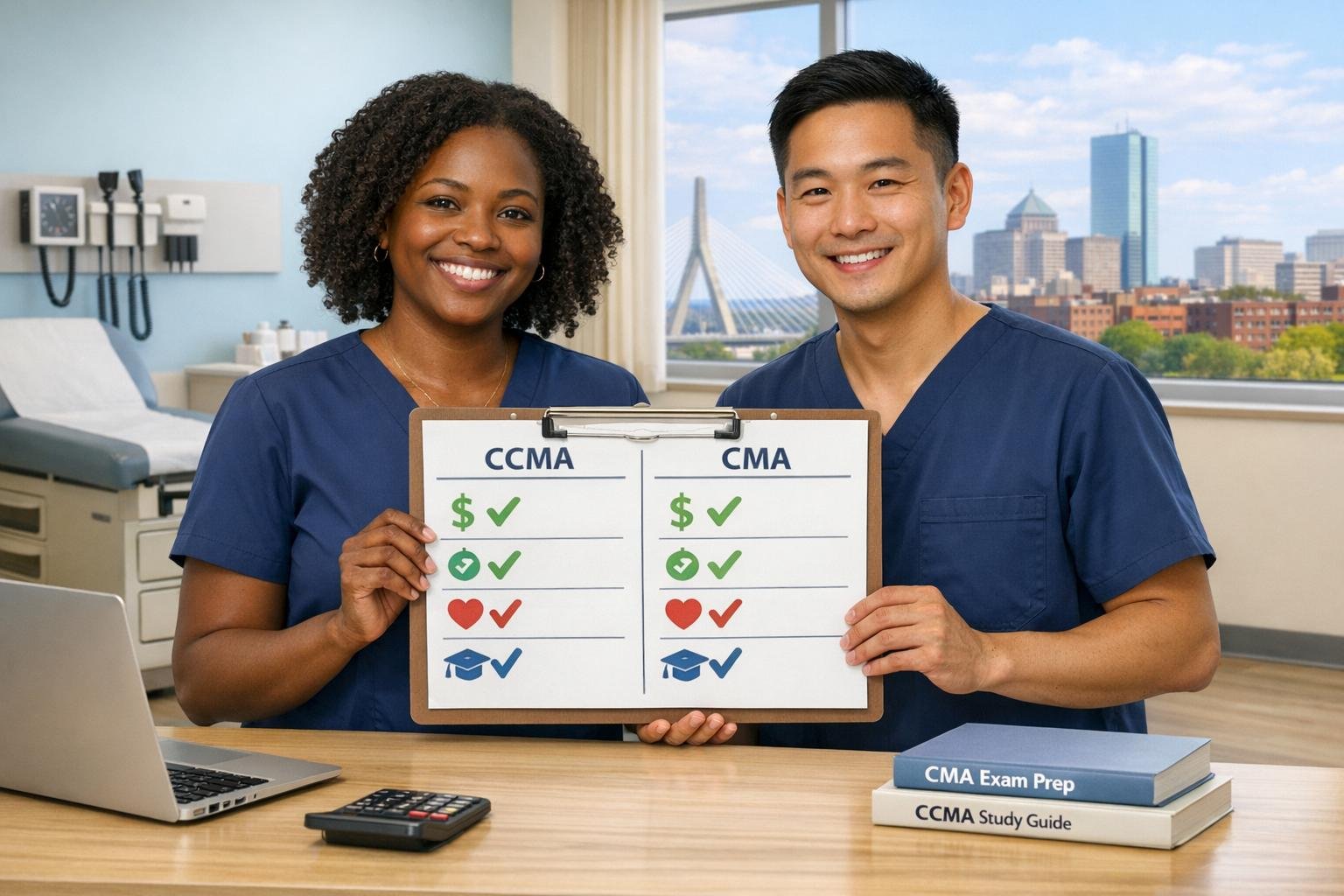
If you’re a pre-med student looking to stand out, clinical certifications are a smart way to gain hands-on experience and boost your medical school application. Certifications like CCMA (Certified Clinical Medical Assistant), BLS (Basic Life Support), CPT (Certified Phlebotomy Technician), and CPCT (Certified Patient Care Technician) can help you secure paid clinical roles, build patient care skills, and strengthen your connections with healthcare professionals. Here’s a quick breakdown of each certification:
- CCMA: Offers broad clinical experience, including vital signs, EKGs, and phlebotomy. Time: 8–12 weeks. Cost: $800–$1,500.
- BLS: Teaches emergency response skills like CPR and AED use. Time: 2–5 hours. Cost: $50–$100.
- CPT: Focuses on blood draws and lab work. Time: 4–6 weeks. Cost: $400–$1,000.
- CPCT: Combines phlebotomy, EKGs, and patient care. Time: 6–8 weeks. Cost: $600–$1,200.
These certifications provide practical experience, help you meet clinical hour requirements, and make your application stronger. Choose the one that aligns with your goals and schedule.
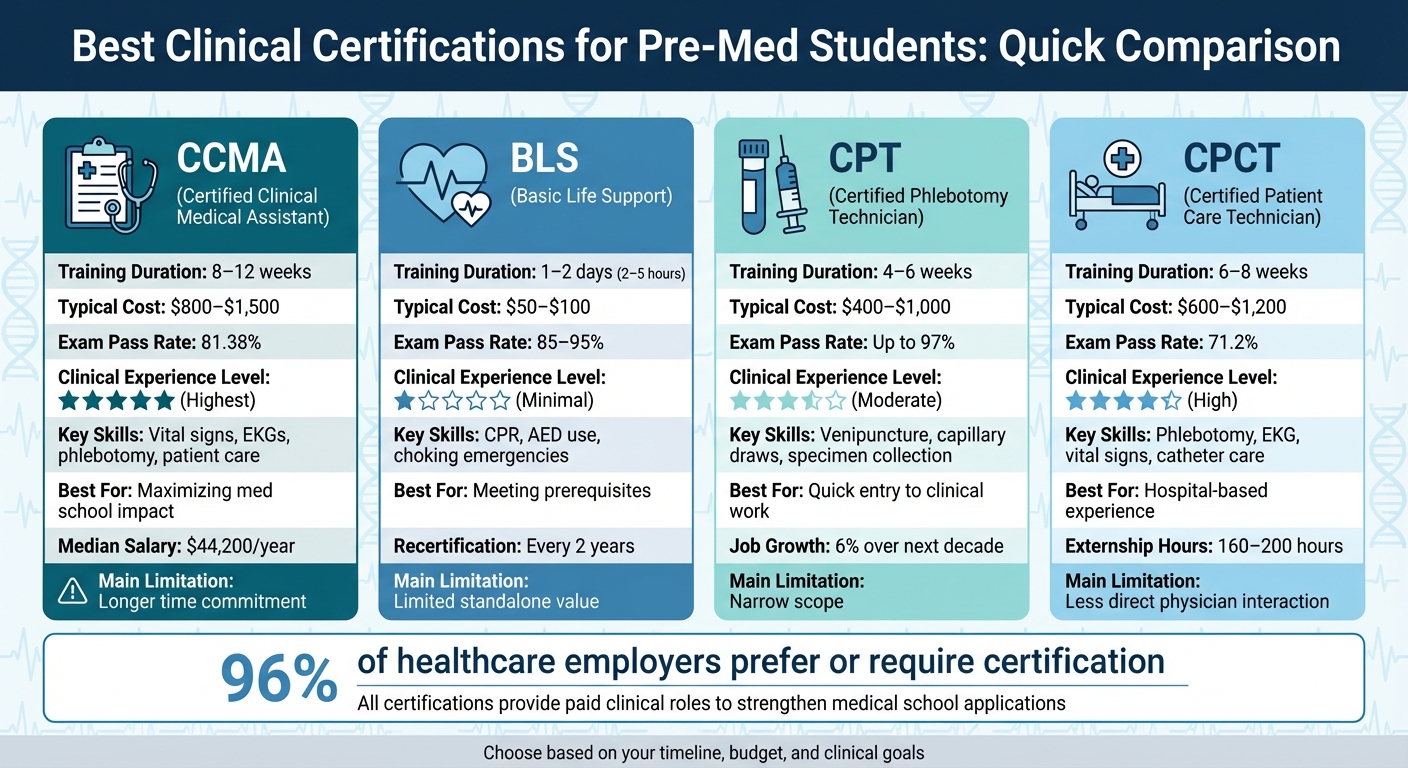
Clinical Certifications for Pre-Med Students: Cost, Duration, and Benefits Comparison
EMT vs CCMA vs CNA | Which is right for you? (Pre-Med TIPS)
sbb-itb-7a67ffa
1. Certified Clinical Medical Assistant (CCMA)
The Certified Clinical Medical Assistant (CCMA) certification, offered by the National Healthcareer Association (NHA), equips pre-med students with essential skills like measuring vital signs, performing phlebotomy, administering EKGs, and providing patient care. This certification opens doors to paid clinical roles, emphasizing hands-on patient interaction. Below, we’ll break down the prerequisites, costs, time commitment, and why it’s a great fit for pre-med students.
Prerequisites
To take the CCMA exam, you’ll need a high school diploma or GED. Additionally, you must either complete a medical assistant training program within the past five years or have at least one year of supervised medical assisting experience within the last three years. For pre-med students, accelerated online programs are a popular choice since they allow for quicker completion of required clinical hours.
Cost and Accessibility
The NHA charges $155–$165 for the certification exam. Training program costs vary widely, from around $900 for online courses to over $15,000 at community colleges. While the upfront investment may seem steep, it can quickly pay off. As Ally White, a CCMA alumna, shares:
"While the upfront cost is a lot, I was able to make it back in just one month of being an MA. I now have a full-time job that I love, and I will receive many letters of recommendation from doctors I work with for medical school".
With a median annual salary of $44,200, working as a CCMA can help pre-med students save for medical school. Keep in mind that recertification is required every two years, costing about $165 and requiring 10 continuing education credits.
Time to Completion
The time needed to complete the CCMA certification depends on the type of program you choose. Accelerated programs can take as little as 8–12 weeks, while traditional programs may last 6–18 months. The certification exam itself includes 150 multiple-choice questions, takes three hours to complete, and requires a scaled score of at least 390 out of 500 (approximately 78%) to pass. In 2024, the pass rate was 81.38%. This flexibility makes it an appealing option for pre-med students juggling busy schedules.
Relevance for Pre-Med Students
The CCMA certification is a standout choice for pre-med students because it offers direct patient interaction and hands-on clinical experience – both of which are highly valued by medical schools. Beyond the technical skills you’ll gain, this role provides opportunities to build meaningful professional relationships, which can lead to strong letters of recommendation and compelling personal statements. According to the 2025 Industry Outlook, 96% of employers prefer or require certification for medical assistants, and the field is expected to grow by 12.5% through 2034. This growing demand makes the CCMA a smart investment for pre-med students looking to enhance their resumes while earning practical experience.
2. Basic Life Support (BLS)
Basic Life Support (BLS) certification equips individuals with essential skills like performing CPR for adults, children, and infants, using an Automated External Defibrillator (AED), and managing choking emergencies. Offered by organizations like the American Heart Association (AHA) and the American Red Cross, this certification is a must-have for nearly all clinical roles and medical school rotations. While it doesn’t involve direct patient care like a CCMA certification, it’s critical for opening doors to clinical opportunities and preparing for emergency scenarios.
Prerequisites
BLS certification doesn’t require any prior medical knowledge or experience, making it widely accessible. It’s designed for healthcare professionals and students alike, ensuring anyone interested in healthcare can enroll.
Cost and Accessibility
BLS certification typically ranges from $60 to $100 for first-time certification, while recertification costs are slightly lower, around $50 to $80 every two years. Some hospital volunteer programs or internships might cover these expenses during onboarding, so it’s worth checking with your organization before paying out of pocket.
Training options are flexible and widely available. You can choose between:
- Traditional classroom training (about 4.5 hours)
- Blended learning, which combines 1–2 hours of online coursework with a 2–3 hour in-person skills session
- Fully online courses, though these may not always meet clinical requirements
The pass rate for BLS certification is high, typically between 85% and 95%, and the certification remains valid for two years.
Time to Completion
Depending on the format, completing BLS certification usually takes between 2 and 5 hours. Traditional courses last about 4.5 hours, but blended learning or recertification options can reduce in-person time to as little as 1–2 hours. This flexibility makes it easy to fit into a busy pre-med schedule.
Relevance for Pre-Med Students
For pre-med students, BLS certification is often a basic requirement for gaining hands-on clinical experience. Many emergency departments, outpatient clinics, and volunteer programs won’t accept applicants without it. As Sohini M., a writer for ACLSNow.com, explains:
"BLS certification is generally not required for medical school applications in the United States. Nevertheless, once accepted, most medical schools insist that students acquire and retain American Heart Association (AHA) BLS for Healthcare Providers certification prior to participation in patient care activities."
Getting certified early not only makes you eligible for more active roles but also transitions you from observational volunteering to more involved clinical tasks. Studies have shown that formal life-support training can significantly improve patient survival rates in cardiac arrest cases, increasing survival from 28% to 53%. When adding BLS certification to your AMCAS or AACOMAS application, include your certification number and expiration date, as schools will verify this information before clinical rotations. This foundational skill set is an excellent stepping stone for more advanced certifications that further expand your clinical exposure.
3. Certified Phlebotomy Technician (CPT)
The Certified Phlebotomy Technician (CPT) certification equips you with the skills to collect blood samples through venipuncture and capillary draws, preparing you for direct patient care in hospitals, diagnostic labs, and blood donation centers. This certification is particularly helpful for pre-med students since it combines technical training with hands-on clinical experience – offering much more than observational volunteer work.
Prerequisites
To qualify, you’ll need a high school diploma (or GED), completion of an accredited phlebotomy program within the last five years, proof of 30 venipunctures and 10 finger sticks on live subjects, and you must be at least 18 years old.
Cost and Accessibility
Costs for phlebotomy programs vary widely. Accelerated courses range from $500–$1,500, while community college programs typically cost $2,000–$4,000. The national certification exam costs $125 for NHA members and $225 for non-members, with renewal fees of about $185 every two years.
Many programs offer flexible online learning options, making it easier to fit into a packed pre-med schedule. Additionally, interest-free payment plans or grants might be available to help with costs. Be aware of state-specific requirements – California, Louisiana, Nevada, and Washington, for example, have additional licensure rules beyond national certification.
"I gained so much from this course that prepared me for PA school. From valuable clinical training to expert advice regarding my PA school applications."
Nisera McDaniels, a PA student, shared her positive experience with phlebotomy training.
Time to Completion
Accelerated programs can be completed in 1–3 months, while standard programs take 3–4 months. Self-paced online courses offer the most flexibility, with timelines ranging from 8 weeks to 12 months. The NHA CPT exam includes 100 multiple-choice questions to be completed in 2 hours, and some programs, like Advanced eClinical Training, report pass rates as high as 97%.
Relevance for Pre-Med Students
Phlebotomy certification is a standout addition to any pre-med application, providing clinical hours and real-world patient care experience that medical schools prioritize. According to industry data, 96% of employers either require or prefer certification for phlebotomy technicians. The Bureau of Labor Statistics projects a 6% job growth in this field over the next decade, with median salaries in California around $55,460. Beyond boosting your resume, this certification sharpens essential patient communication skills.
As pre-med student Darius Ross put it:
"With this certification, you can land a healthcare job practically in any specialty you want. Seriously best investment I’ve made for my future!"
Up next, we’ll dive into the Certified Patient Care Technician certification, which builds on your clinical expertise.
4. Certified Patient Care Technician (CPCT)
The CPCT certification combines skills in phlebotomy, EKG, and patient care into one credential, making it a comprehensive option for those seeking clinical experience. CPCTs perform tasks such as drawing blood, monitoring vital signs, and assisting with catheter care. This certification is particularly suited for gaining extensive clinical hours in various hospital settings.
Prerequisites
To qualify, you’ll need a high school diploma or GED and must be at least 18 years old. To take the National Healthcareer Association (NHA) exam, you’ll need to meet one of two criteria: complete an accredited training program within the last five years along with one year of supervised work experience, or have two years of supervised work experience in the past five years. Most programs also require you to be physically fit and up to date on immunizations. Many accelerated, fully online programs allow you to fulfill these requirements on a flexible schedule, accommodating the demands of pre-med coursework.
Cost and Accessibility
The cost of CPCT programs varies widely, from $550 to $4,500, depending on what’s included. For example:
- Budget-friendly options like Phlebotomy Career Training start at $550–$700.
- U.S. Career Institute charges between $979 and $1,279.
- More comprehensive programs, such as Advanced eClinical Training’s pre-med mentorship package, range from $3,300 to $4,500. These often include extras like the national exam fee (typically $115–$165), BLS certification, and venipuncture practice kits for home use.
Many providers offer 0% interest payment plans over two to four months, making the programs more accessible. Most are self-paced and available online, making it easier to fit certification into a busy schedule.
Time to Completion
Accelerated programs can be completed in as little as 8 weeks, while others allow up to 12 months. The NHA CPCT exam includes 100 multiple-choice questions, with a 2-hour time limit. A passing score requires at least 390 on a scale of 200–500, and the overall pass rate is about 71.2%. Some programs, like Advanced eClinical Training, boast pass rates as high as 97%.
Relevance for Pre-Med Students
The CPCT certification is a strong addition to a pre-med student’s resume. Like CCMA and CPT certifications, it provides hands-on clinical experience that enhances medical school applications. This certification goes beyond volunteer roles, offering paid opportunities with greater responsibility. You’ll gain practical skills in areas like EKG and phlebotomy, which are directly applicable to medical school rotations.
Many programs include guaranteed externship placements, typically ranging from 160 to 200 hours, ensuring you meet the patient-facing hour requirements for medical school applications. Some even offer pre-med mentorship, including personal statement reviews, mock interviews, and recommendation letters from MD or PA mentors. Madison King, a patient care technician, shared her experience:
"This course was amazing. I was able to get it done on my own time, and pre-med prerequisites complemented my pre-med requirements."
With 96% of healthcare employers preferring or requiring certification for patient care technicians, this credential not only boosts your medical school application but also provides a stable income while you pursue your goals.
Pros and Cons
Let’s break down the key strengths and limitations of each certification to help you figure out which one fits your pre-med goals.
CCMA offers the most extensive clinical experience, including direct mentorship from physicians. This makes it a strong choice for boosting your medical school application. However, it does require a bigger time and financial commitment. According to the Clinical Skills Institute, "Medical Assistant = highest quality + highest quantity + fastest to obtain". With CCMA certification, you could rack up anywhere from 1,000 to 3,000 clinical hours in just one gap year.
BLS, on the other hand, is an easy-to-access foundational skill and often a prerequisite for other certifications. However, it doesn’t provide much standalone clinical experience. Most CCMA and CPCT programs already include BLS training, so you won’t usually need to take it separately. Meanwhile, CPT focuses on technical skills like venipuncture and specimen collection, making it a quicker route to clinical work. The downside? It’s specialized, so you won’t gain much exposure to broader clinical decision-making.
CPCT emphasizes bedside care in hospital settings, which helps you build strong patient interaction skills. However, these roles tend to involve more collaboration with nursing staff rather than physicians, which could limit opportunities for direct mentorship compared to CCMA positions.
| Certification | Training Duration | Typical Cost | Clinical Experience | Best For | Main Limitation |
|---|---|---|---|---|---|
| CCMA | 8–12 weeks | $800–$1,500 | Highest; broad clinical tasks with direct physician mentorship | Maximizing med school impact | Longer time commitment |
| BLS | 1–2 days | $50–$100 | Minimal; focused on emergency response | Meeting prerequisites | Limited standalone value |
| CPT | 4–6 weeks | $400–$1,000 | Moderate; specialized technical skill (venipuncture) | Quick entry to clinical work | Narrow scope |
| CPCT | 6–8 weeks | $600–$1,200 | High; bedside care emphasizing patient mobility and catheter care | Hospital-based experience | Less direct physician interaction |
Conclusion
Choose a certification that aligns with your clinical aspirations. If you’re looking for broad exposure to both clinical and administrative tasks while working directly under a physician’s guidance, the CCMA offers an excellent balance. It provides the most clinical hours in the shortest time, making it a top choice for medical school applicants. On the other hand, the CPCT focuses on bedside care in hospital environments, where you’ll collaborate closely with nursing staff. Lastly, the CPT is ideal for those seeking a quicker route into healthcare through specialized venipuncture training, often with flexible part-time opportunities.
Timing matters. If you’re a junior, senior, or taking a gap year, consider pursuing formal certification to transition into paid clinical roles rather than relying solely on volunteering or shadowing. Dr. Jessica Freedman from MedEdits emphasizes, "Deep involvement in fewer roles often proves more valuable than superficial participation in many activities". Medical schools increasingly favor applicants who have taken on hands-on healthcare responsibilities over those with primarily observational experience.
Once you’ve identified the best certification for your goals, take actionable steps to enter the clinical field. Enroll in a nationally recognized program – preferably one accredited by the National Healthcareer Association (NHA) or a similar body. Prioritize programs that guarantee externship placements, as these practical hours are highly valued by medical schools. This approach not only strengthens your application but also equips you with essential hands-on experience. For example, HealthCareer Certs offers flexible, online programs for CCMA, CPT, and CPCT certifications, which can be completed in just 4–12 weeks. These programs include guaranteed externships, ensuring you gain the clinical exposure admissions committees expect.
Keep track of your clinical hours, key skills, and patient interactions to enhance your personal statement. Remember, 85% of healthcare employers prefer candidates with nationally recognized certifications, which can open doors to paid clinical roles and further solidify your medical school application.
As CCMA alumna Ally White shared:
"While the upfront cost is a lot, I was able to make it back in just one month of being an MA. I now have a full-time job that I love".
This certification not only strengthens your application but also lays a strong foundation for success in medical school and your future career.
FAQs
Which certification is best for med school applications?
The Certified Clinical Medical Assistant (CCMA) certification is a strong asset for med school applications. It provides valuable hands-on clinical experience and highlights your ability to deliver patient care effectively. By earning this certification, you demonstrate practical skills and a commitment to healthcare – qualities that medical schools highly appreciate. This makes it a smart option for pre-med students looking to stand out.
Do I need BLS before CCMA, CPT, or CPCT?
No, obtaining a BLS certification isn’t usually a prerequisite for certifications like CCMA, CPT, or CPCT. That said, most medical schools and clinical programs do mandate BLS certification before permitting involvement in patient care. It’s an important credential that equips you to handle basic life-saving situations in clinical environments.
How do I find a program with guaranteed externship hours?
When exploring certification programs, prioritize those that clearly state they include guaranteed externship hours as part of their curriculum. This feature is often highlighted to offer students valuable hands-on clinical experience. Before enrolling, double-check that the program details specify the externship hours and ensure they fit your goals and availability. For example, programs like the Certified Clinical Medical Assistant (CCMA) typically incorporate externships to help students gain practical experience in real clinical environments.