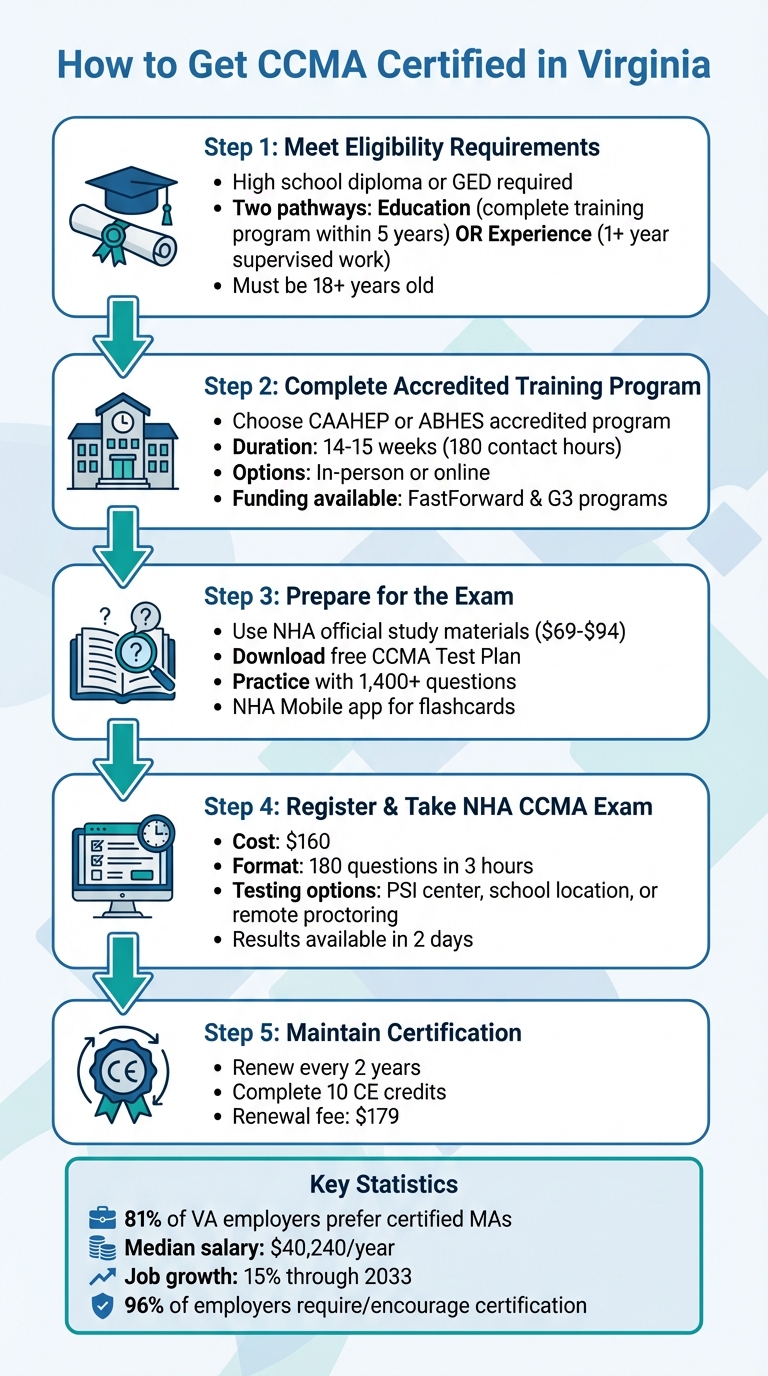
To become a Certified Clinical Medical Assistant (CCMA) in Virginia, follow these steps:
- Meet Eligibility Requirements: You need a high school diploma or GED. You can qualify via two pathways: completing a medical assistant training program or having relevant work experience.
- Choose a Training Program: Look for programs accredited by CAAHEP or ABHES. These can be in-person or online and typically last 14–15 weeks.
- Register for the NHA CCMA Exam: The exam costs $160 and includes 180 questions to be completed in 3 hours. You can take it at a testing center or remotely.
- Prepare for the Exam: Use official study materials, practice tests, and resources like the NHA Mobile app to study effectively.
- Maintain Your Certification: Renew every two years by completing 10 continuing education credits and paying a $179 fee.
In Virginia, certification isn’t legally required but is preferred by 81% of employers and can lead to better job opportunities and higher pay. Medical assistants in the state earn a median salary of $40,240 annually, with projected job growth of 15% through 2033. Funding options like FastForward and G3 can help reduce training costs significantly.
Earning a CCMA certification can set you apart in Virginia’s growing healthcare market.
5 Steps to Get CCMA Certified in Virginia
Eligibility Requirements for CCMA Certification
Basic Prerequisites
To earn your CCMA certification, you’ll need at least a high school diploma or GED. High school seniors can take the exam early and receive provisional certification up to 12 months before graduation. This provisional status remains valid until you complete your diploma.
In Virginia, most training programs require students to be at least 18 years old by the time classes begin.
You can qualify for the NHA CCMA exam through one of two pathways. The education pathway involves completing a medical assistant training program within the last five years. Alternatively, the experience pathway requires at least one year of supervised work experience in the past three years (or two years within the last five years). If you’re new to healthcare, the education pathway through an accredited program is often the most practical starting point.
Once you’ve met these prerequisites, you can decide which pathway – education or experience – best suits your background.
Virginia-Specific Requirements
While Virginia doesn’t legally require certification for medical assistants, many employers prefer or insist on it. In fact, 89% of healthcare organizations in the state either encourage or require certification.
Some Virginia community colleges have additional requirements for admission. For example, you might need to complete an English self-assessment or a computer literacy test before enrolling. If English isn’t your first language, a CASAS assessment with a qualifying score may be necessary. Additionally, if you earned your high school diploma outside the U.S., you’ll likely need a formal evaluation and translation by an approved agency, a process that can take at least three weeks.
Certain specialized programs, like the one at Virginia Highlands Community College, have even more specific requirements. For instance, students must have at least one year of healthcare experience and an employer-provided preceptor to participate.
These tailored requirements ensure you’re well-prepared to meet both state and employer expectations.
sbb-itb-7a67ffa
Step 1: Complete an Accredited Training Program
How to Choose a Training Program
To qualify for the CCMA exam, your training program must align with the National Healthcareer Association (NHA) standards. Look for programs accredited by the Commission on Accreditation of Allied Health Education Programs (CAAHEP) or the Accrediting Bureau of Health Education Schools (ABHES). These accreditations ensure the curriculum meets employer-recognized standards.
In Virginia, most programs last about 14 to 15 weeks and include roughly 180 contact hours. You can choose between in-person or fully online classes, but make sure the program is specifically designed to prepare you for the NHA CCMA exam. The right program will provide study materials and practice tests to help you succeed.
To confirm the legitimacy of your program, use the NHA’s online portal. Create a candidate account and check if your school is listed as a pre-approved partner. Also, ensure your tuition includes essentials like the NHA exam voucher (valued at $160), textbooks, and clinical kits such as stethoscopes and blood pressure cuffs.
If you’re a Virginia resident, look into state funding options like FastForward or G3. These programs can significantly cut down the cost of your training.
When assessing program quality, make sure hands-on clinical experience is part of the curriculum. This is crucial since 96% of employers prefer or require certification. Some programs will help you secure externship placements, while others may require you to find a preceptor on your own. For added convenience, consider online programs that still offer comprehensive training and clinical support.
Online Programs Like HealthCareer Certs
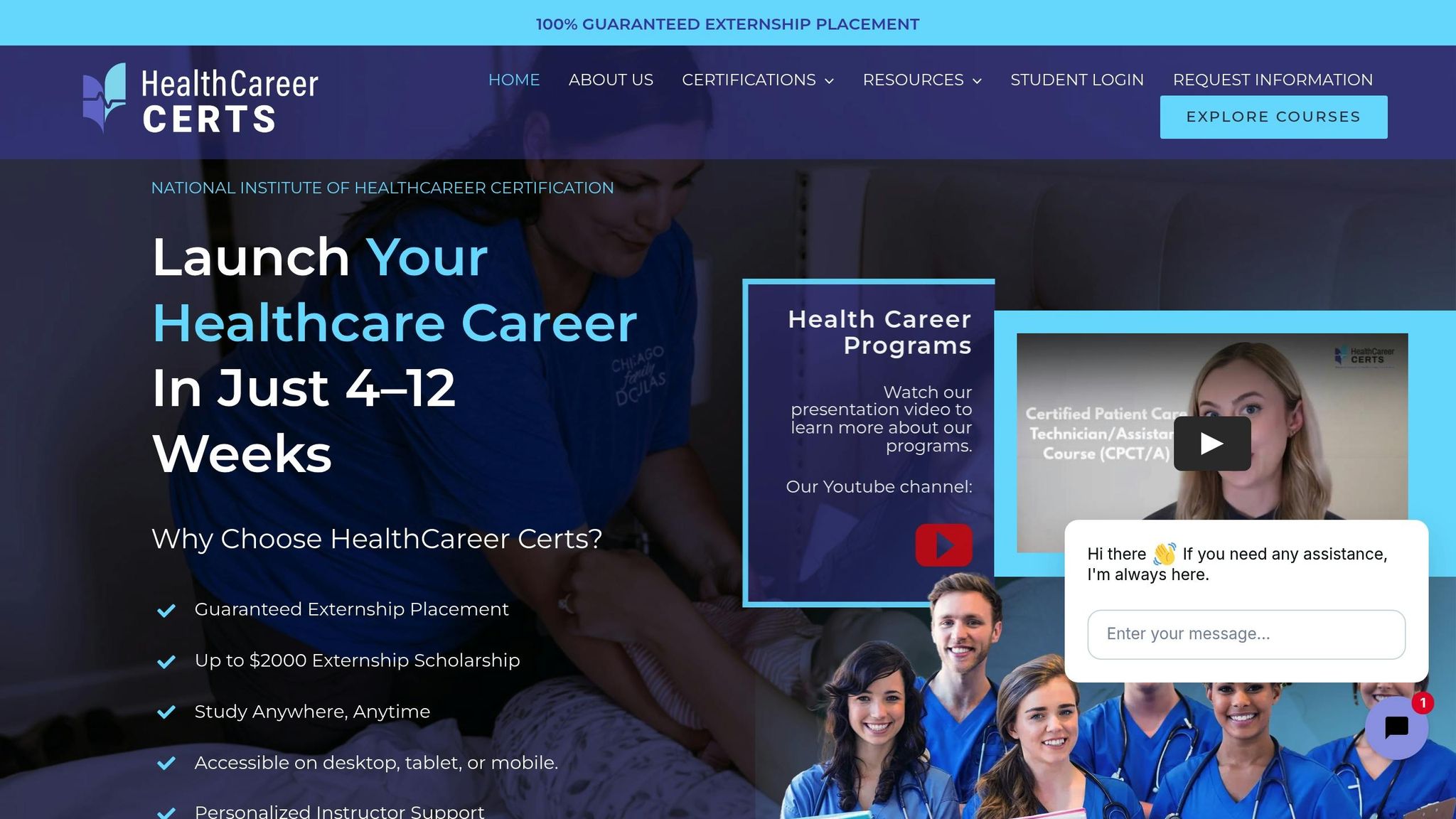
Online CCMA programs are a great option if you need flexibility to fit your education around other commitments. HealthCareer Certs, for instance, offers a self-paced, 100% online program featuring personal Zoom sessions, interactive 3D demos, and over 1,400 practice questions.
These online programs often combine virtual coursework with in-person clinical externships at local clinics in Virginia. HealthCareer Certs simplifies the process by guaranteeing externship placement and even provides scholarships of up to $2,000 for eligible students. Depending on your schedule, you can complete the program in as little as 4 to 12 weeks.
Many online programs also send clinical kits directly to your home. These kits typically include tools like venipuncture trainer arms, stethoscopes, and blood pressure cuffs, allowing you to practice hands-on skills during virtual labs. With mobile-friendly platforms, you can conveniently study from your phone, tablet, or computer.
Step 2: Prepare for the NHA CCMA Exam
Study Materials and Practice Tests
The National Healthcareer Association (NHA) provides official study materials tailored for the CCMA exam. Their interactive online study guide includes practice drills, audio narration, and video lessons, all aligned with the NHA test plan. You can purchase the study guide for about $69 or opt for the bundle with practice tests for $94.
To kick off your preparation, download the free CCMA Test Plan. This document breaks down the content domains covered in the exam and serves as a roadmap for your study sessions. Start by taking a baseline practice test to identify your strengths and weaknesses. The NHA’s official practice tests can be taken up to five times, and after each attempt, you’ll receive a Focused Review® report that pinpoints areas needing improvement.
For added flexibility, the NHA Mobile app offers flashcards that align with the curriculum while tracking your progress. Additionally, HealthCareer Certs provides access to over 1,400 practice questions and 700 self-checks as part of its program. The updated CCMA 3.0 materials now include EHR simulations, such as patient registration, scheduling, and medication reconciliation, reflecting the digital skills increasingly used in Virginia healthcare facilities. To stay organized, use the NHA Exam Readiness Checklist, which provides a structured timeline for preparation – covering key milestones at 45 days, 30 days, two weeks, and one week before the exam.
Once you’ve worked through your study materials and practice tests, shift your attention to preparing for exam day itself.
Exam Day Tips
After completing your preparation, focus on ensuring a smooth exam day experience. The CCMA exam consists of 180 questions to be completed within 3 hours. About a week before the test, schedule a full-length practice exam to build the stamina needed for the actual test.
If you’re testing at a PSI center or a school location in Virginia, arrive early and bring a valid, government-issued photo ID that matches the name on your NHA account registration. For those taking the exam via live remote proctoring from home, check your computer setup and internet connection the day before, and review NHA’s "What to Expect on Test Day" guide to familiarize yourself with the check-in process and rules.
During the exam, take your time to carefully read each question, especially during clinical scenarios. If you’re unsure about a question, flag it and return to it later if time allows. The test covers seven domains, with Clinical Patient Care making up the largest section at 84 questions. Stay calm and trust the preparation you’ve done – your official results will typically be available in your NHA account within two days of completing an online exam.
Step 3: Register and Take the NHA CCMA Exam
How to Register for the Exam
Once you’re ready to take the next step, head over to NHANOW.com to set up your candidate account. The process is simple: click on "Apply for Exam", select the CCMA certification, and complete the online application.
If your school or employer is covering the exam fee, make sure to select the correct organization in your profile and enter the Access Key provided to you. This ensures that any applicable discounts are applied and your results are shared with your institution. After completing the payment, don’t forget to print your receipt from the Review & Checkout page. During registration, you’ll also choose your testing method – whether it’s at your school or training center, a PSI testing center in Virginia, or through live remote proctoring from home.
Once you’ve registered, it’s time to get familiar with what happens on exam day.
What to Expect During the Exam
The CCMA exam now follows the updated 3.0 test plan, which became standard on January 10, 2024. This exam evaluates both clinical and administrative skills, covering areas like:
- Taking patient vital signs
- Assisting with exams and procedures
- Administering injections or medications
- Performing EKG and phlebotomy
- Managing patient check-in and check-out
- Maintaining Electronic Health Records (EHR)
It also assesses professionalism and critical thinking. According to a 2025 report, 96% of employers either require or encourage certification for medical assistants.
If you choose live remote proctoring, you’ll use either Prometric‘s ProProctor™ or PSI’s remote platform. Before scheduling, make sure your computer has a working camera, microphone, and a reliable internet connection. Keep in mind that Chromebooks are not compatible with ProProctor™. For those opting for in-person exams, Prometric and PSI offer testing centers throughout Virginia where NHA exams are conducted.
You can expect to see your official results in your NHA account within two days. If you don’t pass the first time, don’t worry – you’ll need to wait 30 days before retaking the exam. To boost your chances of success, use study materials that align with the CCMA 3.0 test plan, as this version emphasizes updated healthcare skills, especially EHR simulations.
Maintaining Your CCMA Certification in Virginia
Renewal Requirements
Keeping your CCMA certification up to date is essential for staying competitive in Virginia’s healthcare job market. To maintain your certification, you’ll need to renew it every two years. The National Healthcareer Association (NHA) requires you to complete 10 continuing education (CE) credits within each two-year cycle. Along with these credits, you’ll need to submit the required renewal fee.
You can begin the renewal process as early as three months before your certification expires. Simply log into your NHA account and complete the online recertification application, or submit the PDF form if you prefer. If your certification lapses, you still have up to 12 months to renew, but additional fees will apply.
While Virginia doesn’t have state-specific renewal rules, most employers expect adherence to national standards. Keeping your certification current not only aligns with these expectations but also enhances your appeal as a healthcare professional in Virginia.
Continuing Education Resources
Earning CE credits is more convenient than ever, thanks to flexible online options. Platforms like HealthCareer Certs offer modules that meet NHA standards, allowing you to complete your requirements without interrupting your schedule.
For more advanced training, check out programs at Virginia community colleges. These resources can build on your clinical foundation and help you stay informed about the latest healthcare practices. Additionally, the Virginia Board of Medicine’s "Practitioner Resources" portal is a valuable tool for accessing updated guidelines. Keep tabs on the Virginia Department of Health Professions (DHP) website as well, since competency requirements may change over time. Use your NHA certification portal to monitor deadlines and upload your CE credits before your renewal date.
CCMA Certification – Everything You Need To Know
Conclusion
Earning your CCMA certification in Virginia opens the door to one of the fastest-growing careers in healthcare. Completing an accredited training program is your first step – this can take as little as 14 to 15 weeks at Virginia community colleges or 4 to 5 months with online options like HealthCareer Certs. After that, passing the NHA CCMA exam puts you ahead in Virginia’s competitive job market, where 81% of healthcare organizations prefer hiring certified medical assistants.
This credential not only demonstrates your skills but also aligns with a thriving job market. Employment for medical assistants is expected to grow by 15% from 2023 to 2033, well above the national average for other occupations. In Central Virginia, the outlook is even brighter, with a projected 16% growth through 2030. On top of this, the median salary for medical assistants in Virginia is approximately $40,240 per year.
Virginia residents also benefit from funding programs that make certification more affordable – or even free. Programs like G3 and FastForward significantly reduce tuition costs. For example, Virginia Western Community College’s program costs just $1,089 with FastForward funding or $0 for students eligible for G3 funding. Corey McCray, Vice President for Workforce Solutions at Tidewater Community College, highlights the impact of these programs:
What’s wonderful about this program is students can attain these credentials at a fraction of the cost they would normally pay.
These funding options ease the financial burden, allowing you to focus on completing your training, passing the exam, and maintaining your certification through continuing education. Whether you choose an online program or a local community college, now is the time to take advantage of these opportunities and start your journey toward CCMA certification.
FAQs
Which pathway should I use to qualify for the CCMA exam in Virginia?
In Virginia, there are two primary ways to qualify for the CCMA exam:
- Employment-Based: Gain at least one year of work experience with a healthcare organization, where your clinical practice is supervised by your employer.
- Educational: Finish an accredited medical assistant training program designed to prepare you for the CCMA exam through the National Healthcareer Association (NHA).
Pick the option that best fits your background and career aspirations.
Do Virginia employers require CCMA certification to get hired?
While employers in Virginia don’t specifically mandate CCMA certification, having it can open doors to better job prospects. It showcases your expertise in both clinical and administrative tasks, helping you stand out as a stronger candidate in the healthcare industry.
What happens if my CCMA certification expires before I renew?
If your CCMA certification expires, it becomes inactive. Some programs may offer a grace period – typically around a year – during which you can renew by submitting the necessary credits and paying the renewal fee. However, if you let this grace period pass, your certification will no longer be valid. At that point, you’ll need to start the process from scratch, reapplying and meeting all the current requirements to regain certification.