Becoming a certified medical assistant in Virginia is a smart move if you want better job opportunities and higher pay. While the state doesn’t mandate certification, most employers either require or prefer it. Here’s what you need to know:
- Job Growth: Medical assistant jobs in Virginia are projected to grow by 21% from 2020 to 2030, with about 2,150 openings annually.
- Salary: Certified medical assistants earn an average of $37,500 in Virginia, with top earners making over $54,000.
- Certification Options: Popular certifications include CMA (Certified Medical Assistant), CCMA (Certified Clinical Medical Assistant), and RMA (Registered Medical Assistant). Each has specific requirements, costs, and renewal cycles.
- Training Programs: Choose from online or in-person programs. Costs range from $665 at community colleges to $7,500+ at private institutions. Financial aid options are available.
- Exam Prep: Both CMA and CCMA exams test clinical, administrative, and general knowledge. Practice exams and hands-on training can improve your chances of passing.
Certification boosts your career by improving job prospects, increasing pay, and offering job security in a growing healthcare field. Ready to start? Look for accredited training programs and prepare for your certification exam today.
sbb-itb-7a67ffa
Virginia’s Medical Assistant Certification Requirements
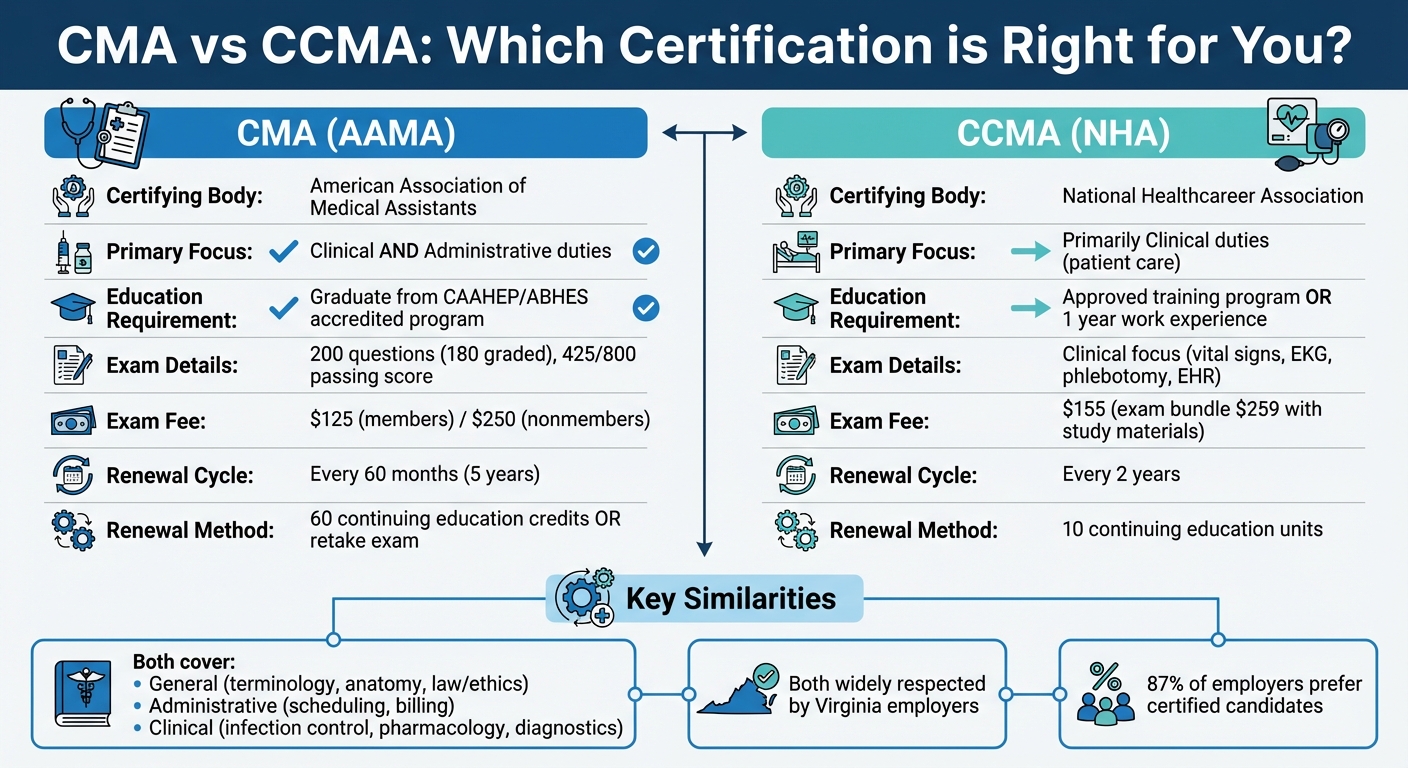
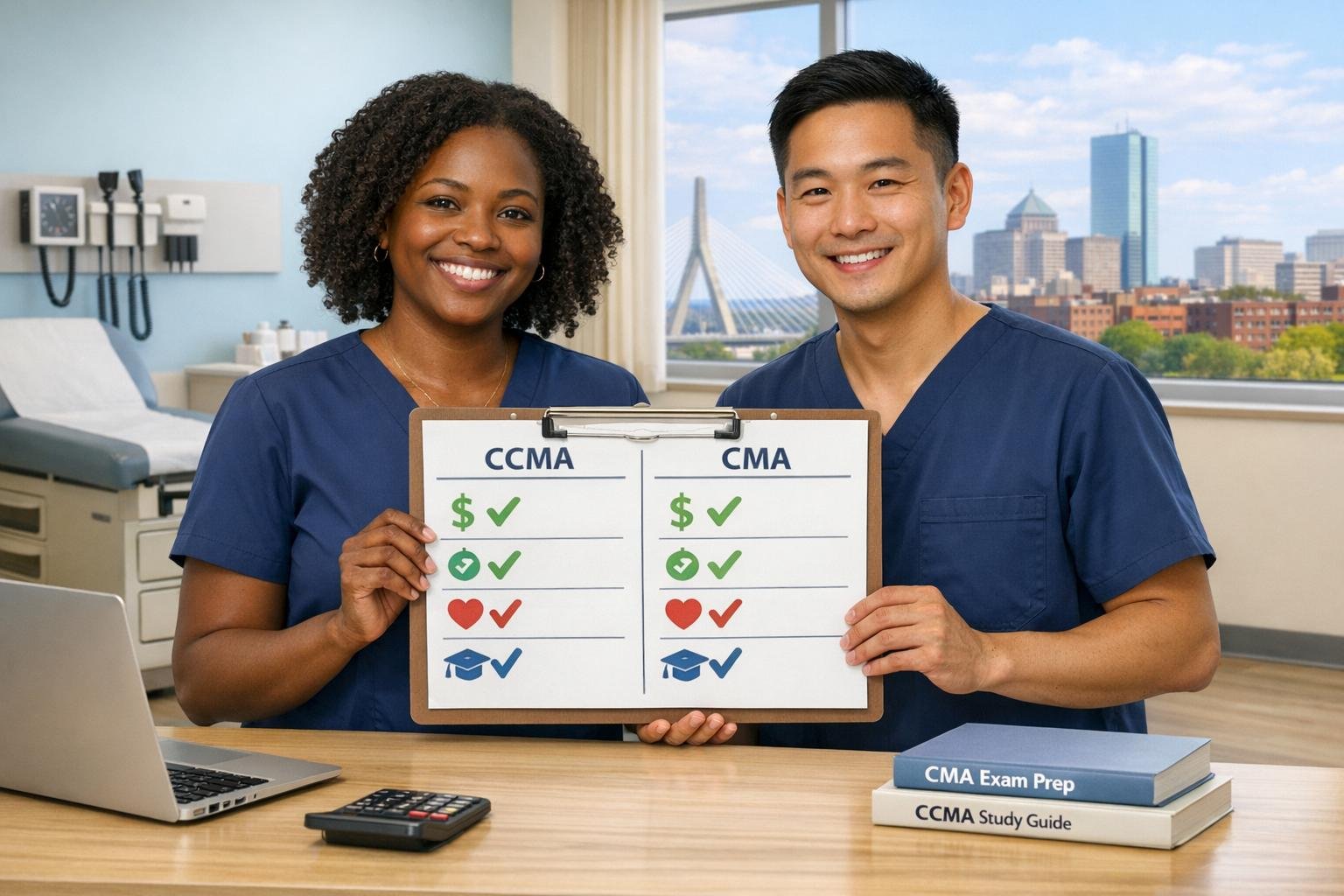
CMA vs CCMA Certification Comparison for Virginia Medical Assistants
In Virginia, medical assistants aren’t required to have licensure, registration, or certification to work. However, having a certification can greatly improve your job prospects. As A2A explains:
"Medical assistants in Virginia are not required to possess a certification, registration or medical assisting license to work as a medical assistant."
There’s no state-level regulation for medical assistants, so hiring standards are left to individual employers. That said, certification is highly regarded – nearly 87% of employers prefer candidates with certification, which means skipping it could limit your opportunities.
Certifications like the Certified Medical Assistant (CMA), Registered Medical Assistant (RMA), and Certified Clinical Medical Assistant (CCMA) demonstrate that you meet national competency standards. In Virginia, the Virginia Society of Medical Assistants – a branch of the American Association of Medical Assistants (AAMA) – supports professionals aiming to earn these credentials.
CCMA and CMA Certifications Explained
Two of the most common certifications in Virginia are the CMA (Certified Medical Assistant) and CCMA (Certified Clinical Medical Assistant). Each caters to different aspects of medical assisting.
The CMA, offered by the AAMA, is one of the most recognized certifications in the field. It covers both clinical and administrative responsibilities, making it versatile. The exam includes 200 multiple-choice questions (180 of which are graded), and you’ll need a score of at least 425 out of 800 to pass. Exam fees are $125 for AAMA members and $250 for nonmembers, and recertification is required every 60 months. You can renew by earning 60 continuing education credits or retaking the exam.
The CCMA, provided by the National Healthcareer Association (NHA), focuses more on clinical tasks – like drawing blood, recording vital signs, and assisting with procedures. It’s a great choice if you’re drawn to direct patient care rather than administrative work. The exam costs $155, and certification must be renewed every two years by completing 10 continuing education units.
| Feature | CMA (AAMA) | CCMA (NHA) |
|---|---|---|
| Certifying Body | American Association of Medical Assistants | National Healthcareer Association |
| Primary Focus | Clinical and administrative duties | Primarily clinical duties |
| Education Requirement | Graduate from a CAAHEP/ABHES accredited program | Approved training program or 1 year work experience |
| Exam Fee | $125 (members) / $250 (nonmembers) | $155 |
| Renewal Cycle | Every 60 months | Every 2 years |
Both certifications are widely respected, but employer preferences can vary depending on the role and workplace.
What You Need to Qualify for Certification
To pursue certification, you typically need to be at least 18 years old and have a high school diploma or GED. For the CMA, you must graduate from a program accredited by CAAHEP or ABHES. For the CCMA, you’ll need to complete an approved training program or have one year of relevant work experience.
For the CMA (AAMA), the accredited program must include coursework in areas like anatomy, pharmacology, ethics, laboratory techniques, and diagnostic procedures, along with hands-on clinical training. An externship in a healthcare setting is also required. Once you graduate, you’ll have 60 months to pass the certification exam.
Another option is the RMA (Registered Medical Assistant) certification through AMT. To qualify, you’ll need to graduate from an accredited program, complete military medical training, or have five years of work experience within the last seven years. The RMA exam has 210 questions, and you’ll need a score of 70% (147 correct answers) to pass. This certification must be renewed every three years.
Before starting clinical training, you’ll also need to complete a few prerequisites, including a Basic Life Support (BLS) certification, a criminal background check, tuberculosis screening, and a physical exam.
Selecting a Training Program in Virginia
Once you’ve met the certification requirements, the next step is choosing a SCHEV-certified training program to kickstart your career. Virginia offers a variety of options, including online and in-person programs, each tailored to different schedules and learning preferences.
It’s important to confirm that the program is SCHEV-certified and, if you’re aiming for the CMA credential, that it holds CAAHEP or ABHES accreditation. Program lengths vary widely: you can find accelerated certificate programs lasting 14–15 weeks, 12-month diploma programs, or more in-depth associate degree programs spanning 24 months. Tuition costs also range significantly – from as low as $665 at community colleges for Virginia residents to $7,500 or more at private institutions. If you’re eligible for financial aid programs like "Fast Forward", your expenses could drop to just 10% of the standard tuition rate.
When comparing programs, check whether tuition covers essentials like textbooks, exam fees, practice exams, and clinical equipment. Also, review the clinical training component. Entry-level programs typically include an externship as part of the curriculum, while work-based programs may require you to already be employed in healthcare and have an employer-provided preceptor. Choosing the right program involves balancing these factors with your personal needs and career goals.
HealthCareer Certs: Online CCMA Training
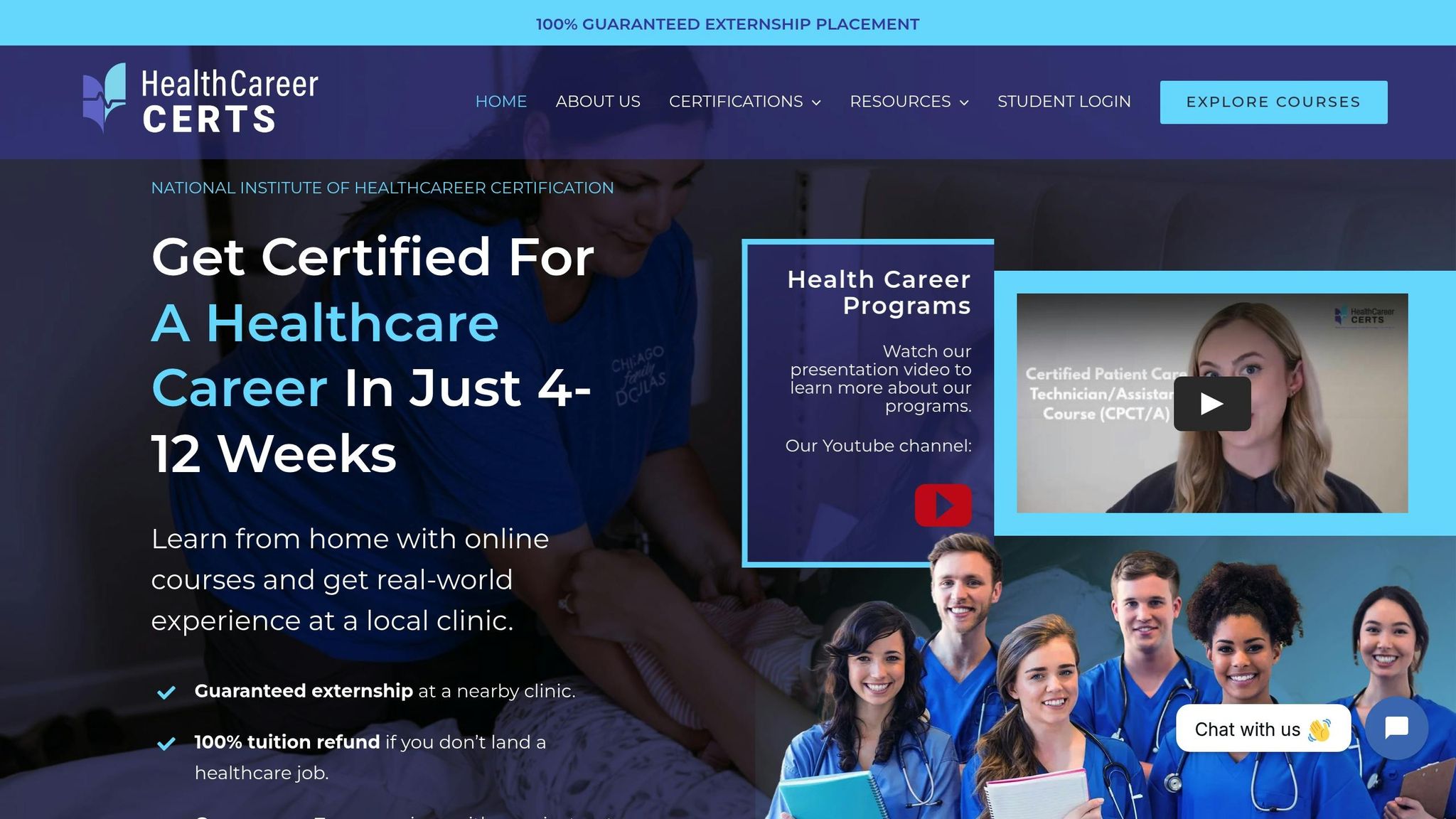
HealthCareer Certs offers a fully online CCMA program designed for maximum flexibility. This self-paced course is perfect for those juggling work or family commitments, allowing you to complete the program in 4 to 12 weeks, with an option to extend up to 6 months if needed.
The program features one-on-one Zoom sessions with instructors, interactive tools like 3D demonstrations and quizzes, and over 1,400 practice questions to help you prepare for the NHA certification exam. Additional resources include 700 self-checks and flashcards, all accessible on mobile devices, tablets, or computers, making it easy to study anywhere.
One of the program’s standout features is its 100% guaranteed externship placement. HealthCareer Certs arranges a clinical externship near your location, ensuring you gain practical, hands-on experience. They also offer a $2,000 scholarship to support your externship and a tuition refund guarantee if you don’t land a healthcare job after completing the program.
Online vs. In-Person Training: A Comparison
Both online and in-person programs prepare you for the CCMA exam, but they differ in structure, timeline, and flexibility. Here’s a quick comparison:
| Feature | Online (e.g., HealthCareer Certs) | In-Person Training |
|---|---|---|
| Duration | 4–12 weeks (accelerated) | 12 months (Diploma) to 24 months (Degree) |
| Flexibility | 100% online, self-paced | Fixed schedules (day/evening classes) |
| Clinical Training | Guaranteed local externship placement | On-campus labs with a final externship |
| Location | Accessible from anywhere in Virginia | Offered at specific campus locations |
| Cost Range | Varies; externship scholarships available | Typically higher tuition (e.g., $7,500+) |
Online programs are a great fit if flexibility is a priority or if you’re far from a campus. You’ll handle coursework at your own pace and complete a supervised externship arranged by the program. On the other hand, in-person programs provide immediate hands-on practice in campus labs, which can be especially helpful for mastering clinical skills like injections or vital sign measurements. Understanding these differences will help you choose a program that aligns with your lifestyle and career aspirations.
How to Prepare for and Pass Your Certification Exam
CCMA and CMA Exam Structure and Content
The CMA exam is a computer-based test that consists of 200 questions (180 of which are graded). It’s divided into four 40-minute segments and uses adaptive scoring. To pass, you’ll need to score at least 425 out of 800 within 60 months of completing your program. On the other hand, the CCMA exam from the NHA focuses on clinical tasks like taking vital signs, performing EKGs, drawing blood (phlebotomy), and managing electronic health records. The national average pass rate for this exam is 83%. The exam bundle, which includes the exam fee, a study guide, and practice tests, costs around $259.
Both exams are built around three main areas:
- General: Medical terminology, anatomy, and law/ethics.
- Administrative: Scheduling, insurance, and billing.
- Clinical: Infection control, pharmacology, and diagnostic testing.
Knowing the structure of your exam is the first step toward effective preparation. From here, you can use specific strategies to boost your chances of success.
Study Tips for Exam Success
Start your preparation with practice exams and a student kit to refine your clinical skills. Many programs in Virginia, such as those at Virginia Western Community College, include NHA online practice exams and study guides within their tuition costs. These practice exams closely simulate the actual test environment.
Hands-on practice is equally important. Use tools like a stethoscope and blood pressure cuff to improve your proficiency with clinical tasks like measuring vital signs. These practical exercises can make a big difference in your readiness.
For the CMA exam, focus on its adaptive format. Questions start off easier and get progressively harder as you answer correctly. If you’re preparing for the CCMA exam, consistent and structured study habits typically lead to better results and higher pass rates.
Registering and Taking Your Exam in Virginia
Once you’ve established a solid study routine, it’s time to register for your exam.
For the CCMA exam, start by creating a free account on the NHA website and submitting your application through their portal. During registration, you’ll select your exam date, testing location, and payment method. Virginia residents can choose from three testing options: taking the exam at your school, visiting a PSI testing center, or using live remote proctoring from home or work.
"For online CCMA exams, NHA will officially post your certification results to your account page within two days of scoring your test."
For the CMA exam, you’ll need to apply online through the AAMA website. The exam fee is $125 for AAMA members, students, or recent graduates of accredited programs, and $250 for non-members. If you graduated more than 12 months ago, make sure you have your official transcripts ready when applying. Before registering, use the AAMA eligibility survey or NHA eligibility check to confirm you meet all requirements.
Virginia residents have the flexibility to choose between remote proctoring and in-person testing at PSI centers. Remote proctoring is ideal if you have a stable internet connection, while testing centers offer a more controlled environment. Pick the option that aligns best with your preferences and setup. Passing your certification exam is a key milestone in advancing your healthcare career in Virginia.
Using Your Certification to Advance Your Career in Virginia
Where Medical Assistants Work in Virginia
In Virginia, many certified medical assistants find employment in physicians’ offices, though hospitals and outpatient centers also offer plenty of opportunities. Major healthcare systems in the state, such as UVA Health in Charlottesville, are key employers. UVA Health, for instance, runs a 612-bed hospital with a Level I trauma center, making it one of Virginia’s prominent hiring hubs.
To explore job openings, check the career portals of leading facilities like Inova Fairfax Hospital, Carilion Roanoke Memorial Hospital, and Sentara Norfolk General Hospital. Becoming a member of the Virginia Society of Medical Assistants (VSMA) can also be a smart move. Membership provides access to job postings, networking events, and continuing education opportunities. While certification isn’t legally required in Virginia, it’s worth noting that 81% of healthcare employers now require it – a significant jump of 30% since 2021.
Medical Assistant Salaries in Virginia
Certified medical assistants in Virginia earn an average annual salary of $46,198. Entry-level roles typically pay around $45,850, while those with over eight years of experience can see earnings rise to $47,604. The top 10% of earners in this field make $54,378 per year.
Where you work in Virginia can affect your pay. For example, Falls Church offers the highest average salary at $50,795, followed by Reston ($50,703) and Stafford ($50,566). Additionally, specializing in areas like Family Medicine ($21.24/hour) or Cardiology ($21.07/hour) can increase your earning potential. Soft skills matter too – improving your listening skills can boost your salary by 5%, and strong organizational skills can add 4%.
While competitive salaries are appealing, staying certified is just as important for long-term career growth.
Renewing Your Certification
Keeping your certification up to date is essential for job security and demonstrating your dedication to quality patient care. Renewal requirements vary: CCMA/NCMA certifications must be renewed every 24 months through continuing education or re-examination, CMA certifications every 60 months, and RMA certifications every three years.
Stay on top of your renewal dates to avoid any lapses. Make sure to complete all continuing education requirements and submit your renewal application before the expiration date to avoid late fees. You can check your renewal status anytime using the "License Lookup" tool on the Virginia Department of Health Professions website. After completing your online renewal, print and save the receipt page since it won’t be accessible later.
Conclusion
Becoming a certified medical assistant in Virginia is a clear and achievable path that can lead to a fulfilling career in healthcare. Start by earning your high school diploma or GED, then enroll in an accredited training program that includes a supervised externship to develop essential clinical skills. While certification isn’t legally required in Virginia, 96% of employers either require or prefer it, making credentials like the CCMA or CMA crucial for securing a job.
Once you’ve completed your training, the next step is earning your certification. Passing a national certification exam – such as the CCMA, which provides results within two days – is key. Certification must be maintained every two years through continuing education. With medical assistant jobs in Virginia expected to grow by 21% through 2030 and around 2,150 job openings annually, now is the perfect time to start.
The benefits of certification are highlighted by real-world stories:
"My NHA certification has helped me financially advance my career. Most importantly it has given me opportunity to get a job that allows me to be a better mom by being home in the evenings and on the weekends." – Jessica Aponte, CCMA
HealthCareer Certs offers a 100% online CCMA program tailored to your schedule. It includes self-paced learning, one-on-one instructor support, and guaranteed externship placements. The program also features interactive study guides, practice tests, and mobile-friendly tools to help you prepare for the certification exam. With tuition plans starting at just $99 and a refund guarantee if you don’t secure a healthcare job, this program makes starting your certification journey accessible.
Take the first step toward becoming a certified medical assistant in Virginia with HealthCareer Certs’ online training program and start building your future today.
FAQs
Which certification should I choose in Virginia – CCMA, CMA, or RMA?
In Virginia, medical assistants aren’t required to hold a license or certification. However, obtaining a credential such as the CMA (AAMA) or CCMA can significantly boost your employment opportunities. Both certifications are well-regarded by employers across the state, so consider which one best fits your career aspirations and meets the eligibility criteria.
How do I find an accredited Virginia program that qualifies me for the CMA exam?
If you’re searching for an accredited program in Virginia to prepare for the CMA exam, focus on those recognized by trusted institutions and aligned with certification standards. Community colleges such as Piedmont Virginia Community College and Virginia Western Community College are excellent options to consider. Make sure the program is accredited and designed to prepare you for national exams like the CMA or CCMA. Before enrolling, double-check the program’s eligibility requirements to ensure it meets your needs.
Can I take the certification exam online from home in Virginia?
Yes, you can take the certification exam online from the comfort of your home in Virginia. The Certified Clinical Medical Assistant (CCMA) exam, provided by NHA, is available online. Additionally, American Allied Health offers online certification exams for learners in Virginia. This allows you to complete the process conveniently without traveling to a testing center.