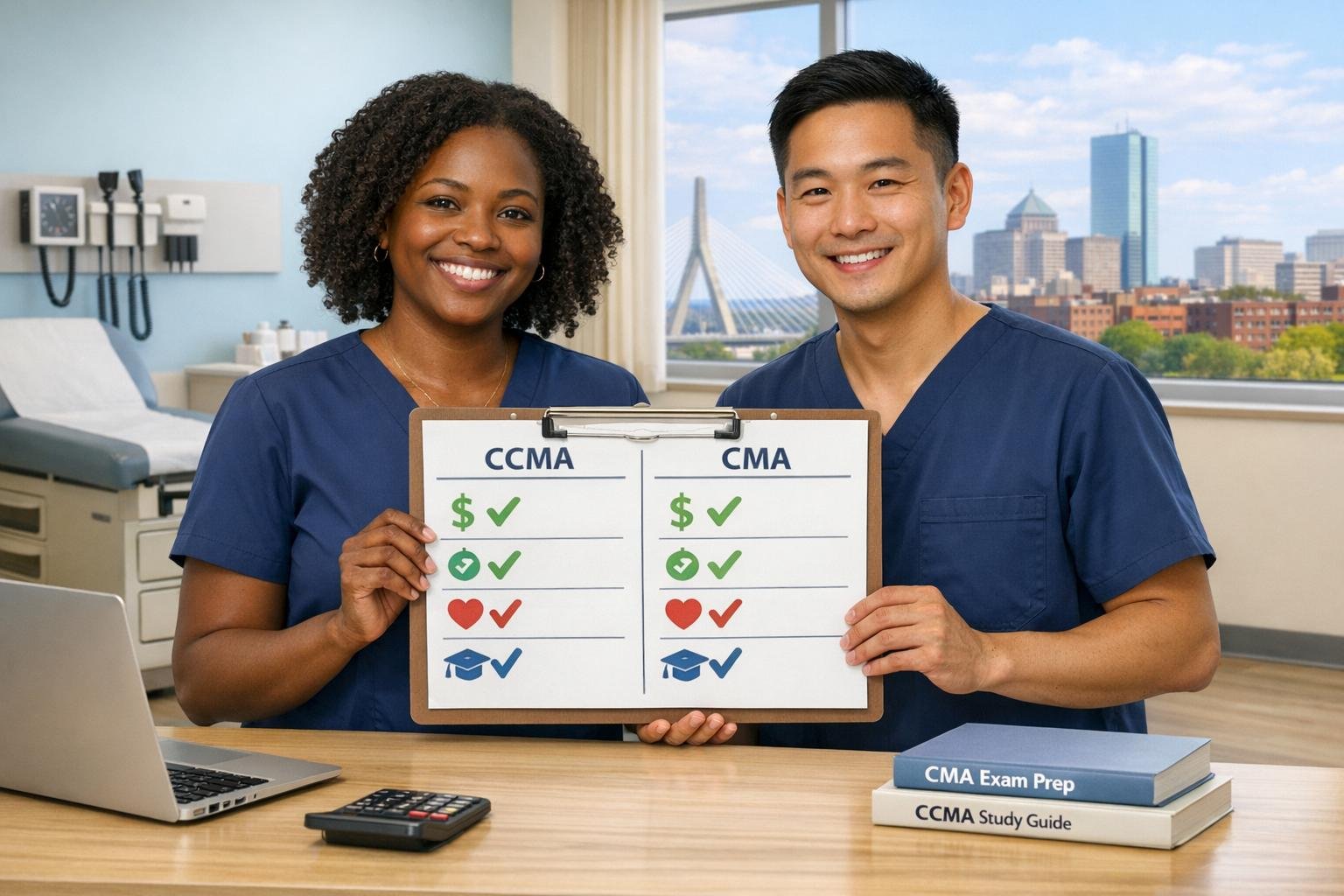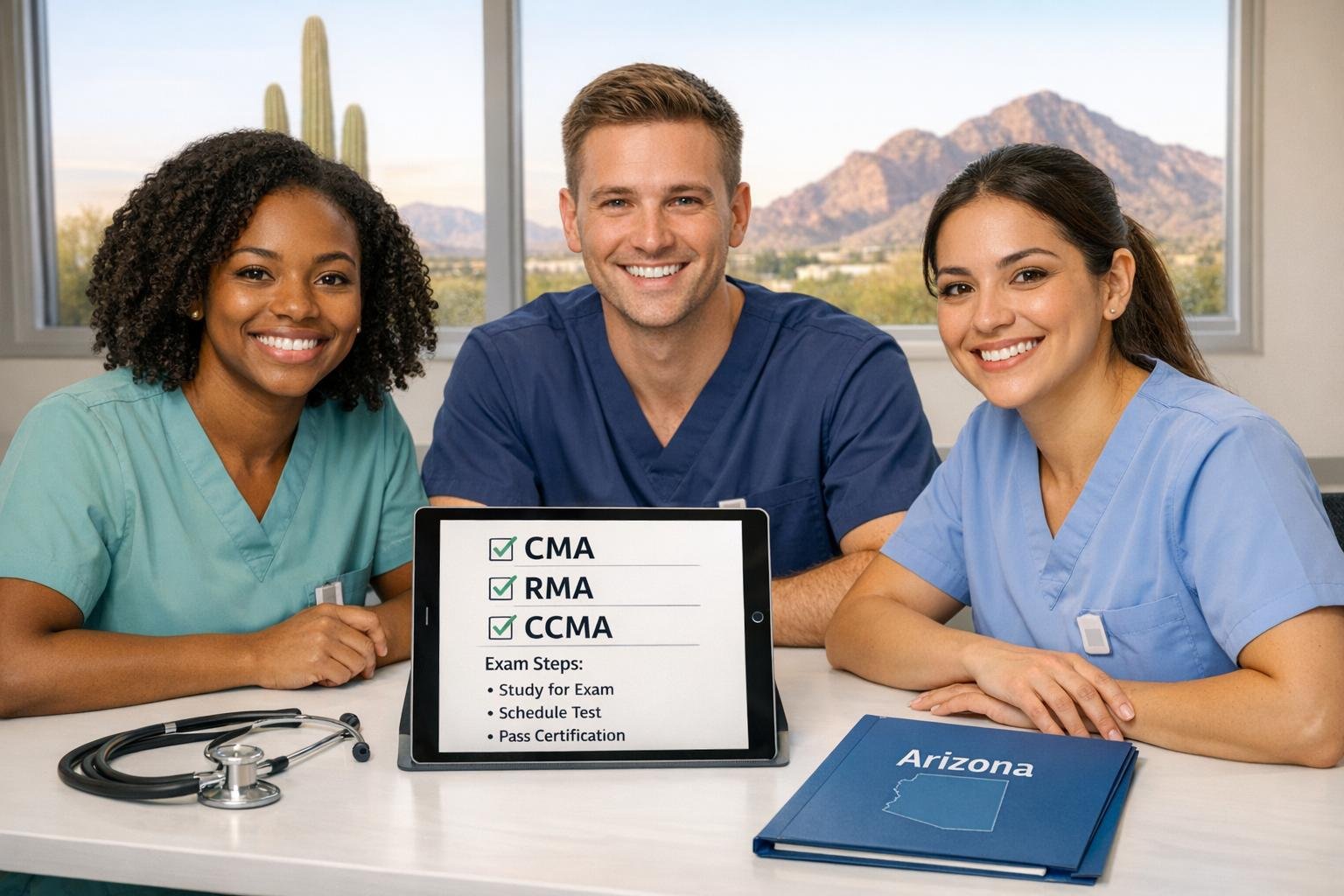
The CCMA credential, offered by the National Healthcareer Association (NHA), opens doors to clinical roles in healthcare. With 96% of employers requiring or encouraging certification and a 12.5% job growth expected through 2034, this certification boosts employability and earning potential (median salary: $44,200/year). The exam fee is $165, with a pass rate of 81.38% in 2024.
Key Steps to Certification:
- Eligibility: Must be 18+, hold a high school diploma/GED, and have CPR certification. Qualify via:
- Approved medical assistant program (completed within 5 years).
- 1–2 years of supervised work experience.
- Relevant military medical training.
- Training: Programs focus on clinical tasks (e.g., phlebotomy, EKGs) and administrative skills. Online, self-paced options available.
- Exam Prep: Study guides, practice tests, and externships help you prepare for the 180-question exam.
- Renewal: Certification lasts 2 years. Renewal costs $185 and requires 10 continuing education credits.
This certification validates your skills, increases job opportunities, and supports career growth in healthcare. Ready to start? Explore online CCMA programs for flexible, self-paced training.
CCMA Certification – Everything You Need To Know
sbb-itb-7a67ffa
CCMA Eligibility Requirements
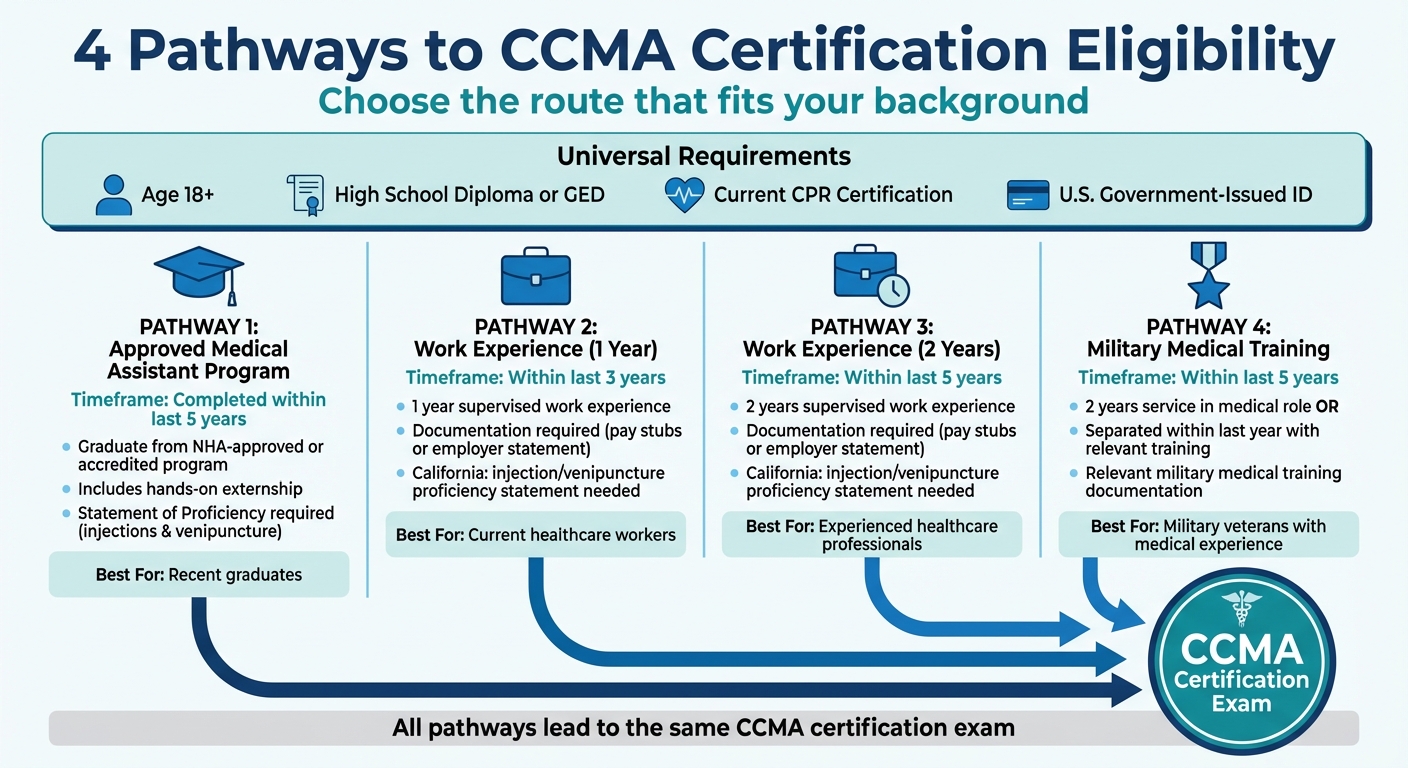
CCMA Certification Eligibility Pathways Comparison Chart
The NHA offers three distinct pathways to qualify for the CCMA exam, catering to recent graduates, seasoned healthcare professionals, or those with only a high school diploma. Regardless of the pathway, all candidates must meet these baseline requirements: be at least 18 years old, have a current CPR certification, and present a U.S. government-issued ID.
Here’s a closer look at each pathway and what’s needed to get started:
Approved Medical Assistant Program
If you’ve graduated from a medical assisting program within the past five years, this pathway is for you. Eligible programs include those offered by secondary schools, postsecondary institutions, adult education programs authorized by the Department of Education, or accredited community colleges. These programs focus on essential skills – like anatomy, phlebotomy, and wound care – and include a hands-on externship.
Before enrolling, confirm that the program is NHA-approved or accredited. You’ll also need a Statement of Proficiency signed by an instructor or supervising physician, verifying your competency in injections and venipuncture. Completing such a program not only qualifies you for the exam but also equips you for its clinical components.
Work Experience Pathway
For those already working in healthcare, eligibility can be achieved through supervised work experience under one of two options:
- One-year pathway: At least one year of supervised work experience within the last three years.
- Two-year pathway: At least two years of supervised work experience within the last five years.
To verify your experience, you’ll need documentation, such as pay stubs or a signed statement from your employer confirming your hours. In California, medical assistants must also submit a signed injection and venipuncture proficiency statement while working under physician supervision. If you’re a military service member with relevant medical training, you may qualify if you separated within the last year or served in a medical role for at least two of the past five years. This pathway is ideal for leveraging prior experience toward certification.
High School Diploma Plus Training
If you hold a high school diploma or GED – or are on track to earn one within the next 12 months – you can qualify by completing a medical assistant training program through an accredited institution . This option is especially suited for career changers or those new to healthcare. The training mirrors the core curriculum of approved programs, emphasizing clinical care (56% of the exam), foundational knowledge, and administrative tasks.
High school students can even take the exam provisionally up to 12 months before graduation, provided all other requirements are met. This allows you to kickstart your career as soon as you finish school.
| Eligibility Pathway | Work Experience Requirement | Timeframe | Education Requirement |
|---|---|---|---|
| Experience Option 1 | 1 year supervised | Within last 3 years | HS Diploma or GED |
| Experience Option 2 | 2 years supervised | Within last 5 years | HS Diploma or GED |
| Education Pathway | N/A | Program completed in last 5 years | HS Diploma or GED |
| Military Pathway | 2 years service | Within last 5 years | Relevant Military Training |
CCMA Training Program Components
Once you’re eligible, the next step in becoming a Certified Clinical Medical Assistant (CCMA) is completing a training program that equips you with the clinical and administrative skills needed for both the job and the exam. These programs combine essential medical knowledge with hands-on practice, preparing you for the tasks medical assistants handle daily in healthcare settings.
Core Curriculum and Skills
CCMA training programs focus on the skills you’ll use in real-world healthcare environments. The knowledge portion covers topics like human anatomy, medical terminology, pharmacology, and medical laws and ethics. These areas lay the groundwork for understanding patient care and clinical decision-making.
The clinical skills section, which makes up the largest part of your training, reflects the fact that 56% of the CCMA exam focuses on patient care. You’ll learn to take vital signs, perform patient assessments, administer medications and injections, provide wound care, and assist with oxygen therapy. Training also includes specialized procedures like phlebotomy (venipuncture), EKGs, and basic lab techniques.
On the administrative side, you’ll cover tasks such as managing Electronic Health Records (EHR), patient communication, medical record organization, and check-in/check-out processes. You’ll also learn about safety and compliance topics, including infection control (OSHA standards), patient privacy (HIPAA), and general safety protocols to ensure you’re prepared for all aspects of the role.
Online and Self-Paced Programs
Many CCMA programs now offer 100% online, self-paced formats, allowing you to study whenever it fits your schedule. Accelerated programs can be completed in as little as 6 to 8 weeks, while others may extend up to a year, depending on your pace. This flexibility is ideal for those balancing work or family commitments.
To help students build hands-on skills, these programs often include interactive tools like 3D animations, virtual clinical simulations, and flashcards. Some even send practice kits to your home, such as dummy arms with lifelike veins for practicing venipuncture and injections. HealthCareer Certs, for example, offers self-paced learning with one-on-one instructor sessions via Zoom, over 1,400 practice questions, and 700 self-checks to reinforce your understanding. They also guarantee externship placement and provide mobile-friendly access so you can study from anywhere.
"I was able to get certified and pass the NHA exam on the first try in only 6 weeks, and I appreciated the ease of the entire process/course."
- Olivia, CCMA Graduate
Programs like Advanced eClinical Training (ACT) boast a 97% NHA exam pass rate for their graduates, proving that online training can be just as effective as traditional classrooms when paired with advanced virtual tools and practical application.
Externship Requirements
The externship is where you put your classroom knowledge to work. This hands-on component places you in real healthcare settings – such as hospitals, clinics, or urgent care centers – where you perform tasks under supervision to refine your skills.
During the externship, you’ll practice vital tasks like administering injections, performing venipuncture, taking vital signs, conducting EKGs, and updating EHRs. Working with actual patients under the guidance of healthcare professionals gives you valuable feedback and builds the confidence you’ll need to succeed in the workplace. For online students, the externship is a required step to meet NHA certification eligibility.
Although externships are typically unpaid, they significantly boost your job prospects by showcasing your skills to potential employers. Some programs even offer scholarships of up to $2,000 to help with externship costs. HealthCareer Certs ensures every student completes this requirement by offering guaranteed externship placement, making it easier to transition from training to employment.
CCMA Exam Preparation
Once you’ve completed your training and externship, the next step is preparing for the CCMA exam. Knowing the exam format and adopting effective study habits can help you avoid the frustration of retakes.
Exam Format and Content
The CCMA exam is a computer-based test consisting of 180 multiple-choice questions – 150 of these are scored, while 30 are pretest questions. You’ll have three hours to complete it, and a passing score is 390 out of 500. About 77% of test-takers pass the exam.
The exam places a strong emphasis on Clinical Patient Care, which makes up 54% to 56% of the questions. This section includes topics like infection control, phlebotomy, EKG procedures, and general patient care. Administrative Assisting accounts for roughly 13% and covers areas such as scheduling, insurance, billing, and medical law. Foundational Knowledge represents about 10% of the exam, focusing on medical terminology, pharmacology, and nutrition. Lastly, Anatomy & Physiology makes up 5% to 8% of the test content.
"Professionalism and critical thinking are the most important soft skills employers are looking for, when hiring a clinical medical assistant." – National Healthcareer Association
If you opt for online testing, results are typically available in your NHA account within two days. With this format in mind, it’s essential to tailor your preparation to the exam’s structure.
Study Strategies and Materials
Start your exam prep early – ideally 1–3 months in advance – to prevent last-minute stress and burnout. Limit study sessions to three or four hours a day, and take regular breaks to stay focused. Spend extra time on your weaker subjects from the start.
The NHA offers official study tools, including a free CCMA Test Plan that outlines exam topics. Additional resources include:
- Online Study Guide: $69
- Practice Tests: $49
- Preparation Package: $94 (includes both the guide and tests)
The practice tests come in three versions, each allowing two attempts. These are excellent for familiarizing yourself with the exam format. For added convenience, the NHA Mobile app provides flashcards that align with the CCMA curriculum.
For more in-depth preparation, platforms like Smarter MA and HealthCareer Certs offer thousands of practice questions. Smarter MA provides over 2,000 questions, while HealthCareer Certs includes more than 1,400 questions and 700 self-checks, giving you plenty of opportunities to test your knowledge.
"Endurance is the hardest thing about a test like this. It’s a marathon, not a sprint." – Katie Miller, Co-creator, Smarter MA
If you don’t pass on your first try, review your Detailed Score Report in your NHA account. This report highlights areas needing improvement before retaking the test. Keep in mind, each attempt costs $160.
Remote Proctored Testing
You have three options for taking the CCMA exam: at your school, at a PSI testing center, or through live remote proctoring from home. Remote proctoring offers convenience, sparing you the need to travel.
To take the exam remotely, you’ll need a computer with a camera, microphone, stable internet, and a quiet, private space. Make sure your photo ID is clear and readable for verification. Stay within the camera’s view throughout the exam, and note that food and drinks are usually not allowed during the three-hour session.
This remote option maintains the same security standards as in-person testing, ensuring fairness and integrity.
Certification Timeline and Renewal
Once you’ve passed the exam, it’s crucial to stay on top of the certification timeline and renewal process to ensure your career remains on track.
Time to Complete Certification
The time it takes to complete your certification varies. Training programs typically range from three months to a year, depending on whether you enroll full-time or part-time. After completing your coursework and externship, you’ll schedule your CCMA exam, which takes about three hours to complete.
Renewal Requirements
Your CCMA certification is valid for two years. To renew, you’ll need to complete 10 continuing education (CE) credits within each two-year cycle. The NHA makes this process easier by offering free CE courses through their online library, accessible 24/7 for certified members.
The renewal fee is $185 every two years. You can earn your CE credits anytime during the cycle, and there’s no penalty for renewing early. If your certification expires, there’s a 30-day grace period to renew by completing the standard 10 credits and paying the $185 fee. However, if you miss this window but renew within one year, you’ll need 15 credits and must pay $376.50, which includes a $99 reinstatement fee. Let your certification lapse for more than a year, and you’ll be required to retake the full exam.
Staying current with your certification not only keeps you compliant with industry standards but also supports your long-term career development.
Keeping Your Certification Active
Maintaining your certification is more than just a formality – it can significantly impact your career. According to the 2025 Industry Outlook, 96% of employers either require or strongly encourage certification for medical assistants. Even better, 63% of healthcare organizations offer higher pay to employees who hold professional certifications.
To stay ahead, plan your continuing education throughout the two-year cycle. Use your NHA account to track renewal dates and take advantage of the free CE courses to meet your requirements without extra financial strain. Staying proactive ensures your certification remains an asset to your career growth.
Conclusion
Earning your CCMA certification is a clear and rewarding step toward a thriving career in healthcare. Once you meet the eligibility requirements and complete your training, you can apply through the NHA website and take the computer-based exam to secure your credential.
This certification not only validates your skills but also opens doors to better job opportunities. Consider this: 96% of employers either require or prefer certification for medical assistants, and 63% of healthcare organizations offer higher pay to certified professionals. With a median annual salary of about $44,200 and top earners making over $57,830, the financial benefits of certification are hard to ignore. Beyond the paycheck, the CCMA credential demonstrates your clinical expertise and can serve as a stepping stone to advanced roles like nursing, physician assistant programs, or specialized clinical fields. Plus, the demand for medical assistants is on the rise, with employment expected to grow by 12.5% through 2034, thanks to an aging population and increasing healthcare needs.
To keep your certification active, you’ll need to complete 10 continuing education credits every two years and pay a renewal fee. By staying on top of your CE credits, you ensure your credential remains valid and your career keeps progressing.
If you’re looking for a flexible and supportive way to prepare for your CCMA certification, check out the online programs at HealthCareer Certs (https://healthcareercerts.org). Their self-paced courses, personalized instructor sessions, and interactive tools are designed to help you succeed. Start your journey with HealthCareer Certs and take the first step toward a fulfilling clinical career.
FAQs
Can I take the CCMA exam without a medical assistant program?
To qualify for the CCMA exam, you generally need to complete a medical assisting program or have equivalent training. Most certification programs require candidates to either graduate from an accredited medical assisting program or have relevant work experience to meet the eligibility requirements.
What’s the fastest way to qualify for the CCMA exam?
The fastest route to qualify for the CCMA exam is by enrolling in an accelerated medical assistant training program. For example, an 8-week self-paced course that blends online learning with hands-on externship experience can get you there quickly. Make sure the program includes both clinical and administrative skills required for the exam. You’ll also need to meet eligibility requirements, such as holding a high school diploma or GED and completing any required practical training.
What happens if my CCMA certification expires?
If your CCMA certification lapses, you’ll need to retake and pass the certification exam to restore it. Make sure to review the renewal guidelines carefully to prevent any gaps in your certification status.