
Balancing healthcare education with personal life is tough, but it’s not impossible. With 60–80 hour weeks filled with lectures, clinical rotations, and studying, burnout is a real risk. Nearly 50% of U.S. medical students report symptoms of burnout, and around 33% show signs of depression. This isn’t just about stress – it impacts your health, relationships, and even patient safety.
Here’s the good news: you can take control with practical strategies. Key tips include:
- Time management: Use tools like the Eisenhower Matrix, time blocking, and the 80/20 Rule to prioritize tasks.
- Setting boundaries: Protect your personal time by scheduling breaks and limiting distractions.
- Self-care: Prioritize sleep, exercise, and healthy eating to maintain energy and focus.
- Flexible learning: Online, self-paced programs can help you fit studies into your busy schedule.
Building these habits now will not only help you succeed in school but also prepare you for a sustainable career in healthcare.
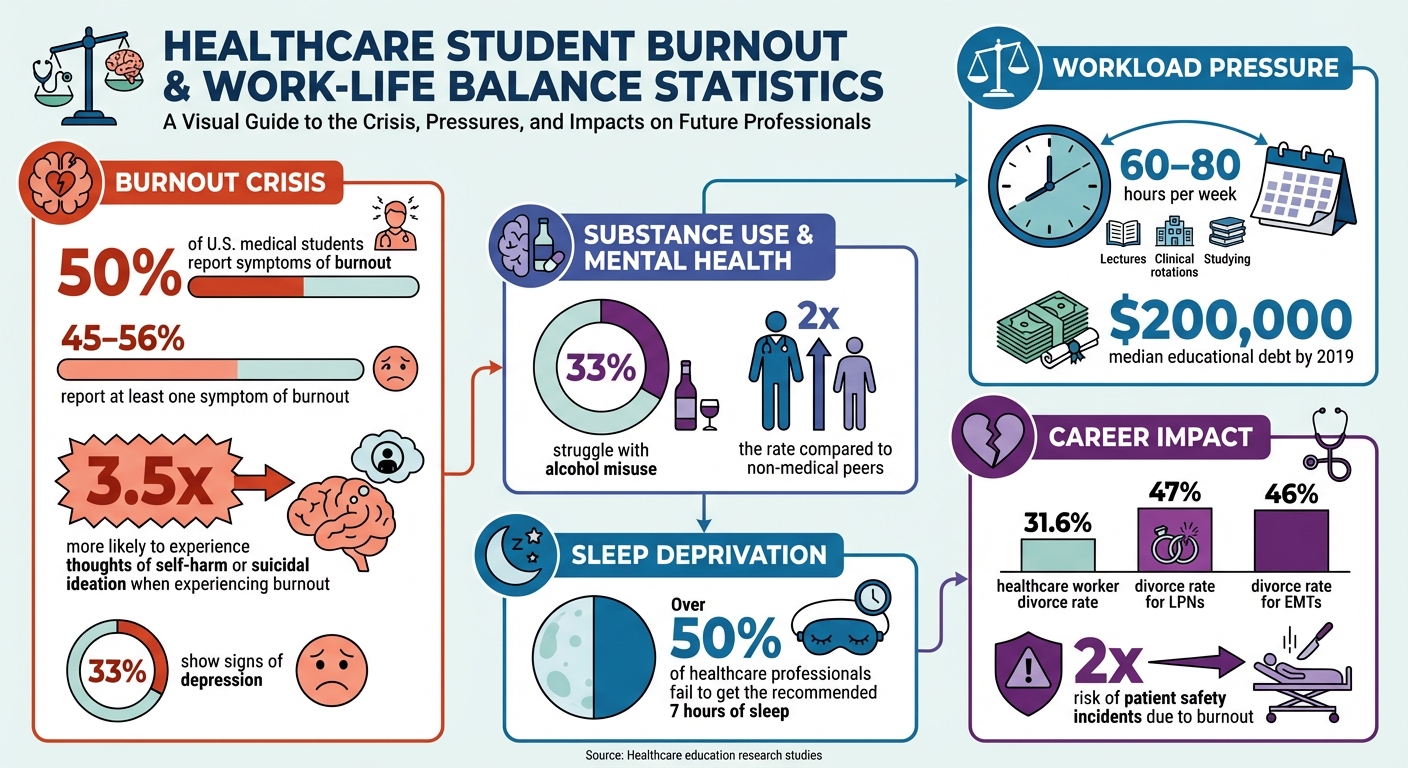
Healthcare Student Burnout Statistics and Work-Life Balance Impact
Recognizing Burnout Risks and Warning Signs
Common Causes of Burnout in Healthcare Education
Pinpointing the causes of burnout is crucial for maintaining a healthy balance between work and personal life. For healthcare students, the pressures often go well beyond the usual academic hurdles. The sheer volume of medical knowledge to absorb can feel overwhelming – like trying to drink from a firehose. Add to that the constant scrutiny during clinical rotations, where preceptors and residents evaluate your every move, and the stress multiplies.
Financial strain is another heavy burden. By 2019, the median educational debt for medical students was a staggering $200,000, and residency salaries often fail to even cover the interest on these loans. Beyond finances, there’s the emotional toll of moral injury – being unable to deliver essential care due to systemic shortcomings. Pair this with the "hidden curriculum", where enthusiasm can dwindle under the weight of repetitive tasks and disengaged supervision, and the challenges become even more daunting. Medical student Rachel Stones captures this sentiment perfectly:
"Students are struggling because there’s no incentive to take care of themselves. And even when we do have a supportive administration saying ‘take care of yourself,’ the larger culture of medicine is focused on sucking up and pushing through".
On top of all this, the constant exposure to human suffering and death adds an emotional weight that’s hard to compare to other fields. These combined stressors often build up, leading to burnout that manifests both physically and emotionally over time.
Physical and Emotional Signs of Burnout
The pressures healthcare students face don’t just stay in the background – they often show up as physical and emotional red flags. In fact, your body might alert you to burnout before your mind fully grasps what’s happening. Persistent fatigue, headaches, muscle tension, and gastrointestinal issues are common physical signs. Sleep disturbances, appetite changes, and a weakened immune system, which leaves you more vulnerable to illness, are also key indicators.
Emotionally, burnout can lead to detachment and cynicism, sometimes reflected in depersonalization – like referring to patients by numbers rather than names. Feeling "used up", snapping over small irritations, or struggling with heightened irritability are other emotional warning signs. Cognitive symptoms might include re-reading the same material repeatedly or making uncharacteristic mistakes during rounds. Spotting these signs early can give you a chance to adjust your habits and prioritize self-care.
The stakes are high. Medical students grappling with burnout are about 3.5 times more likely to experience thoughts of self-harm or suicidal ideation. To put things into perspective, studies show that 45% to 56% of U.S. medical students report at least one symptom of burnout, and nearly 33% struggle with alcohol misuse – double the rate of their non-medical peers. These alarming statistics underscore the importance of recognizing and addressing burnout before it spirals.
sbb-itb-7a67ffa
Mental Health and Burnout Prevention in Healthcare Students
Setting Priorities and Managing Your Time
Once you’ve identified burnout creeping in, the next step is to regain control by organizing your workload. For healthcare students, the constant juggling of clinical rotations, exams, and administrative responsibilities can feel overwhelming. But here’s the thing: time management isn’t about cramming in more – it’s about focusing on what truly matters. The right strategies can help you prioritize effectively and reduce unnecessary stress.
Using Task Prioritization Methods
To tackle overload, structured tools like the Eisenhower Matrix can make a world of difference. This method breaks tasks into four categories: Urgent & Important (handle immediately), Important but Not Urgent (schedule for later), Urgent but Not Important (delegate or batch), and Neither (eliminate). For healthcare students, this might mean prioritizing a deteriorating patient or responding to STAT pages first, while scheduling study sessions for board exams at a later time. The trick is understanding that not every task demands your immediate attention.
Another approach is starting each shift by identifying three key tasks to focus on in the next one to two hours. Reassess as new demands arise. This keeps low-impact distractions from eating into your time. You can also apply the 80/20 Rule, which highlights that 20% of your efforts often yield 80% of your results. For example, prioritizing active learning methods like flashcards or question banks – especially during peak energy times – can be far more effective than passive review.
Time management techniques like time blocking and timeboxing are also worth exploring. Time blocking involves reserving specific hours for distinct tasks, such as studying cardiovascular physiology from 4:00 p.m. to 6:00 p.m.. Timeboxing goes a step further by setting a strict time limit for a single task, like spending 90 minutes updating clinical notes. This helps you stay focused and on schedule. Similarly, task batching – grouping similar small tasks like checking emails – reduces the mental strain of constant multitasking, which costs the U.S. economy millions each year.
Setting Achievable Study and Work Goals
Vague goals are a recipe for frustration. Instead, use the SMART framework: goals should be Specific, Measurable, Attainable, Relevant, and Time-bound. For instance, instead of saying, "I’ll study for boards", aim for something like, "Complete 50 cardiology practice questions by Friday at 3:00 p.m." Clear, measurable goals not only boost productivity but also help reduce stress. Breaking larger projects into smaller milestones makes them less intimidating and helps you avoid procrastination.
Consider adopting the Daily Big 3 method. Rather than drowning in an endless to-do list, focus on the three most important tasks for the day. If you complete those three, you can count the day as a win – even if smaller tasks are left undone. This approach also combats perfectionism by encouraging you to define what "good enough" looks like upfront. For example, while color-coding old notes might feel productive, it usually falls into the "Neither Urgent nor Important" category and can be postponed or skipped.
Lastly, set boundaries to protect your focus. Share your study schedule or exam dates with family and friends so they know when you need uninterrupted time. Build in buffer time by leaving 30 to 60 minutes each day unscheduled to handle unexpected interruptions. End your day with a brief evening routine to review completed tasks and plan for tomorrow. This helps you draw a clear line between work and personal time, making it easier to unwind and recharge.
Creating a Flexible Study Schedule
Once you’ve set your priorities and goals, the next step is crafting a study plan that works with your unpredictable schedule. Healthcare students often face irregular routines – clinical rotations, work shifts, and personal responsibilities can make it tough to stick to a fixed timetable. That’s where flexibility becomes key.
Benefits of Self-Paced Learning Programs
Traditional classroom schedules can feel rigid, especially when you’re balancing a demanding healthcare job. Self-paced programs, on the other hand, let you decide when and how quickly you progress through the material – giving you control over your learning.
This approach is a game-changer for healthcare workers. For instance, HealthCareer Certs offers programs like the Certified Clinical Medical Assistant course entirely online. Depending on your schedule, you can complete the course in as little as 4 weeks or take up to 12 weeks. With tools like interactive 3D demos, over 1,400 practice questions, and flexible access, you can study when it’s convenient – whether it’s early morning before a shift or late at night after work.
Eliminating the need to commute to a physical campus frees up precious hours, which you can use for studying or personal time. Plus, self-paced learning helps you avoid burnout by letting you spend more time on challenging topics without the pressure of keeping up with a fixed class schedule.
This flexibility also pairs well with structured planning techniques, like time blocking, to make the most of your available hours.
Using Time Blocking for Studies and Personal Time
While self-paced learning lets you set your own pace, a structured daily schedule ensures you stay on track. Time blocking is a great way to do this – it involves assigning specific hours of your day to particular tasks, reducing decision fatigue and helping you focus. As Julie Campos, Vice President of Student Success and Career Services at MedCerts, puts it:
"When you create a time-blocked schedule for your virtual learning, you’re giving yourself permission to forget everything else but the task at hand".
Start by marking your non-negotiables: work shifts, clinical rotations, and sleep (aim for at least 7 hours). Once these are set, you can see how much time remains. Most students realistically have 2 to 4 hours of study time each day after accounting for other responsibilities. Instead of attempting long, exhausting sessions, break your study time into manageable blocks.
For example, you could dedicate 7:00–7:45 p.m. to reviewing cardiovascular anatomy flashcards, take a 10-minute break, and then use 8:00–8:30 p.m. to tackle circulatory system practice questions. Short, focused sessions are often more productive than trying to cram for hours.
Don’t forget to schedule personal time, too. Whether it’s 30 minutes for a jog, 15 minutes to catch up with a friend, or 10 minutes to scroll through social media guilt-free, giving these activities a spot on your calendar ensures you can enjoy them without feeling torn between work and relaxation. This balance helps you stay fully present in both your studies and personal life.
| Technique | Key Benefit | Best For |
|---|---|---|
| Time Blocking | Reduces stress and improves focus with a structured plan | Managing a packed daily schedule with many tasks |
| Timeboxing | Sets strict time limits to avoid procrastination | Handling tough assignments or staying on track |
| Task Batching | Cuts down productivity loss from multitasking | Managing emails, notifications, and admin tasks |
| Day Theming | Dedicates full days to a single focus | Preparing for exams, research, or self-care days |
Finally, review your schedule at the end of each day. If something didn’t get done, simply move it to tomorrow. This approach keeps you organized and helps maintain a balance between work, study, and personal time.
Self-Care Practices to Prevent Burnout
Having a flexible schedule won’t mean much if you’re running on empty. Shockingly, over half of healthcare professionals fail to get the recommended seven hours of sleep each night. Self-care is about conserving the energy you need to thrive. As Graves Fromang, DO, an Emergency Room Physician, explains:
"There is this myth in medicine that you have to sacrifice your health, your relationships, and your overall well-being for the cause or your career. If you don’t take care of yourself, then you can’t take care of patients".
Daily Stress-Relief Activities
Small, consistent habits can make a big difference. For example, physical activity is a powerful stress reliever – even just 5 to 10 minutes of movement between study sessions or hitting a goal of 5,000 steps a day can reduce anxiety and ease depression.
Mindfulness practices are equally effective. Daily meditation, deep breathing exercises, or body scans can calm your thoughts and sharpen your focus. If sitting quietly isn’t your thing, try journaling – it’s a great way to process stressful clinical experiences. Wayne Bond Lau, MD, Dean for Student Affairs at Sidney Kimmel Medical College, stresses the importance of balance:
"Only studying and not taking care of your whole health, your mental health and your physical body is not, is not the solution to anything".
And don’t underestimate the basics. Sleep hygiene is critical – aim for 7 to 9 hours of rest each night to enhance memory and cognitive function. Jason Lambrese, MD, from Case Western Reserve University, highlights the importance of prioritizing sleep:
"A well-rested brain is an effective brain. Staying up that extra hour to study is usually ineffective studying, and you lose an hour of sleep, so it’s a lose-lose situation".
For those long shifts or 24-hour calls, consider "sleep banking" by getting extra rest before and after.
Nutrition planning is another lifesaver. Preparing meals in advance and keeping healthy snacks like nuts, fruit, or protein bars on hand can help you avoid late-night vending machine runs. This not only saves money but also keeps your energy stable during those grueling clinical days.
Incorporating daily self-care into a structured routine helps you maintain both academic performance and personal well-being. However, self-care goes beyond daily habits – it’s also about setting boundaries.
Setting Boundaries Between Studies and Personal Life
Boundaries aren’t selfish – they’re essential. Consider this: the healthcare industry has one of the highest divorce rates, with 31.6% of healthcare workers experiencing divorce, and rates climbing to 47% for LPNs and 46% for EMTs. Without clear boundaries, work and personal life can blur together, leading to burnout.
Start with digital boundaries. Establish a "phone bedtime" 30 to 60 minutes before sleeping, and turn off non-essential notifications during study or personal hours. Blue light from screens can disrupt melatonin production, making it harder to fall asleep. During vacations or designated downtime, remove work emails from your phone entirely to avoid the temptation of staying "always connected".
Physical boundaries can also help you mentally shift gears. Create specific "work zones", like a library or a dedicated desk, and reserve your bed exclusively for rest. At the end of your study day, take 5 to 10 minutes to tidy your workspace and jot down a to-do list for the next day. This simple "shutdown ritual" signals your brain that it’s time to relax.
Temporal boundaries are equally important. Schedule at least one evening or half-day each week as completely study-free. Use that time for hobbies, socializing, or simply unwinding. Treat these breaks as non-negotiable appointments on your calendar – not something you can skip when you’re busy. When faced with additional commitments, try the "pause" technique: "Let me review my schedule and get back to you".
Finally, rethink perfectionism. Decide ahead of time what "good enough" looks like for less critical tasks. If pre-reading isn’t heavily tested, limit it to 90 minutes rather than spending hours perfecting every detail.
Conclusion
Balancing work and personal life is more than a nice-to-have skill – it’s a critical part of maintaining your career and well-being. As Katherine Chretien, MD, Associate Dean for Medical Student Affairs at Johns Hopkins University School of Medicine, emphasizes:
"There’s nothing as important as your health – both physical and mental – for you and for your future patients."
The tips shared here – like time blocking, setting "Big 3" daily goals, prioritizing sleep, and drawing clear boundaries – go beyond just boosting productivity. They act as safeguards against burnout, a serious issue in healthcare. Burnout can double the risk of patient safety incidents, and 31.6% of healthcare workers experience divorce. Medicine is a long journey, and building sustainable habits now ensures you can go the distance without compromising your career or personal life.
If juggling coursework, clinical rotations, work shifts, or family feels overwhelming, flexible learning options can ease the load. Online programs, such as those from HealthCareer Certs, offer 100% online certification courses like Certified Clinical Medical Assistant (CCMA) and Certified Phlebotomy Technician (CPT). These programs allow self-paced learning and include guaranteed externship placements, cutting out commute time and letting you study during breaks or at home. This approach preserves your personal time, helping you rest and recharge.
FAQs
What are some effective ways for healthcare students to manage their time and avoid burnout?
Healthcare students can juggle their busy schedules and avoid burnout by adopting some practical time management tactics. One of the simplest yet most effective strategies is keeping a detailed calendar. By organizing classes, clinical rotations, and personal commitments in one system, you can reduce the chaos and ensure nothing slips through the cracks.
Another key tip is crafting a realistic schedule. Focus on prioritizing essential tasks, but don’t forget to include regular breaks. These moments of rest aren’t just nice to have – they’re essential for recharging and maintaining productivity. Equally important is setting boundaries. Avoid taking on more than you can handle and get comfortable with saying no when necessary. Striking this balance between academics, clinical duties, and personal life can significantly lower stress levels and set the stage for both academic success and a thriving healthcare career down the road.
What are the signs of burnout healthcare students should be aware of?
Burnout can quietly creep into the lives of healthcare students, making it essential to spot the early warning signs. Physical symptoms might include constant fatigue, frequent headaches, muscle tightness, digestive discomfort, or ongoing sleep troubles. On the emotional and mental side, students may notice irritability, a sense of apathy, feeling overwhelmed, withdrawing from responsibilities, or avoiding social connections.
These symptoms don’t appear overnight – they often build up over time due to prolonged stress. Recognizing and addressing them early is key to avoiding more serious health challenges. Taking small but impactful steps, such as setting clear boundaries, prioritizing self-care, and reaching out for support, can help restore balance and protect overall well-being.
What are the benefits of self-paced learning for healthcare students trying to balance their schedules?
Self-paced learning offers healthcare students the flexibility to fit their studies into their hectic schedules. This method allows individuals to move through material at their own pace, making it easier to juggle personal responsibilities, academic demands, and work obligations.
By giving students control over their learning timeline, this approach can help lower stress levels and support a healthier work-life balance. These factors are key to avoiding burnout and staying committed to long-term aspirations.