The Certified Clinical Medical Assistant (CCMA) exam is a key certification for advancing your career in healthcare. With over 233,190 active certifications as of late 2024, this credential is widely recognized, with 72% of employers requiring certification and certified professionals earning 10–15% more than non-certified peers.
The 2026 exam includes 180 multiple-choice questions (150 scored, 30 unscored) and focuses heavily on Clinical Patient Care (54–56% of the test). To pass, you need a scaled score of 390 out of 500 (about 78% correct). The exam costs $165 and can be taken at testing centers or remotely via live proctoring.
This guide walks you through everything you need: exam structure, a 6-week study plan, and top preparation tips. Key strategies include focusing on high-weighted topics, using practice exams to identify weak areas, and aiming for 80%+ on practice tests before the official exam.
Quick Facts:
- Exam Fee: $165
- Passing Score: 390/500
- Key Focus: Clinical Patient Care (54–56%)
- Testing Options: In-person or Remote
- Study Tip: Use practice exams and target weak areas.
Keep reading for a detailed breakdown of the exam, study resources, and actionable tips to succeed.
CCMA Practice Test 2026 NHA (NEW) Updated Medical Assistant 50 Questions and Answers
CCMA Exam Structure and Content
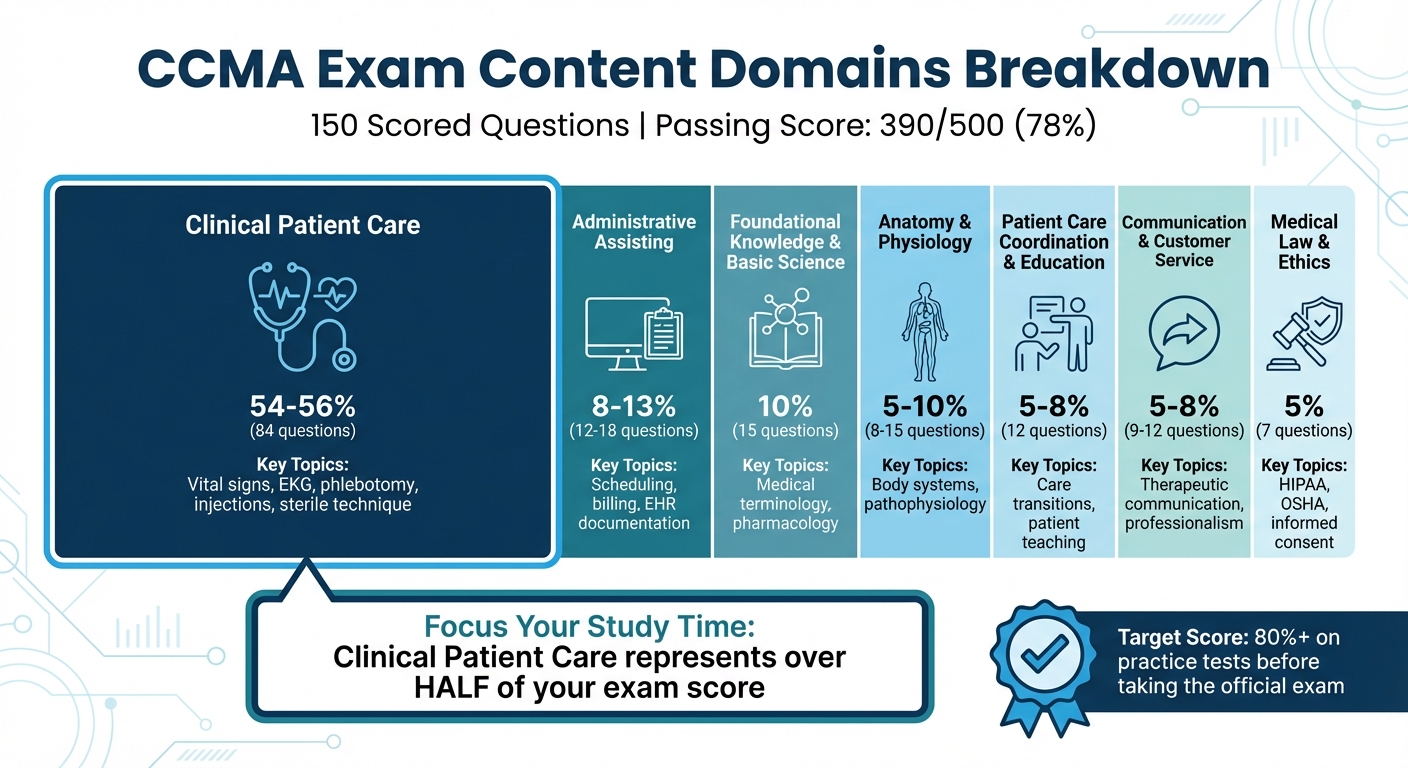
CCMA Exam Content Domains Breakdown and Weighting Distribution
Exam Format and Timing
The CCMA exam is conducted on a computer and includes 180 multiple-choice questions. Of these, 150 are scored, while 30 are unscored pretest questions designed to refine future exam versions. You’ll have between 2 hours and 15 minutes to 3 hours to complete the test, which gives you approximately 45–60 seconds per question.
You can take the exam at various locations, including PSI testing centers, approved school sites, or even at home through live remote proctoring. For in-person testing, calculators and scratch paper are provided. If you opt for remote testing, your computer must meet specific requirements: Windows 7/Mac OS X or higher, Google Chrome, a webcam, a microphone, and at least 466 kb/s internet bandwidth.
In 2024, the exam had a pass rate of 81.38%. Back in 2021, 77.08% of candidates passed out of 44,588 test-takers. Understanding the exam’s content and focus areas is essential for creating an effective study plan.
Content Areas and Domain Weights
The CCMA exam is divided into seven key domains, each with distinct weightings. Knowing how much each domain contributes to your overall score can help you allocate your study time effectively. The Clinical Patient Care domain dominates the exam, making up 54–56% of the total score. This section includes critical topics like vital signs, EKG lead placement, phlebotomy procedures, sterile fields, and injection techniques. Other domains, ranging from 5% to 13%, cover administrative tasks, basic sciences, anatomy, patient education, communication, and medical law.
Here’s a detailed breakdown of the exam content:
| Content Domain | Weighting (%) | Number of Scored Questions | Key Topics |
|---|---|---|---|
| Clinical Patient Care | 54–56% | 84 | Vital signs, EKG, phlebotomy, injections, sterile technique |
| Administrative Assisting | 8–13% | 12–18 | Scheduling, billing, EHR documentation |
| Foundational Knowledge & Basic Science | 10% | 15 | Medical terminology, pharmacology |
| Anatomy & Physiology | 5–10% | 8–15 | Body systems, pathophysiology |
| Patient Care Coordination & Education | 5–8% | 12 | Care transitions, patient teaching |
| Communication & Customer Service | 5–8% | 9–12 | Therapeutic communication, professionalism |
| Medical Law & Ethics | 5% | 7 | HIPAA, OSHA, informed consent |
The exam tests both theoretical knowledge and practical skills. Domains like Foundational Knowledge and Anatomy & Physiology focus on theoretical understanding, while areas like Clinical Patient Care and Administrative Assisting evaluate how well you can apply your skills in real-world scenarios. Expect questions that involve scenarios, multi-step reasoning, and clinical problem-solving. To boost your chances of success, aim for at least 80% on practice exams before attempting the official test.
6-Week CCMA Study Plan
This six-week plan is designed to align with the CCMA exam’s key areas, helping you tackle core topics, practice essential skills, and simulate real test conditions. By following a structured timeline, you’ll have enough time to thoroughly review the material while maintaining steady progress. While preparation time can vary from one to three months for most students, six weeks strikes a balance between thorough review and maintaining momentum. The strategy? Break the exam into manageable sections and build your confidence step by step.
Weeks 1-2: Core Concepts and Medical Terminology
Start your journey by laying a strong foundation in medical terminology and basic science. Spend these two weeks memorizing prefixes and suffixes – this will make understanding complex terms, diseases, and procedures much easier.
Focus on Anatomy & Physiology (about 5–10% of the exam) and Foundational Knowledge (approximately 10% of the exam). Dive into essential body systems like cardiovascular, respiratory, endocrine, and musculoskeletal. Pair this with topics in basic pharmacology and nutrition. Though Clinical Patient Care represents the majority of the exam (55–56%), use tools like flashcards to reinforce vital details such as normal vital sign ranges, injection angles, and the phlebotomy order of draw. Watching clinical skills videos can also help you visualize procedures, like proper EKG lead placement.
Once you’ve built a solid base, you’ll shift gears in Weeks 3-4 to focus on practice tests and targeted reviews.
Weeks 3-4: Practice Tests and Weak Areas
In week three, start taking practice exams to assess your progress. Official NHA practice tests provide detailed score reports, categorizing your performance as "above", "near", or "below" the passing standard. Use these insights to zero in on your weak areas. For each mistake, write down the correct answer along with a brief explanation – this method can improve recall by up to 300%.
Since Clinical Patient Care is the largest portion of the exam, prioritize any weaknesses in this area. Drill high-frequency topics like EKG lead placement, phlebotomy order of draw, vital signs, and injection techniques until you feel confident. If certain concepts still feel unclear, try clinical videos or interactive worksheets to reinforce your understanding.
With your weak areas addressed, you’ll be ready to focus on final preparations during Weeks 5-6.
Weeks 5-6: Final Review and Mock Exams
In the final stretch, your focus shifts to building endurance and refining your test-day strategies. Complete full-length practice exams under timed conditions to simulate the real testing environment. Aim to spend no more than 60 seconds per question, and use the "flag" feature to mark questions you want to revisit later.
Avoid cramming the day before the exam. Instead, do a light review and make sure to get 7–8 hours of sleep. If you’re using Live Remote Proctoring, check your system compatibility 24 hours in advance, and plan to log in or arrive at least 30 minutes early.
For additional support, you might want to explore the online CCMA certification program offered by HealthCareer Certs (https://healthcareercerts.org). Their program includes self-paced learning, one-on-one instructor guidance, interactive tools, and guaranteed externship placements – all designed to help you succeed.
sbb-itb-7a67ffa
Study Methods and Resources
Proven Study Techniques
If you want your study sessions to stick, distributed practice is the way to go. Instead of cramming, spread your study time into shorter, consistent blocks over several weeks. This method helps your brain hold onto information much longer. Try 90-minute focused sessions with breaks in between – your productivity tends to dip after 3–4 hours of studying in one day.
Another game-changer is practice testing. Regularly taking practice exams trains your brain to retrieve information quickly, just like you’ll need to do on test day. Plus, reviewing missed questions and their correct answers can boost your recall by as much as 300%.
Flashcards are a great tool for nailing down high-yield topics like lab values and injection angles. And if a concept isn’t clicking, switch gears – watch clinical videos to see procedures like venipuncture or EKG placement in action. This visual approach can make tricky concepts easier to understand.
To feel confident, aim to consistently hit 80% or higher on your practice exams before scheduling the real deal. Use "question tagging" in your study tools to focus on tough areas, moving them from "unknown" to "known" through repetition. Since the passing score is 390 out of 500 (about 78% correct), setting your target above that gives you a cushion for success.
Now, let’s dive into some top-notch CCMA prep resources that align with these strategies.
CCMA Prep Resources
HealthCareer Certs (https://healthcareercerts.org) has built a reputation as a go-to option for CCMA certification prep. Their program includes 1,400+ practice questions and 700 self-checks, covering every exam domain in detail. You’ll also find 3D demos, quizzes, and flashcards – all accessible on mobile, so you can study wherever you are.
What sets them apart? They offer one-on-one Zoom sessions with instructors who can break down tough concepts and answer your questions live. Plus, you’ll get guaranteed externship placement for hands-on experience in a clinical setting. And here’s a standout feature: they promise a 100% tuition refund if you don’t land a healthcare job after certification. With over 5,000 students giving them a perfect 5/5 rating on Google, you’ll be joining a program with a proven track record. The self-paced format means you can complete the course in as little as 4 weeks or take up to 12 weeks, making it flexible enough to fit your schedule.
Test-Day Strategies
How to Perform Your Best During the Exam
With your study plan ready, focusing on these test-day strategies can help you stay on track and perform effectively.
You’ll have 3 hours to tackle 180 questions – roughly 60 seconds per question. If you encounter a tough question, flag it and move on; you can circle back later. Pay close attention to keywords like "first," "immediately," "most important," or "except" to understand exactly what the question is asking. For example, if a patient has an abnormal blood pressure reading, the first step is typically to recheck it manually before contacting the provider.
Using elimination is another smart approach. Often, you can rule out two options right away, leaving a 50/50 chance of selecting the correct answer. Since Clinical Patient Care makes up over half of the exam score (54–56%), prioritize these questions if you’re running short on time.
Plan to arrive at the testing center – or log in for remote testing – at least 30 minutes early to allow for a smooth check-in process. Bring a government-issued photo ID with a matching signature to your registration. For remote testing, ensure your workspace is clear of prohibited items like food, water, and personal electronics, as remote proctoring rules are strict.
Common Mistakes to Avoid
Even with solid strategies, certain missteps can throw you off course on test day.
One frequent error is giving equal time to every subject. Since Clinical Patient Care accounts for the majority of the exam score, neglecting this section can have a major impact.
Another common mistake is cramming the night before. Instead of trying to absorb new material, focus on staying mentally sharp. Aim for 7 to 8 hours of sleep, drink plenty of water, and eat a protein-packed meal before your exam.
For those taking the test remotely, run a system check ahead of time to avoid technical hiccups. Ensure your device meets the requirements (Windows 7+/Mac OS X with Google Chrome), your screen resolution is at least 1368×768, and your webcam and microphone are functioning properly.
Conclusion
Preparing for the 2026 CCMA exam requires a well-structured approach, focused practice, and smart strategies for test day. With a national passing rate of 81.38% as of 2024, success is achievable if you stick to a solid study plan. A study period of about six weeks – or longer if necessary – allows you to thoroughly cover all exam areas, with particular focus on Clinical Patient Care, the section that carries the most weight.
Practice exams play a critical role in gauging readiness. Aim to consistently score 80% or higher, and use your results to pinpoint weak areas. For every mistake, write a one-sentence explanation to reinforce your understanding and improve retention. This method can make a big difference in avoiding repeated errors and boosting your confidence. These steps form the foundation for selecting the best preparation tools.
Choosing effective resources is equally important. HealthCareer Certs offers an NHA-aligned curriculum, six in-depth practice tests, interactive 3D demonstrations, and guaranteed externship placements for hands-on clinical experience. With personalized instructor support via Zoom and email, plus a 100% tuition refund if you don’t land a healthcare job, you’ll be fully equipped to tackle the exam with confidence.
FAQs
How do I know I’m ready to schedule the CCMA exam?
When you’re ready to schedule the CCMA exam, it means you’ve put in the effort to thoroughly review the key content areas, practiced essential clinical procedures, and built confidence in both patient care and administrative responsibilities. A good way to gauge your readiness is by taking practice tests that mimic the actual exam format. Consistently scoring well on these tests is a strong sign that you’re prepared. Additionally, working through the NHA CCMA study guide and confidently answering sample questions can further confirm that you’re on the right track.
What Clinical Patient Care skills should I focus on the most?
If you’re preparing for the CCMA exam or stepping into clinical practice, certain skills deserve special attention. These include patient intake, general care, infection control, laboratory procedures, phlebotomy, and EKG/cardiovascular testing.
Make sure to hone your abilities in:
- Patient assessment: Understanding and evaluating patient needs effectively.
- Specimen collection: Proper techniques for collecting and handling samples.
- Infection prevention: Applying techniques to minimize risk and ensure safety.
- Performing EKGs: Accurately conducting and interpreting cardiovascular tests.
These skills aren’t just test material – they’re the backbone of clinical responsibilities. Mastering them will set you up for success in both exam scenarios and day-to-day patient care.
What should I do if I’m running out of time during the exam?
If you’re feeling pressed for time during the CCMA exam, try pacing yourself by allotting no more than 60 seconds per question. If you encounter a particularly tricky question, flag it so you can circle back later. This approach helps you stay on track and maximize the number of questions you can tackle before time runs out.