
The CCMA exam requires preparation, focus, and a clear plan to succeed. With a passing score of 390 out of 500 and a 2024 pass rate of 81.38%, many candidates succeed by following a structured approach. Here’s how you can do it:
- Understand the Exam: The test has 180 questions (150 scored, 30 unscored) covering clinical care (55–56%), anatomy, medical law, and more. You’ll have 2 hours and 15 minutes to complete it.
- Build Knowledge: Focus on clinical patient care, medical terminology, and phlebotomy. Use the NHA test plan and study tools like flashcards and practice tests.
- Stick to a Schedule: Study consistently for 1–3 months, dedicating extra time to high-weighted topics like clinical care.
- Prepare for Test Day: Confirm logistics, review key topics, and practice timed tests. Stay calm, rested, and focused.
CCMA Practice Test – NHA 2025 | 50 Questions and Answers to Pass the Exam
sbb-itb-7a67ffa
Step 1: Learn the CCMA Exam Format and Topics
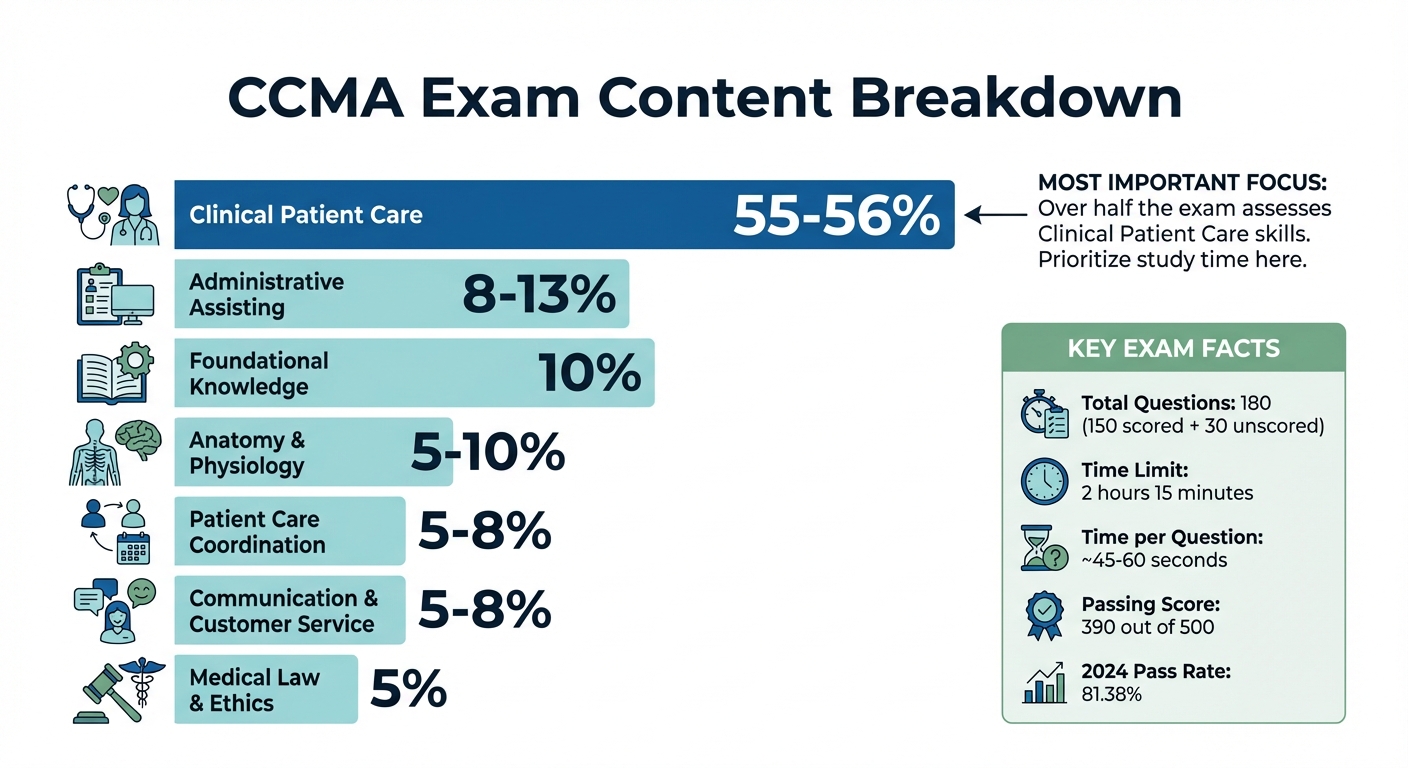
CCMA Exam Content Distribution by Topic Weight
Before diving into your study plan, take time to familiarize yourself with the exam structure and content outlined by the National Healthcareer Association. This blueprint acts as a roadmap, helping you focus your preparation on the most important areas.
Exam Format and Time Limits
The CCMA exam includes 180 questions in total: 150 scored questions and 30 unscored pilot questions that the NHA uses to evaluate potential future test items. Since these pilot questions are mixed in with the scored ones and aren’t labeled, treat every question seriously. You’ll have 2 hours and 15 minutes to complete the test, which breaks down to roughly 45 seconds per question.
The test features a mix of question types, including standard multiple-choice, scenario-based questions, multi-step reasoning, and clinical review formats. You can take the exam at a PSI testing center, an approved school site, or online with a live remote proctor.
Topic Distribution by Weight
Once you understand the format, focus on the topics that carry the most weight. The largest portion of the test, 55% to 56%, is dedicated to Clinical Patient Care. This section covers essential hands-on skills like vital signs, EKGs, phlebotomy, injections, and infection control – practical knowledge you’ll use every day as a medical assistant.
The remaining topics are divided as follows:
- Administrative Assisting: 8–13% (topics include scheduling, electronic health records, insurance, and billing).
- Foundational Knowledge: 10% (medical terminology, basic science, and nutrition).
- Anatomy & Physiology: 5–10% (body systems and pathophysiology).
- Patient Care Coordination: 5–8% (care transitions and team communication).
- Communication & Customer Service: 5–8% (professionalism and cultural sensitivity).
- Medical Law & Ethics: 5% (HIPAA, OSHA, informed consent, and patient rights).
Knowing how the topics are weighted allows you to prioritize your study time effectively. As Shamsah Noorani from Health Tech Academy puts it:
Understanding the exam blueprint and content outline provided by the National Healthcareer Association (NHA) helps candidates prioritize their study efforts and focus on areas where they may need additional review.
If there’s one area to dedicate the bulk of your preparation, it’s Clinical Patient Care – this section alone accounts for more than half of the exam’s points.
Step 2: Build Your Medical Knowledge Base
The key to success is a strong foundation. This step focuses on solidifying your understanding of essential medical concepts and skills.
Study Core Materials
Pick study tools that match how you learn best. Flashcards work well for memorizing medical terms, normal vital sign ranges (like blood pressure and pulse), injection angles, and EKG lead placements. If you’re more of a visual learner, clinical skills videos can be a game-changer for grasping procedures like the phlebotomy order of draw or setting up sterile fields.
Focus your efforts on Clinical Patient Care – this includes vital signs, EKG lead placement, phlebotomy techniques, injection methods, and infection control practices. Alongside these, make sure to master the medical terminology that ties it all together [14].
Use the NHA Test Plan
The official NHA test plan is a roadmap to success. It breaks down what you need to know into "Knowledge Statements" (facts) and "Task Statements" (skills). Use this as a checklist to guide your studies. For example, dedicate two weeks to Clinical Patient Care and one week each to smaller domains. Structuring your study time like this ensures you cover everything systematically.
Find and Fix Your Weak Spots
Practice tests are your secret weapon for spotting gaps in your knowledge. After taking a test, review the detailed score report in your NHA account portal to see which of the seven domains need extra work. Katie Miller, co-creator of Smarter MA, highlights the importance of this approach:
"Use practice questions to identify your strengths and weaknesses. This will help you focus your study efforts on the areas where you need improvement" [14].
Keep track of missed questions, note the correct answers, and write brief explanations to reinforce what you’ve learned. This will help you recognize patterns and address recurring challenges. Aim for an 80% score on official NHA practice exams before scheduling your test.
Once your knowledge base feels solid, you’ll be ready to move on to the next step and refine your skills further.
Step 3: Create a Study Schedule and Practice Regularly
Sticking to a consistent study routine beats cramming every time. A well-thought-out schedule helps you stay organized and reduces the risk of burnout.
Set Up a Study Schedule
Most students need anywhere from one to three months of preparation, depending on their prior knowledge and experience [14]. Ideally, aim for at least eight weeks to cover all seven exam domains without scrambling at the last minute. Break your study sessions into shorter, regular intervals spread over several weeks [16]. Keep in mind that studying more than three to four hours a day can backfire, leading to fatigue and poor retention [14].
Since Clinical Patient Care accounts for 56% of the exam, dedicate about two weeks to this domain. For the other areas, plan to spend roughly one week per domain. This approach ensures you build on the groundwork you laid in Step 2, giving proper attention to each topic. Don’t forget to include regular breaks – like 90 minutes of focused study followed by a quick walk or light exercise – to keep your mind fresh [14].
Once your schedule is in place, make sure to practice under exam-like conditions to develop both your accuracy and stamina.
Take Full-Length Practice Tests
Practicing under timed conditions is key to mastering the test’s pacing. You’ll have 2 hours and 15 minutes to answer 180 questions (150 scored and 30 unscored), which averages out to about 60 seconds per question [16]. Regularly taking timed practice exams can also help ease test-day nerves [16].
Use the results from these practice tests to identify areas where you need more focus. When you miss a question, jot down the correct answer along with a brief explanation. This method has been shown to improve recall significantly – by as much as 300%.
Use Flashcards and Memory Tools
To complement practice tests, use flashcards and other memory aids to reinforce key concepts. Flashcards can help you memorize critical terms and values, such as medical prefixes and suffixes, vital sign ranges, and injection angles (e.g., intradermal at 10–15°, subcutaneous at 45°, intramuscular at 90°) [14]. Mnemonics like "RACE" (Rescue, Alarm, Confine, Extinguish) for fire safety or "FLATPIG" for pituitary hormones are also great for boosting memory [14].
The NHA offers a mobile app with flashcards aligned to the official study guide, making it easy to review on the go – whether during your commute or a lunch break. Focus your flashcard practice on high-priority topics like EKG lead placement, the phlebotomy order of draw, and the chain of infection [14].
Step 4: Get Ready for Test Day
After weeks of preparation and practice, the final days before your exam are all about fine-tuning your approach. This includes double-checking logistics, refining your test-taking strategies, and ensuring you’re mentally and physically ready to perform at your best.
Confirm Exam Details and Review Key Topics
About a week before the test, log into your NHA account to confirm all the important details: exam location, time, required materials, and technical setup. Whether you’re testing at a PSI center, an approved school site, or remotely from home, make sure you know exactly what you’ll need [17].
For in-person exams, bring a valid government-issued photo ID, like a driver’s license or passport, and two No. 2 pencils [17]. If you’re testing remotely, you’ll need to complete a system check for your webcam and microphone. Be prepared to provide a 360-degree scan of your room for the proctor before starting [17].
In the days leading up to the exam, focus on reviewing material you’ve already studied rather than trying to cram new concepts. Go over any mistakes you made on practice tests and reinforce those areas. As the Clinical Skills Institute wisely puts it: "Mental clarity is better than last-minute studying".
Once you’ve confirmed the logistics, turn your attention to sharpening your test-day strategies.
Test-Day Techniques
The exam consists of 180 questions – 150 scored and 30 unscored – and you’ll have 2 hours and 15 minutes to complete it. That means you should aim to spend about 60 seconds per question. Use the software’s flagging feature to mark any tricky questions so you can revisit them later [18].
Pay close attention to keywords like "first", "most important", "immediately", or "except". These words often highlight what the question is really asking and can help you avoid common pitfalls. If you’re not sure about an answer, try to eliminate one or two obviously wrong options to improve your chances of guessing correctly [18].
While strategy is key, your mental and physical state can make just as much of a difference.
Manage Stress and Take Care of Yourself
Your well-being plays a huge role in your performance. The night before the test, aim for 7–8 hours of sleep to keep your mind sharp. On the morning of the exam, eat a balanced meal and stay hydrated [18]. If you’re taking the test in person, plan to arrive early. This gives you time to get comfortable with the environment and avoid any last-minute stress.
During the exam, if you start feeling overwhelmed, take a moment for deep breathing or a quick visualization exercise to stay calm. You’ve put in the work, and with an 81.38% pass rate in 2024, you’re in a strong position to succeed if you’ve followed the preparation plan.
Conclusion
By sticking to these four steps, you’re setting yourself up for success. To pass the CCMA exam, focus on understanding the format, building a strong knowledge base, practicing under timed conditions, and preparing both mentally and physically. Since Clinical Patient Care makes up more than half the exam, mastering this section is crucial – though it’s important to cover all areas thoroughly.
In 2024, the CCMA exam had an 81.38% pass rate out of 78,681 tests taken. Additionally, there are over 233,190 active CCMA certifications. These numbers prove that with dedication and a structured eight-week preparation plan, success is within reach. Use official NHA test plans and practice exams to sharpen your skills and pinpoint areas that need extra attention.
As Katie Miller, co-creator of Smarter MA, explains:
Certification demonstrates to employers that you have the knowledge, skills and abilities necessary to perform the job successfully. It also shows your commitment to professional development and excellence [14].
This credential not only validates your expertise but also highlights your dedication in a field where certification is both required and valued by employers.
Keep in mind, certification is just the beginning. To maintain your CCMA status, you’ll need to earn 10 continuing education credits every two years, ensuring your skills stay relevant as the healthcare field evolves. The time and money you invest in preparing for and taking the exam today will pay off through better career opportunities and higher earning potential.
Now you’ve got the strategy, the knowledge, and the tools to succeed. On test day, trust your preparation, stay focused, and aim for that passing score of 390 to kickstart your healthcare career.
FAQs
How do I know when I’m ready to schedule the CCMA exam?
When you’re fully prepared and confident in your understanding of essential areas like medical terminology, anatomy, pharmacology, and clinical procedures, it’s time to schedule your CCMA exam. A great way to gauge your readiness is by taking full-length practice tests under timed conditions. These tests not only simulate the exam environment but also help identify any weak areas. Once you’re consistently scoring well and feel at ease with the material, you can move forward with scheduling your exam.
What should I study first if I’m short on time?
If you’re pressed for time, prioritize the topics that carry the most weight on the CCMA exam. Clinical Patient Care accounts for a hefty 56% of the test, focusing on areas such as patient intake, infection control, and phlebotomy. Once you’ve tackled this section, shift your attention to Foundational Knowledge and Basic Science and Administrative Assisting to solidify your grasp of other important concepts.
What’s the best way to pace myself during the test?
To manage your time effectively during the CCMA exam, it’s crucial to familiarize yourself with the exam’s structure in advance. Practice with sample questions to build both speed and confidence. Make sure to allocate your time thoughtfully – read each question carefully, but don’t get stuck on the challenging ones for too long. Working through timed mock exams can fine-tune your pacing and help ensure you finish all the questions within the given time.