The NHA CCMA exam is a certification test for aspiring clinical medical assistants. It measures your ability to perform both clinical and administrative tasks in healthcare settings. Here’s what you need to know:
- Pass Rate: 77% in 2023, meaning 1 in 4 candidates didn’t pass on their first attempt.
- Passing Score: Scaled score of 390 out of 500 (approximately 78% correct answers).
- Exam Format: 180 multiple-choice questions (150 scored, 30 unscored) completed in 3 hours.
- Content Areas: The largest section, Clinical Patient Care, makes up 56% of the exam, covering skills like vital signs, phlebotomy, and EKG lead placement.
Preparation is crucial. Focus on Clinical Patient Care while also reviewing other areas like medical law, anatomy, and administrative tasks. Use practice exams to identify weak spots and manage your time effectively during the test. Certification can open doors to better job opportunities in a growing field, with medical assistant roles expected to grow by 16% through 2031.
CCMA Exam Practice Pt 1 | Certified Clinical Medical Assistant Exam Review | NHA CCMA Study Guide
Exam Format and Structure
NHA CCMA Exam Content Domains Distribution and Breakdown
Duration and Question Types
The NHA CCMA exam is a computer-based test that gives you 3 hours (180 minutes) to complete 180 multiple-choice questions. Out of these, 150 questions are scored and contribute to your final result, while the remaining 30 are unscored pretest items used by the NHA to evaluate future exam questions. Since you won’t know which ones are pretest items, it’s best to treat every question as if it matters.
With only about 60 seconds per question, managing your time effectively is crucial. The test software allows you to flag tricky questions so you can revisit them later. The question formats include traditional multiple-choice, scenario-based questions, multi-step reasoning, and clinical review questions designed to mirror real-life medical situations.
Content Categories and Distribution
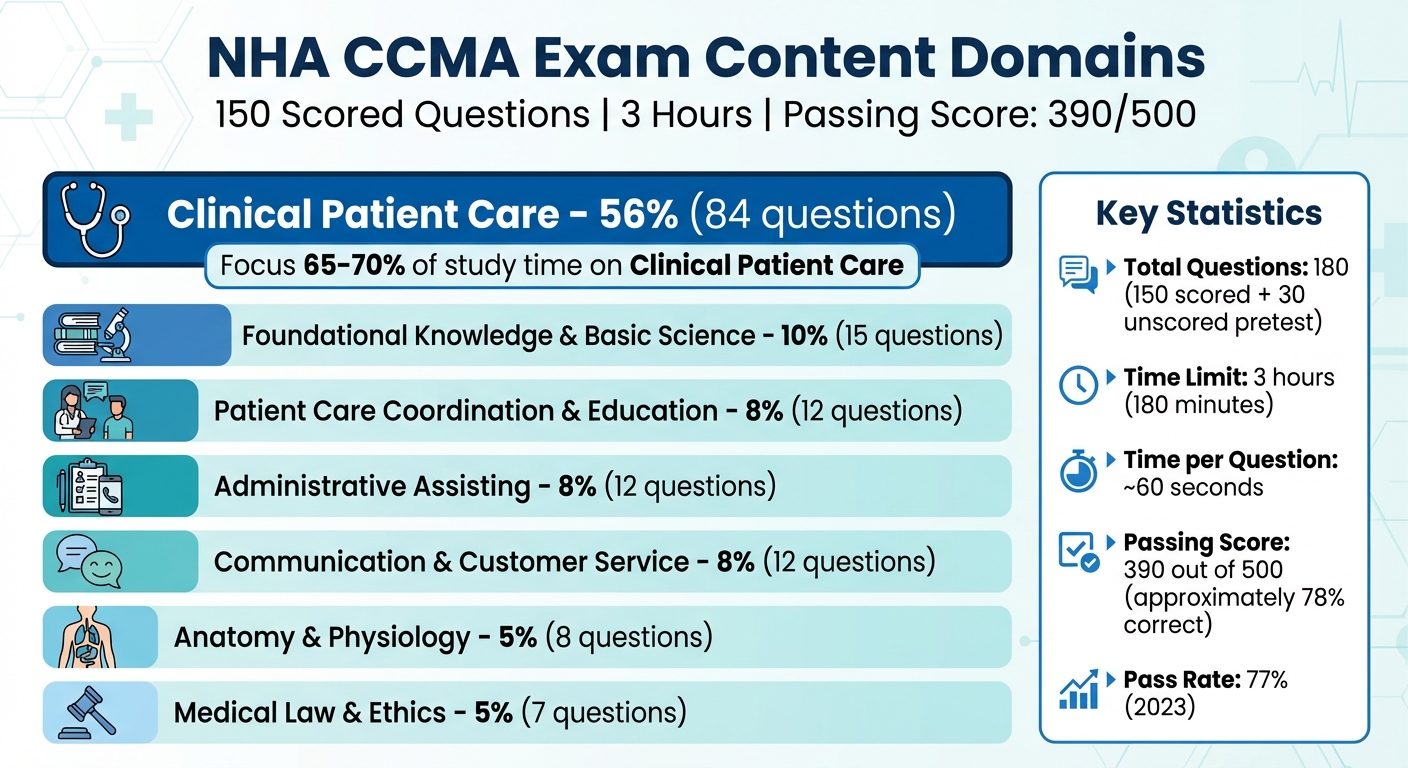
Once you’ve grasped the timing and question types, it’s time to focus on the exam’s content breakdown. The 150 scored questions are divided into seven content domains, each weighted based on its relevance to a medical assistant’s role. The largest portion, Clinical Patient Care, makes up 56% of the exam (84 questions). This section covers areas like vital signs, phlebotomy, EKG lead placement, infection control, and point-of-care testing.
Here’s how the domains are distributed:
| Content Domain | Scored Questions | Percentage of Exam |
|---|---|---|
| Clinical Patient Care | 84 | 56% |
| Foundational Knowledge & Basic Science | 15 | 10% |
| Patient Care Coordination & Education | 12 | 8% |
| Administrative Assisting | 12 | 8% |
| Communication & Customer Service | 12 | 8% |
| Anatomy & Physiology | 8 | 5% |
| Medical Law & Ethics | 7 | 5% |
This breakdown highlights where you should concentrate your study time. With Clinical Patient Care making up over half the exam, honing your clinical skills should be a top priority.
Scoring System and Passing Requirements
Scaled Scoring and Passing Score
The NHA CCMA exam uses a scaled scoring system, with scores ranging from 200 to 500 points. To pass, you need a minimum scaled score of 390, which is roughly 78% correct responses. Your raw score – the total number of correct answers – is converted into a scaled score that accounts for question difficulty.
The scoring process relies on a psychometric method called standard setting. Here, subject matter experts assess the complexity of each question. More challenging questions are weighted more heavily, ensuring the exam measures true competency. This fixed, criterion-based system means your performance is evaluated against a set standard, not other test-takers. And here’s a relief – there’s no penalty for guessing. Historically, the national pass rate has been consistent, with 77.08% of candidates passing in 2021 (out of 44,588 exams) and a 77% pass rate in 2023.
Score Reporting and Feedback
Once the scoring process is complete, candidates receive detailed performance feedback quickly. Scores are typically posted to your online account within two business days after completing the exam. These reports go beyond just pass or fail – they provide a diagnostic breakdown of your performance across the seven content domains.
Your results are categorized as "above", "near", or "below" the passing standard for each domain. If you don’t pass on your first try, this breakdown is incredibly useful for identifying weak areas to focus on before retaking the exam. Candidates must wait at least 30 days before attempting the exam again, giving ample time for targeted preparation. Keep in mind, the retake fee ranges from $155 to $160 per attempt.
sbb-itb-7a67ffa
Content Domains Breakdown
Understanding the content domains of the exam can help you focus your study efforts where they matter most. The test’s 150 scored questions are divided across seven domains, each evaluating specific clinical and administrative skills. Knowing how much each domain contributes to the overall score allows you to prioritize your study time effectively.
Clinical Patient Care is the largest and most critical domain, making up about 56% of the exam (around 84 questions). This section tests essential hands-on skills, such as:
- Measuring vital signs for adults, children, and infants
- Performing EKGs with proper lead placement
- Conducting phlebotomy procedures while following the correct order of draw
- Ensuring infection control using OSHA guidelines and PPE
- Administering injections with proper techniques
While Clinical Patient Care holds the most weight, the other domains are also important for achieving a passing score:
- Foundational Knowledge and Basic Science (10%; about 15 questions): Includes medical terminology, basic pharmacology, nutrition, and psychological concepts like the stages of grief.
- Administrative Assisting (8–12%; 12–18 questions): Focuses on scheduling methods (e.g., wave, cluster, open), EHR documentation, and insurance coding basics (ICD-10 vs. CPT).
- Patient Care Coordination and Education (8%; 12 questions): Highlights care transitions and educating patients about follow-up care.
- Communication and Customer Service (6–8%; 9–12 questions): Evaluates empathy, professional boundaries, and sensitivity to diverse patient needs.
- Anatomy and Physiology (5–10%; 7–15 questions): Covers body systems, pathophysiology, and microbiology.
- Medical Law and Ethics (5%; 7–8 questions): Focuses on HIPAA compliance, informed consent, patient rights, and scope of practice.
With this breakdown in mind, allocate about 65–70% of your study time to Clinical Patient Care, as it is essential for reaching the required passing score of 390. However, don’t overlook the other domains – they collectively contribute around 20–22% of your total score and can make a difference in your performance.
What to Expect on Exam Day
Exam Delivery and Environment
The CCMA exam follows a structured process to ensure consistency, whether you’re taking it in person or remotely. It’s delivered via computer at PSI testing centers, designated school locations, or through live remote proctoring from home. No matter where you test, you’ll need a valid government-issued photo ID, like a driver’s license or passport. Keep in mind that military IDs and credit cards aren’t accepted.
If you’re testing at a PSI center or a school site, plan to arrive at least 30 minutes early. This allows time to check in, sign the testing log, and secure personal items like bags, phones, or other belongings in the provided lockers. The testing room is closely monitored, and items such as food, drinks, calculators, and electronic devices aren’t allowed.
For those testing remotely, you’ll need to log in at your scheduled time, show your ID to the proctor via webcam, and complete a 360-degree scan of your room to confirm it’s private and free of distractions. The proctor will monitor you throughout the 3-hour exam, so you’ll need to stay in full view of the camera, remain silent, and keep your focus on the screen.
Once your exam is complete, here’s what happens next.
Post-Exam Results and Next Steps
After finishing the exam, your performance will be evaluated quickly. Within two business days, your results will be available in your NHA account at NHANOW.com. You’ll also receive an email notification when your score is ready. To view your Individual Result Report, simply log in to your account.
The report breaks down your performance across all seven content domains, highlighting both your strengths and areas for improvement. If you score 390 or higher, you’ll pass and gain immediate access to your digital certification in your account. A hard copy will also be mailed to you. If you don’t pass, the domain-specific feedback can help guide your studies for a retake, which you can schedule after a 30-day waiting period.
Your certification is valid for two years. To keep it active, you’ll need to complete 10 continuing education credits and pay a $169 recertification fee.
Conclusion
Understanding the structure of the NHA CCMA exam is key to effective preparation. Prioritize essential Clinical Patient Care topics like vital signs, phlebotomy, and EKG lead placement, as these areas carry significant weight on the exam. Familiarity with the test format – 150 scored questions, a 3-hour time limit, and a passing scaled score of 390 out of 500 – helps you manage your study schedule and build confidence.
Aim to consistently score 80% or higher on practice exams, and use domain score reports to identify and address weaker areas. This targeted approach sharpens your readiness while aligning with the resources provided by HealthCareer Certs.
A well-thought-out preparation plan ensures you’re equipped to handle the exam, whether you choose an in-person testing center or remote proctoring. HealthCareer Certs offers a robust online CCMA program, which includes self-paced lessons, one-on-one instructor support, interactive tools with over 1,400 practice questions, and guaranteed externship placements. These resources provide both the knowledge and practical experience needed to excel in the certification process and beyond.
Passing the CCMA exam can be a game-changer. With medical assistant jobs expected to grow by 16% through 2031, this certification opens doors to opportunities in clinics, hospitals, and other healthcare settings nationwide. Once certified, your digital credential will be immediately accessible in your NHA account, enabling you to start applying for positions right away. Use your success on the exam as a springboard to advance your career in the thriving healthcare industry.
FAQs
What topics should I study most for the CCMA exam?
To excel on the CCMA exam, it’s crucial to concentrate on several key areas:
- Clinical Procedures: Familiarize yourself with common procedures, such as taking vital signs, assisting with examinations, and performing basic lab tests. Understanding these will help you feel confident in practical scenarios.
- Patient Care: Focus on effective communication, patient education, and proper documentation. Building strong patient relationships is a cornerstone of quality care.
- EKG and Phlebotomy Basics: Learn the fundamentals of performing EKGs and blood draws, including proper techniques, equipment handling, and troubleshooting common issues.
- Medical Law and Ethics: Study the principles of patient confidentiality, informed consent, and professional conduct. Knowing these ensures you act within legal and ethical boundaries.
- Safety and Infection Control: Master protocols for maintaining a clean and safe environment, including sterilization techniques, hand hygiene, and handling hazardous materials.
- Administrative Tasks: Develop skills in scheduling, record-keeping, and managing patient information. These tasks are just as important as clinical duties in a healthcare setting.
Understanding these core concepts and practicing the related skills will set you up for success on the exam and in your medical assisting career.
Can I retake the CCMA exam if I fail?
If you don’t pass the CCMA exam, you’re allowed to retake it. For the first two attempts, you’ll need to wait 30 days before trying again. However, if you fail three times, you’ll have to wait 12 months before your next attempt. Make sure to review the retake policies thoroughly, as they outline the waiting periods and any limits on the number of attempts.
What do I need for remote proctoring at home?
To take the exam remotely, you’ll need a computer equipped with a functioning webcam, microphone, and a reliable internet connection. It’s crucial to run a compatibility check on your system beforehand to ensure everything works smoothly and to prevent any technical hiccups during the exam.