
Medical assistants in Oregon are in high demand, with job openings projected to grow by 23.3% through 2032. Certification is not legally required but is highly preferred by top employers like Providence Medical Group and Kaiser Permanente. Here’s what you need to know:
- Average Salary: $49,950 annually in Portland, with hourly wages between $19.34 and $30.88.
- Education: A high school diploma or GED is required. Accredited programs, like those at Portland Community College or Lane Community College, prepare students for national certification exams.
- Certification Options: CMA (AAMA), CCMA (NHA), and RMA (AMT) are the most recognized credentials.
- Training Programs: Options include community colleges and online programs like HealthCareer Certs, which offers flexible, self-paced training.
- Job Placement: PCC reports a 93% employment rate within a month of graduation.
Certification boosts job prospects and pay, making it a smart step for anyone entering Oregon’s growing healthcare sector.
Medical Assisting Program at Portland Community College

sbb-itb-7a67ffa
Oregon Medical Assistant Certification Requirements
The Oregon Medical Board oversees the medical assisting profession in the state, ensuring proper regulation and standards. While not legally required, most employers prefer candidates who hold national certification and have graduated from accredited training programs. Understanding these requirements is a crucial first step in planning your certification journey.
Education Requirements
To start, you’ll need a high school diploma or GED. From there, Oregon offers several educational pathways, primarily through community colleges. These programs often lead to a Certificate of Completion, with options ranging from a 9-month Career Pathway Certificate to a one-year program requiring 35 to 41 credits for a One-Year Certificate.
If you’re aiming to take the AAMA Certified Medical Assistant (CMA) exam, you’ll need to graduate from a program accredited by either the Commission on Accreditation of Allied Health Education Programs (CAAHEP) or the Accrediting Bureau of Health Education Schools (ABHES). Oregon programs typically uphold strict academic standards, requiring students to maintain a minimum grade of "C" in all medical assisting courses to stay enrolled and earn their certificate.
Health and Background Check Requirements
Before entering any program, you’ll need to complete a series of mandatory screenings. Criminal background checks are required for all applicants. Be sure to review the Oregon DHS Division 7 list of disqualifying crimes, as specific convictions could prevent you from gaining admission to a program or becoming certified.
Additionally, applicants must undergo drug screenings, disclose any physical or mental health conditions that could affect their ability to perform clinical tasks, and maintain up-to-date CPR/BLS certification and immunizations before starting their clinical practicum or externship.
These requirements ensure that medical assistants in Oregon meet the high standards necessary to succeed in this field.
Medical Assistant Training Programs in Oregon
Oregon provides multiple pathways to becoming a certified medical assistant, ranging from traditional community college programs to flexible online options. These programs are tailored to meet the state’s rigorous certification standards. The right choice depends on factors like your schedule, budget, and career aspirations.
Community College Programs
Community colleges in Oregon offer accredited programs designed to prepare students for certification exams and successful careers as medical assistants.
Portland Community College (PCC) runs a 9-month certificate program at its Cascade, Sylvania, and Willow Creek campuses. This program blends in-person and online classes, starting new cohorts every term for added flexibility. From 2019 to 2023, PCC achieved impressive outcomes: a 96.65% retention rate, a 92.21% national exam passage rate, and an 87.65% job placement rate. Within a month of graduating, 93% of students found employment, with Fall 2023 graduates earning an average starting salary of $48,270 per year. Some students even complete paid externships, earning wages while fulfilling their clinical hour requirements.
Lane Community College in Eugene offers a one-year CAAHEP-accredited certificate program, preparing students for the CMA (AAMA) exam. The program includes a Cooperative Education internship and provides a Basic Health Care Certificate, which can be applied toward an Associate of General Studies degree. Between 2019 and 2023, Lane reported an 87% CMA exam passage rate and an 82% job placement rate. The core program costs approximately $12,196, not including prerequisite courses.
Chemeketa Community College offers a certificate program at its Yamhill Valley Campus in McMinnville. This program prepares students for the NCMA (NCCT) and NCPT (Phlebotomy) exams. The estimated cost for the 2025-2026 academic year is $7,421, covering tuition, fees, and some lab supplies. Meanwhile, Oregon Coast Community College (OCCC) provides a shorter certificate program (41 credits) at its North County Center in Lincoln City. OCCC graduates can transfer credits to the Oregon Institute of Technology to pursue a Bachelor of Science in Health Care Management.
| Institution | Location | Program Length | Certification Eligibility | Approximate Cost |
|---|---|---|---|---|
| Portland CC | Portland (Multiple) | 9 months | CMA (AAMA) | Low total cost |
| Lane CC | Eugene | 1 year | CMA (AAMA) | $12,196 |
| Chemeketa CC | McMinnville | < 1 year | NCMA (NCCT), NCPT | $7,421 |
| Oregon Coast CC | Lincoln City | < 1 year | NCMA | 41 credits |
If you’re looking for more flexibility than traditional classroom settings, online programs are an excellent alternative.
HealthCareer Certs Online CCMA Program
The HealthCareer Certs Online CCMA Program provides a self-paced, fully online option that aligns with Oregon’s certification requirements. Students can enroll immediately and prepare for the NHA Certified Clinical Medical Assistant (CCMA) exam in as little as 4 to 12 weeks, depending on their pace.
This program includes interactive 3D demos, quizzes, flashcards, over 1,400 practice questions, and 700 self-checks. Students also benefit from one-on-one Zoom sessions with instructors for personalized guidance. A standout feature is the externship guarantee, ensuring every student gains hands-on clinical experience. Plus, if graduates don’t secure a healthcare job after certification, the program offers a 100% tuition refund.
Unlike many community college programs that require prerequisites like Medical Terminology, Introductory Algebra, and Writing, HealthCareer Certs minimizes enrollment barriers, making it accessible to a broader range of students.
National Medical Assistant Certification Exams
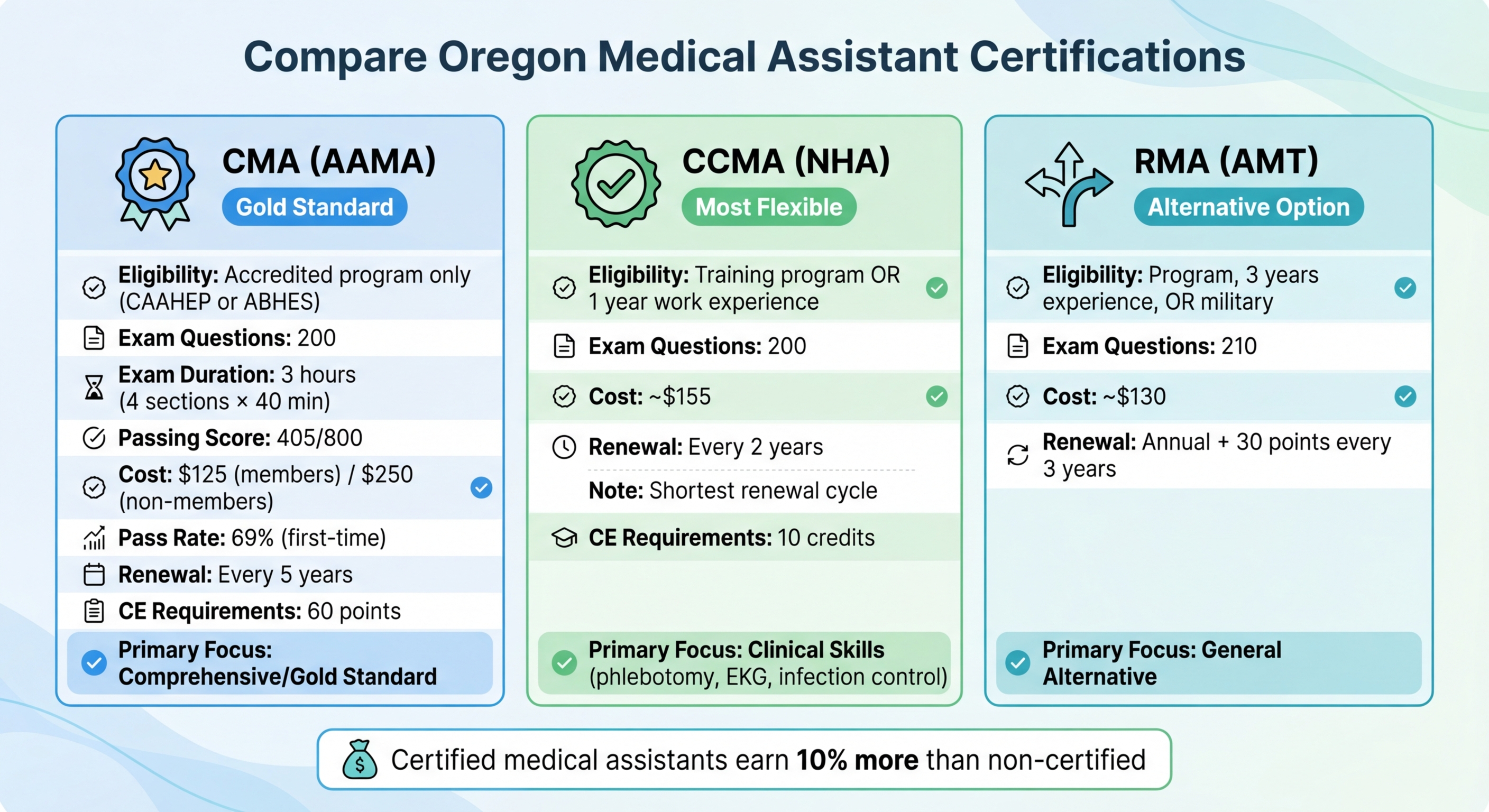
Oregon Medical Assistant Certification Comparison: CMA vs CCMA vs RMA
Getting certified is often a key step for medical assistants in Oregon to secure better pay and career opportunities. On average, certified medical assistants earn about 10% more than their non-certified counterparts. The most recognized national certifications in Oregon are the CMA (AAMA), RMA (AMT), and CCMA (NHA). Each has its own eligibility requirements, exam structure, fees, and renewal timelines, so understanding their differences is crucial when planning your career.
AAMA Certified Medical Assistant (CMA) Exam
The CMA (AAMA) is often considered the top-tier certification in the field. Unlike other certifications, it requires candidates to graduate from a program accredited by CAAHEP or ABHES – work experience alone won’t qualify you. This makes it a great option for graduates from schools like Portland Community College or Lane Community College.
The exam consists of 200 multiple-choice questions divided into four 40-minute sections, taking about three hours in total. To pass, you need a score of at least 405 on a scale of 200 to 800. Between July 2024 and April 2025, 4,171 candidates took the exam, with a first-time pass rate of 69%. The cost is $125 for AAMA members and $250 for non-members.
To register, you’ll need to create an account on the AAMA website and obtain an AAMA ID. After that, you can schedule your exam through PSI, the testing partner. It’s recommended to start preparing 4–6 weeks in advance, using the AAMA Exam Content Outline as a guide. The AAMA also offers a 200-question practice exam and 50 free sample questions covering topics like anatomy, physiology, and medical terminology. You can attempt the exam up to six times per year, but each attempt requires a new application and fee. Once certified, you’ll need to recertify every five years by earning 60 continuing education points.
For those looking for more flexible eligibility options, the CCMA (NHA) exam might be a better fit.
NHA Certified Clinical Medical Assistant (CCMA) Exam
The CCMA (NHA) certification is more accessible, allowing candidates to qualify through either a medical assistant training program or at least one year of clinical work experience. This makes it a popular choice for those already working in the field or graduates of online programs.
The exam includes 200 questions and is administered at PSI testing centers. It costs around $155 and focuses heavily on clinical skills like phlebotomy, EKG, infection control, and patient care. To prepare, students have access to over 1,400 practice questions, 700 self-checks, interactive 3D demonstrations, and one-on-one Zoom sessions. Using official NHA study materials can help you focus on weaker areas. The CCMA certification requires renewal every two years with 10 continuing education credits, which is a shorter and simpler renewal process compared to the CMA’s five-year cycle.
Here’s a quick comparison of the three certifications:
| Feature | CMA (AAMA) | CCMA (NHA) | RMA (AMT) |
|---|---|---|---|
| Eligibility | Accredited program only | Program or 1 year experience | Program, 3 years experience, or military |
| Exam Questions | 200 | 200 | 210 |
| Cost | $125–$250 | ~$155 | ~$130 |
| Renewal Cycle | Every 5 years | Every 2 years | Annual + 30 points every 3 years |
| Primary Focus | Comprehensive/Gold Standard | Clinical Skills | General Alternative |
Choosing the right certification depends on your education, experience, and career goals. These credentials are vital for moving forward in Oregon’s growing healthcare industry.
Medical Assistant Career Opportunities in Oregon
Oregon Job Market Trends
The demand for medical assistants in Oregon is on the rise. The Oregon Employment Department anticipates a 23.3% increase in job openings by 2032. This growth is fueled by the state’s aging population and expanding healthcare services. Right now, there are more than 1,746 active job postings for medical assistants across the state. Portland, Eugene, and Bend are the top cities with the highest job concentrations.
Healthcare systems and specialty clinics are consistently on the lookout for certified medical assistants. Graduates from accredited programs in Oregon enjoy impressive job placement rates, ranging from 82% to 87.65%. Many of these programs even offer paid externships, which often lead directly to permanent roles with the host organizations. These trends point to a strong job market with competitive pay and clear pathways for career growth.
Salaries and Benefits
Salaries for medical assistants in Oregon reflect their growing importance in healthcare. The average annual salary is $55,004, with most earning between $50,419 and $58,552, depending on experience and location. Recent graduates, as of Fall 2023, reported starting salaries averaging $48,270 per year.
Pay rates vary by city, with Portland leading the way. Here’s a quick look at average salaries by location:
- Portland: $58,590
- Hillsboro: $57,080
- Bend: $56,379
- Eugene: $55,156
Top employers also offer competitive compensation. For example, St. Charles Health System pays around $59,114, while Providence offers $58,438 for specialized roles like Medical Assistant – PACE.
Career Advancement Options
A career in medical assisting can open doors to various opportunities. Certification not only helps secure entry-level positions but also sets the stage for advancement into specialized or supervisory roles. Many medical assistants choose to further their education, transitioning into nursing through LPN programs (typically one year) or RN programs (two to four years). Registered nurses in Oregon earn an average of $86,070 annually.
For those interested in specialization, areas like cardiology, pediatrics, and oncology often offer higher pay compared to general practice. Administrative roles are another popular option. Experienced medical assistants can move into positions such as clinical supervisors, office managers, or program managers. Others branch into health information technology, medical records, or claims examination, with some roles averaging $48,780 annually.
Oregon also offers unique opportunities for growth through education. Community colleges in the state have agreements with the Oregon Institute of Technology, allowing medical assistants to transfer credits toward a Bachelor of Science in Health Care Management. This opens doors to leadership positions in healthcare.
Experts agree that as the demand for certified medical assistants continues to grow, so do opportunities in specialized clinical fields and administrative roles.
Conclusion
Aligning your education, certification, and career planning is crucial for building a successful path in Oregon’s medical assisting field. To work as a certified medical assistant in Oregon, you’ll need to complete an accredited program, pass a national certification exam, and meet background check and screening requirements.
Community colleges throughout Oregon offer a variety of programs to help you get started. For those who prefer flexibility, the HealthCareer Certs Online CCMA Program provides a fully online, self-paced learning experience. This program includes guaranteed externship placements, one-on-one instructor support, and over 1,400 practice questions with interactive tools to help you prepare for the NHA CCMA exam.
Oregon’s healthcare job market is filled with opportunities for certified medical assistants, and the training programs available are designed to equip graduates for a range of roles in the field. By following the preparation strategies and exploring the career options covered earlier, you’ll be better positioned to enter Oregon’s growing healthcare sector.
Beyond entry-level roles, there are opportunities to advance into specialized clinical positions, nursing, or even healthcare management with additional education and certifications.
Before enrolling in any program, make sure to review the state’s disqualification criteria to confirm your eligibility. Also, check that your chosen program is accredited and consider tools like automated tracking systems to stay on top of license renewals and continuing education requirements. These steps will help you move forward in your career as a certified medical assistant in Oregon.
FAQs
Which certification should I choose in Oregon: CMA, CCMA, or RMA?
Choosing between the CMA, CCMA, or RMA in Oregon largely comes down to your career goals and what employers in your area are looking for. The CMA (Certified Medical Assistant) is a nationally recognized credential and is often the go-to choice for many employers. However, the CCMA (Certified Clinical Medical Assistant) and RMA (Registered Medical Assistant) are also respected certifications that can open doors to various job opportunities.
When deciding, think about which certification matches your training program and long-term goals. It’s also a good idea to research the specific requirements of healthcare employers in your region to ensure you’re making the best choice for your future.
Will a past conviction stop me from joining a medical assistant program in Oregon?
A prior conviction doesn’t necessarily bar you from enrolling in a medical assistant program in Oregon. However, the Oregon Board of Nursing will assess your criminal history during background checks and fitness evaluations to determine eligibility. Their decision takes into account the specifics of the conviction and other relevant factors.
How fast can I get certified and start working as a medical assistant in Oregon?
You can usually earn your certification and start your career as a medical assistant in Oregon within 9 months to a year, depending on the program you select. Many colleges provide certificate programs designed to equip students with the skills needed for entry-level healthcare positions in less than a year. Once you’ve completed the necessary coursework and hands-on clinical training, you can get certified and begin working shortly thereafter, often within a year of beginning your education.