To succeed as a medical assistant in North Carolina, earning a national certification can boost your career. While certification isn’t legally required, most employers prefer it, and certified professionals earn 10–15% more, with salaries ranging from $29,000 to $46,000 annually. Here’s what you need to know:
- Certifications: Popular options include CCMA (NHA), CMA (AAMA), and RMA (AMT). Each has unique eligibility requirements and renewal schedules.
- Training Costs: Programs start around $1,500, with options for in-person or online learning. Some include externship placements.
- Job Market: The state offers 3,426 annual openings, with top employers like UNC Health and Duke University Hospital.
- Career Growth: Certification can lead to advanced roles like Licensed Practical Nurse or Physician Assistant.
If you’re ready to start, focus on accredited programs (CAAHEP or ABHES) and prepare for certification exams using tools like practice tests and study guides. Certified medical assistants are in high demand, making this a smart career move in North Carolina’s growing healthcare sector.
sbb-itb-7a67ffa
North Carolina Medical Assistant Certification Requirements
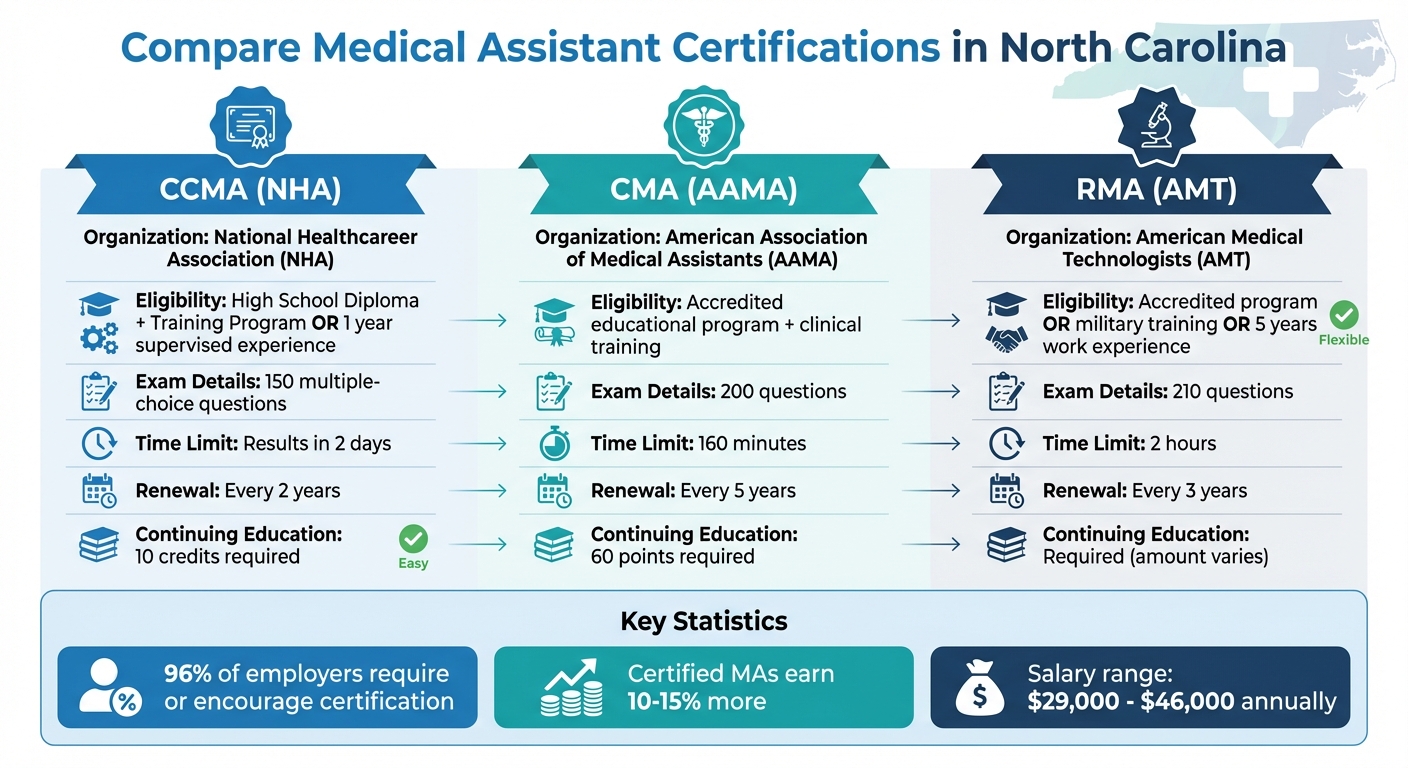
North Carolina Medical Assistant Certification Comparison: CCMA vs CMA vs RMA
Eligibility Criteria
To qualify as a medical assistant in North Carolina, you’ll need at least a high school diploma or GED. Beyond that, the specific requirements depend on the certification you’re pursuing. For the Certified Clinical Medical Assistant (CCMA) through the National Healthcareer Association (NHA), candidates must have completed a medical assistant training program within the last five years or have one year of supervised experience in the past three years.
For the Certified Medical Assistant (CMA) credential offered by the American Association of Medical Assistants (AAMA), applicants need to graduate from an accredited program that includes supervised clinical training. Meanwhile, the Registered Medical Assistant (RMA) certification, provided by American Medical Technologists (AMT), offers several eligibility routes: completing an accredited program, finishing military-based training, or having five years of work experience. Some certifications, such as those recognized by the AMCA, may also require a 100-hour externship for individuals new to the field.
These varied requirements offer several pathways to certification, each with its own exam structure and renewal schedule.
Certification Pathways
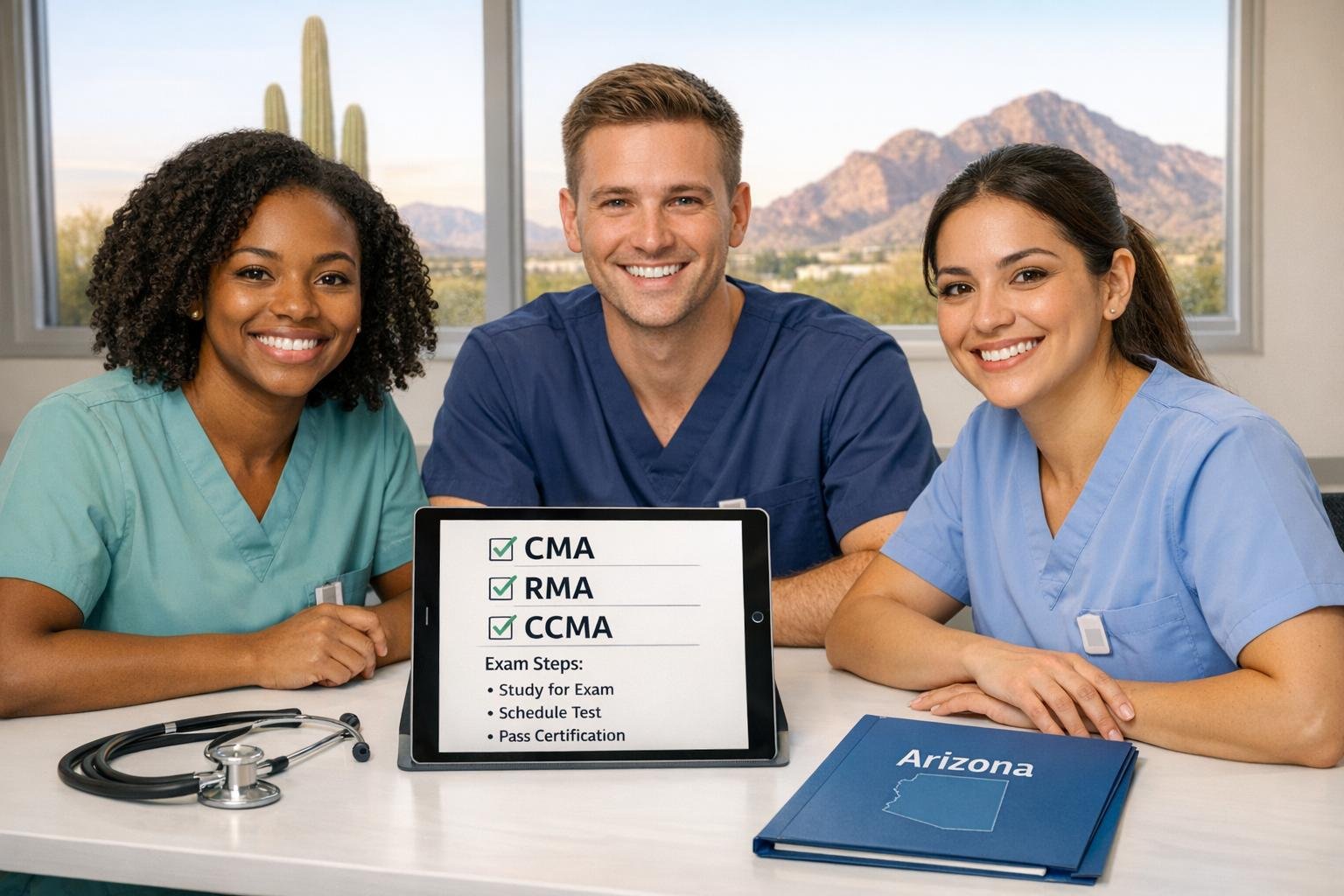
The most popular certifications for medical assistants in North Carolina include:
- Certified Clinical Medical Assistant (CCMA) from the NHA
- Certified Medical Assistant (CMA) from the AAMA
- Registered Medical Assistant (RMA) from the AMT
Each certification has a distinct exam and renewal process. For example:
- The CMA exam includes 200 questions, must be completed in 160 minutes, and requires renewal every five years.
- The RMA exam consists of 210 questions, has a two-hour time limit, and must be renewed every three years.
- The CCMA exam features 150 multiple-choice questions, with results typically available within two days. Renewal is required every two years, along with 10 continuing education credits.
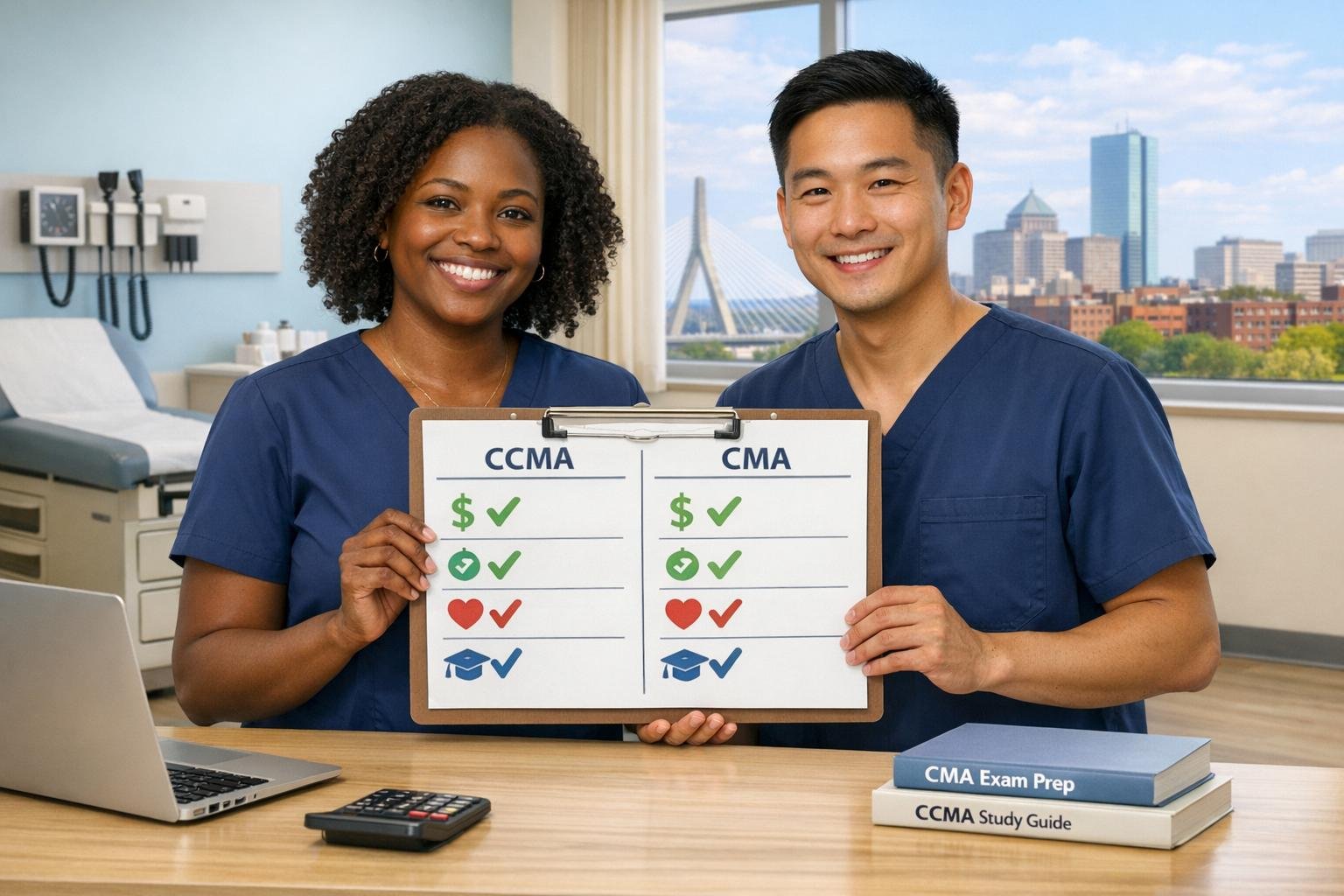
Here’s a quick comparison of the certifications:
| Certification | Organization | Primary Eligibility Requirements | Renewal Period |
|---|---|---|---|
| CCMA | NHA | High School Diploma + Training Program OR 1 year supervised experience | Every 2 years |
| CMA | AAMA | Completion of an accredited educational program plus clinical training | Every 5 years |
| RMA | AMT | Accredited program OR military training OR 5 years work experience | Every 3 years |
Why Certification Matters
While North Carolina doesn’t legally require certification for medical assistants, most employers strongly prefer or mandate it. A 2025 Industry Outlook report found that 96% of employers either require or encourage certification, and research from the National Healthcareer Association reveals that 89% of healthcare organizations expect medical assistants to hold certification.
Certification not only validates your skills and knowledge but also ensures your credentials are recognized nationwide – a key advantage if you decide to work outside North Carolina. Additionally, being certified can significantly boost your chances of landing a job or advancing your career in the state’s competitive healthcare industry. Understanding these requirements is crucial for selecting the right certification path and thriving in North Carolina’s growing healthcare sector.
Selecting an Accredited Training Program
Accredited Programs in North Carolina
Finding the right training program starts with confirming its accreditation. Look for programs approved by organizations like the Commission on Accreditation of Allied Health Education Programs (CAAHEP), the Accrediting Bureau of Health Education Schools (ABHES), or those recognized by the National Healthcareer Association (NHA).
In North Carolina, you’ll find several accredited options. Community colleges such as Alamance Community College in Graham, Carteret Community College in Morehead City, and Fayetteville Technical Community College offer programs ranging from certificates to Associate in Applied Science (AAS) degrees. These traditional programs typically take one to two years to complete, with resident tuition costs ranging from about $1,886 to $2,696 annually. They include hands-on training in on-campus labs and scheduled clinical rotations, requiring students to attend during specific hours.
For those seeking more flexibility, online certificate programs are increasingly popular. These programs are designed to be completed faster, typically within four to seven months, making them a great option for busy individuals. With such a variety of program types available, it’s crucial to choose one that balances flexibility with the support you need – something HealthCareer Certs excels at.
HealthCareer Certs CCMA Program Features
Among the accredited programs in the state, HealthCareer Certs has carved out a reputation for its flexible and modern approach. This program is especially relevant in North Carolina, where 87% of healthcare employers prefer hiring certified medical assistants. The program’s 100% online, self-paced format is ideal if you’re juggling work, family, or other responsibilities. Depending on your schedule, you can finish the coursework in as little as four weeks or take up to 12 weeks.
One of the standout features is the guaranteed externship placement, which saves you the hassle of finding your own clinical site. Many programs require students to secure their own 100-hour externships, which can be a major roadblock. Additionally, the program offers one-on-one Zoom sessions with instructors, ensuring you have personalized support whenever you need it.
To enhance your learning experience, the program includes interactive tools like 3D demonstrations, over 1,400 practice questions, 700 self-checks, quizzes, and flashcards, all accessible from your phone or computer. These resources are tailored to prepare you for the NHA CCMA exam, and the program includes comprehensive exam prep materials. Another major perk? A 100% tuition refund guarantee if you don’t land a healthcare job after earning your certification. This structure is designed to help you confidently and quickly secure your place in North Carolina’s competitive healthcare field.
Comparing Training Program Features
When deciding on a program, focus on factors that will directly impact your success, such as scheduling flexibility and exam preparation resources. If you’re managing work or family obligations, online programs offer the convenience of self-paced learning, while community colleges often require attendance at set times. The duration of programs is another consideration – online certificates can be completed in a few months, while traditional diploma or degree programs may take one to two years.
Externship support is equally important. Programs that include guaranteed externship placements handle the logistics for you, while those requiring self-directed externships can add unnecessary stress. Costs should also be evaluated carefully. Beyond tuition, check whether the program covers the $259 CCMA exam fee and provides study materials. While community colleges often have lower tuition rates for residents, additional expenses like lab fees and textbooks can add up.
Finally, the quality of exam preparation can make or break your certification journey. For example, Central Piedmont Community College has achieved a 100% pass rate on the AAMA national certification exam for 15 consecutive years. Look for programs offering practice tests, study guides, and dedicated support to maximize your chances of passing on the first try.
Preparing for the NHA CCMA Exam
Study Strategies and Resources
Getting ready for the CCMA exam is crucial for advancing in your medical assisting career. Thankfully, the NHA offers a variety of tools to help you prepare and boost your chances of passing on the first try. Start by downloading the free CCMA Test Plan – this guide outlines every topic you’ll face on the exam, giving you a clear focus for your study sessions.
Make your preparation engaging with the interactive online study guide. It includes games, quizzes, and flashcards to make learning less monotonous. For added convenience, the NHA Mobile app lets you review flashcards anytime, even on a packed schedule. To zero in on your weaker areas, take advantage of the three practice tests (each allowing two attempts) and the Focused Review® feature. These tools ensure you’re spending time where it’s needed most. For additional support, HealthCareer Certs offers comprehensive prep materials that complement NHA’s resources, providing a solid foundation for tackling the exam content.
Exam Content Overview
The CCMA exam includes 180 questions – 150 of them scored and 30 unscored pretest items – and you’ll have 3 hours to complete it. To pass, you need a scaled score of 390 or higher on a 200–500 scale. In practical terms, this means answering about 78% of the questions correctly.
Clinical Patient Care is the most heavily weighted section, making up 56% of the exam. This part tests your knowledge of vital signs, assisting with exams, giving injections, performing EKGs, phlebotomy, and lab procedures. Beyond clinical tasks, you’ll also be assessed on administrative duties like managing patient check-ins, answering phones, and maintaining electronic health records. Communication and patient interaction skills are equally important.
The exam doesn’t just test technical ability – it also evaluates soft skills. The National Healthcareer Association highlights this by stating:
Professionalism and critical thinking are the most important soft skills employers are looking for when hiring a clinical medical assistant.
This focus on certification is reflected in the industry, where 96% of healthcare employers require or encourage certification, and 89% specifically seek certified medical assistants.
Common Challenges and How to Overcome Them
Knowing what’s on the exam is just one piece of the puzzle. Managing time and nerves is just as critical. With 180 questions in 3 hours, you’ll need to pace yourself – aim for roughly one minute per question. Use the practice tests to refine your timing and get comfortable handling tougher questions.
Anxiety can also be a hurdle. Completing all three practice tests can help you feel more confident and familiar with the exam format. On exam day, make sure to get a good night’s sleep and arrive or log in 30 minutes early to handle biometric scans and ID checks without feeling rushed.
If you’re taking the exam via Live Remote Proctoring (LRP), technical hiccups can be a distraction. To avoid these, run a system compatibility check 24 hours before the exam. Ensure your setup meets the minimum requirements of 466 kb/s bandwidth and 2 GB RAM. Using Google Chrome, disabling automatic updates, and testing your webcam and microphone ahead of time can also help ensure a smooth experience. With the right preparation and tools, you’ll be ready to tackle the CCMA exam – keeping in mind that the 2021 pass rate was 77%.
Applying for Certification and Starting Your Career
Submitting Your Certification Application
In North Carolina, medical assistants don’t need a state license or registration. After passing your exam, you’ll handle your credentials directly through the national certification organization, such as the National Healthcareer Association (NHA), American Association of Medical Assistants (AAMA), or American Medical Technologists (AMT). This makes the process quicker and more streamlined – your certificate will be accessible online within two days, ready for job applications.
For those who passed the NHA CCMA exam, your results and certificate will appear in your online account within 48 hours. You can download and print it for job applications. If you took the AMCA exam, you’ll receive a mailed certificate along with a digital verification badge that employers can easily verify. Employers typically confirm your credentials directly with the certifying organization.
Job Search Tips for Certified Medical Assistants
Once you’re certified, it’s time to jump into North Carolina’s healthcare job market. With 6,800 openings statewide, there’s no shortage of opportunities. Start by focusing on major healthcare systems like UNC Health, Duke Nursing, Atrium Health, OrthoCarolina, and Pediatrix, all of which accept direct applications. The Research Triangle area, in particular, is known for its wealth of healthcare opportunities.
The North Carolina Society of Medical Assistants (NCSMA) offers a job board featuring openings from employers like Eagle Physicians & Associates and Atrium Health. You can also explore roles through the North Carolina Community Health Center Association (NCCHCA), which lists positions at community health centers such as the C.W. Williams Community Health Center in Charlotte. Before applying, confirm that your certification is accepted by the employer. For example, Atrium Health acknowledges credentials from organizations like AAMA, NHA, AMT, and NCCT.
When applying, emphasize your hands-on experience, such as your 100-hour clinical externship, which showcases your practical skills. Highlight abilities like phlebotomy, EKG operation, patient triage, and electronic health record management during interviews. Some employers even offer sign-on bonuses to attract talent. For instance, Eagle Physicians & Associates recently provided a $1,500 bonus for new medical assistants working at least 0.50 FTE after six months of satisfactory performance.
Certified medical assistants in North Carolina typically earn 10–15% more than their uncertified counterparts. Entry-level salaries start around $29,000, while experienced professionals can earn up to $46,000, with a median annual wage of $42,600. The field is growing quickly, with 3,426 annual job openings and a 2.1% annual growth rate.
Career Growth Opportunities
Certification isn’t just a starting point – it’s a gateway to long-term career advancement in North Carolina’s healthcare sector. Medical assisting can lead to higher-paying roles with additional education. For instance, earning an Associate of Science degree can increase wages and provide transferable credits for bachelor’s programs in healthcare or public health. You could also pursue nursing or physician assistant programs at institutions like Duke, UNC, ECU, or Wake Forest. Licensed Practical Nurses (LPNs) and Registered Nurses (RNs) in the state earn an average of $72,000, while physician assistants and nurse practitioners earn about $115,000 annually.
Specializing is another way to advance. Consider focusing on areas like dermatology, pediatrics, urgent care, or becoming an Ophthalmic Assistant. Joining the North Carolina State Society of Medical Assistants (NCSMA) can help you stay informed about professional development opportunities, continuing education, and legislative updates. The AAMA also has 22 local chapters in the state, offering networking and growth opportunities.
To stay competitive, you’ll need to maintain your certification. CCMA holders must complete 10 continuing education credits every two years, while CMA (AAMA) holders require 60 points every five years. Maintaining NHA certification costs about $8 per month.
As Jessica Aponte, a certified medical assistant, shared:
My NHA certification has helped me financially advance my career. Most importantly, it has given me the opportunity to get a job that allows me to be a better mom by being home in the evenings and on the weekends.
- Jessica Aponte, CCMA
With 96% of employers requiring or encouraging certification and 35% noting that medical assistants are taking on more responsibilities than ever, keeping your credentials current and expanding your skills can open doors to a fulfilling and stable career in North Carolina’s growing healthcare industry.
Conclusion
While certification isn’t a legal requirement in North Carolina, earning a nationally recognized credential can open doors to better job opportunities and higher pay. The process is straightforward: you need to meet basic requirements (like being at least 18 years old and having a high school diploma or GED), complete an accredited training program, gain practical experience through a supervised externship, and pass a national certification exam from organizations such as the NHA, AAMA, or AMT.
This certification has a direct impact on your career. Certified medical assistants typically earn 10–15% more, with salaries ranging from $29,000 to $46,000 annually, and the state offers a strong job market for this role.
HealthCareer Certs offers a 100% online, self-paced Clinical Medical Assistant training program designed to help you succeed. The program includes over 40 hours of training, covering clinical skills, administrative tasks, and exam preparation. It also guarantees externship placements, provides interactive learning tools, and offers one-on-one instructor support.
To ensure you’re on the right path, make sure your program is accredited by CAAHEP or ABHES. Keep up with continuing education requirements – CCMA holders, for example, need 10 credits every two years, costing about $8 per month. Joining professional organizations like the North Carolina State Society of Medical Assistants can also help you stay competitive in the field.
With North Carolina’s healthcare industry expanding rapidly – especially in areas like the Research Triangle – certified medical assistants are in high demand. By completing focused training and earning your certification, you’ll be well-positioned to succeed in one of the fastest-growing healthcare markets in the country.
FAQs
Which certification should I choose: CCMA, CMA, or RMA?
Choosing between CCMA, CMA, and RMA comes down to your career goals and how each certification aligns with them. While all three are nationally recognized, they are issued by different organizations and come with distinct requirements. Employers often favor certifications like CMA or RMA when it comes to career growth opportunities. That said, North Carolina doesn’t require certification for medical assistants. To make the best decision, think about your educational background and where you see your professional path heading.
Can I get certified in North Carolina with online training?
You can earn a medical assistant certification in North Carolina by enrolling in online training programs. These programs are designed to help you prepare for certification exams, such as the CCMA, while offering the convenience of studying from home. Just make sure the program you choose aligns with your certification goals and fulfills the requirements for residents of North Carolina.
How do I keep my certification active after I pass?
To maintain your medical assistant certification, you’ll typically need to renew it every two years by meeting the criteria outlined by your certifying body or state. In North Carolina, this could involve activities like completing continuing education courses, updating your employment details, or meeting specific work experience requirements. Missing the renewal deadline might lead to losing your certification, which could mean reapplying or undergoing retraining to get it back. Be sure to review the exact renewal steps for your certification to stay on track.