Medical assistant certification in Massachusetts is optional but highly preferred by employers. While state law doesn’t mandate certification, about 89% of employers require or prefer it, offering better job opportunities and higher pay. Certified medical assistants in Massachusetts earn 10% more than non-certified peers, with an average salary of $48,000 annually, above the national average.
Here’s a quick overview:
- Top Certifications: Certified Clinical Medical Assistant (CCMA) and Certified Medical Assistant (CMA – AAMA).
- Certification Costs: CCMA ($155-$160), CMA ($125-$250).
- Eligibility:
- CCMA: Training program or 1 year of clinical experience.
- CMA: Graduation from an accredited medical assistant program.
- Exam Focus: Clinical skills like EKG, phlebotomy, and patient care dominate both certifications.
- Job Growth: Employment expected to grow 16% by 2031.
Certification enhances career prospects, increases earning potential, and opens doors to leadership roles. Whether you’re new to the field or experienced, pursuing certification is a smart career move in Massachusetts.
Top 10 ONLINE CCMA Courses (NHA-approved) | By a Certified MA
sbb-itb-7a67ffa
Medical Assistant Certification Options
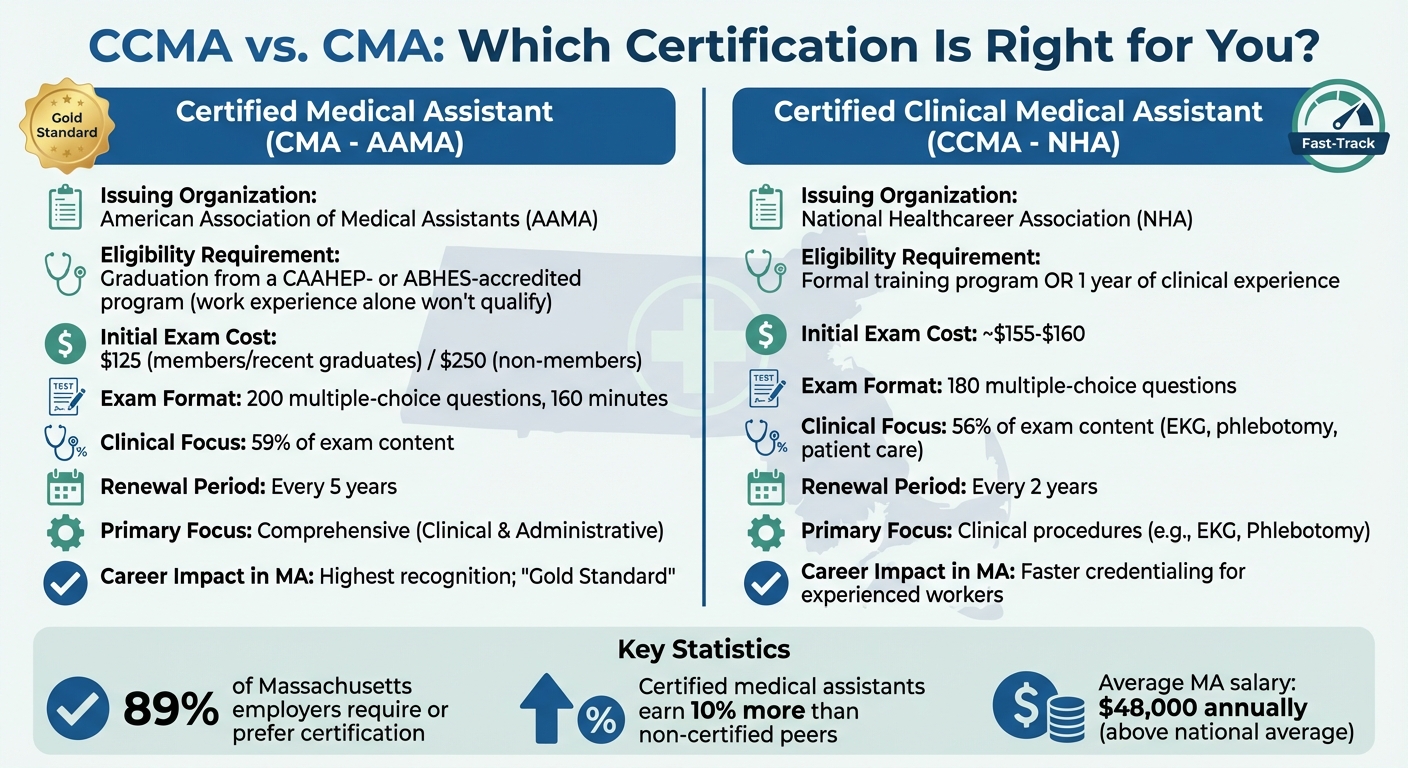
CCMA vs CMA Certification Comparison for Massachusetts Medical Assistants
Medical assistants in Massachusetts have several certification paths to consider, with the Certified Clinical Medical Assistant (CCMA) and Certified Medical Assistant (CMA – AAMA) being two of the most recognized. The choice between these certifications depends on career aspirations and educational background. Below is a breakdown of what each certification entails, including requirements, exam details, and their relevance in the healthcare field.
Certified Clinical Medical Assistant (CCMA)
The CCMA certification, offered by the National Healthcareer Association (NHA), focuses heavily on clinical skills needed for patient care. This credential ensures proficiency in areas such as phlebotomy, EKG administration, infection control, and monitoring vital signs – skills that are in high demand across Massachusetts healthcare facilities.
To be eligible for the CCMA, candidates must either complete a formal training program or have one year of clinical experience. The exam costs around $155 and includes 180 multiple-choice questions, with clinical patient care making up about 56% of the content.
"Earning a certification such as the CCMA establishes a medical assistant as a caring, responsible professional who has undergone a study and assessment program to validate their credentials."
– Westfield State University
This certification is ideal for roles in hospitals, outpatient clinics, and physicians’ offices that emphasize direct patient care. In fact, approximately 89% of healthcare employers require or prefer this credential.
Certified Medical Assistant (CMA – AAMA)
The CMA credential, awarded by the American Association of Medical Assistants (AAMA), is often viewed as the leading certification in the field. To qualify for the CMA, candidates must graduate from a program accredited by either the Commission on Accreditation of Allied Health Education Programs (CAAHEP) or the Accrediting Bureau of Health Education Schools (ABHES).
"The CMA is the only major credential requiring graduation from an accredited program – work experience alone won’t qualify you."
– CareerGuidePro
The CMA exam assesses both clinical and administrative skills through 200 multiple-choice questions, with clinical topics accounting for about 59% of the test. The exam takes 160 minutes to complete and costs $125 for AAMA members or recent graduates, and $250 for non-members. This certification is widely recognized by major healthcare systems, specialty centers, and government employers.
CCMA vs. CMA: Key Differences
Here’s a side-by-side comparison of the two certifications:
| Feature | Certified Medical Assistant (CMA) | Certified Clinical Medical Assistant (CCMA) |
|---|---|---|
| Issuing Organization | American Association of Medical Assistants (AAMA) | National Healthcareer Association (NHA) |
| Eligibility Requirement | Graduation from a CAAHEP- or ABHES-accredited program | Formal training or 1 year of work experience |
| Initial Exam Cost | $125 (members) / $250 (non-members) | ~$155 |
| Renewal Period | Every 5 years | Every 2 years |
| Primary Focus | Comprehensive (Clinical & Administrative) | Clinical procedures (e.g., EKG, Phlebotomy) |
| Career Impact in MA | Highest recognition; "Gold Standard" | Faster credentialing for experienced workers |
For Massachusetts medical assistants, the CMA is an excellent choice for those graduating from accredited programs, as it offers broad recognition and career opportunities. On the other hand, the CCMA provides a quicker path to certification, especially for those with prior experience. Adding specialty certifications, such as in phlebotomy or EKG, can further enhance job prospects in the state.
Eligibility Requirements and Certification Pathways
To pursue certification as a Certified Clinical Medical Assistant (CCMA) or Certified Medical Assistant (CMA), you’ll need at least a high school diploma or GED – this is the baseline requirement for all national medical assistant certification exams. From there, you can choose between the CCMA and CMA certification paths, each tailored to different career goals and experiences.
CCMA Eligibility Requirements
For the CCMA, there are two main qualification options: completing a medical assistant training program or having one year of documented full-time clinical experience. This flexibility makes the CCMA a great choice for those transitioning into healthcare or already working in the field without formal credentials.
In Massachusetts, many programs, like those at Massasoit Community College, include a 245-hour clinical practicum as part of their curriculum, meeting the training program requirement. If you’re qualifying through work experience, it’s important to keep thorough records of your clinical hours, as the NHA requires proof of your experience. The CCMA certification remains an option regardless of specific state regulations.
Unlike the CCMA’s adaptable approach, the CMA certification focuses more on formal academic preparation.
CMA (AAMA) Eligibility Requirements
The CMA certification takes a more structured path. To qualify, you must graduate from a medical assisting program accredited by CAAHEP or ABHES – work experience alone won’t suffice. This educational requirement emphasizes the CMA’s strong foundation in academic training.
If you’re a recent graduate, you can register for the CMA exam after completing your classroom coursework, even if your practicum isn’t finished yet. The AAMA considers applicants “recent graduates” if they apply within 12 months of completing their program. Medical assistant programs in Massachusetts are designed to meet AAMA and MAERB standards, ensuring students are well-prepared for the exam right after graduation.
While Massachusetts doesn’t require certification for medical assistants by law, about 89% of employers either require or strongly prefer it. Additionally, certified medical assistants tend to earn around 10% more than their non-certified peers, making the effort to obtain certification a smart financial move.
How to Prepare for Certification Exams
Preparing for certification exams requires focused, distraction-free study sessions. To get started, download the free, detailed test plan from the NHA website to understand the exam format and create a strategic study plan. The exam places heavy emphasis on Clinical Patient Care, which accounts for 54% to 56% of the scored questions. Other areas include Administrative Assisting (8-13%), Foundational Knowledge (10%), and smaller sections like anatomy, communication, and medical law. Prioritize areas where you feel less confident early in your preparation.
Study Resources and Materials
HealthCareer Certs offers a CCMA program packed with 1,400+ practice questions, 700 self-checks, interactive 3D demos, quizzes, and flashcards. This self-paced program allows you to study at your convenience, and you can schedule one-on-one Zoom sessions for additional support when needed.
The NHA also provides official study tools: the online study guide costs $62, the practice exam is $44, or you can purchase both for $94. These resources closely mimic the exam format, helping you identify weak areas and improve your performance. Taking timed practice exams is particularly effective, as it builds familiarity with the three-hour testing experience and strengthens test-taking stamina.
Use practice test results to refine your study plan. For example, if your scores are low in Medical Law and Ethics or Anatomy and Physiology, dedicate extra time to those areas. The passing score is 390 out of 500, which translates to about 78%, and the national pass rate in 2024 was 81.38%. Starting your preparation well in advance – rather than cramming – helps you retain complex medical terms and clinical procedures more effectively.
Once you’ve gathered the right study materials, you’ll be ready to register and complete the exam without any hiccups.
Exam Registration and Testing Process
The NHA CCMA exam costs $160. You can take the test at your postsecondary institution, a PSI testing center, or through live remote proctoring from home. Remote testing requires a stable internet connection, a webcam, and a microphone. Before starting, you’ll need to complete a 360-degree room scan and ensure your system meets all technical requirements.
For in-person testing, arrive early with a valid government-issued ID and two No. 2 pencils. Note that calculators and digital devices are not allowed. Since the exam lasts three hours with no scheduled breaks, take care of personal needs beforehand. If you don’t pass, there’s a 30-day waiting period before retaking the test, and you’ll need to pay the $160 fee again. After three failed attempts, a one-year waiting period applies.
Maintaining Certification and Continuing Education
Once you’ve earned your certification, keeping it active is crucial for staying competitive in your career. The CCMA credential isn’t a one-and-done deal – it requires regular renewal. Knowing the renewal process and requirements ensures you don’t risk losing your certification, which can directly impact your career opportunities and earnings.
CCMA Certification Renewal Requirements
The CCMA credential needs to be renewed every two years. During each renewal cycle, you must complete 10 continuing education (CE) credits to keep your certification valid. Since Massachusetts doesn’t have specific state requirements for certification renewal, you’ll follow the guidelines set by the National Healthcareer Association (NHA).
"Recertification standards vary based on the national organization and graduates are responsible for maintaining their national credential." – Massasoit Community College
It’s smart to earn and document your CE credits consistently throughout the two years instead of scrambling at the last minute. Letting your certification lapse means you’ll need to retake the exam to regain it. This could be a major setback, especially since about 89% of employers require or strongly prefer certification. Plus, maintaining your certification isn’t just about staying employed – it can also boost your income. Certified medical assistants earn about 10% more than their non-certified peers over the course of their careers.
Continuing Education Resources
The NHA provides several tools to help you earn the required 10 CE credits. Their online portal offers resources like:
- MA Skillsbuilder: Focuses on clinical and administrative skills.
- PersonAbility: Enhances soft skills like communication and teamwork.
- Principles of Health Coaching: Covers patient interaction and health education.
These modules include topics like medical terminology, anatomy, administrative tasks, and patient communication, giving you a well-rounded skill set.
If you work in Massachusetts, check with your employer to see if they cover renewal fees or offer professional development programs that count toward CE credits. Many healthcare facilities support their employees’ continuing education as part of their investment in staff development. Keep track of all your CE activities – save certificates and note completion dates – to make the renewal process smoother when your two-year cycle is up. Treat continuing education with the same diligence as exam prep – it’s key to long-term career growth.
Massachusetts Training Programs and State Guidelines
Accredited Medical Assistant Programs in Massachusetts
While Massachusetts doesn’t mandate certifications for entry-level medical assistant roles, 89% of employers either require or prefer certification. Training programs across the state align with national standards (CAAHEP, MAERB, NHA), ensuring students are well-prepared for certification exams and practical job responsibilities.
Here’s a snapshot of some programs available in Massachusetts:
| Institution | Location | Program Length | Externship Hours | Certification Prep |
|---|---|---|---|---|
| Massasoit Community College | Canton | 9 Months | 245 Hours | CMA (AAMA), RMA (AMT), or CCMA (NHA) |
| Holyoke Community College | Holyoke | 16 Weeks | 160 Hours | CCMA (NHA) |
| Millennium Training Institute | Woburn/Braintree | 16 Weeks | 160 Hours | Clinical Medical Assistant |
| Mount Wachusett Community College | Gardner | ~1 Year | 160 Hours | CMA (AAMA) |
| Metrowest Healthcare Academy | Framingham | 720 Total Hours | 300 Hours | CCMA, CMAA, CPT, CET (MedCA) |
| Westfield State University | Online | Self-paced | N/A | CCMA (NHA) |
For example, Massasoit Community College boasts 90-100% job placement rates annually, highlighting the program’s ability to equip students for the local job market. If you’re looking for flexibility, Westfield State University offers an online CCMA program that guarantees externship placement and can be completed in as little as 4-12 weeks.
These programs combine classroom learning with clinical externships, giving students the opportunity to practice their skills in real healthcare environments under professional supervision. This hands-on component is a key part of preparing for the demands of the workplace.
With accredited programs offering comprehensive training, students are well-prepared to meet Massachusetts’ clinical practice standards and succeed in healthcare roles across the state.
Massachusetts Clinical Practice Requirements
In addition to completing a training program, Massachusetts has specific clinical practice standards to ensure both student readiness and patient safety. Certification in the state requires meeting these rigorous health and safety guidelines.
Before starting clinical externships, students must provide a complete immunization record, including proof of COVID-19 vaccination, flu shots, and recent TB test results. Programs also require CORI (Criminal Offender Record Information) and SORI (Sex Offender Registry Information) background checks. Clinical sites won’t allow participation without these documents.
Some programs, such as Holyoke Community College, take additional steps, like requiring drug screenings that prohibit marijuana use – even though it’s legal in Massachusetts. Other requirements may include a physical exam and proficiency testing in Math and English (e.g., "WorkKeys"). It’s important to review your program’s policies early to avoid delays.
Once cleared, students perform clinical duties under the supervision of licensed healthcare professionals. The tasks you’ll handle depend on the practice setting, but all require oversight to ensure compliance with state regulations.
Medical assistants in Massachusetts enjoy an average annual salary of $48,000, which surpasses the national average of $46,000. With employment in the field expected to grow by 14% through 2032, completing a well-rounded training program and meeting all clinical requirements sets you up for a rewarding career in the state’s healthcare industry.
Conclusion
Although medical assistant certification isn’t legally required in Massachusetts, it significantly improves career opportunities. With 89% of employers either requiring or strongly encouraging certification, earning credentials like the CCMA or CMA (AAMA) can lead to better-paying jobs. In fact, medical assistants in Massachusetts earn an average of $48,000 annually, which is higher than the national average of $46,000. Achieving certification involves completing accredited programs, gaining hands-on experience through externships, and passing a national exam.
The process begins with selecting an accredited training program, completing clinical externships (typically ranging from 160 to 245 hours), and then passing a national certification exam. Options like the CMA (AAMA), costing between $125 and $250 for eligible candidates, or the CCMA, often offered through workforce development programs, cater to different career goals. Both certifications prepare you for roles in clinical and administrative healthcare settings.
For those looking for flexible training options, online programs make certification more accessible. HealthCareer Certs, for instance, offers a fully online CCMA program with self-paced learning, one-on-one guidance, and guaranteed externship placements. This program can be completed in just 4-12 weeks, helping you quickly meet Massachusetts’ clinical practice standards and start your career.
With strong job growth projections and accessible training paths, there’s no better time to begin your journey. Start today and become part of the growing community of medical assistants contributing to healthcare in Massachusetts.
FAQs
Which certification should I choose in Massachusetts: CCMA or CMA (AAMA)?
In Massachusetts, two prominent certifications for medical assistants are the CCMA (Certified Clinical Medical Assistant) and the CMA (AAMA) (Certified Medical Assistant). Both are well-respected and can boost your career opportunities. Since Massachusetts does not mandate state-specific licensing for medical assistants, either credential can strengthen your job applications. Your choice should depend on your career goals and the preferences of healthcare employers in your area.
How do I get certified if I already have medical assistant work experience but no accredited program?
If you have experience working as a medical assistant but haven’t gone through an accredited program, you can still earn certification by taking an exam like the Certified Clinical Medical Assistant (CCMA) offered by the National Healthcareer Association (NHA). Make sure your work experience meets the eligibility criteria, use study guides or online courses to prepare, and pass the certification exam. While Massachusetts doesn’t mandate formal certification, earning one can help demonstrate your skills and knowledge.
What are the main reasons Massachusetts employers prefer certified medical assistants?
Massachusetts employers often prefer hiring certified medical assistants, even though the state doesn’t mandate certification. Why? Certification highlights proven clinical and administrative expertise, showing that the individual can meet safety and regulatory requirements. This translates to more efficient, safer, and patient-centered care – qualities that are highly sought after in healthcare environments.