
In Arizona, medical assistants can work without state-specific licensure or certification. However, most employers prefer candidates with national certifications like CMA (Certified Medical Assistant), RMA (Registered Medical Assistant), or CCMA (Certified Clinical Medical Assistant). These credentials not only enhance job prospects but also lead to higher salaries, with certified medical assistants earning about 10% more than their non-certified peers.
Key Points:
- Certification is not legally required, but it’s highly valued by employers.
- Job growth for medical assistants in Arizona is expected to rise by 23% by 2030.
- Median salary for medical assistants in Arizona: $45,440 annually.
- Entry-level salaries range between $37,840–$40,000, while experienced professionals can earn up to $54,260.
- National certifications like CMA, RMA, and CCMA require completing an accredited training program, passing an exam, and maintaining credentials through continuing education.
Certification Process:
- Complete an accredited program (CAAHEP or ABHES-approved).
- Meet prerequisites: High school diploma/GED, CPR certification, and official transcripts.
- Choose a certification: CMA, RMA, or CCMA.
- Pass the exam: Exam fees range from $125–$165.
- Maintain certification: Renew periodically with continuing education credits.
Arizona offers both in-person programs (e.g., Arizona College or Pima Medical Institute) and online options (e.g., HealthCareer Certs) to prepare for certification. Costs for training programs typically range from $17,000–$20,000, with online courses offering flexible schedules.
Certifications can help you secure roles in hospitals, surgical centers, and clinics, where salaries and career growth opportunities are higher. Although not mandatory, certification is a smart career move for Arizona’s growing healthcare industry.
Medical Assistant Certification Exam Breakdown
sbb-itb-7a67ffa
Arizona’s Requirements for Medical Assistants
In Arizona, there’s no legal requirement for medical assistants to obtain state-specific certification or licensure to start working. Essentially, you could begin your career without formal credentials. However, while not legally required, earning a national certification is widely recognized as the industry standard. It demonstrates your skills to potential employers and can open doors for career growth and advancement.
Medical assistants in Arizona work under the supervision of licensed physicians, meaning they do not operate independently.
Prerequisites for Certification
If you’re aiming for national certification, there are a few key requirements you’ll need to meet:
- A high school diploma or GED
- Completion of an accredited medical assistant program (approved by CAAHEP or ABHES)
- A current CPR/BLS for Healthcare Providers certification
- Official transcripts and, in some cases, a typing test
National Medical Assistant Certifications
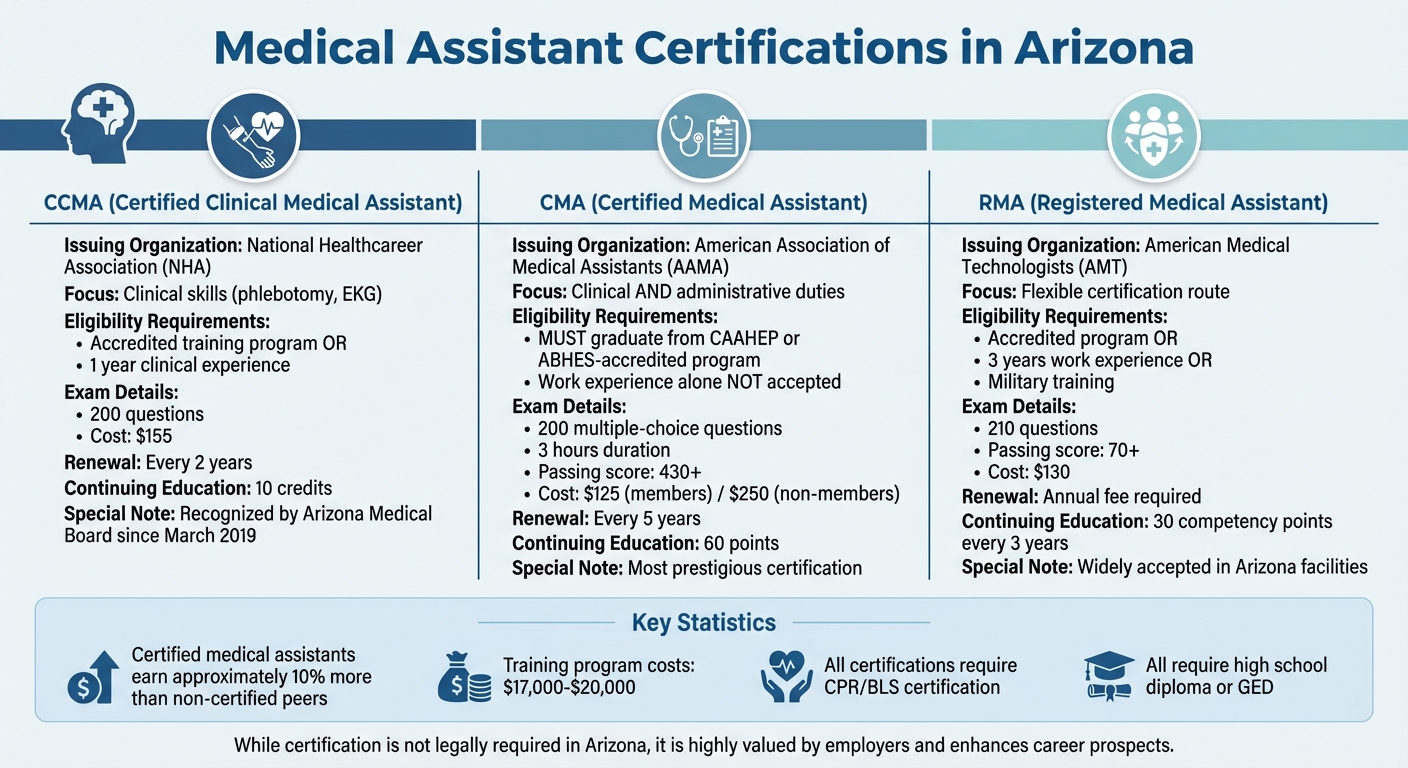
Medical Assistant Certifications in Arizona: CMA vs RMA vs CCMA Comparison
In Arizona, while certification isn’t legally required, most healthcare employers prefer candidates with national credentials. The three primary certifications recognized nationwide are the Certified Medical Assistant (CMA), Registered Medical Assistant (RMA), and Certified Clinical Medical Assistant (CCMA). These certifications are widely accepted across healthcare facilities, though specific employer preferences can vary.
"Certified medical assistants earn roughly 10% more than their non-certified peers." – CareerGuidePro
Each certification differs in terms of eligibility requirements and renewal processes. For example, the CMA is often seen as the most prestigious due to its stringent requirement of graduating from a CAAHEP- or ABHES-accredited program – work experience alone isn’t enough. The RMA, by contrast, offers more flexibility, accepting candidates with accredited education, three years of work experience, or military training. Meanwhile, the CCMA accepts candidates who have completed a training program or have at least one year of clinical experience. Notably, the Arizona Medical Board officially recognized the CCMA in March 2019, further solidifying its standing.
Here’s a closer look at each certification:
Certified Clinical Medical Assistant (CCMA)
The CCMA, offered by the National Healthcareer Association (NHA), emphasizes clinical skills like phlebotomy and EKG procedures. Candidates can qualify by completing an accredited training program or by having one year of clinical work experience. The exam includes 200 questions and costs about $155. Certification renewal requires earning 10 continuing education credits every two years. For medical assistants already working without formal credentials, the CCMA provides a straightforward path to certification.
Certified Medical Assistant (CMA)
The CMA, issued by the American Association of Medical Assistants (AAMA), is well-regarded for its focus on both clinical and administrative duties. To qualify, candidates must graduate from a CAAHEP- or ABHES-accredited program – work experience alone doesn’t meet the criteria. The exam features 200 multiple-choice questions, takes roughly three hours, and requires a passing score of 430 or higher. Exam fees are $125 for AAMA members and $250 for non-members. Many institutions in Arizona, such as Arizona College, recommend the CMA as a way to strengthen a resume. Renewal is required every five years and involves completing 60 continuing education points.
Registered Medical Assistant (RMA)
The RMA, administered by American Medical Technologists (AMT), provides a flexible certification route. Candidates can qualify through an accredited program, three years of work experience, or military training. The exam has 210 questions, requires a passing score of 70 or higher, and costs approximately $130. Schools like Pima Medical Institute and Arizona College offer programs to prepare for the RMA exam. To maintain certification, RMAs must pay an annual fee and earn 30 continuing competency points every three years. The RMA is widely accepted in Arizona healthcare facilities and is a strong alternative to the CMA.
Medical Assistant Training Programs in Arizona
Arizona provides two primary options for medical assistant training: traditional in-person programs offered by colleges and universities and fully online programs tailored for students seeking flexibility, particularly those balancing work or other commitments.
When selecting a program, accreditation is a critical consideration. Programs accredited by the Accrediting Bureau of Health Education Schools (ABHES) or the Commission on Accreditation of Allied Health Education Programs (CAAHEP) adhere to rigorous educational standards. Graduating from one of these programs ensures eligibility for nationally recognized certification exams, which is an essential step toward becoming certified in Arizona.
In-Person Training Programs
Campus-based programs in Arizona vary in length, offering options like 7-month diploma programs or 2-year associate degrees. For instance, Arizona College provides an ABHES-accredited "Medical Assistant with Phlebotomy" diploma program. This program takes approximately 7 months to complete and prepares graduates for certifications such as the Registered Medical Assistant (RMA) through AMT and the Certified Medical Assistant (CMA) through AAMA.
The cost for these programs typically ranges between $17,000 and $20,000, covering tuition, books, uniforms, and certification fees.
One of the standout features of in-person programs is the integration of laboratory sessions and clinical externships within the curriculum. This hands-on experience is invaluable, especially for those new to the healthcare field, as it provides practical skills in a structured environment.
While in-person programs offer direct, hands-on training, online options provide comparable preparation with added flexibility.
100% Online Training with HealthCareer Certs

For those needing a more adaptable schedule, HealthCareer Certs offers a fully online Certified Clinical Medical Assistant (CCMA) program. Approved by the National Healthcareer Association (NHA) and recognized by the Arizona Medical Board since March 2019, this program is designed to fit into a busy lifestyle. Students typically dedicate 15–20 hours per week and complete the program in about 28 weeks.
The program includes interactive learning tools, one-on-one Zoom sessions, and guaranteed externship placements to ensure hands-on clinical experience – an essential requirement for many employers in Arizona. It specifically prepares students for the NHA CCMA exam, which has a fee of $165.
"The NHA’s Medical Assistant Certification (CCMA) is now accepted by the Board, allowing educational institutions and health care employers in the state of Arizona to utilize the CCMA and NHA’s full suite of learning resources." – Jessica Langley, NHA News Center
The online format is ideal for individuals juggling other responsibilities. Course materials are accessible from any device, allowing students to study during evenings or weekends. However, the flexibility of online learning demands strong self-motivation and discipline to stay on track without the structure of regular class meetings.
How to Get Medical Assistant Certification
Becoming a certified medical assistant in Arizona involves a straightforward process, starting with the right training and continuing through to maintaining your credentials. Here’s a step-by-step guide to help you navigate the journey.
Step 1: Complete an Accredited Program
Begin by ensuring your training program is accredited by either ABHES or CAAHEP. This is essential for eligibility to take nationally recognized certification exams like the CMA, RMA, or CCMA. To enroll, you’ll need a high school diploma or GED. Some schools, such as Pima Medical Institute, might also require you to pass a typing test before admission. Once you’ve confirmed these requirements, submit your application along with any necessary documents. If financial aid is needed, check if the program is WIOA-approved.
Step 2: Apply for Certification Exams
Once your training is complete, apply for certification through the appropriate organization: AAMA for CMA, AMT for RMA, or NHA for CCMA. Applications are typically submitted online, and you’ll need to upload supporting documents. Exam fees vary depending on the certification type, so be sure to check those details in advance. A key advantage of the CMA exam is that you can register as soon as you finish your classroom coursework – even if your externship is still in progress. If you’re applying more than 12 months after graduating, make sure to have an official transcript ready.
Step 3: Prepare for the Certification Exam
Effective preparation is crucial for success. Use study guides and materials provided by your certifying organization. For example, the AAMA offers tailored resources for the CMA exam, while AMT provides materials for the RMA. Many training programs also include helpful textbooks like Medical Assisting Certification Exam Review and Comprehensive Medical Assisting in their curriculum. Once your application is approved, schedule your exam date to establish a clear study timeline. To pass, you’ll need a score of 430 or higher for the CMA exam or at least 70 for the RMA exam.
Step 4: Pass the Exam and Get Certified
After preparing thoroughly, focus on passing your exam. Once certified, you’ll be ready to pursue opportunities in Arizona’s healthcare sector. The Arizona Medical Board accepts certifications from organizations accredited by the National Commission for Certifying Agencies (NCCA) or the American National Standards Institute (ANSI), which includes the NHA’s CCMA certification. According to updated board rules, medical assistants can qualify for employment by completing an approved training program or passing an accredited certification exam.
Step 5: Maintain Certification
Staying certified requires periodic renewal and continuing education to keep up with changes in healthcare practices. Each certifying body has its own renewal timelines and requirements. For instance, the AAMA allows you to apply for recertification by providing your previous certificate number and the date of your last certification. Be sure to check with your certifying organization for specific deadlines and the required continuing education hours to ensure your certification remains active.
Conclusion
Getting your Arizona medical assistant certification can open up exciting career opportunities. With job growth expected to hit 23% by 2030 and a median annual salary of $45,440 in Arizona, the future looks bright for those entering this field. While certification isn’t legally required in the state, it demonstrates your expertise and strengthens your resume, making it an important step for career advancement.
To earn your certification, complete an accredited training program approved by ABHES or CAAHEP, study using official materials, and pass a nationally recognized exam such as the CCMA, CMA, or RMA. The Arizona Medical Board acknowledges certifications from accredited programs. As Jessica Langley from NHA explains:
"Proper accreditation indicates that the certification program adheres to rigorous guidelines surrounding examination design and development, psychometric defensibility, exam administration, and item security".
For a flexible and convenient option, HealthCareer Certs offers a fully online, self-paced program. It includes interactive tools, guaranteed externship placements, personalized instructor support, and thorough exam preparation. With timelines ranging from four to twelve weeks, it’s a great way to kickstart your healthcare career on your own schedule.
FAQs
Which certification should I choose in Arizona: CCMA, CMA, or RMA?
In Arizona, certifications such as CMA (Certified Medical Assistant), RMA (Registered Medical Assistant), and CCMA (Certified Clinical Medical Assistant) are widely recognized. The right choice often depends on your career goals and what employers in your area are looking for.
While the CMA and RMA certifications are respected across the country, the CCMA is often favored by employers. Although Arizona does not require certification to work as a medical assistant, earning one can boost your job opportunities, enhance earning potential, and showcase your skills and qualifications.
Can I get certified in Arizona without going to school first?
Yes, in Arizona, you can earn certification without attending a formal school program by passing the CMA (Certified Medical Assistant) or RMA (Registered Medical Assistant) exam. This means you can qualify for certification solely through examination, without the need to complete a traditional training program.
How do I find an accredited program and know it qualifies me for the exam?
To locate an accredited medical assistant program in Arizona that qualifies you for the certification exam, start by ensuring the program is approved by recognized accrediting organizations and aligns with state certification standards. Look for programs that include both detailed coursework and hands-on training tailored to meet exam requirements. It’s also a good idea to verify with the program’s administration that it prepares students for certifications such as the Certified Clinical Medical Assistant (CCMA) and satisfies Arizona’s eligibility criteria for certification.