Becoming a certified medical assistant in Maryland can boost your job prospects, increase earning potential, and open doors to advanced clinical responsibilities. While certification isn’t legally required in the state, most employers prefer candidates with credentials like the Certified Medical Assistant (CMA) or Certified Clinical Medical Assistant (CCMA). Here’s what you need to know:
- Certification Benefits: Certified medical assistants in Maryland earn around $45,260 annually, compared to $39,900 for non-certified professionals. Certification also allows for more advanced tasks and career growth.
- Eligibility: You’ll need a high school diploma/GED, immunizations, a background check, and CPR certification. Completing a training program with at least 160 hours of clinical externship is essential.
- Certification Options: The CMA (offered by AAMA) and the CCMA (offered by NHA) are widely recognized. The CMA is often considered the gold standard due to stricter requirements, while the CCMA offers flexible eligibility paths.
- Job Market: Maryland’s medical assistant jobs are projected to grow by 12% from 2020 to 2030, with 2,220 openings annually. Top employers include Johns Hopkins, MedStar Health, and the University of Maryland Medical System.
To get started, choose an accredited training program like HealthCareer Certs, which offers self-paced online learning and guaranteed externships. Certification can be completed in as little as 4–12 months, paving the way for a rewarding career in healthcare.
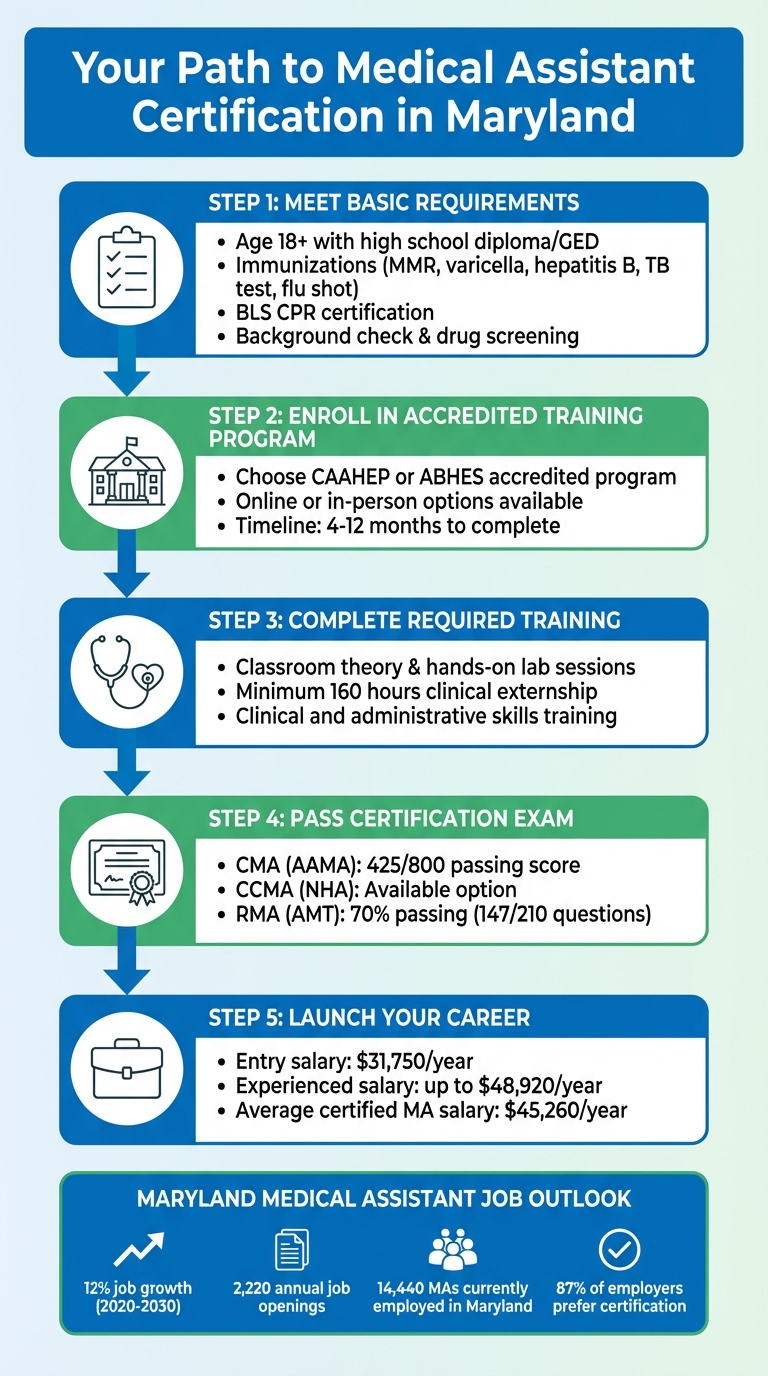
Steps to Become a Certified Medical Assistant in Maryland
Eligibility Requirements for Medical Assistant Certification
Basic Requirements
To apply, you must be at least 18 years old and hold a high school diploma or GED. Additionally, you’ll need proof of medical insurance and up-to-date immunizations, including MMR, varicella, hepatitis B, a TB test, and an annual flu shot. Some programs also require proof of a COVID-19 vaccination.
Before starting clinical rotations, you’ll need a current BLS CPR certification (the American Heart Association is often recommended). A criminal background check and a 10-panel urine drug screening are also mandatory. Keep in mind that a positive drug test result, even for medical cannabis, could disqualify you from the program.
Once you meet these initial requirements, you’ll need to complete specific academic milestones during your training.
Academic and Program Requirements
To qualify for national certification exams, students must complete coursework that includes classroom theory, hands-on lab sessions, and a clinical externship – most programs require at least 160 hours of clinical practice.
Some schools may require additional steps, such as passing a basic reading assessment (e.g., an Accuplacer score of 240 or higher), demonstrating English proficiency, and having computer skills along with reliable internet access for training in electronic records. Many programs allow students to register for certification exams after completing their classroom coursework, even if their externship is still in progress.
sbb-itb-7a67ffa
Choosing and Enrolling in Accredited Training Programs
Available Training Programs in Maryland
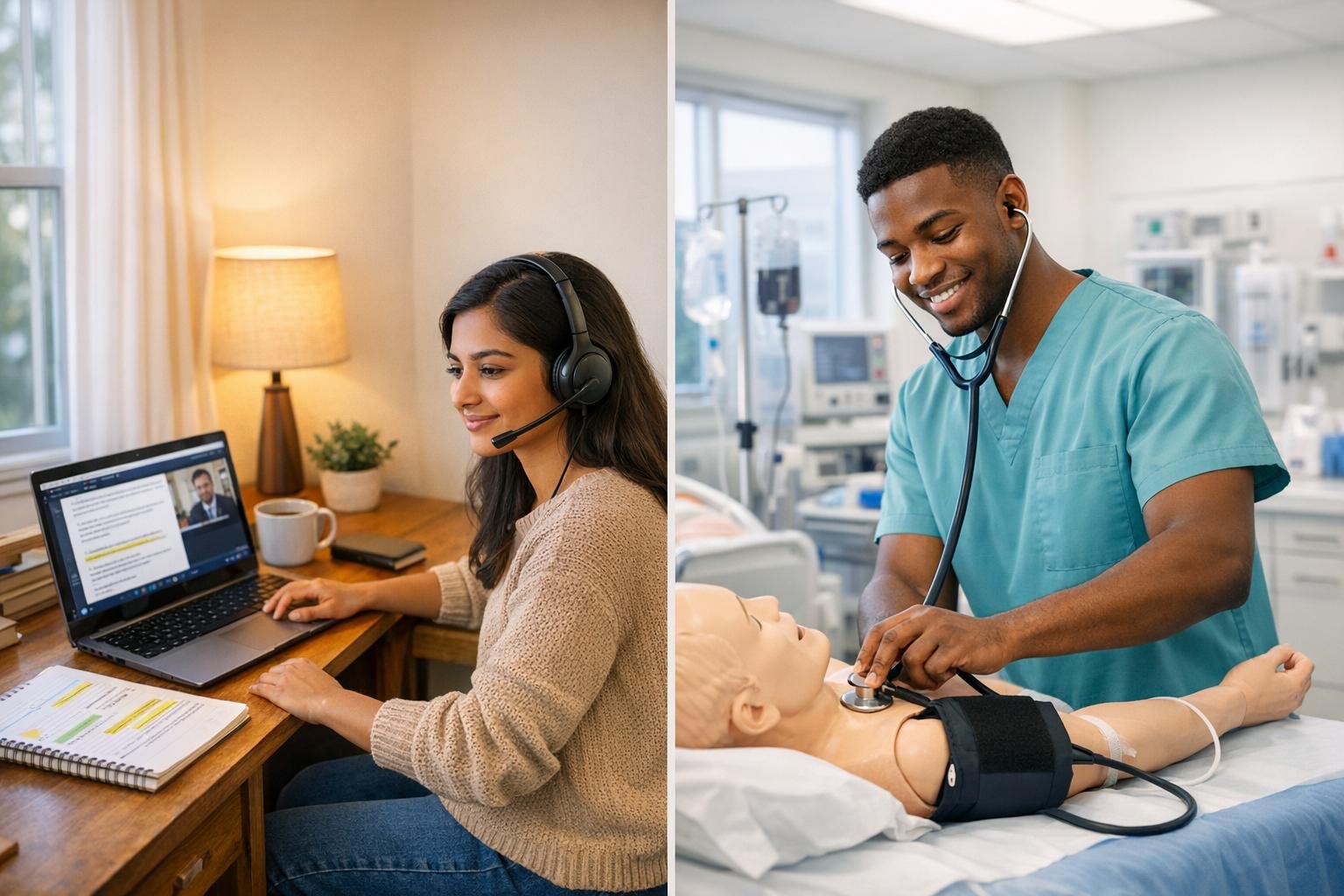
If you’re a Maryland resident looking to become a certified medical assistant, HealthCareer Certs offers a convenient option. Their Certified Clinical Medical Assistant (CCMA) program is entirely online, self-paced, and approved by the National Healthcareer Association. Plus, it includes a guaranteed externship, making the certification process straightforward and stress-free while meeting all necessary accreditation standards.
This program is perfect for those juggling work or family responsibilities. You can complete the coursework on your own schedule, typically within 4–5 months. The guaranteed externship ensures you get the required hands-on clinical experience without the hassle of finding a placement on your own.
Before enrolling, it’s important to confirm the program’s accreditation through CAAHEP (caahep.org) or ABHES (abhes.org). Graduating from an accredited program is essential if you want to qualify for top certifications like the CMA (AAMA). HealthCareer Certs makes the process seamless, aligning with Maryland’s healthcare training standards.
Program Comparison
HealthCareer Certs stands out as a well-rounded online training option that meets Maryland’s certification requirements for medical assistants. The program includes everything you need:
- Self-paced coursework covering clinical and administrative skills
- Interactive learning modules
- Guaranteed externship for hands-on training
From the moment you enroll to the day you sit for your CCMA exam, you’ll have full support to ensure you meet all certification requirements. This program is designed to make your journey to becoming a certified medical assistant as smooth as possible.
Preparing for and Passing the Certification Exam
What the Exam Covers
Certification exams test a mix of clinical and administrative skills. For the CCMA exam, expect questions on key areas like vital signs, patient exams, injections, EKGs, phlebotomy, and record management. The CMA (AAMA) exam covers a broader scope, with 22 topics including psychology, communication, medical law and ethics, infection control, pharmacology, anatomy and physiology, and emergency management. On the other hand, the RMA (AMT) exam splits its focus into three main areas: general medical knowledge, administrative tasks, and clinical skills.
All these exams align with Maryland’s scope of practice, meaning certified medical assistants in the state can handle tasks like preparing patients for exams, conducting pregnancy tests, and performing certain lab and clinical procedures under supervision. Knowing what to expect is the first step toward effective preparation.
How to Prepare for the Exam
Preparation is key to success, and there are plenty of resources to help you get ready. For the CCMA exam, HealthCareer Certs offers over 1,400 practice questions, 700 self-checks, flashcards, and interactive tools. The NHA provides three online practice tests (with two attempts each) and a mobile app for studying on the go. If you’re tackling the CMA exam, the AAMA has a 200-question online practice exam with a timer to help you manage your pace.
Make sure to dedicate extra time to infection control, patient safety, and healthcare ethics – these are critical areas for all exams. Free test plans from the NHA and AAMA can also help you map out the content you need to review. Keep in mind the passing scores: the CMA exam requires at least 425 out of 800, while the RMA exam needs 70% correct answers (147 out of 210 questions). Time management is crucial, so practice pacing yourself across different types of questions.
Don’t underestimate the value of hands-on experience. Externship practice in phlebotomy, EKG placement, and taking vital signs can build your confidence and skills for exam day. With 89% of healthcare organizations either encouraging or requiring certification, thorough preparation not only helps you pass but also sets you up for success in landing your first job.
Maryland Regulations and Starting Your Career
Maryland’s Rules for Medical Assistants
In Maryland, medical assistants don’t need a license or certification to work. The state doesn’t have a governing body for the profession, leaving it up to employers to ensure their hires are qualified. While a high school diploma or GED meets the minimum requirement, many healthcare employers favor candidates who’ve completed an accredited training program.
Even though certification isn’t required by the state, credentials like the Certified Medical Assistant (CMA) or Registered Medical Assistant (RMA) are often expected by employers. These nationally recognized certifications have become essential for landing a job with Maryland’s leading healthcare organizations. Major systems like Johns Hopkins Health System, MedStar Health, University of Maryland Medical System, and LifeBridge Health typically require certification for employment or advancement opportunities. Medical assistants in Maryland handle a mix of clinical tasks, such as preparing patients for exams, recording vital signs, administering medications, performing lab tests, conducting pregnancy tests, drawing blood, and more – all under the direct supervision of a physician.
Getting Your First Job After Certification
Once certified, the next step is finding your first job. The mandatory 160-hour clinical externship included in your training is a great way to gain hands-on experience and connect with potential employers. Maryland employs about 14,440 medical assistants, and the field is expected to grow by 12% between 2020 and 2030, resulting in around 2,220 job openings annually.
When starting your job search, focus on Maryland’s top healthcare employers, such as Johns Hopkins Health System, MedStar Health, University of Maryland Medical System, and LifeBridge Health. Entry-level medical assistants in Maryland earn around $31,750 annually, while experienced professionals can make up to $48,920. Salaries vary by region, with the Washington-Arlington-Alexandria metro area offering a median salary of about $44,680, compared to $39,900 in the Baltimore-Columbia-Towson area.
To help you land your first role, HealthCareer Certs provides job search tools and resources tailored to connect you with Maryland healthcare facilities actively hiring certified medical assistants. Don’t forget: maintaining your CMA credential requires completing 60 continuing education units every 60 months – a key step to staying competitive in this growing field.
How To Become a Certified Medical Assistant
Conclusion
While Maryland doesn’t mandate a state license for medical assistants, earning credentials like CMA, RMA, or CCMA can open doors to better job prospects and higher salaries. Here’s the path: complete your high school diploma or GED, enroll in an accredited training program, finish a 160-hour externship, and pass the certification exam. With programs lasting just 4 to 12 months, you can fast-track your entry into the healthcare field.
Maryland’s healthcare industry is thriving, offering strong job growth and competitive pay. Employers like Johns Hopkins Health System and MedStar Health actively recruit certified medical assistants, with 87% of healthcare organizations in the state preferring candidates with certification. On average, certified medical assistants in Maryland earn around $44,100 annually, reflecting the growing demand and value of certification.
Choosing an accredited program with focused exam prep, practice tools, and a guaranteed externship significantly boosts your chances of success. For instance, HealthCareer Certs provides a 100% online CCMA program featuring self-paced learning, personalized instructor support, and guaranteed externship placements to prepare you for Maryland’s expanding healthcare opportunities.
With short training periods, promising job growth, and competitive salaries, now is the perfect time to pursue certification in Maryland. Take the first step today and position yourself for success in this growing field.
FAQs
Which certification should I choose in Maryland – CMA or CCMA?
Choosing between the CMA (Certified Medical Assistant) and CCMA (Certified Clinical Medical Assistant) largely depends on what you want to achieve in your career. The CMA, offered by the American Association of Medical Assistants (AAMA), is highly respected and requires you to complete an accredited program before sitting for the exam. On the other hand, the CCMA, provided by the National Healthcareer Association (NHA), is another strong credential, particularly for those focusing on clinical roles.
Although certification isn’t mandatory in Maryland, earning either credential can make you a more competitive candidate in the job market. That said, the CMA is often regarded as the more universally recognized certification across various states and healthcare settings.
What can disqualify me from a Maryland medical assistant program?
If you’re pursuing a medical assistant program in Maryland, certain actions can lead to disqualification. This includes instances of abuse, negligence, misappropriation, or disciplinary issues. Additionally, having a criminal history that hasn’t been properly documented or explained could also jeopardize your eligibility. These issues might result in certification denial or disciplinary measures.
How do I make sure my program’s externship counts for certification?
To make sure your externship qualifies for certification in Maryland, start by enrolling in an accredited medical assisting program – certification eligibility is limited to graduates of such programs. Once you’ve completed your externship, double-check that it aligns with the requirements of certifying organizations like the AAMA or AMT. Be diligent about keeping records of your clinical hours and verify with both your program and the certifying body that your externship fulfills their criteria.