
Keeping your phlebotomy certification active is critical for maintaining your career, avoiding penalties, and staying competitive in the healthcare field. Here’s what you need to know:
- Know Your Expiration Date: Certification typically lasts two years. Log into your certifying organization’s portal (like NHA or NHCO) to check your status and expiration date.
- Complete Continuing Education (CE) Requirements:
- Prepare Documents and Pay Fees:
- Standard NHA renewal: $185 every two years.
- Late renewal (30+ days): $376.50 (includes reinstatement fee).
- NHCO requires CE documentation within six months of your application.
- Submit Your Application:
- Upload documents and pay fees on your certifying agency’s portal.
- Processing times vary (e.g., NHA updates instantly, NHCO takes 7 business days).
- Expired Certification?:
- NHA: Retake the exam if expired for over a year.
- NHCO: Renew with CE hours if expired for up to two years.
Pro Tip: Renew early to avoid extra fees and ensure uninterrupted certification.
With phlebotomy jobs growing at 6% annually and 63% of employers offering higher pay to certified professionals, staying certified is a smart career move.
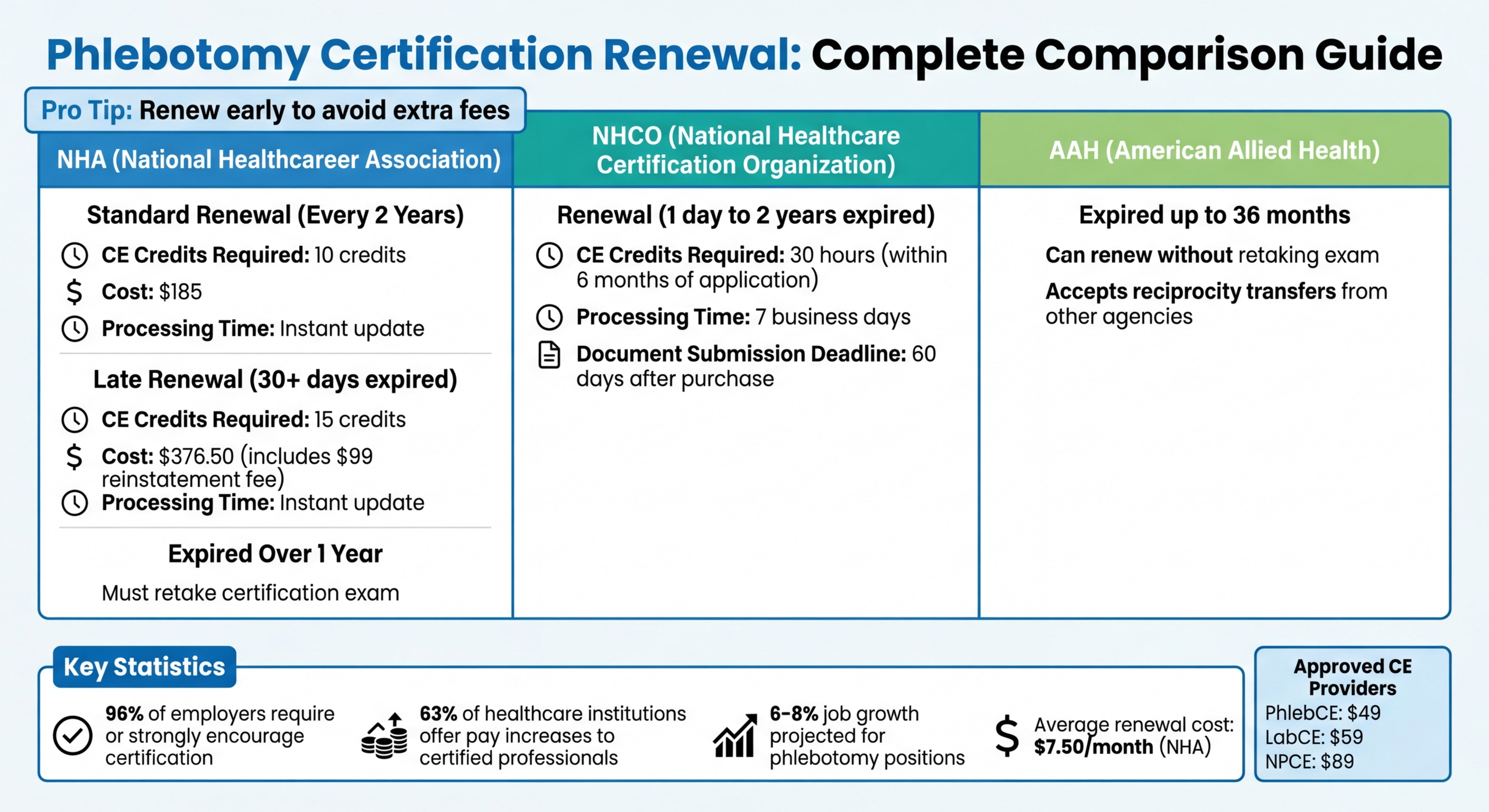
Phlebotomy Certification Renewal Requirements by Organization
🔴 Certified Phlebotomist Technician (CPT) renewal NHA

sbb-itb-7a67ffa
Verify Your Certification Status and Expiration Date
Check your expiration date before you start gathering documents or paying fees. Most phlebotomy certifications are valid for two years, so knowing exactly when yours expires can help you avoid unnecessary penalties. Be sure to review your certification’s specific guidelines to understand the consequences of letting your credentials lapse.
Log into your certification portal to confirm your status. For example, the NHA updates certification results and account information within two business days of scoring. If you’re certified through the National Healthcare Certification Organization (NHCO), you can access your dashboard at nhcocert.com or use their public verification tool at nhcocert.com/verification/. Your portal will include a digital badge and a high-resolution PDF certificate, both of which display your credential number and expiration date.
If you’re unable to log in, search your email for the original PDF certificate you received when you passed the exam. This document includes your expiration date and credential number. NHCO also provides updates on application approvals and statuses under the "Recent Feedback" section of your course.
"If you need assistance to find your current certificate information, please utilize the tool found on the https://www.nhcocert.com/verification/ website." – NHCO
If you’re renewing with NHCO, plan for a seven-business-day review period for your application. Considering that 96% of employers either require or strongly encourage certification for phlebotomy technicians, staying on top of your credentials is critical for maintaining your job and income. Once you’ve confirmed your expiration date, you’ll be ready to tackle any continuing education requirements needed for renewal.
Complete Continuing Education Requirements
To maintain your certification, you need to complete continuing education (CE) credits regularly. The National Healthcareer Association (NHA) requires 10 CE credits every two years to keep your Certified Phlebotomy Technician (CPT) credential active. If your certification has been expired for over 30 days but less than a year, you’ll need to complete 15 CE credits instead. However, if your certification has lapsed for more than a year, you’ll be required to retake the full certification exam rather than just completing CE credits.
NHA makes it easy to access approved CE courses through their online library, which is available 24/7. Simply log in to your NHA account and use the "Find CE Courses" tool to locate eligible CE credits. If you hold multiple NHA certifications, you only need a total of 10 CE credits to renew all of them at the same time.
Be sure to also check both national and state-specific CE requirements to stay compliant.
National Certification CE Requirements
For NHCO renewals with an expiration of one day to two years, you’ll need to provide documentation of 30 CE hours from approved providers. These hours must be completed within six months of submitting your renewal application. Some approved CE providers include:
- PhlebCE: $49
- LabCE: $59
- NPCE: $89
State-Specific CE Requirements
State regulations for phlebotomy technicians can vary. While national certifications, like those from NHA or NHCO, follow standardized CE guidelines, certain states may require additional CE hours or have unique mandates. To confirm whether extra requirements apply, check your state health department website or contact your state licensing board. You can also check your certifying organization’s portal for any compliance updates specific to your state.
Gather Required Documents and Pay Renewal Fees
Before submitting your renewal application, make sure you have proof of your completed CE credits ready. If you’ve taken courses through NHA’s online library, your credits are automatically tracked in your account. For courses completed with external providers like PhlebCE, LabCE, or NPCE, download and save your completion certificates as PDFs. NHCO requires documentation showing you’ve earned your 30 CE hours within six months of your application submission date. Having everything organized ahead of time will make the process much smoother.
You’ll also need your identification details, such as your Member ID or Certification number, for secure login and verification. To stay organized, save digital copies of these documents in a dedicated folder on your computer or cloud storage for quick access whenever needed.
When it comes to fees, they vary depending on your situation. A standard two-year renewal through NHA costs $185, and each additional certification adds $60. If your certification has been expired for over 30 days, you’ll need to pay a $99 reinstatement fee, bringing the total fees to $376.50. According to NHA:
"The purpose of NHA certification renewal is to encourage you to continue to expand your knowledge and skills in your field, demonstrate your ongoing commitment to keeping pace with developments in your field, and assure the public that you have met current professional standards".
Once you’ve purchased your renewal application through NHCO, make sure to submit all required documents within 60 days. The review process typically takes seven business days. Renewing on time not only avoids extra fees but also keeps your certification active.
Interestingly, 63% of healthcare institutions offer pay increases to certified professionals, making renewal a smart move for your career growth.
Submit Your Renewal Application
Once you’ve gathered all necessary documents and paid the required fees, it’s time to submit your renewal application online. Following the correct process ensures your credentials remain valid without interruption.
For NHA renewals, log in to your account at nhanow.com and click on "Renew Certifications" from your dashboard. After completing the payment, your expiration date updates instantly – no waiting required. This efficient system allows you to maintain your certification without delays.
If you’re renewing through NHCO, sign in to the NHCO Portal and enroll in the renewal application. After completing the checkout process, upload your continuing education (CE) documentation as part of the application form. The review process generally takes five to seven business days. Be sure to submit all required materials within 60 to 90 days of purchasing your renewal package.
For state-level renewals, such as those in Texas, visit your state’s Online Licensing System. Typically, one to three months before your certification expires, you’ll see a notification on the main menu that says, "It is time to Renew!" According to the Texas Department of State Health Services (DSHS):
"Online renewals, initial license applications, and change of addresses are submitted daily to the licensing boards or programs, therefore, renewing online will expedite the renewal process by eliminating mailing time to the agency".
After submitting your application, use the system’s "Check Status" feature to track your application. You’ll see updates like "Open", "In Process", or "Approved." Submitting your renewal application early – ideally one to three months before expiration – helps ensure your credentials stay current.
Next, find out what steps to take if your certification has already expired.
Renew an Expired Certification
If your certification has expired, don’t worry – there are steps you can take to get back on track. Renewal processes vary depending on the organization and how long your certification has been inactive.
For NHA certifications, you have a few options:
- If your certification expired less than 30 days ago, you can renew it without any additional fees.
- If it’s been expired for more than 30 days but less than a year, you’ll need to complete 15 continuing education (CE) credits and pay $376.50 (this includes a $277.50 renewal fee and a $99 reinstatement fee).
- If your certification has been expired for over a year, you’ll have to retake the exam to regain your credentials.
For NHCO, the process is slightly different:
- If your certification has been expired for anywhere between one day and two years, you must complete 30 CE hours (earned within six months) and submit the necessary documentation within 60 days. The review process typically takes about seven business days.
- Approved CE providers include PhlebCE ($49), LabCE ($59), and NPCE ($89).
Other agencies, like American Allied Health (AAH), offer more flexible options. AAH allows you to renew certifications that have been expired for up to 36 months without retaking the exam. Additionally, if your certification from another agency has been expired for less than three years, you can transfer it to AAH through reciprocity by providing a copy of your previous certification card or member ID.
Here’s a quick comparison of policies for NHA and AAH:
| Expiration Duration | NHA Policy | AAH Policy |
|---|---|---|
| Less than 30 days | Normal renewal process; no extra fees | Small late fee added to dues |
| More than 30 days to 1 year | Reinstatement required (15 CE credits + $99 fee) | Reinstatement fee required |
| 1 to 3 years | Must retake certification exam | Renewal possible via CE without retaking exam |
| More than 3 years | Must retake certification exam | Must re-register and retake exam |
Conclusion
Renewing your phlebotomy certification can be a smooth process with a little preparation. Keep an eye on your expiration date, complete your continuing education (CE) requirements on time, and submit your renewal application early. This approach not only helps you avoid costly reinstatement fees but also ensures your certification stays current.
Staying on top of your certification isn’t just about compliance – it’s about safeguarding your career and boosting your earning potential.
"Staying certified isn’t just about meeting a requirement; it’s about demonstrating a commitment to excellence and patient safety." – Sarah Miller, Certified Phlebotomist
To stay organized, consider keeping your CE certificates in a dedicated folder and setting calendar reminders well ahead of your renewal deadline. Renewal cycles vary by agency – ASCP requires renewal every three years, while NHA mandates it every two years. Knowing these specifics can help you avoid unnecessary stress. Plus, maintaining active certification keeps you competitive in the job market.
Here’s the bottom line: monitor your certification status, complete your CE credits, and renew on time to keep your career moving forward.
With phlebotomy jobs expected to grow by 8% over the next decade, keeping your credentials up to date ensures you’re ready to seize new opportunities. And at just about $7.50 per month for NHA renewal, it’s a small price to pay for long-term career growth.
FAQs
How early should I renew to avoid any lapse?
Renewing your phlebotomy certification ahead of time can save you from unnecessary stress and potential job disruptions. Ideally, aim to renew 30–60 days before your certification expires. This buffer ensures you maintain continuous certification and avoid any interruptions in employment or credentialing. Take a moment to check your certification’s expiration date and plan to complete the renewal process at least a month in advance.
What CE courses count toward renewal, and how do I prove them?
Continuing education (CE) courses for phlebotomy certification renewal need to come from approved providers like NPCE, LabCE, or PhlebCE. These courses are designed to keep you informed about the latest industry standards and techniques.
To confirm completion, you’ll need to provide documentation – such as certificates or proof of hours earned – to your certifying organization. Make sure your CE hours fall within the required timeframe and include all necessary documentation when submitting your renewal application.
What should I do if I can’t access my certification portal?
If you can’t access your certification portal, start by checking your internet connection and ensuring your login credentials are correct. If the problem persists, head over to the Help Center or support page provided by your certification provider. Still stuck? Reach out to their customer support team for help with regaining access or getting guidance on what to do next.