Want to become a Certified Phlebotomy Technician (CPT) in Virginia? Here’s how:
- Meet Basic Requirements: Be at least 18 years old, have a high school diploma or GED, and pass a background check, drug screening, and required health screenings (e.g., immunizations, TB test).
- Complete Training: Enroll in an accredited phlebotomy program that includes coursework and hands-on clinical practice (e.g., 30 venipunctures and 10 capillary sticks).
- Pass the CPT Exam: Take and pass the NHA CPT certification exam (120 questions, 2 hours, $117 fee).
- Start Working: Virginia doesn’t require state licensure, so once certified, you can begin working.
- Maintain Certification: Renew your certification every 2 years and complete continuing education if required by your certifying organization.
Certification boosts job prospects and salaries, with Virginia phlebotomists earning a median of $40,800 annually. Programs like HealthCareer Certs offer flexible training and externship placement to help you succeed.
Ready to start your healthcare career? Let’s break it down step by step.
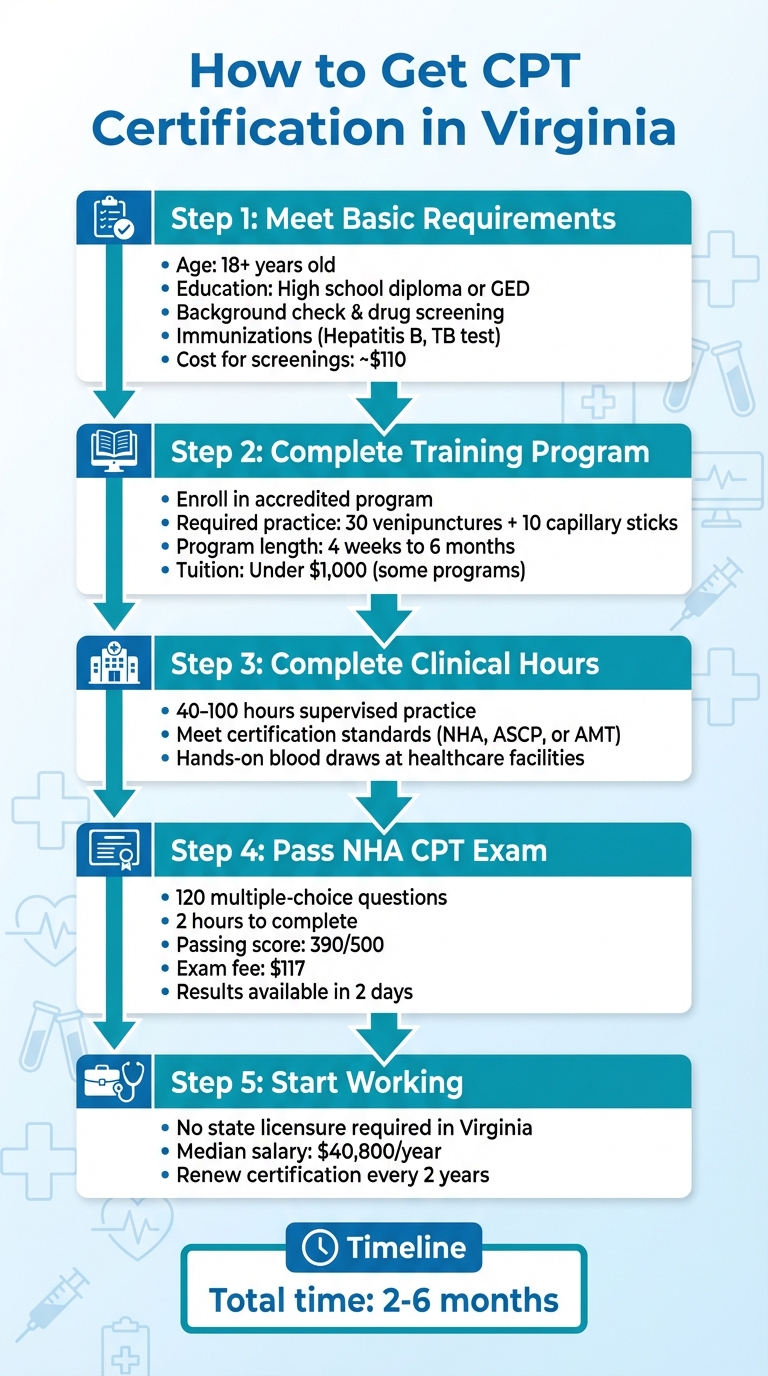
5 Steps to Get CPT Certification in Virginia
Preparation and Tips to ace your Phlebotomy Certification Exam
sbb-itb-7a67ffa
Step 1: Check If You Meet the Requirements
Before diving into phlebotomy training, make sure you meet the necessary eligibility criteria. This step is essential to ensure a smooth entry into a phlebotomy program in Virginia, as most programs follow similar guidelines.
Education and Age Requirements
To enroll in a phlebotomy training program and eventually qualify for the national certification exam, you must be at least 18 years old by the time classes begin and have a high school diploma, GED, or equivalent credential.
"To qualify for the certification exam, a High School Diploma or equivalent is required." – Virginia Wesleyan University
If you hold a foreign diploma, it must be evaluated and translated by an approved agency. This process can take about three weeks, so plan accordingly. Additionally, non-English speakers may need to pass a CASAS assessment to prove sufficient reading comprehension skills.
Once you’ve confirmed your educational and age qualifications, it’s time to focus on completing the required screenings and immunizations.
Background Checks and Immunization Records
Before starting clinical training, you’ll need to complete several screenings. These include a criminal background check and a drug screen, both of which must be clear to proceed with hands-on practice. At Virginia Western Community College, these screenings typically cost around $110.00, and financial aid usually does not cover this expense.
You’ll also need to provide immunization records, including proof of completing the Hepatitis B series or a negative test, along with a current Tuberculin Skin Test (TST) for tuberculosis. Some programs may also require a physical exam and a valid American Heart Association (AHA) Basic Life Support (BLS) certification for healthcare providers. Since these documents are mandatory for placement in healthcare facilities, it’s a good idea to gather your immunization records and schedule any necessary exams as soon as possible.
Here’s a quick summary of the core eligibility requirements:
| Requirement Type | What You Need | Notes |
|---|---|---|
| Minimum Age | 18 years old | Must be met by the first day of class |
| Education | High School Diploma or GED | Foreign diplomas require evaluation |
| Background Check | Clean criminal record | Required for clinical placement |
| Drug Screen | Negative test result | Must pass before clinicals begin |
| Immunizations | Hepatitis B series and TB/TST test | Proof required by clinical sites |
| CPR Certification | AHA BLS for Healthcare Providers | Required by some programs |
Step 2: Complete an Approved Phlebotomy Training Program
After ensuring you meet the basic qualifications, the next step is enrolling in a phlebotomy training program designed to prepare you for national certification. While Virginia doesn’t require a state-issued license for phlebotomy technicians, completing a program that aligns with national certification standards is crucial for advancing your career.
How to Find an Accredited Program
Look for programs that prepare you for certification exams offered by recognized organizations like the National Healthcareer Association (NHA), National Phlebotomy Certification Examination (NPCE), or the National Association of Phlebotomy Technician Professionals. A good program should cover essential topics such as:
- Anatomy and physiology
- Medical terminology
- Safety protocols and infection control
- HIPAA regulations
Hands-on clinical training is a must. For example, NHA certification eligibility requires completing at least 30 venipunctures and 10 capillary sticks on live individuals. Before committing to a program, ask how clinical hours are handled and whether the school provides access to volunteers or clinical sites for practice.
It’s also important to note that the program should prepare you for a national certification exam – not just issue a diploma. Some training programs in Virginia are budget-friendly, with tuition costs under $1,000.
One standout example of a program meeting these standards is HealthCareer Certs.
HealthCareer Certs CPT Program Details

HealthCareer Certs offers a flexible, comprehensive training program that checks all the boxes. Their Certified Phlebotomy Technician (CPT) program is entirely online and self-paced, allowing students to complete their coursework within four weeks to six months. The program is structured to meet NHA certification requirements, including 30 supervised venipunctures completed during a guaranteed clinical externship.
Students benefit from tools like an IV Practice Arm and Venipuncture Kit for at-home practice, plus 3D animations to help visualize procedures. To prepare for the certification exam, the program includes six practice tests, one-on-one Zoom sessions with instructors, and personalized support from a dedicated advisor. Even better, the tuition fee covers the cost of the NHA CPT exam, ensuring you’re fully equipped to take the next step in your career.
Step 3: Complete Your Clinical Training Hours
Once you’re enrolled, it’s time to dive into clinical training. This hands-on phase takes everything you’ve learned so far and puts it into practice, focusing on supervised blood draws and real-world application.
Virginia Clinical Training Requirements
To move forward in your phlebotomy career, meeting national certification standards through hands-on practice is essential. While Virginia doesn’t have specific state-mandated clinical hour requirements for phlebotomy technicians, you’ll need to meet the standards set by national certification organizations.
For example:
- The National Healthcareer Association (NHA) requires at least 30 venipunctures and 10 capillary (finger) sticks on live individuals to qualify for their CPT certification.
- The American Society for Clinical Pathology (ASCP) sets a higher bar, requiring 100 venipunctures.
- The American Medical Technologists (AMT) requires 50 venipunctures and 10 finger sticks.
Most training programs include between 40 and 100 hours of supervised practice at healthcare facilities. During this time, you’ll not only perform blood draws but also learn proper specimen labeling, transportation protocols, patient safety procedures, equipment sterilization, and documentation. You’ll also sharpen your patient interaction skills, such as verifying identities and maintaining professional communication.
Don’t forget to keep your screenings and certifications, like CPR, up to date throughout your training.
Externship Placement Through HealthCareer Certs
Finding a clinical site on your own can be tough, but HealthCareer Certs makes it easier by guaranteeing externship placement. This program is tailored to meet NHA requirements, ensuring you complete the 30 venipunctures and 10 capillary sticks needed to qualify for the certification exam.
As part of this process, you’ll receive an Externship Starter Kit to help you prepare for your clinical placement. Plus, a dedicated advisor will guide you every step of the way, ensuring you meet your clinical hour requirements on time. This structured support helps you build the skills and confidence needed to thrive in a healthcare environment.
Step 4: Pass the NHA CPT Certification Exam
Once your clinical training is complete, the next step is tackling the NHA CPT exam. This exam, administered by the National Healthcareer Association (NHA), is the final step to becoming a certified phlebotomy technician. It consists of 120 multiple-choice questions: 100 of these count toward your score, while the remaining 20 are unscored pre-test questions used for data collection. You’ll have two hours to complete the test, and a passing score is 390 out of 500.
You can take the exam at a school, a PSI testing center, or online via live remote proctoring. Be sure to bring a valid, government-issued ID for verification. If you opt for the online format, results are typically available in your NHA account within two days. If you don’t pass, you must wait 30 days for a second attempt, and up to 12 months for a third or fourth try. The exam fee is $117 and is non-refundable.
Here’s a breakdown of what to expect on the exam and how to prepare effectively.
What’s on the Exam
The test focuses on five main areas:
- Routine Blood Collections – 30%
- Safety and Compliance – 25%
- Patient Preparation – 23%
- Processing – 15%
- Special Collections – 7%
Questions fall into two categories: Knowledge Statements (what you need to understand) and Task Statements (what you need to do). The exam also covers 16 essential topics, including medical terminology, vascular anatomy, the cardiovascular system, and hemostasis.
Pay close attention to the order of draw and patient identification procedures. As Katie Miller, Co-creator of Smarter Phlebotomy, stresses:
"The WORST thing a phlebotomist can do is mis-ID the patient!"
Additionally, make sure you’re familiar with special handling requirements. For example, some specimens need to be chilled (like lactic acid and ammonia), while others, such as bilirubin, require protection from light using foil. Knowing these details can help you focus your studies.
Study Materials and Practice Tests
HealthCareer Certs offers a range of study tools to help you prepare. Their program includes official NHA online study guides, interactive games, quizzes, and mobile flashcards, which make it easier to study wherever you are. They also provide practice tests with up to six attempts, allowing you to simulate the exam and identify areas that need improvement.
Start by taking an early practice test to assess your baseline knowledge. Then, use your results to focus on weaker areas as you continue studying. Avoid last-minute cramming – start your preparation early and review critical topics like OSHA guidelines, CLSI standards, needle stick prevention, proper PPE use, and biohazard disposal.
With the right preparation and the support of HealthCareer Certs’ resources, you’ll be well-equipped to pass the exam on your first try.
Step 5: Register with the Virginia Department of Health Professions
Virginia doesn’t require state licensure for phlebotomy technicians. Once you’ve passed your NHA CPT exam, you’re ready to work in Virginia without needing to file additional paperwork, pay state-specific fees, or interact with a state licensing board.
How to Prepare for Employment in Virginia
With your NHA certification from Step 4 in hand, your next step is to ensure all your documentation is well-organized. Since Virginia doesn’t have a state registration process for phlebotomy, your focus should remain on maintaining your national certification. Most healthcare employers in Virginia, including organizations like UVA Health and Sentara Martha Jefferson Hospital, typically require certification from recognized entities such as the National Healthcareer Association (NHA) or the National Association of Phlebotomy Technician Professionals.
To make the hiring process smoother, keep the following documents in an easily accessible portfolio:
- Your NHA certification
- Records of clinical experience (e.g., 30 venipunctures and 10 capillary sticks)
- A copy of your high school diploma or GED
- Updated immunization records
Additionally, many employers may ask for a criminal background check and drug screening as part of their hiring requirements. By keeping these documents organized and ready, you’ll be well-prepared to enter Virginia’s dynamic healthcare workforce with confidence.
How to Maintain Your Certification
Once you’ve earned your CPT certification, keeping it current is essential for your career longevity and professional credibility.
Renewal Deadlines and Fees
CPT certifications need to be renewed every two years if you want to remain eligible for employment in Virginia’s healthcare sector. The renewal process should be initiated 14 to 30 days before your certification expires. As Rafael Sanchez, a Certified Phlebotomy Instructor, shared, "If I didn’t have that certification within the two-day mark, I would’ve been jobless".
Missed the deadline? Don’t panic – most certifying organizations offer late renewal or reinstatement options, though they come with extra costs. For instance, the National Performance Specialists charge a $200 renewal fee, which usually includes study materials, practice exams, and up to three exam attempts.
From here, it’s also a good idea to consider continuing education options, which can help support your renewal process.
Continuing Education Options
Virginia doesn’t enforce state-level continuing education requirements for phlebotomy technicians. However, national certifying organizations often have their own rules. For example, if you’re certified through the National Association of Phlebotomy Technician Professionals (NAPTP), you’ll need to complete 25 Continuing Education (CE) credits every two years. Some organizations also let you renew by submitting CEU credits or completing a short assessment.
For added convenience, platforms like HealthCareer Certs offer online courses tailored to phlebotomy technicians, making it easier to meet your continuing education needs on your own schedule.
Conclusion
Getting your Certified Phlebotomy Technician (CPT) certification in Virginia is a clear and manageable process, typically taking 2 to 6 months to complete. To earn this credential, you’ll need to meet the basic education requirements, complete an accredited training program with hands-on clinical practice, pass the NHA CPT exam, and renew your certification every two years. This step-by-step approach not only confirms your skills but also sets the stage for a stable career in healthcare.
Phlebotomy certification offers more than just immediate job opportunities. It’s often a stepping stone for those aiming to advance into fields like nursing, physician assistant programs, or laboratory science. As Grant Aldrich, Founder of OnlineDegree.com, explains:
"Certification can signal that you’ve mastered safety, infection control, and proper specimen handling – skills that directly affect patient outcomes and lab accuracy".
This highlights why certification is such a critical milestone for anyone pursuing a healthcare career.
HealthCareer Certs supports you at every stage of this journey. Their program offers 100% guaranteed externship placement, flexible online learning available anytime, and all-inclusive tuition starting at $1,700. This fee covers everything you need – exam costs, a practice kit, and study materials. Accredited by the National Healthcareer Association (NHA), this program ensures your certification is recognized not only in Virginia but across the country.
Whether you’re starting your healthcare career or looking to expand your qualifications, phlebotomy certification opens doors to roles in hospitals, diagnostic labs, physician offices, and even travel-based positions. It’s a solid foundation for a rewarding future in healthcare.
FAQs
How long does CPT certification take in Virginia?
The duration to earn a Certified Phlebotomy Technician (CPT) certification in Virginia depends on the program you choose. For instance, community college programs typically last about one semester, or 16 weeks. On the other hand, some online courses paired with clinical externships might provide provisional certification, allowing up to six months to fulfill the hands-on clinical requirements. In general, most programs fall within a 4 to 6-month timeframe.
Do I need a Virginia license after passing the CPT exam?
Virginia does not mandate a state license for phlebotomists once you’ve passed the CPT exam. Instead, holding a certification from a recognized organization like the National Healthcareer Association (NHA) or NPCE is enough to showcase your skills and enhance your job opportunities. Just make sure to meet any specific certification requirements set by employers to qualify for positions in the state.
What should I do if I fail the NHA CPT exam?
If you don’t pass the NHA CPT exam, don’t get discouraged. Take some time to go over the exam content areas, pinpoint where you struggled, and focus on improving those weaknesses. Key topics to revisit include safety protocols, patient preparation, blood collection techniques, and specimen processing.
You might also want to explore extra training or study materials to sharpen your skills. This could make a big difference in boosting your confidence and increasing your chances of success the next time you take the test.