Getting Certified Patient Care Technician/Assistant (CPCT/A) certification can boost your clinical skills and improve your healthcare career prospects. Here’s what you need to know:
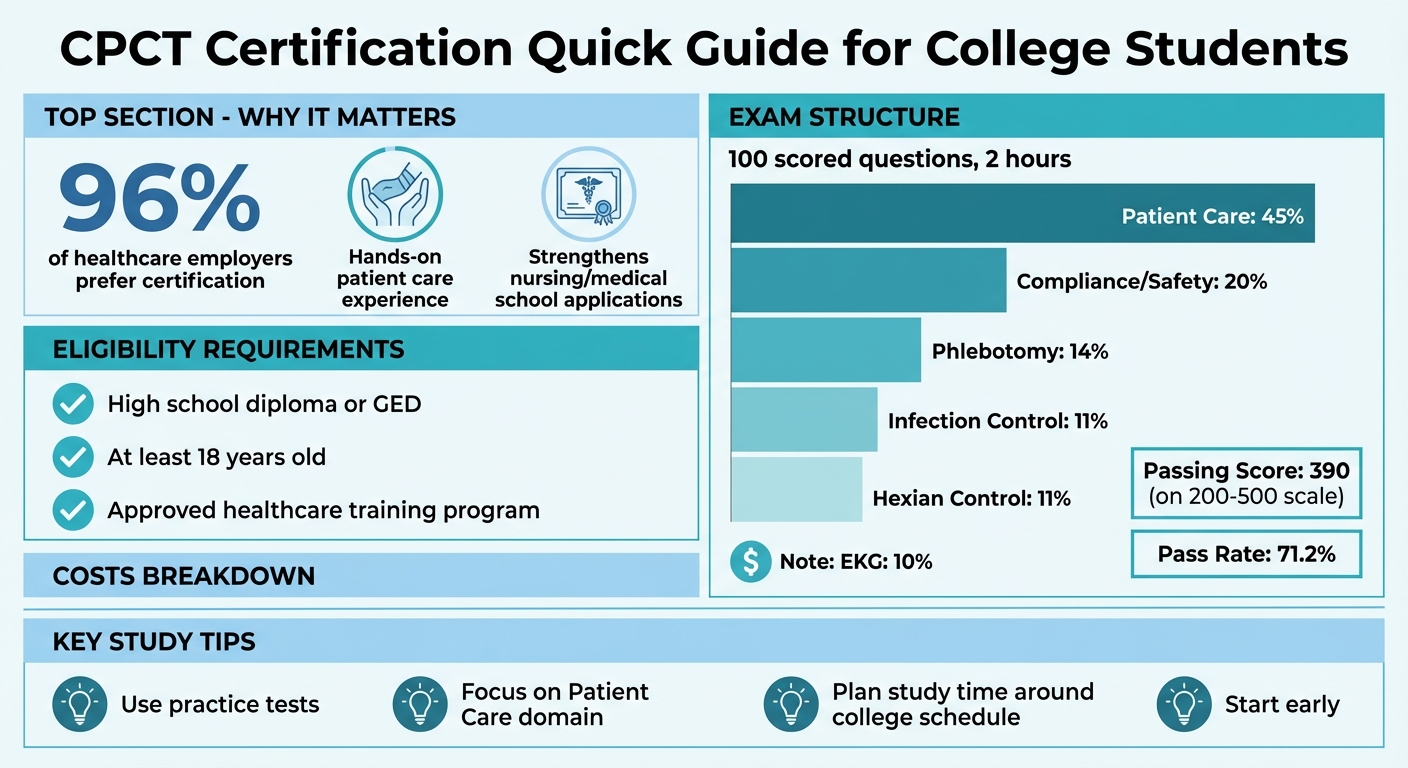
- Why It Matters: 96% of healthcare employers prefer certification. It provides hands-on patient care experience and strengthens applications for advanced programs like nursing or medical school.
- Eligibility: You need a high school diploma or GED, be at least 18 years old, and complete an approved healthcare training program.
- Costs & Training: Programs range from $300 to $4,500. The exam fee is $160, and flexible payment options are available.
- Exam Breakdown: 100 scored questions focus on patient care (45%), compliance/safety (20%), phlebotomy (14%), infection control (11%), and EKG (10%).
- Study Tips: Use practice tests, focus on patient care, and plan study time around college commitments.
Start early, choose the right program, and use online tools to prepare effectively. Certification can open doors to healthcare opportunities while you’re still in college.
CPCT Certification Overview: Requirements, Costs, and Exam Breakdown for College Students
CPCT Certification Requirements Explained
What Is CPCT Certification?
The Certified Patient Care Technician/Assistant (CPCT/A) certification demonstrates your ability to perform vital hospital tasks. These include drawing blood for lab tests, operating EKG monitors, checking vital signs, assisting with patient hygiene, and following infection control protocols. Unlike a basic CNA license, this certification focuses on technical skills hospitals rely on, especially as they navigate LPN shortages and increasing patient demands.
The exam is designed with scenario-based questions, requiring you to show how you’d handle real-world patient care situations rather than relying on rote memorization. Understanding the scope of CPCT certification is the first step to grasping who oversees it and what’s required to earn it.
Who Issues the CPCT Certification?
The National Healthcareer Association (NHA) is responsible for administering and issuing the CPCT/A certification. As an NCCA-accredited organization, the NHA adheres to strict national standards for healthcare credentials. They handle everything from maintaining a registry of certified professionals to developing exam content and providing official study materials. Plus, test results are typically posted within two days of completing the exam.
The NHA also collaborates with the American Council on Education (ACE), allowing the CPCT exam to count toward college credit hours at select institutions. If you’re planning to take the exam in late 2026, keep in mind that updated study materials will be released in Summer 2026, with a revised version of the certification exam launching in Fall 2026.
Now that you know who administers the certification, let’s dive into the eligibility requirements.
Eligibility Requirements for CPCT Certification
To qualify for the exam, you must meet these basic criteria: hold a high school diploma or GED, be at least 18 years old, and complete an approved healthcare training program.
Some college-based Patient Care Technician (PCT) programs may have extra requirements. For example, schools like Kingsborough and Lehman College require students to already have a Certified Nurse Aide (CNA) license before enrolling in their PCT training programs. It’s a good idea to check the specific prerequisites of your chosen program early to ensure you stay on track and avoid delays in starting your certification journey.
sbb-itb-7a67ffa
How to Meet Enrollment Prerequisites
Academic and Certification Prerequisites
To enroll in a CPCT (Certified Patient Care Technician) training program, you’ll need to have a high school diploma or GED and be at least 18 years old. Your age and identity will typically be verified with a government-issued ID during the enrollment process.
Another common requirement is CPR and Basic Life Support (BLS) certification. Many online programs simplify this step by including BLS training – often provided through the American Heart Association – within their curriculum. This eliminates the need to coordinate separate certifications. Additionally, some programs may ask for immunization records, which are often accessible through campus health centers or your healthcare provider.
If you’re considering a community college program, check if they require a Certified Nursing Assistant (CNA) license prior to enrollment. Not having this license could extend your timeline, so it’s important to confirm this requirement early on.
How to Complete Prerequisites Quickly
Once you meet the basic criteria, there are ways to speed up the process of completing the prerequisites. One of the quickest options is enrolling in a self-paced online program that consolidates all requirements into one package. For instance, programs like HealthCareer Certs offer fully online formats that include BLS certification. This setup allows you to manage these prerequisites around your existing class schedule without needing to commute. Madison King, a practicing Patient Care Technician, shared her experience:
"This course was amazing. I was able to get it done on my own time, and pre-med prerequisites went right along with the course".
If your college coursework already covers subjects like Anatomy, Physiology, or Medical Terminology, you can align these classes with your CPCT training to lighten your workload. Pre-med and health science students often find this overlap especially helpful. For programs that require clinical skills verification, consider those offering virtual simulation tools – such as SIMTICS – that let you practice essential skills like vital signs, EKGs, and phlebotomy techniques from home, saving you trips to a physical lab.
UPDATED Patient Care Technician (PCT) Practice Test 2026 | 50 Real Questions and Answers
How to Choose a CPCT Training Program
Balancing certification preparation alongside college responsibilities requires careful planning, especially when it comes to selecting the right training format and budgeting effectively. Here’s how to evaluate your options and make informed decisions.
Training Program Formats for College Students
Your college schedule will play a big role in determining which training format works best for you. Online self-paced programs are ideal for full-time students because they offer 24/7 access to materials without fixed deadlines. These programs typically take anywhere from 8 weeks to 9 months to complete, with costs ranging between $300 and $4,500.
Community college certificate programs offer hands-on learning with scheduled classes, running 3 to 12 months. They generally cost around $3,500 and provide direct instructor feedback, but you’ll need to coordinate these classes with your existing college schedule.
If you’re considering furthering your education in healthcare, associate degree programs could be a good fit. These programs take about 2 years and can cost up to $5,000 per year. They also allow you to apply credits toward advanced degrees like nursing or physician assistant programs.
Once you’ve identified a format that fits your needs, it’s important to look at the program’s features to ensure you’re getting the right support and value.
What to Look For in a Training Program
To avoid unexpected expenses, check if the program includes the cost of the national certification exam (usually $160 to $165), textbooks, and clinical supplies in the tuition. For example, providers like HealthCareer Certs bundle these costs into their packages, offering greater transparency.
Hands-on clinical experience is essential, so verify whether the program guarantees externship placement. Some programs handle this for you, while others require you to find your own placement – an added challenge if you’re new to healthcare. Look for programs offering additional support, such as one-on-one instructor tutoring, career coaching, or resume workshops. For instance, Advanced eClinical Training boasts a 97% pass rate for its graduates, compared to the national average of 71.2%.
Programs that integrate virtual simulation tools, like SIMTICS or 3D-animated demonstrations, allow you to practice clinical skills from home. Some even provide venipuncture practice kits, complete with dummy arms and medical supplies, shipped directly to your door. These features can save time and make learning more convenient.
Once you’ve chosen a program, it’s time to plan your finances to meet your certification goals.
How to Budget for Your CPCT Certification
Understanding the full cost upfront is critical for effective budgeting. Online programs typically range from $2,200 (like those offered by HealthCareer Certs) to $4,500 for premium packages that include mentorship. Community college certificate programs average around $3,525, though costs can vary based on your residency status. Private for-profit schools are significantly more expensive, ranging from $11,982 to $28,600 – often far exceeding the cost needed for entry-level certification.
Many programs offer interest-free payment plans to ease the financial burden. For example, HealthCareer Certs allows payments of $625 over four months instead of requiring the full $2,200 upfront. This can help you manage your college budget without resorting to student loans.
Don’t forget to account for indirect costs like commuting, taking time off work for in-person programs, or childcare. Sometimes, slightly higher tuition for an online program may save you money overall when these factors are considered.
If you’re already working in healthcare, even in a non-clinical role, check with your employer about tuition reimbursement programs. You can also contact your local workforce board to explore state funding options for healthcare training. Lastly, remember to plan for recertification after graduation. The NHA requires 10 hours of continuing education and a renewal fee every two years.
How to Balance Certification Prep With College
Juggling CPCT certification training alongside your college workload requires a solid plan and a good dose of discipline. The trick is to set up systems that help you stay on track while avoiding burnout. Here’s how you can do it.
Time Management Tips for Students
Start by keeping a detailed to-do list that covers both your college assignments and certification tasks. Rather than cramming whenever you find a free moment, carve out specific study blocks in your schedule. This structured approach helps you avoid the stress of last-minute prep, which often leads to poor results.
Develop a consistent study routine. This could involve previewing material before class, actively participating during lectures, and reviewing key points afterward. Tackle the most important tasks first and leave some breathing room between activities to avoid overloading yourself. Digital tools can also help you track deadlines and organize your study sessions efficiently.
"Managing your time and taking good care of yourself can help reduce your risk of struggling with work or school." – College of Health Care Professions
By combining these strategies with flexible learning options, you can create a balanced and sustainable plan.
Using Flexible Learning Options
Flexible online learning programs are a game-changer for balancing certification prep and college. Self-paced courses give you the freedom to study when it suits you – whether it’s between classes, during your commute, or late at night after finishing your schoolwork. Many programs offer 24/7 access to course materials, and some even allow up to 12 months to complete your certification. This means you can adapt your pace, speeding up during breaks or easing off during exams and midterms.
Mobile-friendly platforms make it easy to squeeze in quick study sessions, like reviewing flashcards or watching short video lessons whenever you have a few spare minutes. Some programs also feature 3D-animated procedures and virtual simulations, providing hands-on clinical experience without requiring a trip to a physical lab. This saves valuable time, especially during hectic weeks.
Working With Your Academic Advisor
Once you’ve mapped out your study plan, loop in your academic advisor to make sure your certification goals align with your broader academic and career plans. Advisors can help you determine if your college offers stackable credentials, allowing you to earn certifications like CNA, phlebotomy, and EKG in stages rather than tackling them all at once. This approach can make your workload feel more manageable by spreading it out over several semesters.
They can also guide you in choosing the right program length – whether that’s a full certification program lasting 4–12 months or a shorter "CNA-Plus" option that takes 3–6 months. If you’re aiming for an advanced nursing degree, your advisor can explain how CPCT certification fits into that pathway. Plus, they can connect you with resources like wellness programs if you’re feeling overwhelmed by the demands of school, work, and life.
How to Prepare for the CPCT/A Certification Exam
Once you’ve met the prerequisites and completed your training, the next step is preparing effectively for the exam.
CPCT/A Exam Structure and Format
The CPCT/A exam includes 100 scored multiple-choice questions and 20 unscored pretest questions. You’ll have two hours to complete it, and the exam fee is $160.
To pass, you need a scaled score of at least 390 on a scale of 200–500. With an estimated pass rate of around 71.2%, solid preparation is crucial. The questions are scenario-based, requiring you to apply clinical knowledge in practical situations. The exam covers five key areas:
- Patient Care (45%)
- Compliance, Safety, and Professional Responsibility (20%)
- Phlebotomy (14%)
- Infection Control (11%)
- EKG (10%).
You can take the exam at your school, a PSI testing center, or through live remote proctoring. Keep in mind that the NHA plans to release updated study materials in Summer 2026, with a new exam version launching in Fall 2026. If you fail within 30 days of this update, you’ll need to retake the new version.
With the format in mind, let’s dive into strategies to help you prepare.
Study Strategies for Exam Success
Start by taking a timed baseline practice test from the NHA. This will help you pinpoint the areas where you need the most improvement. Since Patient Care accounts for 45% of the exam, it’s wise to focus heavily on this domain during your study sessions.
The NHA offers a range of study tools, including:
- Study guides (about $54)
- Practice tests (around $49)
- Bundled packages (approximately $84), which include flashcards, content reviews, and formative practice tests with detailed explanations for each answer.
Reviewing the rationales for practice test answers can help you better understand clinical concepts and reinforce your knowledge.
Organize a study schedule that works around your college commitments. Make sure you allocate enough time for both your studies and exam preparation without overloading yourself. If you don’t pass on your first try, you’ll need to wait 30 days before retaking the exam. On test day, remember to bring at least one government-issued ID, as it’s required for entry at testing centers.
How to Register for the Exam Through NHA
To register, visit the NHA website and create an account on their candidate portal. You’ll need to verify your eligibility by submitting proof of a high school diploma along with evidence of completed training or relevant work experience. If you’re currently enrolled in a college program, select the student registration option to link your application to your school’s curriculum.
Once your eligibility has been confirmed, you can schedule your exam and choose your preferred testing method – whether at your school, a PSI testing center, or through live remote proctoring. For busy students, remote proctoring is a convenient option since it allows you to take the exam from home, saving time and travel.
Conclusion
This guide has broken down the steps to help you balance your studies and prepare for the CPCT certification. With thoughtful planning, earning your CPCT certification is entirely within reach.
Start by selecting a program that fits your schedule. Flexible, self-paced options can help you manage both coursework and certification prep. Whether you go for an 8-week accelerated program or a more extended timeline, make sure it aligns with the NHA exam domains and provides hands-on clinical training. Don’t forget to review program costs and payment plans to keep your finances in check.
Time management plays a key role in your success. Dedicate specific study blocks, focus on the Patient Care domain (which makes up 45% of the exam), and use practice tests to pinpoint areas where you need improvement. If scheduling is a concern, remote proctoring options let you take the exam at a time that works best for you, even during a busy semester.
Creating a study plan that fits with your college workload is critical. With 96% of employers either requiring or encouraging CPCT certification for patient care technicians, earning this credential can give you a competitive edge in the healthcare field. Start early, stay organized, and work with your academic advisor to ensure your certification efforts align with your college and career goals. By following these strategies, you’ll be well-prepared to achieve your certification and advance your future in healthcare.
FAQs
Can I get CPCT certified if I’m under 18?
Yes, most programs require you to be at least 18 years old to become a Certified Patient Care Technician (CPCT). However, in some cases, certain states or programs might allow certification at 16 or 17 years old, provided you meet additional requirements. Be sure to review the specific guidelines for your state or program to confirm eligibility.
Does CPCT certification count for college credit?
Yes, earning a CPCT certification could potentially earn you college credit. Some academic programs may award up to 3 credits for obtaining this credential. However, it’s important to check directly with your college or program to understand their specific policies on eligibility and credit transfers.
What jobs can I get with CPCT certification while in school?
With a CPCT certification, you can pursue roles such as Patient Care Technician (PCT), patient care assistant, or nursing assistant. These jobs focus on providing hands-on care, including tasks like monitoring vital signs, assisting with hygiene and mobility, and even performing procedures like EKGs and phlebotomy. For college students, these roles are a great way to gain clinical experience while working around their academic commitments.