
Passing the CCMA certification exam requires a clear study strategy. With 180 questions across seven domains, including Clinical Patient Care (54%-56% of the test), preparation can feel overwhelming. However, breaking the material into smaller, focused sessions over 1-3 months can make the process more effective.
Key steps to succeed:
- Understand the exam structure: 180 questions (150 scored), 3-hour time limit, passing score is 390/500.
- Prioritize high-weight sections: Clinical Patient Care is the largest section, followed by Administrative Assisting.
- Use diagnostic tests: Identify strengths and weaknesses early to guide your study plan.
- Set SMART goals: Specific, measurable, achievable, relevant, and time-bound targets keep you focused.
- Create a structured schedule: Dedicate more time to challenging or heavily weighted topics.
- Practice regularly: Take full-length, timed exams to build confidence and improve pacing.
- Avoid burnout: Use study techniques like the Pomodoro method, take regular breaks, and prioritize sleep.
With consistent effort, targeted resources, and a well-organized plan, you’ll be ready to pass the CCMA exam and advance your career.
Know the CCMA Exam Structure and Content
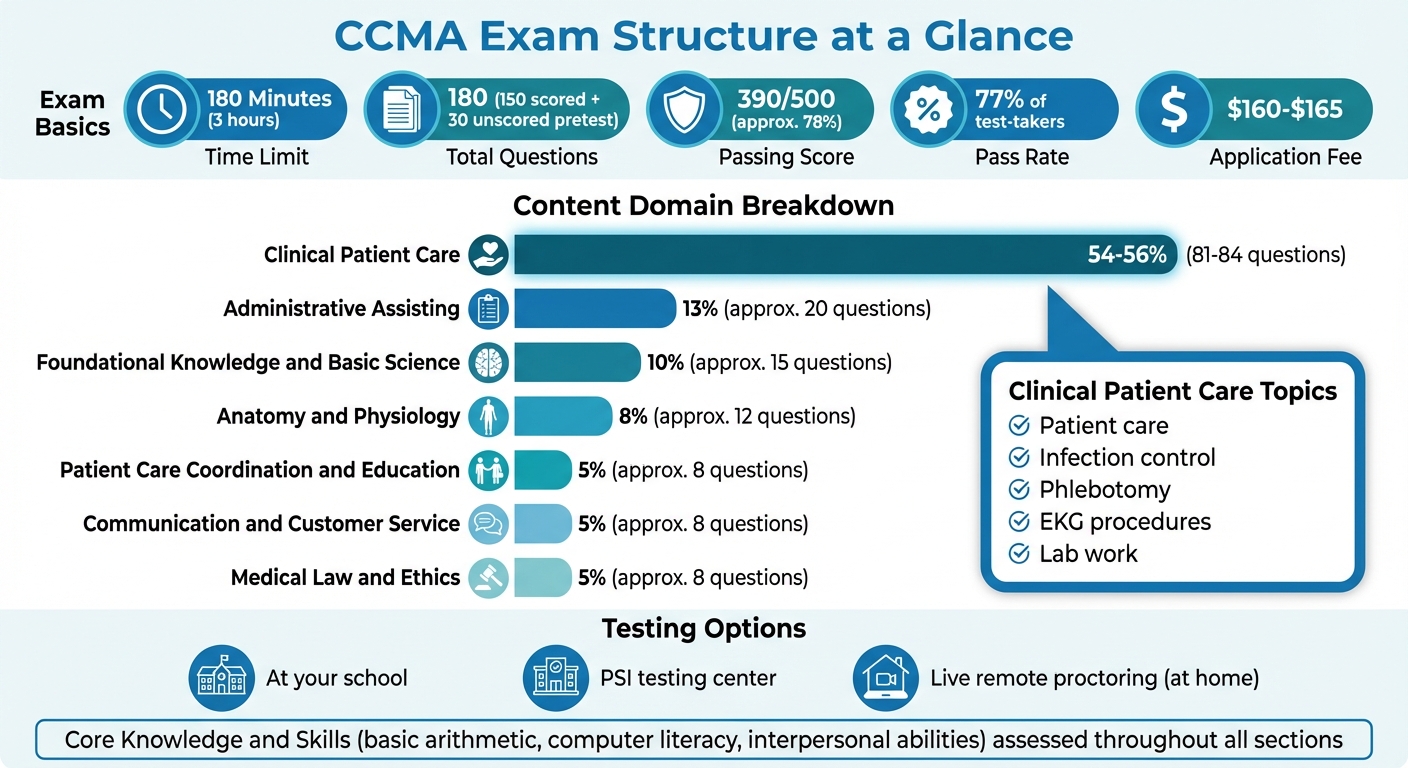
CCMA Exam Structure and Content Breakdown
Before diving into your preparation, it’s crucial to get a clear picture of the CCMA exam’s structure. Knowing how the test is set up helps you plan your study time wisely and focus on what matters most. This understanding forms the foundation for an effective study strategy.
The CCMA exam is a computer-based test with 180 multiple-choice questions. Out of these, 150 questions are scored, while 30 are unscored pre-test items used by the National Healthcareer Association (NHA) to develop future exams. Since you can’t tell which questions are scored, it’s best to treat every question as if it counts. This approach not only ensures thorough preparation but also sharpens your time management during the test.
You’ll need a scaled score of 390 or higher (on a range of 200 to 500) to pass, which translates to roughly 78%. Around 77% of test-takers meet this benchmark. To help you focus your efforts, the NHA provides a free exam blueprint that breaks down all the concepts and subtopics covered. This tool is invaluable for zeroing in on the areas that carry the most weight.
Main Exam Topics
The CCMA exam is divided into seven main domains, each covering specific knowledge and skills. The largest section, Clinical Patient Care, makes up 54% to 56% of the exam – equivalent to about 81 to 84 questions. This section includes topics like patient care, infection control, phlebotomy, EKG procedures, and lab work.
Administrative Assisting is the next largest section, accounting for 13% of the exam. It focuses on tasks like scheduling, billing, insurance, and managing medical records. Foundational Knowledge and Basic Science makes up 10% of the test.
The remaining domains include:
- Anatomy and Physiology: 8%
- Patient Care Coordination and Education: 5%
- Communication and Customer Service: 5%
- Medical Law and Ethics: 5%
Additionally, the exam assesses "Core Knowledge and Skills" throughout, which includes basic arithmetic, computer literacy, and interpersonal abilities. By understanding how these topics are weighted, you can allocate your study time to the areas that matter most.
Exam Format and Requirements
You’ll have 180 minutes to complete the exam in a single sitting, so it’s important to prepare both mentally and physically. The test can be taken in various settings: at your school, at a PSI testing center, or even at home through live remote proctoring, provided you meet the technical requirements.
The application fee ranges from $160 to $165, and if you don’t pass on your first attempt, you’ll need to wait 30 days before retaking it. After a third failed attempt, a one-year waiting period applies.
Make sure to download the free NHA CCMA Test Plan. This document highlights the high-priority concepts and reflects the current CCMA 3.0 exam version, which launched on January 10, 2024. Given that 96% of employers either require or encourage certification, as noted in the 2025 Industry Outlook, mastering the exam structure is a critical step toward meeting industry expectations.
Evaluate Your Current Knowledge and Set Goals
Once you’ve reviewed the exam structure, your next step is to take a timed diagnostic practice test. This will give you a clear picture of your starting point and help pinpoint your strengths and weaknesses.
"Before you crack open a book or start reviewing exam flashcards, take a timed practice test to get a raw baseline of readiness." – Exam Edge
When analyzing your diagnostic results, focus on how you performed in each domain. For example, Clinical Patient Care makes up a significant portion of the exam – about 54% to 56%, or 81 to 84 scored questions. If this section proves to be a challenge for you, it should become your top priority. Many digital study tools allow you to categorize questions based on your confidence level, such as "confident", "somewhat confident", or "not confident." This feature can help you track your progress as you study.
The key is to evaluate your performance objectively, so you can channel your efforts into the areas that need the most attention.
How to Test Your Starting Point
Set aside three hours for a full-length, timed practice exam that mimics the actual test environment. The exam includes 180 questions, but only 150 are scored; the remaining 30 are unscored pre-test items. Once you complete the test, review your performance by domain. Many practice platforms and official NHA score reports will show whether your performance is "above", "near", or "below" the passing standard. Look for recurring patterns in your mistakes, such as struggling with infection control, EKG procedures, or administrative topics like billing. Make a list of specific subtopics where you’re falling short of a passing score. This focused approach ensures that your study time is spent on the areas where it will have the most impact.
By identifying these gaps, you can create a study plan that addresses your weakest areas first.
Setting SMART Goals
With your diagnostic results in hand, it’s time to set clear and actionable goals using the SMART framework (Specific, Measurable, Achievable, Relevant, and Time-bound):
- Specific: Don’t just say, "I need to study more." Instead, define exactly what you need to work on. For example, "I will focus on improving my understanding of Foundational Knowledge topics."
- Measurable: Set a target score above the passing threshold of 390. Aiming for a score like 410 or 420 gives you a comfortable margin.
- Achievable: Be realistic about how much time you have. Many candidates find that one to three months of preparation works well. If you have other commitments, an eight-week plan may be more manageable than trying to cram in a few weeks.
- Relevant: Use study materials that align with the current NHA CCMA exam blueprint. Outdated resources could slow your progress.
- Time-bound: Schedule your exam date before you start studying. Having a deadline keeps you accountable and allows you to plan your study schedule backward, dedicating specific weeks to each domain based on your diagnostic results.
With your diagnostic insights and SMART goals in place, you’re ready to create a focused and efficient study plan.
Build a Study Schedule That Works
Once you’ve set your goals, it’s time to create a study schedule that aligns with them. Most students spend one to three months preparing for the CCMA exam, but the key to success lies in how effectively you structure your study time. A good schedule breaks down the material by topic, focuses on the most heavily weighted exam areas, and fits into your daily routine without becoming overwhelming.
To maximize retention, keep your study sessions to 3–4 hours at most. Research shows that longer sessions often lead to diminishing returns as your brain struggles to absorb and recall information. Instead, aim for consistent, focused study blocks rather than exhausting all-day marathons.
8-Week Study Plan Example
An eight-week plan offers enough time to thoroughly cover all exam topics without feeling rushed. Considering that Clinical Patient Care makes up 54% to 56% of the exam, it’s smart to dedicate two full weeks to this section alone. The rest of the time can be divided among the smaller domains based on their importance and your diagnostic test performance.
Here’s an example of how you might organize your study plan:
| Week | Focus Topic | Exam Weight |
|---|---|---|
| 1 | Foundational Knowledge & Basic Science | 10% |
| 2 | Anatomy & Physiology | 5–8% |
| 3 | Clinical Patient Care (Part 1: General Care & Infection Control) | 54–56% |
| 4 | Clinical Patient Care (Part 2: Phlebotomy, EKG, Lab Procedures) | 54–56% |
| 5 | Administrative Assisting | 8–13% |
| 6 | Communication, Customer Service, Law & Ethics | 10–13% |
| 7 | Patient Care Coordination & Education | 5–8% |
| 8 | Final Review & Full-Length Practice Exams | N/A |
During each week, break your study time into 90-minute sessions, and follow each session with a short physical break – go for a walk, stretch, or do light exercise. For the Clinical Patient Care sections in weeks three and four, consider splitting your sessions by topic. For example, focus on general patient care one day and phlebotomy the next. This approach keeps your study routine varied and engaging.
Fitting Study Into a Busy Schedule
Once your schedule is mapped out, the challenge becomes fitting study time into your daily life. Early mornings or late evenings are often ideal for focused study sessions.
You can also use smaller pockets of time throughout the day for quick reviews. For instance, go through flashcards or answer practice questions during your lunch break, commute, or while waiting in line. These short bursts of active recall are powerful tools for reinforcing what you’ve learned.
To stay on track, consider teaming up with an accountability partner or joining online groups like the "Medical Assistant Path" subreddit. These communities provide motivation and a space to discuss tricky topics.
With a well-thought-out schedule and practical study strategies, you’ll be ready to tackle all sections of the exam effectively.
sbb-itb-7a67ffa
Select Your Study Materials and Resources
Choosing the right materials can make or break your preparation for the CCMA exam. The National Healthcareer Association (NHA) provides official resources like the CCMA Study Guide and online practice tests. These materials are specifically designed to align with the exam content and are available online at reasonable prices. You can also find bundle options that include personalized tools for targeted review.
"Using outdated or inaccurate resources wastes time and risks failure." – Katie Miller, Co-creator, Smarter MA
It’s essential to use the updated CCMA 3.0 materials, as the exam was revised in January 2024. Outdated resources won’t reflect the current healthcare standards, leaving you at a disadvantage. Prioritize materials that include interactive tools, making it easier to study during short breaks or on the go.
Study Resources to Use
Start with the official NHA study guide and practice tests. These are developed directly from the exam’s test plan and include Focused Review®, a personalized tool that helps you identify and improve weaker areas based on your practice test performance.
For practical skills, consider tools like MA SkillsBuilder™: Clinical, which offers hands-on training in clinical tasks. Mobile apps with digital flashcards can be another great way to review tricky topics and track your progress.
Additionally, self-paced programs provide the flexibility to tailor your study schedule while offering a structured approach to mastering the material.
Advantages of Self-Paced Study Programs
Self-paced programs bring flexibility to your exam preparation. For example, HealthCareer Certs offers an entirely online CCMA certification program packed with interactive features like 3D demonstrations, quizzes, flashcards, and practice questions. These programs also include self-check tools to reinforce your understanding of key concepts.
One standout feature is the inclusion of one-on-one Zoom sessions with instructors, giving you personalized guidance on challenging topics. The program’s tools – such as audio narration, bookmarking, and performance analytics – help you stay organized and track your progress. Whether you prefer to complete the material in just 4 weeks or take up to 12 weeks, you can study at your own pace. Plus, the mobile-friendly design lets you access resources on your phone, tablet, or computer, making it easier to fit studying into a busy schedule.
Use Practice Tests and Review Methods
Once your study schedule is set, the next step is adding regular practice exams into the mix. These tests are a cornerstone of CCMA exam preparation. Relying solely on passive methods like reading or flashcards can give a false sense of mastery. Active self-testing, on the other hand, uncovers your actual readiness and pinpoints areas that need more attention. This targeted approach not only improves your knowledge but also builds your speed and confidence.
"Practice exams are the #1 best way to prepare for the real test. If you’re reading a textbook or just doing flashcards, it’s easy to trick yourself into thinking you ‘know’ the material." – Katie Miller, Co-creator, Smarter MA
The CCMA exam consists of 180 questions (150 of which are scored) to be completed in 3 hours. That’s roughly one minute per question, making timed practice critical for developing both speed and endurance.
Taking Regular Practice Exams
Start with a baseline test to gauge where you stand, then schedule weekly practice exams throughout your 8-week study plan. Treat these as full-length simulations by setting up a quiet, distraction-free environment and sticking to the 3-hour time limit. This not only builds stamina but also helps you refine your pacing strategy. If you come across a difficult question, flag it and move on to avoid wasting time.
The NHA offers official practice tests starting at $49, designed to match the current exam format. These tests also provide score reports that break down your performance by domain, helping you identify specific areas – like Medical Law and Ethics or Anatomy and Physiology – that may need extra review.
Reviewing Mistakes and Using Active Recall
The real value of practice tests lies in the review process. Don’t focus solely on your score; instead, dive into the explanations for every incorrect answer. Understanding why the correct answer is right – and where your reasoning went wrong – clears up misconceptions and strengthens your grasp of the material.
Digital tools can make this process even smoother. For instance, the NHA’s Focused Review® system highlights your weak areas based on test results, so you can zero in on topics that need work. Revisit flagged questions until you can confidently explain the concepts.
"Review questions you’re struggling with frequently using the tagged questions feature to move content you don’t know into content you do know." – Katie Miller, Co-creator, Smarter MA
If a topic remains unclear, switch up your method. Watch a video tutorial, use flashcards for quick repetition, or try another resource to reinforce your understanding. Remember, the passing score for the CCMA exam is 390 out of 500 (about 78%), and the initial pass rate among 693 candidates was 62.9%. Diligently reviewing your mistakes can significantly improve your odds of success. By staying consistent with this process, you’ll make the most of your study time and be well-prepared for exam day.
Manage Your Time and Prevent Burnout
Preparing for an exam often takes 1 to 3 months of steady effort for most candidates. The trick is to maintain a steady rhythm that keeps you energized and focused without overloading yourself. Overloading your brain with information in one go not only saps your energy but also makes it harder to retain what you’ve learned. Instead, aim for a balance – structured study sessions, regular breaks, and plenty of rest. Here’s how to stay on track without burning out.
Structuring Daily Study Sessions
One effective way to stay focused is by using the Pomodoro Technique. Work in 25-minute intervals followed by a 5-minute break. After four cycles, take a longer break of 15 to 30 minutes. There are plenty of timer apps to help you stick to this routine.
"For most people, studying more than 3-4 hours in a day loses its effectiveness." – Katie Miller, Co-creator, Smarter MA
Another option is to break your day into 90-minute study blocks. These extended sessions are great for tackling tougher topics, like Clinical Patient Care, which makes up 56% of the exam. After each block, reward yourself with a relaxing activity – take a walk, grab a healthy snack, or just step away for a bit. The goal is to make each session productive while keeping your mind fresh. Focus on different exam areas during specific time slots, and dedicate extra attention to topics you find challenging or that carry more weight on the test.
Taking Breaks and Getting Enough Sleep
Once you’ve planned your study sessions, it’s equally important to schedule breaks and prioritize sleep. Short breaks throughout the day help prevent mental exhaustion and improve how well you retain information. As your exam date approaches, consider scaling back intense study sessions in favor of lighter reviews and relaxation. This allows your brain to consolidate what you’ve already learned.
Sleep is a non-negotiable part of the process. Adults need 7 to 9 hours of sleep each night to keep their minds sharp. Sleep also plays a key role in strengthening memory, so reviewing notes before bed – using physical materials instead of screens – can be particularly effective. Combine good sleep with a brain-friendly diet that includes nuts, berries, and leafy greens. And if pre-exam nerves creep in, stress-management techniques like deep breathing or meditation can help you stay calm and focused.
Conclusion
Preparing for the CCMA certification can feel like a big task, but it doesn’t have to be. Start by familiarizing yourself with the exam structure, then take a practice test to pinpoint areas where you need improvement. From there, create a manageable study schedule that spreads your preparation over 1 to 3 months. The key is consistency – slow and steady wins the race, far more effectively than last-minute cramming.
Once your schedule is set, focus on active learning techniques. Practice exams and flashcards are much more effective than passively reading through materials. In 2024, the CCMA exam had a passing rate of 81.38%, and you can join those ranks by sticking to a disciplined study routine. HealthCareer Certs offers a structured, self-paced course with interactive tools, one-on-one instructor support, and over 1,400 practice questions, making it easier to fit studying into your busy life.
Remember, this is a marathon, not a sprint. Take regular breaks, get enough sleep, and give your brain time to absorb the material. If the process starts to feel overwhelming, step back and focus on lighter reviews to regain your footing.
Keep yourself motivated by tracking progress – improving your practice test scores is a great way to see how far you’ve come. Celebrate small victories along the way. With a well-thought-out plan, reliable resources, and daily dedication, you’ll walk into exam day feeling confident and ready to succeed. Stay consistent, and you’ll be fully prepared to pass.
FAQs
How can I manage my study time effectively and avoid burnout while preparing for the CCMA exam?
To make the most of your study time and keep burnout at bay, it’s all about finding the right balance and sticking to a structured approach. Start by mapping out a study plan that divides your topics into smaller, easier-to-handle chunks. Assign specific time slots for each section – this keeps you on track and ensures consistent progress without feeling overwhelmed.
Don’t forget to schedule regular breaks. Short, focused study sessions followed by quick rest periods can work wonders for your concentration and memory. And while you’re at it, prioritize self-care. Getting enough sleep, eating nutritious meals, and staying physically active are just as important as the hours you spend studying – they help keep your mind sharp and your body energized.
Lastly, lean on reliable tools like study guides, flashcards, and practice tests to strengthen your understanding. Taking timed practice exams can mimic the test-day experience, highlight areas where you need extra work, and boost your confidence when it counts.
What are the best study materials to prepare for the updated CCMA 3.0 exam?
To get ready for the updated CCMA 3.0 exam, focus on official study materials, practice tests, and structured learning tools that match the latest exam outline. The National Healthcareer Association (NHA) provides updated resources tailored to the CCMA 3.0 exam. These materials cover essential topics such as anatomy, physiology, patient care, infection control, and administrative responsibilities, ensuring you’re studying content aligned with current industry practices.
Practice tests are especially helpful for spotting your strengths and the areas where you need extra focus. Choose tools that offer detailed answer explanations to deepen your understanding of the material. Pair these with a clear, organized study plan to stay focused and make the most of your preparation. Using these resources together will help you approach exam day with confidence.
How can I prioritize CCMA exam topics based on their importance and my strengths?
To prepare for the CCMA exam, it’s smart to focus your efforts on the topics that carry the most weight while also considering your personal strengths and weaknesses. Here’s the breakdown: Clinical Skills dominate the exam, making up about 65–70% of the content. These include areas like patient care, infection control, phlebotomy, and EKG testing. The remaining 30–35% of the exam focuses on Administrative Skills, which involve tasks like scheduling, record management, and billing.
Start by pinpointing your weaker areas using practice tests or self-assessments. Once you know where you struggle, dedicate extra time to those high-priority clinical topics since they make up the majority of the exam. Don’t overlook your stronger areas, though – reviewing them will help solidify your knowledge and build confidence. By targeting your study efforts this way, you can make the most of your preparation time and focus on what matters most for the exam.