Preparing for the CPCT exam in 2026? Here’s what you need to know:
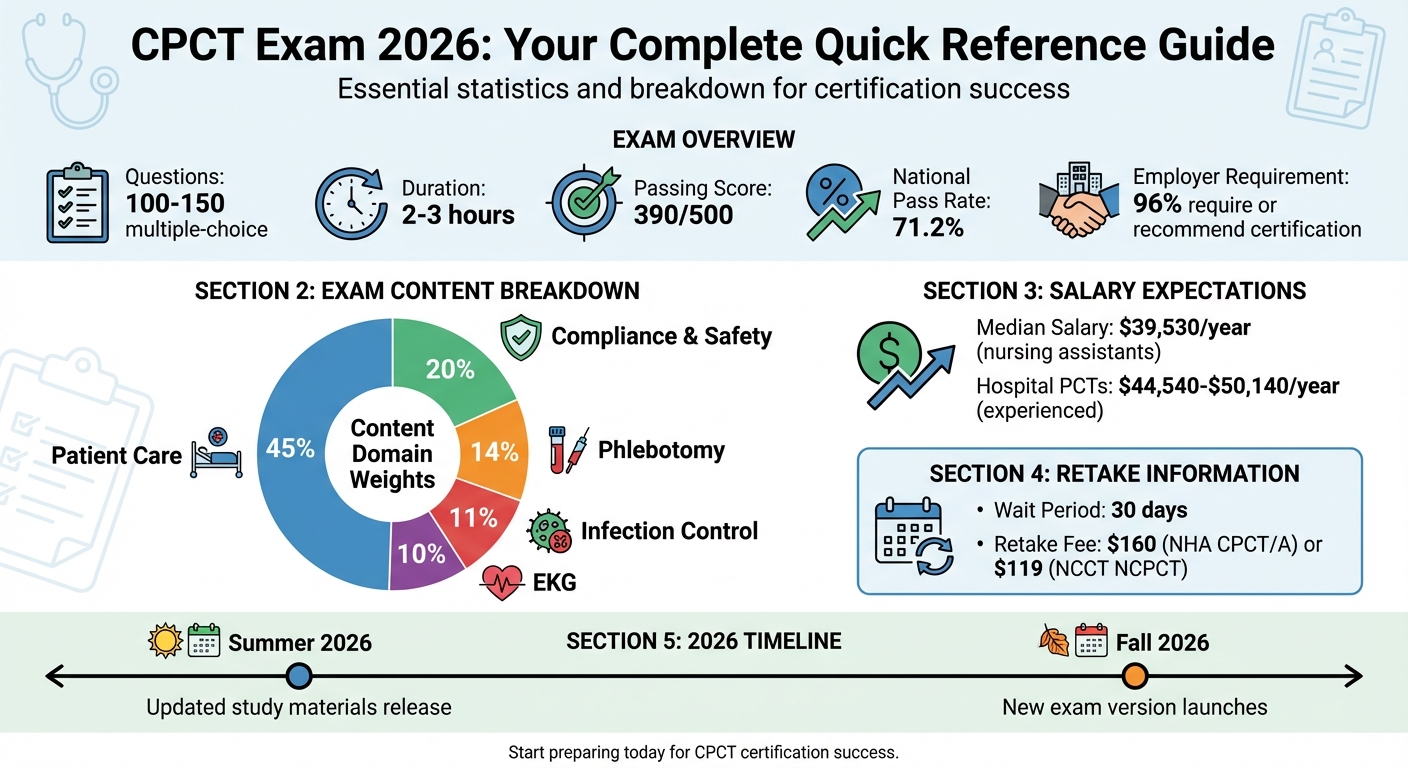
The Certified Patient Care Technician/Assistant (CPCT/A) exam is a certification that validates your skills in patient care, phlebotomy, EKG monitoring, and more. With 96% of employers requiring or recommending this certification, it’s a key step for advancing your healthcare career. The exam includes 100–150 multiple-choice questions, takes 2–3 hours, and requires a passing score of 390/500. The national pass rate is 71.2%.
Key Exam Details:
- Weight by Domain:
- Patient Care: 45%
- Compliance & Safety: 20%
- Phlebotomy: 14%
- Infection Control: 11%
- EKG: 10%
- Median Salary: $39,530/year for nursing assistants; experienced PCTs in hospitals earn $44,540–$50,140/year.
- Upcoming Changes: Updated exam materials release in Summer 2026; new exam version launches Fall 2026.
Study smarter with resources like practice exams, interactive tools, and a structured plan. Focus on the five main content areas, use mock tests to build confidence, and manage your time effectively on exam day. If you don’t pass, retakes are allowed after 30 days with a $160 fee.
Start preparing today to secure your certification and boost your career in healthcare.
CPCT Exam 2026 Quick Reference Guide: Domains, Scores, and Key Statistics
NEW 2026 PCT Exam Certification Practice Test | 50 Real Patient Care Technician Questions
sbb-itb-7a67ffa
CPCT Exam Format and Content Areas
The CPCT/A exam consists of multiple-choice, scenario-based questions that simulate real-world decision-making in patient care. This format is designed to test your ability to think critically and apply knowledge in practical situations, much like you would on the job.
If you’re taking the exam after Fall 2026, be sure to use the updated study materials released in Summer 2026. The NHA has stated that retakes within 30 days of the update will require these new materials. This change stems from a "job task analysis study", which aims to align the certification with the skills and competencies required in modern healthcare. However, the NHA has assured that the core exam topics and content areas remain largely unchanged. To help candidates navigate these updates, the NHA has provided a "crosswalk resource" highlighting differences between the old and new test plans.
The exam is divided into five main content areas, each with a specific weight. Patient Care holds the greatest emphasis at 45%, followed by Compliance, Safety, and Professional Responsibility at 20%, Phlebotomy at 14%, Infection Control at 11%, and EKG at 10%. Knowing these percentages can help you prioritize your study time effectively.
| Domain | Weight | Key Focus Areas |
|---|---|---|
| Patient Care | 45% | ADLs, hygiene, mobility, feeding, body systems |
| Compliance & Safety | 20% | OSHA, HIPAA, abuse reporting, safety goals |
| Phlebotomy | 14% | Venipuncture, capillary sticks, specimen handling |
| Infection Control | 11% | PPE, aseptic technique, biohazard disposal |
| EKG | 10% | Electrode placement, rhythm recognition, artifacts |
Below is a breakdown of each content area to help guide your preparation.
Basic Nursing Skills
This section represents 45% of the exam, making it the most significant area to focus on. You’ll encounter questions on essential patient care tasks like bathing, bed-making, assisting with activities of daily living (ADLs), feeding tube care, and modifying care for patients with functional limitations. Expect an emphasis on body mechanics and patient positioning to ensure safety for both patients and technicians. Additionally, infant measurement, including weighing and measuring infants, became part of the curriculum in October 2025.
Vital Signs and Measurements
This section tests your ability to accurately measure and record vital signs. You’ll need to demonstrate proper use of medical equipment to measure blood pressure, pulse, temperature, and respiration rate. Some scenarios will require you to identify abnormal readings or prioritize which measurements need immediate attention.
Patient Safety and Infection Control
Together, these areas make up 31% of the exam. The Compliance, Safety, and Professional Responsibility section (20%) evaluates your understanding of abuse identification and reporting, OSHA and HIPAA compliance, emergency response, and medical ethics. The Infection Control section (11%) focuses on standard and transmission-based precautions, equipment disinfection, biohazard disposal, and the chain of infection. You’ll also need to know how to use personal protective equipment (PPE) and maintain aseptic technique in different clinical scenarios.
Medical Terminology and Communication
Medical terminology is woven throughout the exam, requiring you to interpret scenario-based questions and communicate effectively with the healthcare team. You’ll need to show proficiency in using medical language in documentation and understanding physician orders. Questions may also assess your communication skills in patient interactions, family education, and teamwork.
Documentation and Legal Responsibilities
This area falls under the Compliance, Safety, and Professional Responsibility domain and focuses on accurate record-keeping and understanding legal aspects of patient care. Questions will cover topics like maintaining confidentiality under HIPAA regulations, documenting care accurately, recognizing scope of practice limitations, and knowing when to escalate concerns to supervisors or authorities. The exam underscores the importance of understanding the legal and ethical boundaries of the Patient Care Technician role, ensuring you’re prepared for the regulatory challenges of the job.
These content areas highlight the practical skills and knowledge you’ll need as a CPCT, making focused preparation essential for success.
Study Resources and Tools from HealthCareer Certs
CPCT Program Features
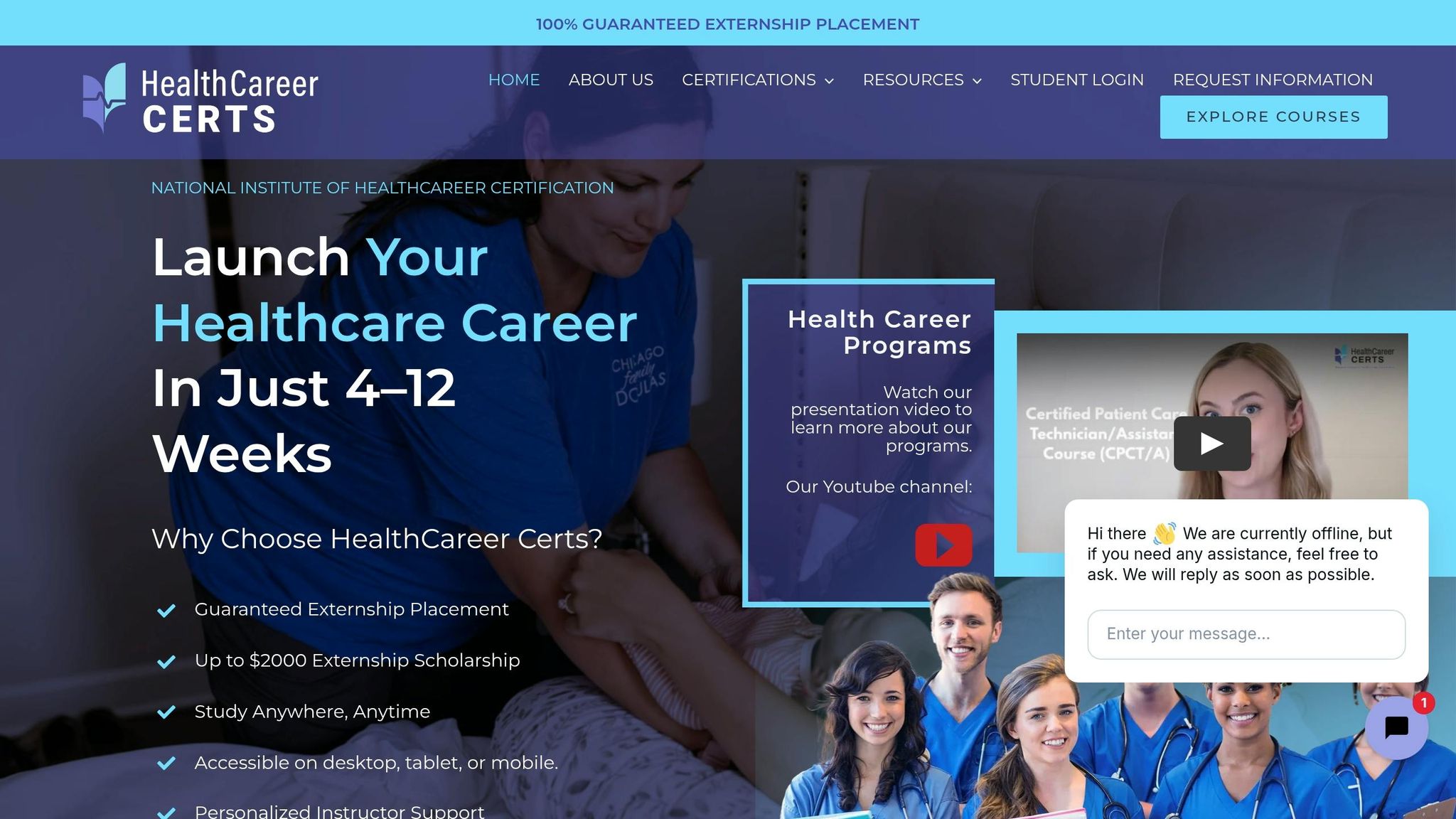
HealthCareer Certs provides a full year of 24/7 access to their CPCT program, packed with 16 modules covering essential topics like anatomy, medical terminology, and clinical skills such as phlebotomy, EKG, and vital signs. Each module is designed to make complex procedures easier to understand through video lectures, audio narration, and 3D animations.
Need help? You can reach out to their team via text, call, or email, and even schedule Zoom meetings for one-on-one guidance. To ensure you’re on track, the program includes six competency test assessments that measure your progress throughout the course.
The program offers flexible payment plans: pay in full ($2,200–$2,300) or choose installments – two payments of $1,200 or four payments of $625. This fee covers everything: registration for the nationally accredited certification exam, study materials, and 12-month program access. Plus, students may qualify for an externship scholarship worth up to $2,000.
Now, let’s dive into how the program’s practice exams and question bank help you prepare for the CPCT exam.
Practice Exams and Question Bank
HealthCareer Certs includes over 1,400 practice questions that closely resemble the format of the NHA CPCT exam. These questions are spread across the exam’s five content domains, ensuring comprehensive coverage. Additionally, the program offers 700 self-check assessments to provide continuous feedback as you study.
After completing a practice exam, you’ll receive a personalized review that breaks down your performance by domain. This helps you pinpoint areas that need more attention. The mock exams simulate the actual testing experience with 150 questions and a 3-hour time limit, helping you build confidence and manage test-day nerves.
Pair these practice tests with interactive tools to further develop your clinical skills and knowledge.
Interactive Study Tools
To enhance your learning, HealthCareer Certs offers a variety of interactive tools. Their 3D animated demonstrations allow you to see clinical procedures from different angles, making complex techniques easier to grasp. You’ll also get hands-on experience with electronic health records (EHR) through realistic simulations, preparing you for real-world scenarios.
For quick study sessions, use the mobile-friendly portal to access interactive flashcards and quizzes. Game-based learning activities are also available to reinforce key job skills in a fun, engaging way. With a perfect 5.0 Google rating from over 5,000 students, these tools have consistently helped candidates succeed on their first attempt.
Study Strategies and Time Management
Creating a Study Schedule
Start by taking a timed baseline test to identify your knowledge gaps and determine which exam areas need the most focus. Once you know where you stand, break the material into smaller, focused sections. For example, dedicate specific days to topics like Infection Control, Phlebotomy, or EKG fundamentals. This targeted approach helps you stay organized and prevents feeling overwhelmed.
Tailor your study methods to your learning style. If you’re a visual learner, incorporate video lectures or diagrams. If hands-on practice works best for you, use interactive tools to reinforce your understanding. Keeping your study area tidy – whether that’s a physical desk or digital folders – can also help you stay on track and maintain focus.
With a structured schedule, you can balance your other responsibilities while ensuring consistent study time.
Balancing Study with Other Commitments
Juggling work, family, and exam prep can be a challenge, but careful planning makes it manageable. Set aside regular study times and include breaks to avoid burnout. Short, focused sessions – like 30 minutes at a time – can be highly effective if done consistently.
An accountability partner can also make a big difference. Whether it’s a coworker or a classmate, studying together can help you tackle tough concepts and keep you motivated. Alongside your study plan, don’t forget to prioritize your well-being. Getting enough sleep, eating nutritious meals, and staying active all contribute to better memory and sharper focus.
This balanced approach helps you stay prepared without sacrificing your overall health.
Using Practice Exams Strategically
Using practice exams effectively can be a game-changer. Follow a three-step process: start with open-book tests, then move to timed sessions with reference materials, and finally, simulate real exam conditions. This progression builds both knowledge and confidence for test day.
| Practice Test Type | Purpose | Best Used When |
|---|---|---|
| Baseline Test | Assess your starting point | Early in your study plan |
| Formative Test | Strengthen your understanding | Midway through preparation |
| Simulation Test | Prepare for test-day conditions | 1–2 weeks before the exam |
When reviewing practice exams, don’t just focus on your overall score. Dive into the explanations for each question, even the ones you got right, to ensure you fully understand the material. Use the "flag" feature to mark tricky questions, so you can revisit them later – just as you’d do during the actual exam. This method helps you refine your approach and manage your time effectively.
Test-Taking Tips and Retake Guidance
Test Day Preparation
Get to the testing center 15–30 minutes early to allow enough time for check-in. Plan your route ahead of time and leave room for unexpected delays – late arrivals may lead to disqualification. Don’t forget to bring a valid, government-issued photo ID, like a driver’s license or passport, that includes your signature.
Leave prohibited items – such as cell phones, smartwatches, and calculators – outside the exam room, as these are not allowed anywhere in the testing area. Before the exam begins, take a moment to settle at your station, calm your nerves, and focus. Use the pacing and review strategies you’ve practiced during your preparation. These steps can help you start the test with a clear and steady mindset.
Staying Focused During the Exam
Once the test begins, staying focused is key. You’ll have 3 hours to complete 170 questions (150 scored and 20 unscored), which means you should aim to spend about one minute per question. Read each question carefully – this is especially important for scenario-based questions that require more critical thinking. If a question stumps you, use the process of elimination to narrow down your choices and make an educated guess without losing too much time.
Flag difficult questions for review so you can move on and tackle easier ones first. This strategy helps ensure you don’t run out of time before answering the questions you’re more confident about.
Handling Retakes: Next Steps
Even with the best preparation, retakes might sometimes be necessary. If you don’t pass, you’ll need to wait 30 days before retaking the exam. Reapply and pay the retake fee – $160 for the NHA CPCT/A or $119 for the NCCT NCPCT. Use your score report to identify areas that need improvement and adjust your study plan accordingly.
| Exam Component | NHA CPCT/A | NCCT NCPCT |
|---|---|---|
| Passing Score | 390 / 500 | 575 / 720 |
| Retake Wait Period | 30 Days | 30 Days |
| Retake Cost | $160 | $119 |
It’s worth noting that if you fail an exam within 30 days of the Fall 2026 rollout of the updated NHA exam, you’ll need to take the new version for your retake. Make sure to use the updated study materials released in Summer 2026 to prepare for these changes. By focusing on your weaker areas and sticking to a targeted practice plan, you’ll improve your chances of passing on your next attempt.
Conclusion: Preparing for CPCT Success in 2026
Passing the CPCT exam in 2026 means focusing your preparation on five key domains. With a national pass rate of 71.2% and a passing score of 390 out of 500, success requires both dedication and strategy. Keep in mind the updated study materials arriving in Summer 2026 and the new exam version launching in Fall 2026.
HealthCareer Certs offers a complete suite of resources to help you prepare, including interactive learning modules, competency tests, and externship support. Their mobile-friendly platform not only covers exam registration but also gives you 12 months of study access. These tools are designed to prepare you for both the written exam and practical, real-world clinical scenarios.
The next step? Build a study plan that fits your schedule. A realistic plan ensures you balance preparation with your other responsibilities. Use practice exams wisely to pinpoint areas where you need improvement, and focus your efforts on strengthening those weak spots. Remember, the CPCT exam doesn’t just test your memory – it challenges you to apply your knowledge to real patient care situations.
Start your certification journey now. With a solid preparation plan and the resources from HealthCareer Certs, you’ll be ready to pass the CPCT exam and take the next step in your healthcare career in 2026.
FAQs
Which CPCT exam version will I take in 2026?
In the fall of 2026, the updated CPCT/A certification exam will be introduced. While the changes are minimal, they are based on a thorough job task analysis. Staying updated on these revisions will help ensure you’re ready when the time comes.
How should I split my study time across the five domains?
The CPCT exam is divided into five main domains, with Patient Care taking up the largest chunk. To prepare effectively, dedicate around 45% of your study time to this area. Use the remaining 55% to focus on the other domains, such as Compliance, Safety, and Professional Responsibilities, prioritizing them based on their weight and relevance. Make sure to give special attention to crucial topics like Safety and Infection Control to ensure a balanced approach and improve your chances of success.
What should I do differently if I need to retake the CPCT exam?
If you need to retake the CPCT exam, keep this in mind: anyone who fails within the 30 days leading up to the new version’s launch in Fall 2026 will need to take the updated exam. Once the update is live, make sure to prepare using the latest study materials. It’s also a good idea to review the retake policies and focus on any updated resources to boost your chances of success on your next attempt.