Certified Phlebotomy Technicians (CPTs) have diverse career options across healthcare settings, with projected job growth of 6% from 2024 to 2034. Salaries range between $29,000–$59,000 annually, depending on experience and role. CPT certification provides not only immediate job opportunities but also a pathway to advanced healthcare roles like Medical Laboratory Technician or Registered Nurse.
Here are 9 common career paths for CPTs:
- Hospital Phlebotomist: Fast-paced environment handling routine and urgent bloodwork. Median salary: $45,100.
- Outpatient Clinic Phlebotomist: Stable hours in clinics or urgent care centers. Median salary: $43,660.
- Medical Laboratory Assistant: Combines blood collection with specimen processing in labs. Median salary: $41,580.
- Independent Laboratory Technician: Works in diagnostic labs with structured schedules. Median salary: $41,580.
- Blood Donation Center Phlebotomist: Collects blood in fixed or mobile donor centers. Salary: $33,000–$48,000.
- Mobile Phlebotomist: Travels to patients for at-home or workplace blood draws. Average hourly rate: $23.20.
- Research Phlebotomist: Supports clinical trials and research studies. Salaries range from $52,800–$68,400 with certifications.
- Physician Office Phlebotomist: Works in outpatient settings assisting with routine diagnostics. Median salary: $40,480.
- Lab Patient Service Technician: Handles blood collection and administrative tasks in labs. Median salary: $43,660.
CPT certification also serves as a stepping stone for career growth, with opportunities in supervisory roles, specialized fields, or further education in healthcare. These roles offer flexibility, steady demand, and the chance to make a meaningful impact in patient care.
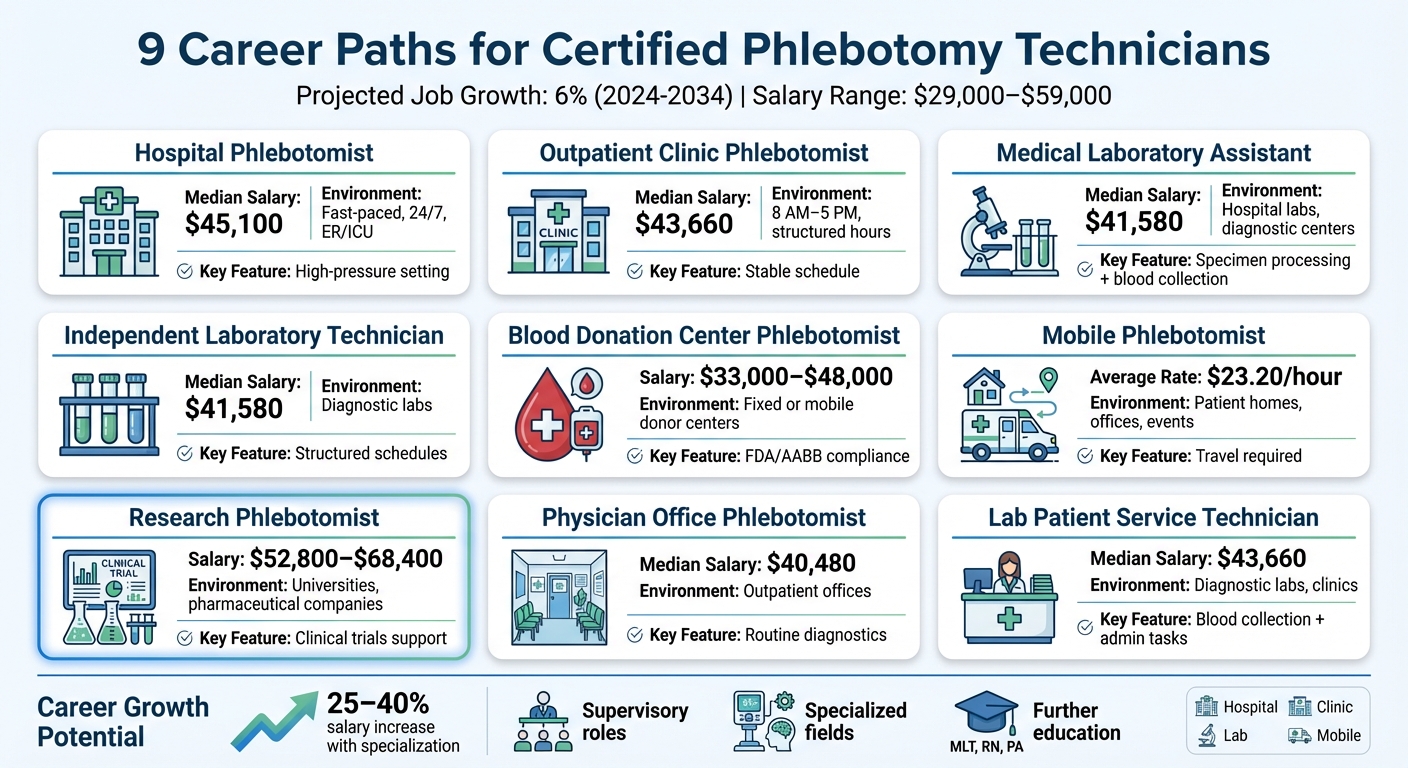
9 Phlebotomy Technician Career Paths: Salaries and Work Settings Comparison
A Day in the Life of a Phlebotomist: Exploring a Rewarding Career Path – Careers That Work
1. Hospital Phlebotomist
Hospital roles highlight the importance of CPT certification in high-pressure healthcare settings.
Work environment
Hospital phlebotomists operate in fast-paced, round-the-clock environments that demand both physical stamina and adaptability. Shifts often start as early as 5:30 AM to accommodate fasting blood draws. The job involves standing for long periods, moving quickly between departments like the Emergency Room and ICU, and handling physically demanding tasks. Work schedules typically include early mornings, nights, weekends, and holidays. This high-energy setting requires precision and efficiency at all times.
Job responsibilities
Key duties include performing venipuncture and capillary punctures for routine and urgent (STAT) orders, verifying patient identity using two identifiers, and promptly labeling and processing specimens for lab analysis via systems like Epic, Cerner, or Meditech. Accurate record-keeping in Electronic Health Records and Laboratory Information Systems is critical. Maintaining sterile equipment, ensuring supplies are well-stocked, and keeping workstations OSHA-compliant are also essential parts of the job.
Interaction with patients
Hospital phlebotomists encounter patients of all ages and conditions, from nervous children to critically ill seniors. Easing patient anxiety is a vital skill, achieved through clear communication and empathy. Explaining procedures in simple terms and offering post-collection care instructions fosters trust and cooperation.
Career growth opportunities
The technical expertise and interpersonal skills gained in a hospital setting open doors to career advancement. Supervisory roles, for example, can increase salaries by 25–40%. Specialized fields like pediatric phlebotomy, donor technology, or blood bank operations are also options. Hospital experience can serve as a stepping stone to roles such as Medical Laboratory Technician, Registered Nurse, or Physician Assistant. The median annual salary for hospital phlebotomists is $45,100, with seasoned professionals earning over $58,000 per year.
2. Outpatient Clinic Phlebotomist
Working in an outpatient clinic offers phlebotomists a more consistent and predictable environment compared to the fast-paced, high-pressure settings of hospitals. For those with CPT certification, this role provides both stability and a wide range of opportunities.
Work Environment
Outpatient phlebotomists often work in physician offices, diagnostic labs, urgent care centers, or specialized clinics. Unlike hospital jobs that demand 24/7 availability, outpatient roles typically stick to standard daytime hours – usually 8:00 AM to 5:00 PM. While clinics may experience busier periods during peak times, the overall environment is more structured and less chaotic than hospital settings.
Job Responsibilities
Phlebotomists in outpatient clinics handle a variety of tasks, including verifying patient identities using two identifiers, performing venipunctures and capillary punctures with proper aseptic techniques, and labeling samples accurately. They also update electronic health records or laboratory systems, process specimens (e.g., centrifuging blood or separating serum), and manage inventory by restocking supplies like needles, vials, and tourniquets. The consistent schedule of outpatient clinics makes it easier to maintain organized workflows and supplies.
Interaction with Patients
One of the most important aspects of this role is patient interaction. Phlebotomists are often the first point of contact, so they need to greet patients warmly, explain procedures clearly, and provide empathetic care to ease any anxiety.
“Calming people and perfecting the talent of inflicting more kindness and compassion than pain.”
– CareerStep
They also monitor patients for reactions like dizziness or fainting, ensuring their safety throughout the procedure. Strong communication and interpersonal skills are essential for success in this setting.
Career Growth Opportunities
Outpatient clinics offer plenty of room for career growth. Phlebotomists can advance to positions like Lead Phlebotomist or Lab Coordinator. Expanding skills through additional certifications – such as EKG Technician, Medical Assistant, or Patient Care Technician – can open even more doors.
The median annual salary for phlebotomy technicians is around $43,660, while leadership roles like Phlebotomy Supervisor can earn between $48,000 and $70,000 per year. With experience, some phlebotomists transition into teaching roles, training new hires or leading phlebotomy courses. This structured work environment provides a solid foundation for those looking to grow their careers while maintaining a steady routine.
3. Medical Laboratory Assistant
Medical Laboratory Assistants with CPT certification play a vital role in laboratory settings, blending phlebotomy expertise with specimen processing and basic lab operations. This combination of skills broadens their technical abilities and responsibilities.
Work Environment
Medical Laboratory Assistants often work in hospital pathology departments, clinical diagnostic labs, research facilities, and large diagnostic centers [3, 21, 28]. Unlike mobile phlebotomists, these professionals typically remain in one location, as patients visit the lab instead of the technician traveling to them. The environment is usually calm, though workloads can intensify during busy periods.
Work schedules depend on the setting. While clinical labs often operate during standard business hours (8:00 AM to 5:00 PM), hospital-based roles may involve night, weekend, or holiday shifts to support round-the-clock operations [21, 29]. Around one-third of phlebotomy-related jobs are found in medical and diagnostic laboratories. Employment in this area is expected to grow by 6% between 2024 and 2034 – double the average growth rate for all occupations. This steady work environment allows Medical Laboratory Assistants to focus on a variety of specimen-handling and testing tasks.
Job Responsibilities
Medical Laboratory Assistants take on a wide range of duties beyond drawing blood. They collect various patient specimens, including blood (via venipuncture and capillary sticks), tissue, and other bodily fluids [22, 26]. Responsibilities also include preparing and processing specimens, conducting routine and specialized tests using tools like microscopes and cell counters, and managing quality control, test kits, and lab inventory [22, 25].
They document and communicate test results to physicians while maintaining strict safety and cleanliness standards [22, 25]. As technology evolves, labs increasingly rely on laboratory information systems (LIS), handheld devices for scanning patient wristbands, and automated label printers [21, 29].
“Phlebotomists are an integral part of a laboratory team, as they are responsible for drawing blood both for diagnostic tests and donations, while ensuring patient safety.”
– CCI Training Center
In addition to these technical tasks, their role involves direct patient care.
Interaction with Patients
Medical Laboratory Assistants often engage with patients during stressful or sensitive moments. This requires a compassionate and professional approach to explain procedures and help patients feel at ease [22, 23, 26]. They work with a diverse group of individuals, including children, seniors, pregnant women, and those undergoing routine drug testing [3, 29]. While hospital-based assistants may collect urgent “STAT” samples during rounds, lab-based assistants typically manage a steady flow of outpatients.
Career Growth Opportunities
This position offers a pathway to more advanced roles. With additional education, Medical Laboratory Assistants can transition to positions like Medical Laboratory Technician, which involves more complex diagnostic testing and analysis [2, 9]. Supervisory roles such as Lab Supervisor, Lab Coordinator, or Phlebotomy Shift Lead are also attainable [3, 9]. Specialized areas, including Clinical Research, Dialysis, or Donor Center operations, provide further opportunities.
Obtaining certifications in areas like EKG technology, Patient Care Technology (PCT), or IV therapy can boost career prospects [4, 9]. Moving into specialized or leadership roles can lead to salary increases of 25% to 40% over entry-level positions. Additionally, large diagnostic labs and teaching hospitals often support career advancement by offering structured growth opportunities and tuition assistance.
4. Independent Laboratory Technician
Work Environment
For CPT-certified professionals, working as an Independent Laboratory Technician offers a structured and predictable environment. These technicians are based in diagnostic labs that focus solely on specimen collection and testing, providing a more stable setting compared to the fast-paced atmosphere of hospitals. Unlike mobile phlebotomists who travel to patients, these technicians remain in one location, with patients visiting the facility for their tests. The job often requires long periods of standing and demands excellent manual dexterity to perform precise blood draws. Work schedules can vary, including day, evening, or night shifts, along with weekends and holidays. This controlled environment allows technicians to concentrate on the accuracy and quality of specimen handling, which is a key aspect of their role.
Job Responsibilities
Independent Laboratory Technicians are responsible for performing venipunctures and capillary punctures while strictly following protocols for specimen handling. Their duties include labeling and processing specimens accurately, maintaining sterile equipment, and entering patient information into laboratory systems. The median annual salary for phlebotomists in medical and diagnostic labs is approximately $41,580.
“Phlebotomists in lab settings may work with a diverse client population, including pregnant women, children, the elderly, those with a variety of pre-existing health issues, and employment candidates completing mandatory drug testing.”
– Bernd Geels, Writer, Medical Technology Schools
Interaction with Patients
Independent Laboratory Technicians engage with a wide range of patients, from children to seniors, as well as individuals undergoing mandatory drug testing. A key part of their role is to clearly explain procedures to reduce patient anxiety. However, most of their time is spent processing specimens rather than having extended interactions with patients.
Career Growth Opportunities
This role offers several opportunities for advancement. Technicians can move into positions like Lead Phlebotomist, Lab Supervisor, or Laboratory Coordinator. Pursuing a two-year associate degree can open doors to becoming a Medical Laboratory Technician or Scientist, which can increase salaries by 25–40%. Additionally, cross-training in areas like EKG technology or earning ASCP certification can further expand career prospects.
5. Blood Donation Center Phlebotomist
Blood donation centers provide a steady and flexible career path for CPT-certified professionals, offering opportunities in both stationary and mobile environments.
Work Environment
Phlebotomists in blood donation centers typically work in two settings: fixed donor centers and mobile blood drives. Fixed centers offer a clinic-like environment where donors visit you, while mobile units bring the operation to various locations like offices, schools, and community events. The American Red Cross, for instance, collects and distributes over 5 million units of blood each year. Working in mobile units comes with unique challenges, such as managing 50 lb. equipment, adapting to different sites, and dealing with outdoor conditions. New hires usually undergo 6 to 8 weeks of combined classroom and hands-on training before working independently. Mobile roles often include perks like mileage reimbursement and shift differentials.
Job Responsibilities
Your day starts with screening donors according to FDA and AABB guidelines, which includes interviews, checking vitals, and confirming eligibility. The blood collection process involves performing venipunctures for whole blood or using apheresis machines to collect specific components like plasma or platelets. Afterward, you’ll label and process samples, ensure proper storage, and maintain equipment. Monitoring donors for adverse reactions and providing post-donation instructions are also key responsibilities. Blood Bank Phlebotomy Specialists typically earn between $33,000 and $48,000 annually.
Interaction with Patients
Interacting with donors is central to this role. As the primary contact, you guide them through the process, help ease their nerves, and handle situations where donors may cry, faint, or even scream. Explaining procedures, answering questions, and educating donors on the importance of their contribution are all part of your job. Strong communication and customer service skills are critical for encouraging donor retention and recruitment.
“I love what I do. I love meeting new people every day. And just being part of this team. A life-saving team.”
– Theresa W., Donor Collections Coordinator, The Community Blood Center
Career Growth Opportunities
Blood donation centers offer clear pathways for advancement. You can move up to roles like Lead Phlebotomist, Team Supervisor, or Donor Collections Coordinator. Specializing as an Apheresis Technician or Automation Specialist can lead to working with advanced collection technologies. Experienced professionals may take on roles as Preceptors, training new hires, or transition into teaching as Phlebotomy Instructors. Many centers, including the American Red Cross, provide tuition reimbursement for further certifications or education, which can boost salaries by 25–40%. Positions like Blood Collections Manager and Team Supervisor are also part of defined career tracks in larger organizations.
sbb-itb-7a67ffa
6. Mobile Phlebotomist
Work Environment
As a mobile phlebotomist, your “office” is constantly changing. Instead of waiting for patients to visit a lab, you bring the lab to them. Your day might take you to private homes, corporate offices, nursing homes, assisted living facilities, or community health events. Some mobile phlebotomists focus on rural areas with limited access to labs, while others cater to corporate wellness programs or local health events. This role requires a dependable vehicle and a clean driving record since you’ll be managing your own travel routes and schedules throughout the day. Adapting to these varied settings is a key part of the job, as each location presents its own unique challenges and dynamics.
Job Responsibilities
Your day starts with setting up a clean, portable workstation. Before drawing blood – whether through venipuncture or capillary puncture – you’ll verify the patient’s identity and gather any necessary paperwork. Maintaining strict safety and hygiene protocols is non-negotiable. Once samples are collected, you’ll label, store, and transport them carefully to preserve their integrity during transit. You’ll also monitor patients for potential reactions, like fainting, and provide them with clear aftercare instructions. Being organized is essential, as you’ll need to manage and transport all your equipment efficiently.
Interaction with Patients
Working in patients’ personal spaces means earning their trust quickly. You’ll often interact with homebound individuals, elderly patients, or those with chronic conditions requiring frequent monitoring. Corporate wellness events might also bring you into contact with employees seeking routine health checks. Over time, these visits can lead to meaningful, long-term relationships, especially with regular patients.
“A mobile phlebotomist is a trained professional who travels to different places to collect blood from patients. Unlike phlebotomists in hospitals or clinics, mobile phlebotomists come to you–whether at home, work, or community health events.” – Phlebotomy USA
Career Growth Opportunities
This role is more than just drawing blood – it’s a stepping stone for career advancement. Mobile phlebotomists not only refine their technical skills but also gain experience that can lead to leadership or entrepreneurial opportunities. While the average phlebotomist earns $20.99 per hour, mobile phlebotomists tend to earn slightly more, averaging $23.20 per hour. Career paths include advancing to positions like Lead Mobile Phlebotomist, Mobile Team Coordinator, or Mobile Phlebotomy Supervisor, with supervisory roles offering annual salaries between $45,000 and $60,000.
Specializing in areas like clinical trial sample collection, insurance exams, or pediatric and geriatric care can further enhance your expertise and earning potential. For those with an entrepreneurial spirit, mobile phlebotomy offers the chance to launch your own business. Certified phlebotomists can set their own hours, establish their rates, and build a client base. With the U.S. senior population over 75 expected to double by 2030, the demand for at-home blood collection services is only expected to grow.
7. Research Phlebotomist
Work Environment
Research phlebotomists operate in a variety of professional environments, including scientific labs, pharmaceutical companies, clinical research organizations, universities, and academic hospitals. Unlike traditional clinics, their roles often combine laboratory work with clinical tasks. They handle specialized lab equipment to process specimens and draw blood from study participants in designated clinical areas. This dual focus means they must follow strict research protocols while performing routine blood collection.
Job Responsibilities
In a research setting, your duties go beyond standard phlebotomy tasks. You’ll be responsible for monitoring experimental protocols, ensuring the integrity of samples, and assisting in clinical trials that test new medications and treatments. Following Good Clinical Practice (GCP) guidelines is essential to maintain the quality and reliability of specimens. Beyond blood collection, you’ll handle specimens for genetic research, public health investigations, and disease outbreak monitoring. Proper processing and storage of these samples according to study requirements are critical. Additionally, you’ll document experimental results with precision, maintain detailed records, manage reagent inventories, and operate specialized lab equipment to uphold safety and quality standards.
Interaction with Study Participants
In this role, your primary interaction is with study participants rather than traditional patients. You’ll explain procedures within the framework of investigative studies, collect relevant medical information, and ensure participants fully understand their involvement. Addressing concerns about experimental procedures and maintaining informed consent protocols are key aspects of this interaction. Your ability to ensure participant safety and comfort is vital, as these specialized interactions often contribute to career advancement opportunities in research.
Career Growth Opportunities
Research phlebotomy opens doors to specialized career paths. By completing 80 hours of research-specific training and earning GCP certification, you can move into roles such as Research Phlebotomy Specialist, Research Coordinator, Laboratory Manager, or Quality Assurance Specialist. Holding ASCP credentials can further enhance your earning potential, with salaries increasing by 10% to 15%. In metropolitan areas, certified phlebotomists with ASCP credentials can earn between $52,800 and $68,400 annually. Additionally, the growing field of Molecular Collection offers opportunities for those skilled in DNA/RNA preservation and temperature-controlled protocols for genetic testing.
8. Physician Office Phlebotomist
Work Environment
Working in a physician’s office offers a steady, less hectic environment compared to hospitals. You’ll typically have a predictable schedule, working standard hours – usually from 8:00 AM to 5:00 PM – without needing to cover overnight, weekend, or holiday shifts like in 24/7 facilities. In this outpatient setting, you’ll primarily assist patients coming in for routine diagnostic tests, which allows you to build ongoing relationships with regular visitors. This role highlights how CPT certification can expand your technical skills while also fostering meaningful patient connections. Additionally, the stable work environment often includes a variety of clinical responsibilities beyond just drawing blood.
Job Responsibilities
Your duties go beyond venipuncture and fingersticks. You’ll also measure vital signs like blood pressure, pulse, and respiration. Following strict protocols, you’ll confirm patient identities, label specimens accurately, and document details promptly. Educating patients on how to collect non-blood samples is another key part of the job. Other tasks might include operating a centrifuge, preparing specimens for external transport, keeping the workstation clean and organized, managing inventory, and assisting with patient instructions for non-blood specimen collection.
Interaction with Patients
Effective communication is critical in this role. Since 63.2% of patients have a fear of needles, you’ll need to reassure them by explaining procedures clearly. Before each draw, you’ll screen for any conditions – like latex allergies, adhesive sensitivities, or a history of fainting – that could impact the process. After collecting samples, you’ll apply pressure, bandage the site, monitor for reactions like dizziness, and provide aftercare instructions.
“Skilled phlebotomists use reassuring communication to ease fears, explain procedures clearly, and provide post-collection instructions” – The Interview Guys
Career Growth Opportunities
Developing both technical and interpersonal skills in this role can open doors to advancement. With experience, you could move into positions like Lead Phlebotomist, Preceptor (trainer for new hires), or Lab Coordinator. Smaller practices often offer opportunities for cross-training, and employers value professionals with dual certifications, such as EKG monitoring or additional medical assisting skills. As of May 2024, the median annual salary for phlebotomists in physician offices was $40,480, with job growth projected at 6% through 2034. With further certifications and strategic career planning, salary increases of 25% to 40% are achievable. Many phlebotomists also use this position as a stepping stone toward careers in nursing, medical laboratory technology, or healthcare administration.
9. Lab Patient Service Technician
Work Environment
Lab Patient Service Technicians typically work in diagnostic labs, outpatient clinics, and patient service centers. These settings are more structured compared to hospitals, with standard daytime hours instead of the unpredictable shifts found in 24/7 facilities. Unlike mobile phlebotomists, these technicians operate in a fixed, controlled environment, allowing for focused patient care and efficient workflows. The role combines technical tasks with administrative duties, all within a predictable and well-organized workspace.
Job Responsibilities
The job involves performing venipuncture and skin punctures, managing administrative tasks like interpreting lab scripts, entering patient data, and handling insurance information. Proper specimen labeling and adherence to order-of-draw protocols are essential to prevent diagnostic errors. Other responsibilities include maintaining phlebotomy equipment, keeping workstations sanitized, and preparing samples for lab transport. Documentation is another key aspect – technicians must record blood draws, patient interactions, and any complications with precision.
Interaction with Patients
Patient identification is a critical step. Before drawing blood, confirm the patient’s identity using their full name, date of birth, or a unique ID to avoid errors. Clearly explain the procedure and verify that pre-test instructions, such as fasting, have been followed. Empathy plays a big role – simple techniques like guided breathing can help ease needle anxiety, making the experience more comfortable for patients.
“Phlebotomy techs play a really important role in healthcare. They’re working anywhere where blood collection and specimen handling are needed – medical offices, hospitals, outpatient labs, and clinical laboratories – which is almost every type of healthcare setting.” – Jaime Nguyen, MD, MPH, MS, Sr. Director of Healthcare Programs, Penn Foster Group
Strong interpersonal skills not only improve patient experiences but also set the stage for career advancement.
Career Growth Opportunities
Starting salaries typically fall between $30,000 and $40,000, with a median of $43,660 as of May 2024. Job growth is projected at 8% from 2023 to 2033, translating to about 19,600 new positions annually. With experience, technicians can move into roles like Lead Phlebotomist, Supervisor, or Lab Coordinator, where salaries can climb to $102,500. Pursuing certifications in areas like EKG Technology or Medical Assisting can increase earning potential by 25% to 40%. Many use this role as a stepping stone to careers in Medical Laboratory Technology (MLT), nursing, or clinical research coordination.
Getting CPT Certified with HealthCareer Certs

Earning a solid certification is the first step toward unlocking a range of career opportunities as a CPT-certified professional.
HealthCareer Certs offers a fully online CPT program that you can access anytime, anywhere, from any device. The self-paced structure allows most students to complete the program in 4–12 weeks, with a six-month window to finish coursework. Brianna M., a student, shared her experience:
“HealthCareer Certs was a 10 out of 10, instructors were always available to answer any questions throughout the course… I was able to get certified while taking some time to travel, thanks to the course being online.” – Brianna M.
One standout feature is the guaranteed externship placement at a nearby hospital or clinic. This ensures you meet the required 30 venipunctures and 10 capillary sticks needed to sit for the certification exam. The externship is included in the tuition, along with study materials, over 1,400 practice questions, 700 self-checks, exam prep tools, and more – no hidden fees.
Licensed by the New Hampshire Department of Education, the program prepares you for the NHA exam, which is accredited by the NCCA. Since 1989, the NHA has awarded over 750,000 certifications, with a CPT exam pass rate of 77.31%. Juliana J., another graduate, praised the program:
“I passed my certification exam on the first try because of them! Thank you so much HealthCareer Certs!!!” – Juliana J.
The program goes beyond the basics, offering one-on-one Zoom sessions with instructors, interactive 3D demos, flashcards, and quizzes. After passing the CPT exam, you’ll also earn 2 ACE college credits, which can transfer to over 2,000 colleges and universities. With a 5.0 Google rating and over 5,000 graduates, HealthCareer Certs has built a strong reputation. They even provide flexible payment plans and a 100% tuition refund guarantee if you don’t land a healthcare job.
For additional support, qualified students can apply for an externship scholarship of up to $2,000, making this program an excellent choice for pre-health students, busy professionals, or foreign-trained healthcare workers looking for U.S. clinical experience.
This well-rounded program equips you with the tools and hands-on experience needed to confidently step into one of the nine rewarding careers mentioned earlier.
Conclusion
Earning a CPT certification opens doors to a variety of career opportunities within healthcare, from hospital settings to mobile services and even specialized research roles. With employment for phlebotomists expected to grow 6% between 2024 and 2034, and about 18,400 job openings annually, the demand for skilled professionals in this field is set to remain strong.
Phlebotomy often serves as a gateway to more advanced healthcare careers. Certified phlebotomy technicians (CPTs) frequently move into roles like nursing, medical laboratory technology, or supervisory positions, which can lead to 25–40% salary increases. As Vitali puts it:
“Phlebotomy can be more than a job – it can be the launchpad to a career filled with growth, specialization, and long-term opportunity”.
Beyond career progression, the field offers a level of job security that’s hard to find elsewhere. Blood analysis is a cornerstone of medical diagnosis and treatment, and the human touch in phlebotomy remains irreplaceable. With one in five Americans projected to be over 65 by 2030, the aging population will only heighten the demand for diagnostic bloodwork.
FAQs
Which CPT job fits my schedule best?
The best CPT job for your schedule depends on what works best for you and how much time you have available. If you’re looking for flexibility, jobs like mobile phlebotomy at blood donation centers or in home health settings often let you work evenings or weekends. Hospital or lab positions might include night shifts, while outpatient clinics usually stick to standard daytime hours. Check out local job postings for roles such as mobile phlebotomist or hospital technician to find something that fits your schedule.
How can I move from CPT to nursing or MLT?
Transitioning from a Certified Phlebotomy Technician (CPT) to a career in nursing or becoming a Medical Laboratory Technician (MLT) involves pursuing further education and earning additional certifications.
For nursing, you might look into programs like a Bachelor of Science in Nursing (BSN) or even a Master of Science in Nursing (MSN) if you’re aiming for advanced roles. These programs will prepare you for patient care, clinical decision-making, and leadership in healthcare settings.
If you’re leaning toward becoming an MLT, you’ll need to complete a 2–3 year training program. These programs typically dive into specialized areas such as hematology, microbiology, and other lab sciences, equipping you with the skills to analyze and interpret medical samples.
Your CPT background gives you a solid start, as it already familiarizes you with patient interaction and handling biological specimens – an advantage as you move forward in your healthcare career.
What’s the fastest way to get CPT-certified?
The quickest route to becoming CPT-certified is by signing up for an accredited online program that allows for self-paced learning. These programs are designed to prepare you for the certification exam in just a matter of weeks. To maximize your success, choose a program that offers perks like guaranteed externship placements and focused, hands-on training.