
Becoming a Certified Pharmacy Technician (CPhT) can lead to a stable and rewarding career in healthcare. Here’s what you need to know:
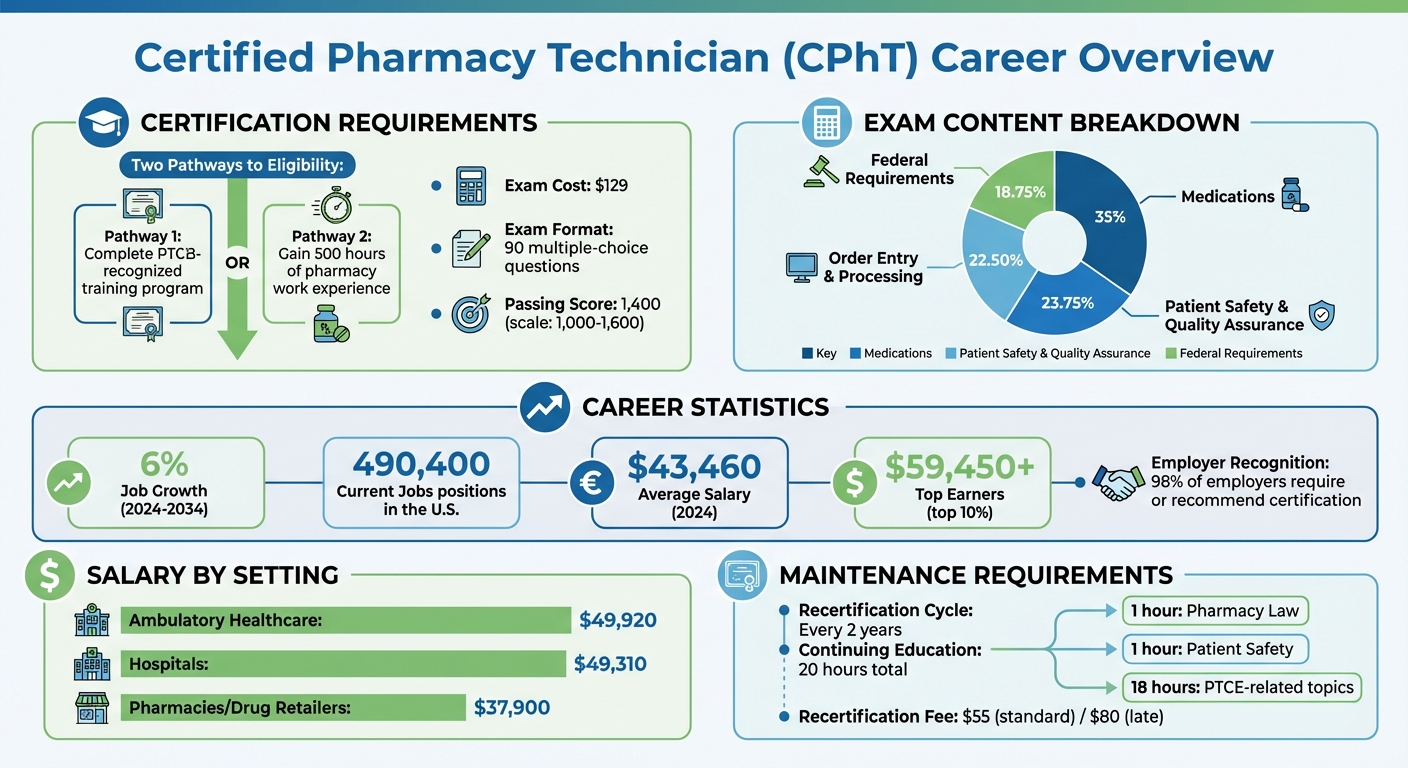
- Certification Requirements: To qualify, complete a PTCB-recognized training program or gain 500 hours of pharmacy work experience. You’ll also need to pass the Pharmacy Technician Certification Exam (PTCE), which costs $129.
- Job Growth: Employment for pharmacy technicians is projected to grow by 6% from 2024 to 2034, driven by increased medication needs and expanded pharmacist roles.
- Salary: Certified pharmacy technicians earned an average of $43,460 in 2024, with higher pay in hospitals and specialized roles.
- Exam Structure: The PTCE includes 90 multiple-choice questions covering medications, patient safety, order processing, and federal requirements.
- Recertification: Maintain your certification every two years by completing 20 hours of continuing education.
Certification is widely recognized across the U.S., with 98% of employers requiring or recommending it. By earning your CPhT credential, you’ll gain access to better job opportunities, specialized roles, and career advancement paths.
Certified Pharmacy Technician Career Overview: Requirements, Salary, and Growth Statistics
Eligibility and Requirements for CPhT Certification
PTCB Eligibility Criteria
To qualify for the Pharmacy Technician Certification Exam (PTCE), you need to meet the criteria set by the Pharmacy Technician Certification Board (PTCB). First, you must reside in the United States or its territories. Active military members and their spouses are also eligible to test internationally.
The PTCB provides two pathways for eligibility. Pathway 1 requires completing a PTCB-Recognized Education/Training Program. You must apply within 60 days of finishing the program and submit proof of completion to receive certification. Alternatively, if you hold a pharmacy degree, it can substitute for the training program. Pathway 2 is for those with at least 500 hours of work experience as a pharmacy technician, which must be completed by the time of application.
Applicants are required to disclose any criminal history or disciplinary actions from a State Board of Pharmacy. You must also adhere to PTCB policies and the Code of Conduct. If you need accommodations under the Americans with Disabilities Act (ADA), be sure to request them when you apply.
Understanding these pathways is key to moving forward. It’s also important to review how your state’s licensing requirements shape your legal responsibilities.
State-Specific Licensing Requirements
Although the CPhT credential is recognized nationally, your actual responsibilities are governed by your state’s Board of Pharmacy. According to the PTCB, "Although CPhTs typically support the medication dispensing process, the legal scope of practice for CPhTs is defined by individual State Boards of Pharmacy". State requirements can differ widely – some states have no registration rules, while others require formal education, hands-on experience, and national certification. Currently, 18 states mandate CPhT certification for pharmacy technicians.
PTCB certification is accepted across all 50 states, the District of Columbia, Guam, and Puerto Rico. However, it’s essential to check with your state’s Board of Pharmacy for specific licensing or registration details before starting work. If you’re planning to move, confirm that your credentials align with the requirements of your new state. For further information on state-specific regulations, you can visit the National Association of Boards of Pharmacy website.
These eligibility and licensing insights provide a solid starting point for your certification journey. Up next, explore how to prepare for the Pharmacy Technician Certification Exam (PTCE) to take the next step in your career.
sbb-itb-7a67ffa
How to Prepare for the Pharmacy Technician Certification Exam (PTCE)
PTCE Content Outline and Exam Structure
The PTCE is a computer-based test with 90 multiple-choice questions, of which 80 are scored and 10 are unscored. The entire session includes a 5-minute tutorial, 1 hour and 50 minutes for the exam itself, and a brief 5-minute post-exam survey. To pass, you’ll need a scaled score of 1,400 on a scale ranging from 1,000 to 1,600.
The exam is divided into four key domains, each weighted differently:
- Medications (35%): Covers topics like generic and brand names, drug interactions, proper storage, and stability.
- Patient Safety and Quality Assurance (23.75%): Focuses on areas such as high-alert medications, preventing errors, and infection control.
- Order Entry and Processing (22.50%): Includes calculations, formulas, and medical terminology.
- Federal Requirements (18.75%): Addresses controlled substance laws, DEA schedules, and FDA recalls.
Some questions require calculation skills, and these are marked with an asterisk in the official content outline.
Study Materials and Practice Tools
Once you understand the exam structure, it’s time to focus on the right preparation tools. The Pharmacy Technician Certification Board (PTCB) offers several resources to help you succeed.
- PTCE Practice Bank: For $65, you get access to over 300 retired exam questions and a 400-card flashcard deck. Candidates who use this resource often score about 10% higher on the real test. It also includes a dashboard where you can filter questions by difficulty or topics, such as calculations.
- Pre-PTCE Simulation: This $29 tool mimics the actual exam interface and uses retired questions. Passing this practice test increases your chances of passing the real exam by threefold. If you bundle the Pre-PTCE with your CPhT application through your PTCB account, you can save $10.
Additionally, free resources are available, including the PTCE Content Outline, Reference List, and the Pearson Tutorial, which provides a preview of the testing interface.
With these resources in hand, you can refine your study approach and focus on areas that need improvement.
Exam Preparation Tips
Plan to dedicate 6–8 weeks to preparation, studying for a few focused hours on multiple days each week. To retain more information, try breaking your material into smaller sections and studying in 1-hour blocks during the day when you’re most alert. Active learning methods like self-quizzing and explaining concepts aloud can also be very effective. For topics like the Top 200 Drugs, group them by class or mechanism of action instead of memorizing them randomly.
Early on, assess your strengths and weaknesses to focus more on challenging areas like pharmacy math or federal regulations.
On test day, arrive early, and ensure your ID matches the information in your PTCB account. Prioritize getting a good night’s sleep and eating a balanced breakfast to stay sharp throughout the exam.
How to Register and Take the PTCE
PTCE Registration Process
Once you’re ready to take the next step after preparing for the exam, it’s time to register and schedule your PTCE. Start by creating an account on the PTCB website. From there, submit your Certified Pharmacy Technician (CPhT) application and pay the $129 fee, which covers both the application and the exam. As part of the process, you’ll need to confirm that you meet one of the two eligibility pathways: either completing a PTCB-recognized training program or accumulating 500 hours of pharmacy work experience. You’ll also need to disclose any criminal history or actions taken by a State Board of Pharmacy.
Once your application gets the green light, you’ll receive an "Authorization to Schedule" (ATS) email from PTCB. This email is your ticket to scheduling your exam appointment through Pearson VUE. You can choose between two testing options: taking the exam in-person at one of 1,400+ Pearson Professional Centers (including over 100 military base locations) or opting for an online proctored test from the comfort of your home.
If you require accommodations under the Americans with Disabilities Act (ADA), be sure to request them during the application process. These accommodations are offered at no additional cost but must be approved beforehand.
Once registered, the next step is scheduling your exam and getting ready for test day.
Scheduling Your Exam and Test Day Preparation
To schedule your exam, log into Pearson VUE’s system and select the date and testing location that works best for you. Keep in mind that the updated version of the PTCE debuted on January 6, 2026, so all current applicants will take this revised version of the test.
One critical detail: make sure the name on your government-issued ID matches exactly with the name on your PTCB account. If they don’t match, you won’t be allowed to take the exam, and your fee will be forfeited. Whether you’re testing in person or online, plan to arrive or log in 30 minutes early. In-person test-takers will have access to a physical calculator, while those testing online will use an on-screen version.
After completing the exam and a brief post-exam survey, you’ll see your unofficial pass/fail result immediately on-screen. Official results, however, will be uploaded to your PTCB account within three weeks.
CPhT Certification – Ultimate guide on PTCB CPhT Certification
How to Maintain Your CPhT Certification
Once you’ve earned your CPhT certification by passing the PTCE, the next step is keeping it active. To do so, you’ll need to renew your certification every two years by completing 20 hours of continuing education (CE).
Continuing Education Requirements
Your 20 CE hours must include 1 hour in pharmacy law and 1 hour in patient safety, with the rest covering topics related to the PTCE. Here’s how CE credits are counted:
- Activities accredited by the Accreditation Council for Pharmacy Education (ACPE) and designated for technicians count fully.
- Pharmacist-specific activities are capped at 5 hours.
- Completing 3 college credits with a grade of C or better equals 10 CE hours.
Keep in mind that CE hours don’t roll over to the next cycle. Each two-year period resets the clock, so plan accordingly. Also, save all certificates and transcripts for at least one year after your cycle ends. The Pharmacy Technician Certification Board (PTCB) conducts routine audits to ensure compliance.
Recertification Application Process
To avoid penalties, submit your recertification application 60 days before your certification expires. The standard fee is $55, but if you apply after the first day of the expiration month, a $25 late fee applies.
Before applying, make sure your NABP e-Profile ID is linked to your PTCB account. This helps streamline the process and avoid delays.
If you miss the expiration date, you can still reinstate your certification within one year by paying a $95 fee and completing 20 CE hours. Note that this reinstatement requires 2 hours in pharmacy law instead of 1. However, if you fail to apply within that one-year grace period, your certification will lapse entirely, and you’ll need to retake the PTCE to regain it.
Keeping your certification up to date is critical for maintaining and advancing your career – a topic we’ll delve into in the next section.
Career Opportunities for Certified Pharmacy Technicians
Getting your CPhT certification can unlock a variety of career paths in the healthcare field. As of 2024, there were about 490,400 pharmacy technician jobs in the U.S., and employment in this area is expected to grow by 6% through 2034. That’s faster than the average for most jobs, reflecting a strong demand for certified technicians. The CPhT credential is widely respected in the industry, offering opportunities to expand your career and take it to the next level.
Common Job Roles for CPhTs
Certified pharmacy technicians can find work in a range of healthcare environments, from retail pharmacies to hospitals. Retail and community pharmacies employ the majority – 52% – of technicians. In these roles, you might fill prescriptions, handle insurance claims, and provide customer service. Hospitals and inpatient settings, which account for 17% of pharmacy technician jobs, require more specialized skills, such as preparing IV medications, performing sterile compounding, or delivering medications directly to patient units.
CPhTs can also branch out into specialized fields. For example, you might work in nuclear medicine (handling radioactive materials), chemotherapy (managing hazardous drugs), or compounding (creating customized medications). Other options include roles in pharmacy informatics (overseeing dispensing software and machinery), purchasing (managing inventory and supplies), and quality assurance (ensuring safety protocols are followed). Additional settings include home infusion services, long-term care facilities, and managed care organizations, where technicians often negotiate with insurance and pharmaceutical companies as pharmacy benefit managers.
When it comes to earnings, the Bureau of Labor Statistics reports a median annual wage of $43,460 for pharmacy technicians as of May 2024. Pay varies by industry: ambulatory healthcare services top the list at $49,920, followed by hospitals at $49,310. Pharmacies and drug retailers offer an average of $37,900. Certification can also open doors to leadership roles and specialized positions, further enhancing earning potential.
Career Advancement with CPhT Certification
Certification plays a big role in advancing your career and increasing your salary. In a survey of more than 23,000 CPhTs, 53.5% pointed to career growth opportunities, and 51.7% mentioned future career development as key benefits of certification. The top 10% of pharmacy technicians earned over $59,450 in 2024.
"Certification ensures you have the skills and knowledge to perform the required tasks, making you a more attractive candidate for hiring managers." – Ayers Career College
As pharmacists focus more on direct patient care, pharmacy technicians are stepping up to take on operational tasks like verifying prescriptions and managing transfers. With experience, CPhTs can move into supervisory roles, manage pharmacies, or even become trainers for new technicians.
Earning advanced credentials can boost your earning potential and open the door to specialized roles. Certifications like the CPhT-Adv (Advanced Certified Pharmacy Technician) and CSPT (Certified Compounded Sterile Preparation Technician) prepare technicians for higher-level positions. Specialty certificates in areas like Immunization Administration, Hazardous Drug Management, or Supply Chain and Inventory Management can also make you stand out. Many of these advanced roles require 1–2 years of experience, particularly for positions in purchasing or nuclear pharmacy. Building on your CPhT certification with additional credentials helps solidify your place as a valuable member of the healthcare team.
Conclusion
Becoming a Certified Pharmacy Technician (CPhT) can lead to a fulfilling career in healthcare. To get started, you’ll need to meet the eligibility requirements – either by completing a PTCB-recognized program or gaining 500 hours of work experience. Once eligible, create your PTCB account, pay the $129 application fee, and schedule your Pharmacy Technician Certification Exam (PTCE). Passing the exam earns you the nationally recognized CPhT credential.
Certification isn’t the end of the road. Every two years, you’ll need to recertify to stay current with industry standards and maintain your commitment to medication safety. This regular renewal keeps your skills sharp and opens doors for career advancement. With the CPhT credential, you can explore opportunities in retail pharmacies, hospitals, and beyond. You might even choose to pursue advanced certifications like the CPhT-Adv or specialize in areas such as immunization administration or sterile compounding.
If you’re ready to take the next step, HealthCareer Certs offers resources to help you prepare for the PTCE. From the PTCE Practice Bank to the Pre-PTCE simulation, these tools are designed to boost your confidence and readiness for the exam. Your journey to becoming a CPhT starts with that first step, and we’re here to support you every step of the way.
FAQs
What are the main advantages of becoming a Certified Pharmacy Technician (CPhT)?
Earning your CPhT certification comes with several key benefits that can elevate your career in the pharmacy field. It highlights your skills in medication safety and patient care – qualities that are highly valued in healthcare settings. Many employers actively seek or require certified technicians because this credential reflects a strong commitment to professionalism and excellence.
On top of that, becoming a CPhT can unlock a variety of career paths and opportunities for growth. Certified technicians often experience greater job stability, higher pay, and the flexibility to work in different settings like hospitals, retail pharmacies, or specialty clinics. This certification not only sets you apart but also lays the groundwork for a rewarding, long-term career in the pharmacy industry.
How do state licensing requirements affect my role as a pharmacy technician?
State licensing requirements heavily influence what you can and cannot do as a pharmacy technician. Even though earning a national certification like the CPhT highlights your knowledge and dedication to safety, the specific tasks you’re allowed to perform depend on the rules set by your state’s Board of Pharmacy. This means your responsibilities can look different depending on where you’re employed.
In most states, pharmacy technicians need to secure a license or register before they can start working. This process typically involves meeting certain criteria, such as being a minimum age, undergoing background checks, and sometimes completing additional state-specific exams or training. In many states, holding a certification is also a necessary step to obtain a license. Knowing the specific requirements in your state is crucial – not just to stay compliant with the law but also to open up more career opportunities and excel in your role.
What advanced certifications can help me grow as a Certified Pharmacy Technician (CPhT)?
Advanced certifications can play a key role in advancing your career as a Certified Pharmacy Technician (CPhT). They help broaden your skill set and create opportunities for specialized positions. One standout option is the Advanced Certified Pharmacy Technician (CPhT-Adv). This certification highlights your advanced knowledge and commitment to the profession. To earn it, you need an active CPhT certification, at least three years of recent work experience, and the completion of specific certificate programs or the CSPT certification. With this credential, you can take on more specialized tasks and position yourself for career growth.
Another important certification to consider is the Certified Compounded Sterile Preparation Technician (CSPT). This is particularly suited for those focused on sterile compounding, a vital aspect of pharmacy work. These advanced certifications not only refine your expertise but also boost your earning potential and open the door to leadership roles, meeting the increasing demands of the pharmacy field.