If you’re a Certified Clinical Medical Assistant (CCMA) looking to expand your career, transitioning to a Certified Patient Care Technician (CPCT) can open up more opportunities. CPCTs work in hospital settings, focusing on direct, hands-on patient care like EKGs, phlebotomy, and daily patient assistance. Here’s a quick breakdown of how to make the switch:
- Evaluate Your Skills: Compare your CCMA experience with CPCT requirements. Focus on areas like patient care, infection control, and EKG techniques.
- Complete Training: Enroll in a CPCT training program if you lack the required work experience.
- Gain Work Experience: Document supervised hours in inpatient care to meet exam eligibility.
- Prepare for the Exam: Study the NHA CPCT/A exam topics, including patient care (45% of the test), compliance, and safety.
- Get Certified: Pass the exam and maintain your credential with continuing education every two years.
This career step can lead to roles in hospitals and even nursing pathways like LPN or RN. With growing demand for CPCTs, now is the time to advance your skills and career.
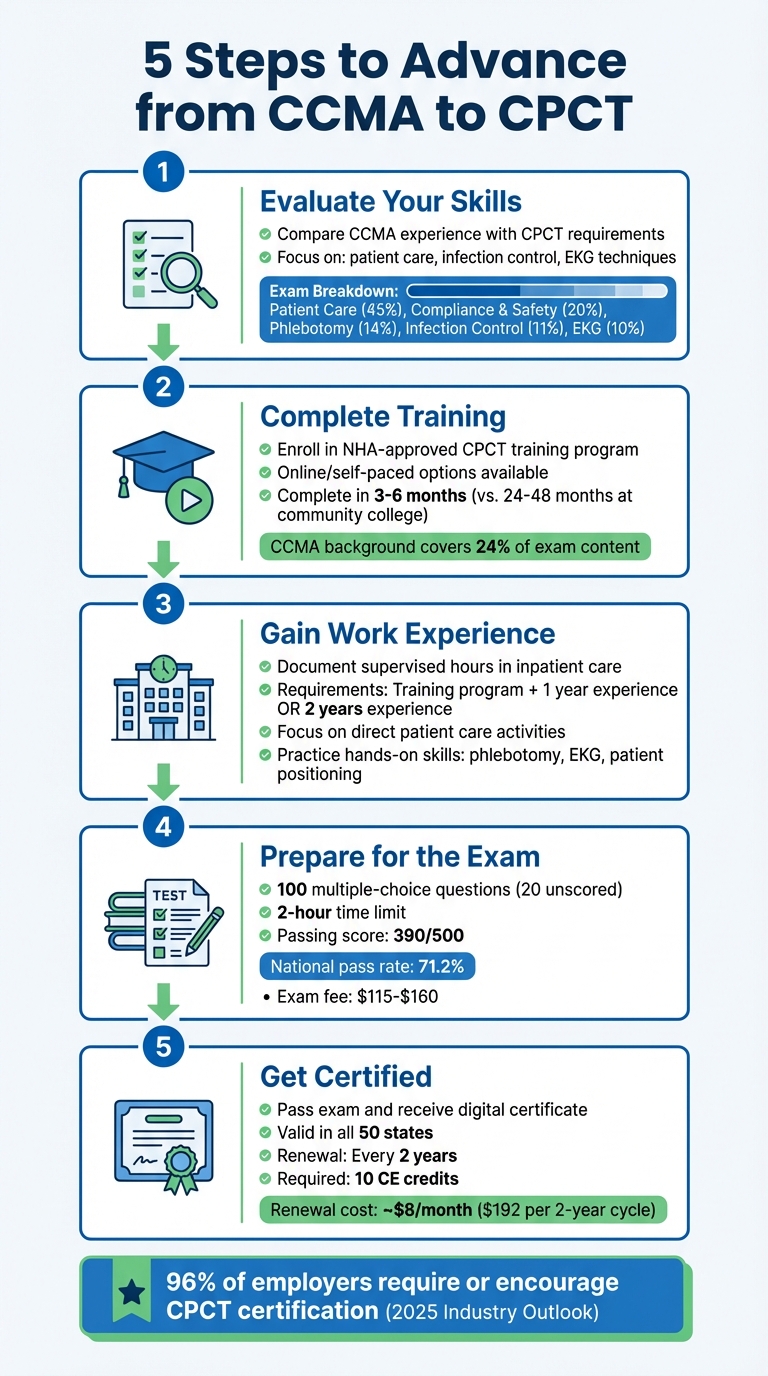
5 Steps to Advance from CCMA to CPCT Certification
Can a Medical Assistant (MA) Work as a Patient Care Tech (PCT)?
sbb-itb-7a67ffa
Step 1: Compare Your CCMA Skills to CPCT Requirements
The first step in transitioning from a CCMA (Certified Clinical Medical Assistant) to a CPCT (Certified Patient Care Technician) is to evaluate how your current skills align with CPCT standards. While your CCMA certification gives you a solid starting point, the two roles have distinct focuses. CCMAs typically handle outpatient clinical and administrative tasks, whereas CPCTs concentrate on providing hands-on care in inpatient settings. Pinpointing areas where you need improvement will help you customize your CPCT training.
The NHA CPCT/A exam is structured around five core domains: Patient Care (45%), Compliance and Safety (20%), Phlebotomy (14%), Infection Control (11%), and EKG (10%). Knowing how much each area contributes to the exam can guide your study efforts.
Find Your Skill Gaps
Start by comparing your current expertise with the CPCT exam requirements. Your CCMA experience likely includes phlebotomy and EKG-related tasks, which gives you a head start in these areas. For phlebotomy, ensure you’re familiar with the proper order of draw and specimen handling techniques. For EKG, focus on mastering electrode placement, resolving artifacts, and recognizing dysrhythmias.
However, many CCMAs may find themselves less experienced in tasks more common for nursing assistants, such as body mechanics, restorative care, range of motion exercises, and catheter care. If these areas are unfamiliar, they’ll need extra attention during your CPCT preparation.
Check NHA CPCT/A Eligibility Requirements

After identifying your skill gaps, the next step is to confirm that you meet the eligibility criteria for the CPCT/A exam. To qualify, you’ll need a high school diploma or GED and one of the following:
- Completion of a training program within the last five years, along with at least one year of supervised work experience in the past three years.
- Alternatively, two years of supervised work experience within the last five years.
The CPCT/A exam includes 100 multiple-choice questions (plus 20 pretest items that don’t count toward your score) and is timed at two hours. A passing score requires a minimum scaled score of 390 out of 500. With the national pass rate at 71.2% and the exam fee ranging from $115 to $160, thorough preparation is key.
Step 2: Complete a CPCT Training Program
If you don’t have at least two years of supervised work experience, completing an NHA-approved CPCT training program is a must. This pathway allows you to qualify for the exam with just one year of work experience, as long as your training program was completed within the last five years. It also ensures you’re fully prepared in the five key exam areas: Patient Care, Compliance and Safety, Infection Control, Phlebotomy, and EKG. Now’s the time to look for a program that fits into your schedule while building on your CCMA experience.
Choose a Flexible Training Program
For those already working as CCMAs, online and self-paced training programs are a great option. Platforms like HealthCareer CERTS provide 24/7 access to courses, letting you learn whenever it’s convenient. These programs often include one-on-one Zoom sessions with instructors, support from personal advisors via text and email, and interactive tools like 3D demonstrations and quizzes to make learning more engaging.
Another big plus? Many programs guarantee externship placements, so you won’t have to worry about finding a clinical site on your own. You can finish your certification in as little as 3 to 6 months – much faster than the 24 to 48 months it typically takes at a community college. The NHA exam fee, which is around $160, is often included in the tuition.
Use Your CCMA Background
Your CCMA certification gives you a head start. It already covers 24% of the CPCT exam content through your training in phlebotomy and EKG. Plus, your existing knowledge of anatomy, medical terminology, infection control, and electronic health records provides a strong foundation for CPCT certification. This background allows you to move quickly through familiar topics and dedicate more time to learning new skills, such as catheter care, patient positioning, range of motion exercises, and proper body mechanics.
To make the most of your time, focus on review tools that emphasize areas you’re less familiar with, skipping over content you’ve already mastered. This targeted strategy is especially helpful in self-paced programs, where you control the speed of your learning.
Step 3: Build Required Work Experience
To qualify for the NHA CPCT/A exam, you’ll need supervised patient care experience. Start by reviewing your training record to confirm the specific requirements you need to meet. If you’re already working in a CCMA role within a patient care technician field, that experience can count toward this requirement – provided you’re under proper supervision. Here’s how to document your hours and enhance your practical skills effectively.
Track Your Work Hours
Make sure your patient care hours are properly documented under supervision to meet the NHA eligibility criteria. Focus on recording hours spent on direct patient care activities, not just administrative tasks. Include activities across areas such as Patient Care, Compliance and Safety, Phlebotomy, Infection Control, and EKG.
If you’re currently in an outpatient setting, consider asking for additional responsibilities in inpatient or long-term care settings. This could involve hands-on tasks like assisting with patient bathing, bed-making, daily activities, or feeding tube care. These experiences not only help you meet the required hours but also give you a broader understanding of patient care. Once your hours are logged, shift your attention to refining and practicing your hands-on skills.
Practice Hands-On Skills
Your CCMA background provides a strong foundation, but further practice is key to becoming CPCT-ready. Build on your experience with phlebotomy and EKG techniques while expanding into areas like patient positioning, range of motion exercises, and compliance protocols.
Ask your supervisor for opportunities to perform additional venipuncture, capillary sticks, and EKG readings to improve your proficiency. Beyond these tasks, focus on mastering other patient care skills, such as proper body mechanics and therapeutic communication. It’s also essential to stay updated on OSHA guidelines, HIPAA regulations, and infection control techniques. These practices ensure you’re fully prepared for the demands of the CPCT role.
Step 4: Register and Study for the CPCT/A Exam
Once you’ve gained the necessary work experience, the next step is registering for the NHA CPCT/A exam and diving into your preparation. To register, you’ll need to meet a few requirements: provide proof of your high school diploma or equivalent, confirm that you’re at least 18 years old, and document either completion of a training program within the last five years along with one year of supervised work experience – or two years of supervised work experience within the last five years. Head over to the National Healthcareer Association’s official website to register and select your preferred testing option.
Learn the Exam Format and Topics
The CPCT/A exam consists of 100 multiple-choice questions, 20 of which are unscored, and you’ll have 2 hours to complete it. To pass, you’ll need a scaled score of at least 390 out of 500, with a national pass rate of about 71.2%. Knowing the exam structure can help you focus your study efforts. The content is divided into several domains, each emphasizing different aspects of patient care:
| Exam Domain | Weighting | Key Focus Areas |
|---|---|---|
| Patient Care | 45% | Body mechanics, vital signs, patient comfort, ADLs |
| Compliance & Safety | 20% | OSHA, HIPAA, patient safety, medical ethics |
| Phlebotomy | 14% | Order of draw, site selection, specimen transport |
| Infection Control | 11% | Aseptic technique, PPE, biohazardous disposal |
| EKG | 10% | Electrode placement, cardiac conduction, dysrhythmias |
Your CCMA training likely covers a lot of this material, but brushing up on patient care techniques – like body mechanics and range of motion – can give you an extra edge for the CPCT role.
Use Study Materials
To prepare efficiently, take advantage of the NHA’s online study guide and mobile app, which include quizzes, flashcards, and three full-length practice tests. The Focused Review® tool helps pinpoint areas for improvement based on your practice test results, making your study sessions more efficient. You can create a free account on the NHA website to access these resources, and if needed, purchase a preparation package for additional support.
If your CCMA training was through HealthCareer CERTS, you’re already familiar with interactive learning tools like 3D demos and self-checks, which are excellent for exam prep. Don’t forget to download the free NHA CPCT/A Test Plan, which outlines the exam topics in detail.
Book and Take the Exam
When you feel ready, log into your NHA account to schedule the exam. You can take it at your school, a PSI testing center, or through live remote proctoring from a private location. If you choose remote proctoring, make sure your setup meets NHA’s requirements for privacy, internet stability, and technical specifications.
"NHA’s certification exams are accredited through the National Commission for Certifying Agencies (NCCA)… Students will take the exam either at their school, a PSI testing center near them, or through live remote proctoring." – National Healthcareer Association
For online exams, you’ll typically receive your results within two days via your NHA account. If you don’t pass on your first attempt, you can reapply after a mandatory 30-day waiting period.
Step 5: Get Certified and Maintain Your Credential
Now that you’ve passed the exam, it’s time to secure your CPCT credential and ensure it stays valid.
Access Your CPCT Certification
Once you pass the exam, you can access your official results within two days through your NHA account. From there, you can instantly download your digital certificate. This serves as proof of your certification and can be shared with employers to meet hiring requirements.
Your certification is recognized in all 50 states. According to the 2025 Industry Outlook, 96% of employers either require or encourage certification for patient care technicians. With your CPCT credential in hand, the next step is to focus on staying compliant with renewal requirements, ensuring you maintain your edge in the job market.
Meet Renewal Requirements
Earning your certification is just the start – keeping it up to date is essential to staying competitive in patient care. The CPCT certification is valid for two years, during which you’ll need to complete 10 CE credits to maintain it. Fortunately, the NHA provides a free, 24/7 CE library for certification holders, so you can complete these credits without additional costs. Renewal costs are approximately $8 per month, totaling about $192 over the two-year cycle.
You can complete the required CE credits anytime during your two-year term. If your certification expires, you still have a one-year reinstatement window. Staying current not only ensures compliance but also demonstrates your readiness for advanced roles and keeps you aligned with evolving patient care standards.
"Keeping your certification current is a small investment (just $8 per month!) that can help you achieve your healthcare career goals." – National Healthcareer Association
Conclusion
Moving from CCMA to CPCT can open up new opportunities, offering greater clinical responsibilities and enhanced job stability. By following these five steps – assessing your skills, completing training, gaining experience, passing the certification exam, and keeping your credentials up to date – you can prepare yourself to take on advanced tasks like EKG readings and phlebotomy, which go beyond the typical duties of a medical assistant.
The demand for CPCTs is growing as hospitals face challenges like increasing patient hospitalizations and a shortage of LPNs. As highlighted in an industry report:
"As hospitals face a shortage of LPNs and a rise in patient hospitalizations, PCTs are stepping up to meet the growing demand and responsibilities." – MedCerts
This demand makes earning your CPCT certification an excellent way to strengthen your position in the job market. That’s where HealthCareer CERTS can help with their all-inclusive CPCT program.
For $2,400, HealthCareer CERTS offers a program designed to make this career transition seamless. It includes 12 months of online interactive materials, guaranteed externship placement, personal advisor support via Zoom and email, and exam fees. The self-paced structure allows you to build on your existing CCMA knowledge, focusing on new areas like EKG and phlebotomy at your own pace.
To ensure you’re fully prepared for the national NHA exam – which has an estimated pass rate of 71.2% – the program includes 3D animations, lab simulations, and six competency assessments. Plus, with added career coaching services, you’ll gain the hands-on experience and guidance needed to confidently step into a hospital-based PCT role.
Your experience as a CCMA has laid the groundwork for this next step. By earning your CPCT certification, you can expand your clinical expertise, boost your value to employers, and set yourself on a path for long-term success in patient care.
FAQs
Can my CCMA work experience count toward CPCT eligibility?
Your experience as a Certified Clinical Medical Assistant (CCMA) could potentially count toward eligibility for the Certified Patient Care Technician (CPCT) certification, depending on the specific requirements of the program. The National Healthcareer Association (NHA), which oversees the CPCT exam, places importance on skills such as patient care, taking vital signs, phlebotomy, and performing EKG procedures. Be sure to review the detailed eligibility criteria for the CPCT program you’re targeting, as similar hands-on clinical experience might qualify. For clarity, reach out to the certification provider directly or consult their official guidelines.
What CPCT skills differ most from CCMA duties?
The main distinction between Certified Patient Care Technicians (CPCTs) and Certified Clinical Medical Assistants (CCMAs) lies in their areas of focus within healthcare.
CPCTs are more involved in hands-on patient care. Their responsibilities include tasks such as performing EKG readings, conducting phlebotomy procedures, and assisting patients with mobility or daily activities.
On the other hand, CCMAs focus more on administrative and educational duties. They handle tasks like gathering patient histories, managing scheduling, and providing patient education, with less involvement in procedures that are invasive.
This division of responsibilities highlights how these roles complement each other in delivering comprehensive patient care.
How do I get supervised inpatient hours for the CPCT exam?
To qualify for supervised inpatient hours for the CPCT exam, you’ll need hands-on clinical experience that involves providing direct patient care in inpatient settings. Programs like those offered by HealthCareer Certs often include externship placements, ensuring students can gain supervised clinical experience in hospitals or similar facilities. Be sure to check with your certification program or the certifying organization, such as the NHA, to verify the specific number of supervised hours required for eligibility.