
Earning your CCMA certification can lead to a rewarding healthcare career, with demand for medical assistants projected to grow 15% by 2033. The exam includes 180 questions (150 scored), requires a minimum score of 390/500 to pass, and costs $160 per attempt. With a 2024 pass rate of 81.38%, preparation is key.
Here are 10 practical tips to help you succeed:
- Understand the Exam Format: Focus on the seven content areas, especially Clinical Patient Care, which makes up 56% of the test.
- Stick to a Study Schedule: Dedicate 1–3 months to preparation, with consistent, manageable daily sessions.
- Use the Pomodoro Technique: Study in 25-minute intervals with short breaks to maintain focus.
- Leverage Flashcards: Break down medical terms into prefixes, suffixes, and roots for active recall.
- Take Practice Tests: Simulate the exam environment and aim for 80%+ scores before scheduling your test.
- Study Anatomy and Patient Care: Prioritize body systems, infection control, and clinical procedures.
- Review Medical Law and Ethics: Learn key regulations like HIPAA and medication safety.
- Find a Study Buddy: Teach-back methods and collaborative quizzes can reinforce learning.
- Use Interactive Tools: Explore apps, videos, and practice questions to strengthen weak areas.
- Manage Test Anxiety: Practice breathing techniques, visualization, and positive affirmations.
Preparation pays off. With the right plan and tools, you can confidently pass the CCMA exam on your first try.
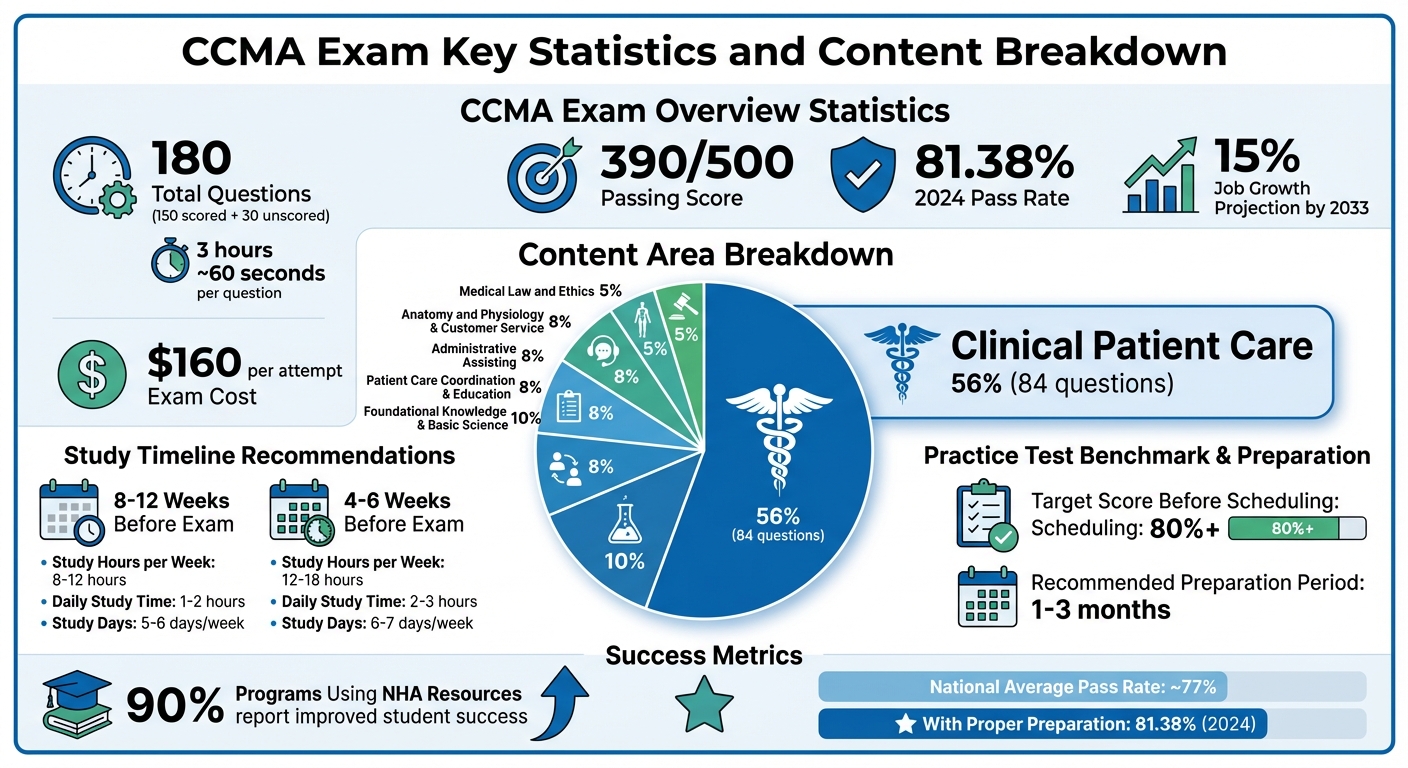
CCMA Exam Statistics and Content Breakdown
NHA CCMA Exam Tips

sbb-itb-7a67ffa
1. Learn the CCMA Exam Format and Topics
Getting familiar with the structure of the CCMA exam is a crucial first step in preparing effectively. The test includes 180 multiple-choice questions, where 150 are scored, and 30 are unscored pre-test items designed to assess potential future questions. Since you won’t know which questions are unscored, approach every single one as if it counts.
The exam allows 3 hours to complete, giving you about 60 seconds per question. Time management is key, so practice answering questions within this timeframe during your study sessions.
The exam is divided into seven content areas, each with a different percentage of weight. The Clinical Patient Care section is by far the largest, making up 56% of the scored questions – 84 out of 150. This section includes topics such as vital signs, EKG lead placement, phlebotomy order of draw, and infection control. Katie Miller, Co-creator of Smarter MA, highlights its importance:
"The section of the CCMA exam that has the most questions is the Clinical Patient Care section, which constitutes 56% of the exam."
The remaining sections are weighted as follows:
- Foundational Knowledge & Basic Science: 10%
- Patient Care Coordination & Education: 8%
- Administrative Assisting: 8%
- Communication & Customer Service: 8%
- Anatomy and Physiology: 5%
- Medical Law and Ethics: 5%
This breakdown helps you prioritize your study time. For example, focusing on clinical skills will likely have a bigger impact than spending too much time on the smaller sections.
To streamline your preparation, download the free NHA test plan early in your study process. This guide outlines the specific topics within each domain, helping you create a targeted and efficient study schedule. Knowing the exam format ahead of time not only saves you valuable time but also helps ease anxiety on test day.
Once you’ve grasped the structure, the next step is to establish a consistent study routine to put this knowledge into action.
2. Build a Regular Study Schedule
Once you’ve got a handle on the exam format, the next step is creating a consistent study schedule. On average, students need 1 to 3 months to fully prepare. The amount of time you’ll need each week depends on how early you start. From there, break your study plan into manageable sessions.
If you’re starting 8 to 12 weeks before the exam, aim for 8 to 12 hours of study per week. That’s about 1 to 2 hours a day, spread over 5 to 6 days. If your timeline is tighter – say 4 to 6 weeks – you’ll need to bump that up to 2 to 3 hours daily, or about 12 to 18 hours weekly. Katie Miller, Co-creator of Smarter MA, offers a helpful reminder about pacing:
For most people, studying more than 3-4 hours in a day loses its effectiveness.
Consistency is key. Short, daily study sessions are far more effective than marathon cramming sessions. This method, known as spaced review, helps commit information to long-term memory by revisiting challenging topics – like medical terminology or lab values – multiple times over several weeks. A steady, organized approach ensures you cover all exam topics without burning out.
Consider using the 10/40/20 rule: start with 10 minutes reviewing previous material, spend 40–60 minutes learning new content, and finish with 15–20 minutes of self-testing. This active learning strategy makes it easier to retain new information.
It’s also smart to prioritize your study time based on the exam’s focus areas. For example, Clinical Patient Care accounts for 56% of the scored questions, so devote more time to this section than smaller ones like Medical Law and Ethics, which only makes up 5%. Use the last two weeks to focus on timed practice exams and analyzing your mistakes.
3. Try the Pomodoro Technique for Better Focus
Long study sessions can quickly sap your mental energy. The Pomodoro Technique offers a practical way to stay sharp: work for 25 minutes, take a 5-minute break, and repeat. After completing four cycles, reward yourself with a longer break of 15–30 minutes. This rhythm keeps burnout at bay and helps maintain focus throughout your study session.
Studies show that using Pomodoro intervals can cut fatigue by about 20% while improving focus by 15–25%. Students who use this method often see better exam results – 82% compared to 70% for those who don’t. Francesco Cirillo, the technique’s creator, highlights its mindset shift:
Time changes from a negative – something that has been lost – to a positive representation of events accomplished.
The 25-minute work period aligns with your natural attention span, which typically ranges from 20 to 45 minutes before fatigue kicks in. Short, frequent breaks help you recharge quickly. For challenging topics like Anatomy and Physiology in CCMA studies, you might stretch the work period to 35–40 minutes and follow it with a 10–15-minute break to allow for deeper focus.
Use your breaks wisely – stretch, grab a snack, or simply gaze out the window. Avoid distractions like scrolling through your phone, which can derail your momentum.
Setting a timer creates a "distraction-free bubble", helping you fend off interruptions. This is especially important since it takes about 23 minutes to fully regain focus after being distracted. Protecting those 25-minute blocks is key to staying efficient.
The Pomodoro Technique fits seamlessly into your broader study plan, ensuring each session is productive. Pair it with other strategies to get the most out of your exam preparation.
4. Use Flashcards to Learn Medical Terms
Medical terminology makes up about 10% of the CCMA exam, playing a key role in the Clinical Patient Care section. Flashcards are an excellent tool to tackle this area, thanks to their ability to promote active recall. This approach encourages you to pull information from memory rather than simply rereading it, making it a highly effective study technique.
"It requires the student to actively retrieve knowledge, rather than simply passively absorbing. This is active recall, a proven high-utility study technique." – Edward Laurent, Trauma and Orthopaedics, Royal National Orthopaedic Hospital
To get started, focus on breaking down medical terms into their components – prefixes, suffixes, and root words. Katie Miller, Co-creator of Smarter MA, emphasizes this strategy: "Memorizing medical terminology prefixes and suffixes ASAP will make [learning diseases and procedures] 100x easier". Create flashcards with the term on one side and its definition or explanation on the other. Review them regularly using spaced repetition, which spreads out review sessions to reinforce memory over time.
Research backs up the effectiveness of flashcards. A study on medical students found that using high-quality electronic flashcards significantly boosted exam performance. Apps like Anki, which incorporate spaced repetition, have been linked to better results on medical licensing exams.
To make your study sessions even more effective, mix flashcards from different subjects – like anatomy, pharmacology, and ethics. This interleaved practice trains your brain to handle the randomized nature of exam questions. For digital flashcards, consider adding visuals like diagrams or images, especially for topics like anatomy and physiology, to strengthen your visual memory. Starting this practice 1–3 months before your exam gives you enough time to benefit from the spacing effect. Flashcards, when combined with other study methods, can be a game-changer for mastering medical terminology and boosting your CCMA exam readiness.
5. Complete Practice Tests Regularly
When preparing for the CCMA exam, practice tests are among the most effective tools you can use. Katie Miller, Co-creator of Smarter MA, emphasizes this point:
CCMA practice tests are the #1 best way to prepare for the real test.
Unlike simply reading through material, practice exams actively test your knowledge, ensuring you truly grasp the concepts rather than just assuming you do.
Taking practice tests regularly helps you track your progress and pinpoint areas that need more attention. For instance, Clinical Patient Care makes up about 56% of the exam, so identifying weaknesses in this section early can be a game-changer.
Simulating the actual test environment is another key benefit. Full-length, timed practice exams help you build the stamina needed for exam day and teach you how to manage your time effectively within the test’s structure. Familiarity with the format can also ease anxiety when it’s time for the real thing.
Experts suggest starting practice tests 1–3 months before your exam date and aiming for consistent scores of at least 80% before scheduling the official test. Reviewing both correct and incorrect answers is equally important. Write down the correct answers along with brief explanations for any mistakes to reinforce your understanding.
Preparation resources from the NHA, including practice assessments, are widely recognized for improving readiness and pass rates. In fact, 90% of Allied Health educational programs report that these tools boost student success. With the national CCMA pass rate hovering around 77%, regular practice testing can give you a critical edge. Pairing this approach with steady study habits will leave you feeling confident and ready to excel.
6. Study Anatomy, Physiology, and Patient Care
Anatomy and Physiology account for about 9% of the exam (roughly 8 scored questions) and are also a key part of the Clinical Patient Care section, which makes up 55–56% of the test. To succeed, you’ll need more than just memorization – you’ll need to understand how body systems interact in real-world clinical scenarios.
Focus on the five main body systems: Cardiovascular, Respiratory, Endocrine, Musculoskeletal, and Nervous. Learn both their structures and their functions. For example, it’s not enough to know the heart has an SA node; you should also understand how it drives the heart’s conduction system. Be prepared to differentiate between "normal and abnormal cues" in these systems, such as identifying causes of symptoms like hyperventilation or irregular vital signs.
To solidify your understanding, use tools like visual aids and videos. Research shows that videos are especially effective for learning, with a reported 73% improvement in recall when animation videos are used. Study diagrams to master concepts like the abdominal quadrants (RUQ, LUQ, RLQ, LLQ) and anatomical planes (sagittal, transverse). Watching clinical skills videos, such as those demonstrating EKG lead placement or phlebotomy techniques, can also be a game-changer for grasping practical applications.
Dive into topics like disease processes, microbiology, and recognizing abnormal vital signs across various age groups. Learn normal ranges for blood pressure, pulse, respiration, and glucose levels for adults, children, and infants. Practicing step-by-step explanations of procedures can help reinforce your memory and build confidence. Infection control is another critical area – make sure you understand the Chain of Infection and know how to use PPE correctly for the patient care portion of the exam.
Additionally, learning medical prefixes and suffixes can make complex terms easier to break down. For instance, terms like "hyperventilation" or "tachycardia" become less intimidating when you understand their components. Consistent review of medical terminology not only strengthens your retention but also boosts your readiness for the exam.
7. Review Medical Law, Ethics, and Pharmacology
To round out your exam preparation, it’s crucial to focus on Medical Law, Ethics, and Pharmacology. These areas are essential for understanding legal compliance, patient rights, and medication safety.
Medical Law and Ethics make up 5% of the exam, while Pharmacology is a key component of Foundational Knowledge (10%) and Clinical Patient Care (55%).
Key Topics in Medical Law and Ethics
Familiarize yourself with the roles of regulatory agencies like OSHA, CLIA, CDC, and FDA, as well as important legislation such as:
- HIPAA: Protecting patient privacy.
- Americans with Disabilities Act (ADA): Ensuring accessibility and non-discrimination.
- Affordable Care Act (ACA): Expanding healthcare access.
- Good Samaritan Laws: Offering legal protection for those providing emergency care.
Additionally, review the legal requirements for Electronic Health Record (EHR) documentation and how to handle patient requests for medical records properly.
Pharmacology Essentials
A solid understanding of pharmacology is critical for clinical scenarios. Organize medications by drug class and learn common suffixes that hint at their functions:
- -lol: Beta-blockers.
- -pril: ACE inhibitors.
Pay attention to clinical details such as:
- Injection angles: For example, 10–15 degrees for intradermal injections.
- Medication routes: Oral, intravenous, intramuscular, etc.
- Controlled substance schedules: Know how drugs are classified and regulated.
According to the Centers for Medicaid Services:
Only those medical assistants who have valid certification can enter medication, laboratory, and radiology orders into the computerized provider order entry system.
Applying Ethics in Clinical Scenarios
Ethical principles are often tested through scenario-based questions. For example, you might need to demonstrate how to handle requests for medical records or ensure patient confidentiality in challenging situations.
8. Partner with a Study Buddy
Once you’ve nailed down your study schedule and solo techniques, teaming up with a study buddy can take your exam prep to the next level. Having a partner adds accountability and encourages active learning through discussions, quizzes, and collaborative problem-solving.
One standout benefit of studying with a buddy is the teach-back method. Explaining a concept – like the phlebotomy tube order or EKG lead placement – to someone else forces you to organize your thoughts and truly understand the material. Medical Assistant Julie Gower highlights this method:
Teach others. … If you take time to teach people what you know, you’d be surprised at how easy it is to recall when taking a test.
You and your study buddy can also quiz each other on medical terminology using flashcards or dive into scenario-based questions about clinical procedures. Medical Assistant Lindsey Louviere shared her strategy:
When I studied for [the exam], I … made a bunch of note cards. I also saved all my notes … from school to study with as well. I would have a friend quiz me.
A study buddy can help you stay on track and even challenge you to see things from a different perspective. If you can’t find someone locally, online communities are a great alternative for virtual study sessions. By working together, you can combine your knowledge and boost your confidence before test day.
Reviewing practice test results as a team is another productive strategy. Discussing answers – both right and wrong – can uncover new ways of understanding tricky topics like medical law, ethics, or pharmacology. This kind of collaboration not only strengthens your grasp on the material but also prepares you to tackle more interactive tools and practice questions effectively.
9. Use Interactive Tools and 1,400+ Practice Questions
Once you’ve established a solid study routine and partnered with a study buddy, it’s time to leverage technology to take your preparation to the next level. Interactive tools like 3D anatomical demos, video tutorials, and audio guides can make learning more dynamic and help clarify complex clinical procedures in a way that feels approachable and engaging.
Practice questions are another key ingredient for exam success. With access to over 1,400 practice questions, you can refine your test-taking skills, build stamina, and get familiar with the exam format. HealthCareer Certs offers a treasure trove of resources, including those 1,400+ practice questions, 700 self-checks, and interactive tools like quizzes and flashcards tailored specifically for CCMA exam prep. These tools not only simulate the actual test environment but also help you zero in on tricky topics like phlebotomy tube order, EKG lead placement, or medical law – areas that might need extra attention.
For added convenience, mobile study apps let you study anytime, anywhere. Apps like Pocket Prep, which boasts an impressive 4.8-star rating on the App Store, and NHA Mobile provide flashcards and practice questions that you can review during short breaks. These apps also include detailed answer explanations, breaking down the reasoning behind each correct answer to deepen your understanding.
Some platforms even feature advanced tools like Focused Review® technology, which analyzes your practice test results and creates a personalized study plan targeting your weaker areas. By complementing your structured study routine with these digital resources, you can focus on areas that need improvement while reinforcing your strengths, ensuring you’re ready to tackle exam day with confidence.
10. Control Test Anxiety and Build Confidence
Even if you know the material inside and out, test anxiety can still throw you off your game. The good news? You can manage it. Cognitive scientist Sian Beilock highlights the impact of anxiety on performance:
When students are anxious, their worries use up some of their working memory, leaving fewer cognitive resources to devote to the test.
One quick way to calm your nerves is through breathing exercises. The 4-4-4-4 box breathing method is a great starting point: inhale for 4 seconds, hold for 4 seconds, exhale for 4 seconds, and hold again for 4 seconds. If you’re pressed for time during the test, try the 2-1-4 method: inhale for 2 seconds, hold for 1 second, and exhale for 4 seconds. These techniques can help you reset and refocus when stress starts creeping in.
In addition to breathing, other strategies can help you feel more in control. Spend 10 minutes journaling about your fears or mentally walking through the exam process. Research shows that these practices can improve performance. Visualization is another powerful tool – athletes who use it have been shown to enhance their performance by as much as 20%.
Tracking your practice exam scores is another way to build confidence. With the CCMA exam’s pass rate sitting at about 81.38%, solid preparation puts you in a strong position to succeed. Use your score reports to pinpoint areas where you’ve made progress, turning weaknesses into measurable achievements. Positive affirmations, like "I am prepared", can also help counteract negative thoughts. As the exam approaches, shift your focus from heavy studying to lighter review and relaxation. This gives your brain the chance to recharge.
On test day, set yourself up for success by creating a ritual. Arrive early, choose a seat free from distractions, and take a few deep breaths to settle your nerves. If the first question feels overwhelming, skip ahead to the last one. Answering a challenging question at the end can boost your confidence for the rest of the exam.
You’ve done the work, practiced under timed conditions, and honed your skills. Trust your preparation, use these stress-management tools, and walk into the testing center ready to perform at your best.
Conclusion
Succeeding on the CCMA exam comes down to three main strategies: sticking to a consistent study routine, taking regular practice tests, and building confidence. Developing steady study habits helps you avoid the stress of cramming, while practice tests highlight your strengths and show where you need improvement. These steps not only prepare you for the 3-hour, 180-question exam but also help ease test-day nerves by simulating the real experience.
The statistics back this up. In 2024, the passing rate for the CCMA exam was 81.38%, and nearly 90% of Allied Health programs report that preparation resources significantly improve readiness and success rates. A good benchmark is aiming for practice test scores of 80% or higher before scheduling your exam.
Pay special attention to Clinical Patient Care, which makes up about 55–56% of the exam. Use your practice test results to zero in on weaker areas, like Medical Law or Anatomy. Reviewing incorrect answers can dramatically improve recall – by as much as 300%. Organize your study sessions to maximize productivity while avoiding burnout.
To enhance your preparation, consider using additional resources. HealthCareer Certs provides extensive support with over 1,400 practice questions, 700 self-checks, and tools like 3D demos and digital flashcards. They also offer personalized guidance through one-on-one Zoom sessions with instructors and guarantee externship placement to build real-world confidence. As Juliana J., a student, shared:
"I passed my certification exam on the first try because of them! All of the instructors were so helpful and amazing, everything is self-paced online."
You now have the tools and strategies you need – it’s time to put them into action. Create a study plan, take full-length practice tests, manage stress, and trust the work you’ve put in. You’re ready to take that next step toward earning your CCMA certification.
FAQs
How do I know when I’m ready to schedule the CCMA exam?
When you’re ready to schedule the CCMA exam, it’s important to feel confident in your preparation and understanding of the material. This usually means you’ve completed the necessary coursework, reviewed essential topics like medical terminology, anatomy, and clinical procedures, and taken practice exams. Practice tests can help you get a feel for the exam environment, and your scores should reflect a strong grasp of the material before you move forward with scheduling.
What should I focus on most in Clinical Patient Care?
In clinical patient care, the main priorities are patient safety and patient-centered care. Patient safety focuses on reducing risks and preventing harm throughout the care process. On the other hand, patient-centered care emphasizes understanding and respecting each patient’s unique preferences, needs, and values while actively involving them in decision-making. By placing these principles at the forefront, healthcare providers build trust, enhance outcomes, and ensure care remains both effective and compassionate.
How can I improve my score after missing practice questions?
To boost your score, start by revisiting the questions you missed. Understanding where you went wrong and learning the correct answers is key to avoiding the same mistakes. Make time for full-length practice exams under timed conditions. This not only mimics the actual test environment but also helps pinpoint areas where you need extra work.
Focus on regular review sessions and targeted practice to address your weak spots. Study guides and practice tests can be incredibly helpful tools. They not only reinforce your knowledge but also build confidence, giving you a better shot at improving your performance before retaking the exam.