
A pharmacy technician (CPhT) and a pharmacist are two distinct healthcare roles that work side-by-side every day, with very different scope, training, and pay. The pharmacist has clinical authority over medication therapy and is the only one legally allowed to verify and dispense prescriptions; the pharmacy technician does the operational work — filling, counting, processing, customer service, inventory — that lets the pharmacist focus on clinical work. Whether you’re researching the pharmacy technician vs pharmacist for the first time or comparing programs, this guide pulls together what matters.
The short version: pharmacy technician = 12-week training + national certification, ~$40,300 median pay. Pharmacist (PharmD) = 6-8 years of post-secondary education + state licensure, ~$130,000 median pay.
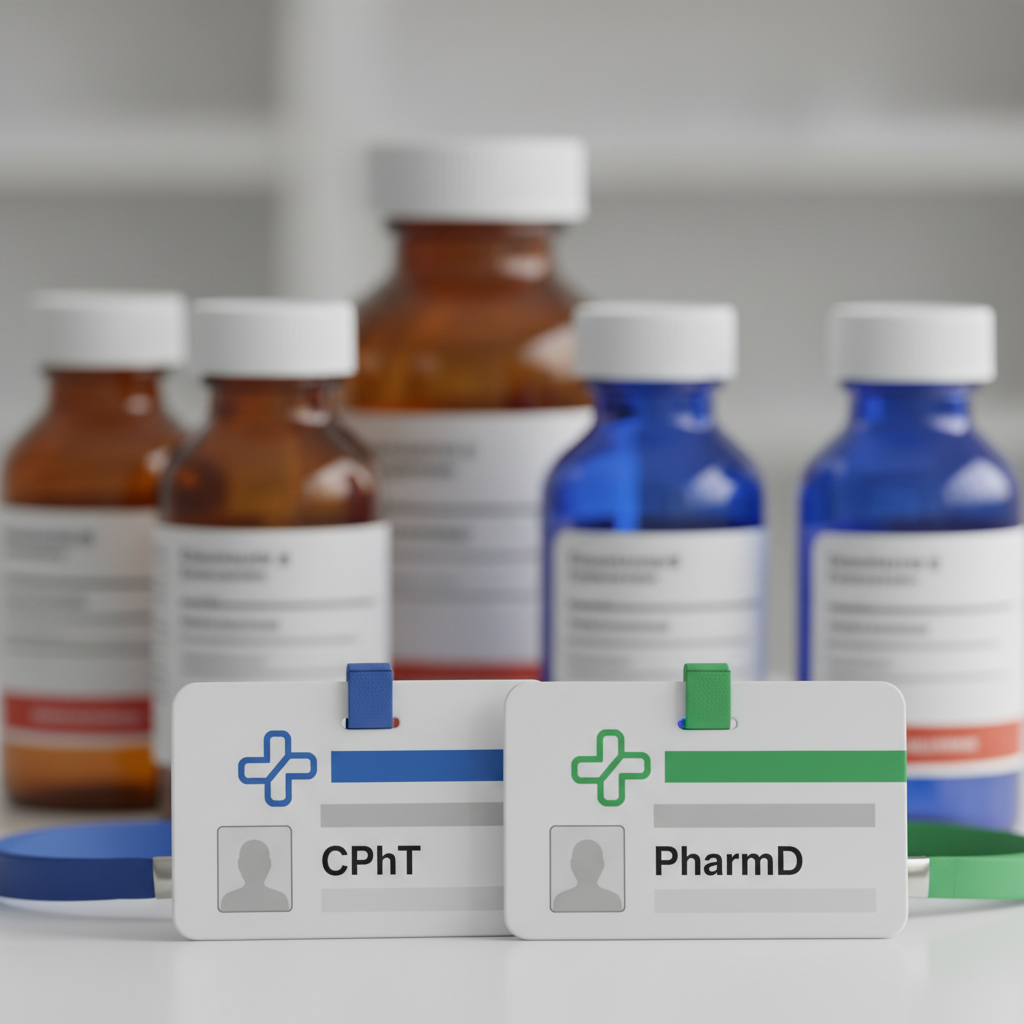
Want a faster path to your CPhT?
Earn your CPhT in 12 weeks online with PTCB or NHA exam fee included and an externship at CVS, Walgreens, or hospital pharmacy.
For students researching pharmacy technician vs pharmacist options, the practical reality is that the right choice depends on your timeline, budget, and target employer. Many candidates start their pharmacy technician vs pharmacist research with general questions and narrow down as they understand which credentials each setting accepts. Treat pharmacy technician vs pharmacist reviews as a comparison exercise, not a single decision.
This post compares the two roles across training, scope, daily work, pay, and career path — so you understand what each actually does and whether one is a path to the other.
Pharmacy Technician vs Pharmacist: At a Glance
| Pharmacy Technician | Pharmacist | |
|---|---|---|
| Education | High school + 12-week certificate program | Bachelor’s + 4-year PharmD (8 years post-secondary total) |
| Credential | CPhT (national certification) | PharmD + state license |
| Cost of training | $1,500-$3,000 | $150,000-$300,000+ |
| Median pay | $40,300 | $130,000 |
| Scope | Operational — filling, processing, inventory | Clinical — verification, counseling, therapy decisions |
| Can dispense? | Prepares; pharmacist verifies | Verifies and dispenses |
| Can counsel patients? | No (general questions only) | Yes — drug therapy, interactions |
| Can interpret labs? | No | Yes |
| Can recommend OTCs? | Limited (read label) | Yes |
| Continuing education | 20 hours / 2 years | 30 hours / 2 years |
What Pharmacy Technicians Do
CPhTs perform operational work under pharmacist supervision:
- Receive and process prescriptions
- Count, measure, and label medications
- Process insurance claims and prior authorizations
- Manage inventory and reorder
- Handle customer service (phone + counter)
- Prepare sterile compounds (hospital, USP )
- Mix IV admixtures (hospital)
- Operate point of sale, accept payment
CPhTs do NOT counsel patients on therapy, verify prescriptions, recommend OTC therapy, or make clinical decisions.
What Pharmacists Do
Pharmacists have clinical authority over medication therapy:
- Final verification of every prescription before dispensing
- Patient counseling on drug therapy, interactions, side effects
- Drug utilization review (DUR) for safety and appropriateness
- OTC recommendations
- Immunization administration (in most states)
- MTM (Medication Therapy Management) for chronic disease patients
- Clinical consultation with physicians
- Compounding sign-off (USP oversight)
- Lab interpretation related to drug therapy
In hospital settings, pharmacists also round with medical teams, manage anticoagulation services, oversee chemotherapy preparation, and run pharmacist-led clinics for diabetes, asthma, and other chronic conditions.
Training Path Comparison
Becoming a CPhT (12 weeks)
- High school diploma or GED
- Complete an accredited 12-week pharmacy tech program (online + clinical, or community college)
- Pass PTCB or NHA pharmacy tech exam ($129)
- Apply for jobs
For our 12-week CPhT program, tuition includes the PTCB or NHA exam fee, externship at CVS, Walgreens, or hospital pharmacy, and online coursework.
Becoming a Pharmacist (6-8 years)
- High school diploma
- Bachelor’s degree with prerequisite courses (chemistry, biology, math) — 2-4 years
- PCAT (Pharmacy College Admission Test)
- PharmD program — 4 years
- NAPLEX (national exam) + MPJE (state law exam)
- State license
Total time: 6-8 years post-high-school. Total cost: $150,000-$300,000+ for the PharmD program alone.
Pay Comparison
| Role | National median | Range |
|---|---|---|
| Pharmacy Technician (CPhT) | $40,300 | $30,200-$57,200 |
| Pharmacist | $130,000 | $95,000-$165,000 |
The pay ratio is roughly 3:1. Pharmacists earn more because of the clinical authority, the 6-8 years of education, and the state licensure liability.
Daily Work Comparison
A typical retail pharmacy day:
| Activity | CPhT | Pharmacist |
|---|---|---|
| Prescription intake | Yes | Reviewer |
| Counting and labeling | Yes | Verifier |
| Insurance claim resolution | Yes (most volume) | Backup |
| Customer counseling | No | Yes |
| Final verification | No | Yes (every Rx) |
| Phone calls (Rx) | Most | Clinical questions |
| Immunizations | Assist | Administer |
| Compounding | Prepares | Signs off |
In hospital settings, CPhT and pharmacist work is more separated: CPhTs in the IV room or unit-dose area; pharmacists doing rounds, MTM, and verification.
Career Path: CPhT to Pharmacist
A CPhT can absolutely become a pharmacist, but it requires:
- Completing a bachelor’s degree with PharmD prerequisites (4 years)
- PCAT
- PharmD program (4 years)
- Total time: 8 years from CPhT certification to pharmacist licensure
Working as a CPhT during pharmacy school is common and provides relevant experience. Many PharmD applicants are former CPhTs.
Ready to stop studying alone? HealthCerts’ Certified Pharmacy Technician (CPhT) program is built around a 12 weeks online course with a guaranteed externship at a named partner clinic — so you walk out with both the credential and the clinical hours employers want.
The bottom line on pharmacy technician vs pharmacist: choose the path that matches your real-world constraints — schedule, financial aid eligibility, and target employer — rather than the cheapest or fastest option in isolation. pharmacy technician vs pharmacist outcomes vary meaningfully by program quality, so verify accreditation and externship support before enrolling.
Frequently Asked Questions
What’s the difference between a pharmacy technician and a pharmacist?
A pharmacy technician (CPhT) handles operational work — filling, processing, inventory, customer service. A pharmacist (PharmD) has clinical authority over medication therapy — verifying prescriptions, counseling patients, recommending OTCs, and interpreting drug-related labs.
Can a pharmacy technician become a pharmacist?
Yes — but it requires completing a bachelor’s degree with PharmD prerequisites (4 years) plus a 4-year PharmD program plus state licensure. Total 8 years from CPhT to pharmacist.
Why do pharmacists make more than pharmacy technicians?
Pharmacists have 6-8 years of post-secondary education vs. 12 weeks for CPhT. They have clinical authority over therapy decisions, state licensure liability, and the responsibility of being the final check on every dispensed prescription.
Do pharmacy technicians need a degree?
No — pharmacy technicians need a high school diploma or GED plus an accredited 12-week pharmacy tech program. No college degree required.
Can a pharmacy technician do everything a pharmacist does?
No. Pharmacists alone can verify prescriptions, counsel patients on therapy, recommend OTCs, interpret labs, and make clinical decisions. CPhTs do operational work only.
How long does it take to become a pharmacist vs a pharmacy tech?
Pharmacy tech (CPhT): 12 weeks. Pharmacist (PharmD): 6-8 years post-high-school (bachelor’s + PharmD program + licensure).
Is being a pharmacy technician a good first step toward becoming a pharmacist?
Yes — many PharmD applicants are former CPhTs. The CPhT role provides relevant experience and a paid job during the bachelor’s and PharmD years.
Do pharmacy techs and pharmacists work together?
Yes — they work side-by-side every shift. CPhTs handle operational tasks; pharmacists handle clinical verification and counseling. The roles are designed to complement each other.
Start Your CPhT Journey with HealthCerts
Reading about pharmacy technician vs pharmacist is one thing — actually getting credentialed and into a clinical role is another. HealthCerts’ Certified Pharmacy Technician (CPhT) program is the fastest, most-supported path: Earn your CPhT in 12 weeks online with PTCB or NHA exam fee included and an externship at CVS, Walgreens, or hospital pharmacy.
See CPhT tuition, schedule, and what’s included →
Source: Pharmacy Technician Certification Board (PTCB)
For people researching pharmacy technician vs pharmacist, the practical decision points usually come down to three things: cost, time, and credential acceptance. Use the pharmacy technician vs pharmacist framing in the sections above to make each decision in the right order, and remember that pharmacy technician vs pharmacist outcomes scale with the quality of the program you pick.