Medical Assistant Day in the Life: A Real Hour-by-Hour Look
A realistic hour-by-hour look at a medical assistant’s day in primary care, specialty practice, and urgent care — patient volume, pace, and what surprises new MAs.


A medical assistant’s day in the life is faster-paced than most healthcare-curious adults expect. A typical primary-care MA rooms 15-25 patients across an 8-9 hour shift, performs 5-15 clinical procedures, processes 20+ insurance and prior-authorization tasks, and handles dozens of phone calls — all while maintaining real-time EHR documentation. The work is hands-on, varied, and demanding.
This post walks through a realistic hour-by-hour MA day, the typical patient mix, what makes a “good” vs “bad” day, and what hiring managers really mean when they say MA work is “fast-paced.”
Want a faster path to your CCMA?
Earn your NHA CCMA in as little as 8 weeks online. Certified Clinical Medical Assistant (CCMA) + Externship includes the NHA exam voucher, externship placement and a venipuncture practice kit; Certified Clinical Medical Assistant (CCMA) is coursework only. 5 ACE college credits.
Hour-by-Hour: A Typical Primary Care MA Day — Medical Assistant Day In The Life
7:30 AM — Arrive Early
Most MAs arrive 30 minutes before clinic opens to:
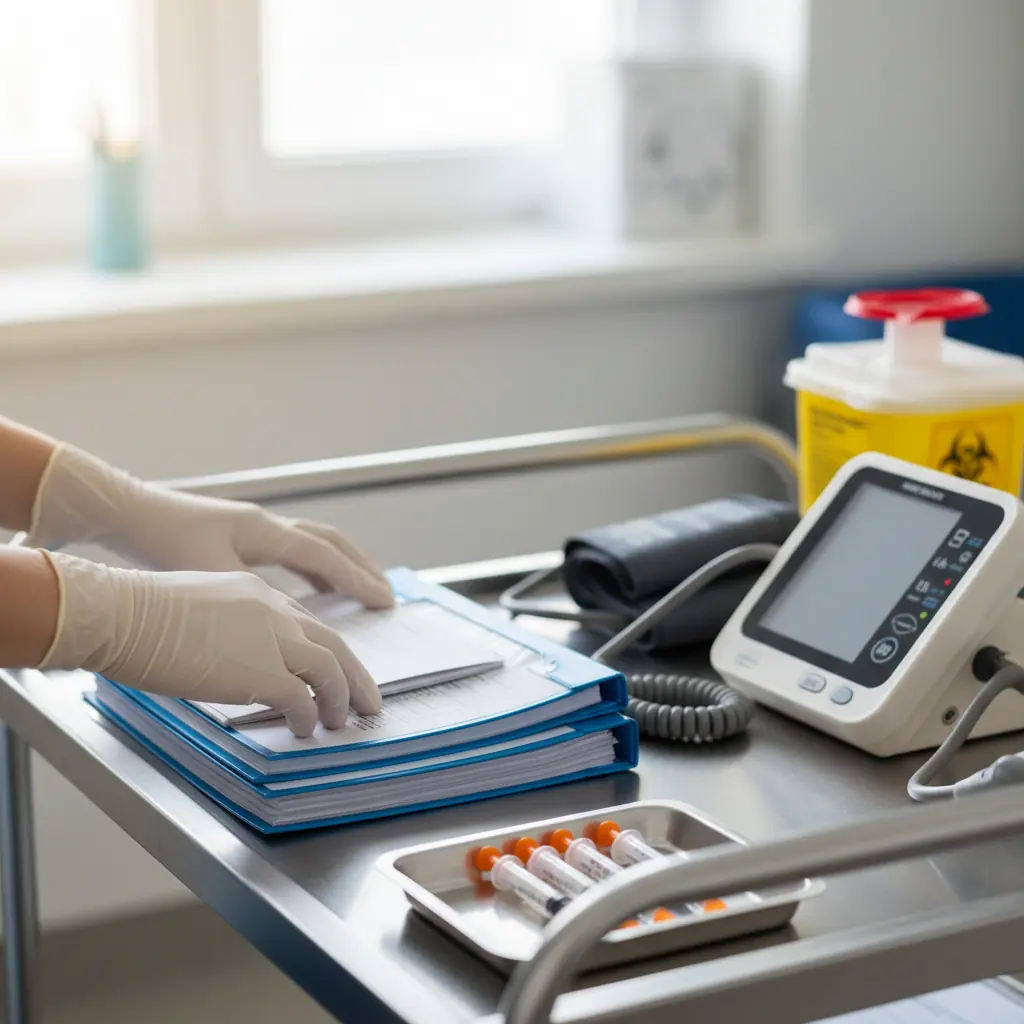
- Set up exam rooms (gowns, table paper, supplies)
- Review the day’s schedule and prep for known procedures
- Stock injection trays with daily vaccines
- Calibrate the BP machines and pulse oximeters
- Catch up on any overnight messages from the answering service
8:00 AM — Morning Clinic Opens
First patient arrives. The 15-minute appointment cycle begins:
- Minutes 0-3: Greet patient, take to exam room, take vital signs
- Minutes 3-7: Update medical history, current medications, allergies
- Minutes 7-10: Document chief complaint, prep for provider visit
- Minutes 10-15: Provider sees patient; MA preps for next patient or handles standing orders (phlebotomy, EKG, injection)
9:00-12:00 PM — Morning Clinic Block
A typical MA rooms 8-12 patients across the morning. The work cycles between:
- Patient rooming (vital signs, history)
- Phlebotomy (blood draws for ordered labs)
- 12-lead EKG
- Vaccinations or other injections
- Specimen collection
- EHR documentation
- Phone messages and triage
Pace is fast. Patients run late or arrive early. The provider needs labs back from the lab. An insurance company calls about a prior authorization. The phone rings constantly.
12:00-1:00 PM — “Lunch” (Sometimes)
In primary care, lunch is often interrupted. Many MAs use it to:
- Catch up on EHR documentation
- Process insurance verifications for tomorrow’s patients
- Return phone calls
- Eat 10 minutes before going back
1:00-5:00 PM — Afternoon Clinic Block
Same cycle as morning. Often includes:
- Walk-ins for urgent issues
- New patient appointments (longer rooming process)
- Procedures (sutures, biopsies, sigmoidoscopy assists)
- Scheduling specialist referrals
5:00-5:30 PM — End of Day
- Finish all EHR documentation
- Return final patient calls
- Prep for tomorrow (chart review, room setup)
- Restock supplies
A Day in Specialty Practice (Cardiology)
Cardiology MAs follow a similar structure but with more technical work:
- Pre-op EKGs and stress test setups
- Holter monitor placements and removals
- Specialty labs (BNP, troponin, lipid panels)
- More medication-specific patient education
- Higher portion of follow-up patients vs new patients
Specialty MAs typically room fewer patients per day (10-15) but each visit involves more technical work. Pay is also typically 10-15% above primary care.
A Day in Urgent Care
Urgent care MAs work at significantly higher patient volume:
- 25-35 patients per shift
- Higher procedure rate (sutures, splints, fracture care, abscess drainage)
- More visible illnesses (URI, UTI, lacerations, sprains)
- Often evening and weekend shifts
Pay typically includes evening/weekend differentials.
What Makes a “Good” vs “Bad” Day
Good day signals
- Schedule runs on time
- Patients are cooperative and arrive prepared
- Insurance verifications are smooth
- Provider is in flow with the schedule
- EHR documentation stays current throughout
Bad day signals
- Multiple patients run 15+ minutes late, cascading delays
- Insurance prior auth takes 30 minutes for a single patient
- A difficult or angry patient takes time to manage
- Phone calls pile up
- A blood draw takes multiple sticks
- EHR documentation falls behind
Most MAs report 70-80% of days fall in “good” or “neutral” range; 20-30% have the cascading issues.
What Surprises New MAs
After completing CCMA training, the things new MAs report being most surprised by:
- The pace. Even with externship hours, the volume of a real clinic is faster than most expect.
- Insurance complexity. Prior authorizations and denials take significant time.
- Phone volume. Patient calls about results, refills, scheduling come constantly.
- EHR system specifics. Each clinic uses Epic, Cerner, or others differently.
- Provider communication style. Each provider has preferences for how rooming and documentation should be done.
- Bonding with patients. Many MAs report the unexpectedly meaningful relationships they build with regular patients.
Ready to stop studying alone? HealthCerts’ Certified Clinical Medical Assistant (CCMA) program is built around fully online, self-paced coursework that can be completed in 8 weeks, with externship placement — so you walk out with both the credential and the clinical hours employers want.
The bottom line on medical assistant day in the life: choose the path that matches your real-world constraints — schedule, financial aid eligibility, and target employer — rather than the cheapest or fastest option in isolation. medical assistant day in the life outcomes vary meaningfully by program quality, so verify accreditation and externship support before enrolling.
Frequently Asked Questions
What does a typical day for a medical assistant look like?
A primary care MA rooms 15-25 patients across an 8-9 hour shift, performs 5-15 procedures (phlebotomy, EKG, injections), handles 20+ administrative tasks (insurance, prior auth, scheduling), and maintains real-time EHR documentation.
How many patients does a medical assistant see per day?
Primary care: 15-25. Specialty practice: 10-15. Urgent care: 25-35. Pediatrics: 20-30.
Is medical assistant work fast-paced?
Yes — significantly faster-paced than most healthcare-curious adults expect. Patients run late, insurance issues delay flow, phones ring constantly, and EHR documentation must stay current throughout.
What’s the hardest part of a medical assistant day?
Most MAs report: time pressure across 15-25 patients, insurance/prior auth complexity, mastering the EHR without slowing provider workflow, and managing difficult or anxious patients while staying warm.
Do medical assistants get a real lunch break?
Often interrupted in primary care and urgent care. Specialty practices and FQHCs sometimes have more protected lunch breaks. Many MAs use lunch for documentation catch-up.
What’s the pace of work in different MA settings?
Primary care: moderate-fast (15-25 patients). Specialty: slower-paced (10-15) but more technical. Urgent care: fastest (25-35). Hospital outpatient: varies.
What surprises new medical assistants most?
The pace, insurance complexity, phone volume, EHR system specifics, provider communication preferences, and the meaningful patient relationships that build with regular patients.
How long is a typical MA shift?
Most MAs work 8-9 hour shifts (e.g., 7:30 AM-5:30 PM with 30-min lunch). Urgent care often has 10-12 hour shifts. Hospital outpatient sometimes uses 4-day 10-hour shifts.
Start Your CCMA Journey with HealthCerts
Reading about it is one thing — actually getting credentialed and into a clinical role is another. HealthCerts’ Certified Clinical Medical Assistant (CCMA) program is the fastest, most-supported path: Earn your NHA CCMA in 8 weeks online with NHA exam fee, externship, and a venipuncture practice kit included. 5 ACE college credits.
Shahnaz Ghassemi Ph.D., is a co-founder of HealthCareerCerts and a dedicated educator, scientist, and workforce development leader. She holds a Ph.D. in Chemistry and brings extensive experience as both an educator and a research scientist in industry. As a co-leader of HealthCareerCerts, Shahnaz is deeply committed to making healthcare education accessible through affordable, flexible, and high-quality learning pathways. She works closely with academic institutions, healthcare partners, and workforce organizations to deliver certification programs that are practical, inclusive, and directly aligned with real-world healthcare needs. Since co-founding the organization, she has played a key role in building strategic partnerships that expand impact and opportunity, helping learners across the country gain essential skills, confidence, and meaningful careers in healthcare. Seeing hundreds of students thrive within the supportive learning community she helps lead continues to inspire and drive her mission forward.