Becoming a certified medical assistant in Ohio involves three main steps:
- Complete an accredited training program: Enroll in a program recognized by CAAHEP or ABHES. These programs ensure you’re eligible for national certification exams. For example, Cuyahoga Community College (Tri-C) offers a program with a 160-hour clinical practicum.
- Pass a certification exam: Choose from recognized credentials like the CMA (AAMA), CCMA (NHA), or RMA (AMT). Each has its own eligibility criteria, exam structure, and renewal requirements.
- Maintain your certification: Stay up-to-date with continuing education to renew your credential based on the issuing body’s guidelines.
Why certification matters in Ohio:
- Certification is required for administering medication or performing advanced tasks.
- Certified medical assistants earn a median salary of $51,000 annually.
- Ohio’s healthcare sector is growing, with 14,712 job openings and a projected 10% increase in demand.
Whether you pursue a traditional classroom program or an online option like HealthCareer Certs, certification sets you up for success in Ohio’s healthcare industry.
How To Become A Certified Medical Assistant
sbb-itb-7a67ffa
Eligibility Requirements for Medical Assistant Certification
To pursue certification as a medical assistant in Ohio, you’ll need to meet specific education and training requirements. These steps ensure you’re well-prepared with the knowledge and practical skills necessary for success.
Education Requirements
The first step is earning a high school diploma or GED, which is required to enroll in any accredited medical assistant training program in Ohio. For example, the Medical Assisting Program at Cuyahoga Community College (Tri-C) has specific entry criteria, including:
- A minimum GPA of 2.0
- Completion of prerequisite courses like college-level English, mathematics, and health-related subjects such as Medical Terminology (MA-1200) and Health Technology (HTEC-1050/1060), all with a grade of "C" or higher.
"The Medical Assisting Program at Cuyahoga Community College is accredited by the Commission on Accreditation of Allied Health Education Programs (CAAHEP) upon recommendation of the Medical Assisting Education Review Board (MAERB)." – Cuyahoga Community College
Beyond meeting these prerequisites, you must graduate from a training program accredited by either CAAHEP or ABHES. This accreditation ensures your education aligns with national standards and qualifies you to sit for certification exams such as the CMA offered by the American Association of Medical Assistants (AAMA).
Work Experience or Training Completion
In Ohio, prior professional work experience isn’t a requirement for medical assistant certification. Instead, accredited programs integrate hands-on training through a clinical practicum. At Tri-C, for instance, students complete a 160-hour unpaid practicum, which provides essential real-world experience. This practical training prepares graduates for the National Certifying Examination, which boasts a 69% pass rate and a 70% job placement rate between 2019 and 2023.
"Graduates are eligible to take the National Certifying Examination given by the American Association of Medical Assistants (AAMA)." – Cuyahoga Community College
Between 2019 and 2023, Tri-C’s Medical Assisting program achieved a 100% satisfaction rate among both graduates and employers, highlighting the program’s success in preparing students for their careers. Once you’ve met these requirements, you’ll be ready to take the next steps toward certification.
How to Get Certified as a Medical Assistant in Ohio
If you’re aiming to become a certified medical assistant in Ohio, here’s a step-by-step guide to navigate the process effectively.
Step 1: Complete an Accredited Training Program
Start by selecting the type of training program that suits your goals: a Certificate of Proficiency or an Associate of Applied Science (AAS) degree. Many institutions in Ohio, like Tri-C, now focus on certificate programs because they offer a quicker path to certification.
During your program, you’ll learn both administrative skills (like billing, coding, and scheduling) and clinical procedures (such as phlebotomy, EKGs, lab tests, and patient exams). For a flexible option, consider programs like HealthCareer Certs, which offer a fully online CCMA certification track. This program allows you to complete your training in as little as 4-12 weeks and includes interactive tools like 3D demos, flashcards, and one-on-one Zoom sessions with instructors.
Make sure the program you choose is accredited by either CAAHEP or ABHES. Accreditation ensures you’re eligible for widely recognized certification exams, such as the CMA (AAMA), which is regarded as the top credential in the field.
After completing your training, shift your focus to exam preparation.
Step 2: Prepare for the Certification Exam
With your coursework complete, it’s time to gear up for the certification exam. Training programs typically include preparation resources covering essential topics like medical terminology, human biology, phlebotomy, lab procedures, and office coding.
Take advantage of practice tools to strengthen your understanding of both clinical and administrative subjects. Many programs also provide support services and access to instructors to help you tackle any challenging areas before exam day.
Once you feel confident, move forward with registering for your certification exam.
Step 3: Register and Take the Certification Exam
When your coursework is finished, register for the certification exam without delay. To qualify for the CMA (AAMA) exam, you must have completed a program accredited by CAAHEP or ABHES. Alternatively, you can pursue certifications like the CCMA (Certified Clinical Medical Assistant) through the National Healthcareer Association (NHA) or the RMA (Registered Medical Assistant).
The exam format depends on the certification you choose, but all options test your knowledge of administrative and clinical skills. For instance, the CCMA exam includes sections on medical terminology, anatomy, patient care, and office procedures. Programs like HealthCareer Certs are specifically designed to prepare students for the NHA’s CCMA exam, which is widely accepted by Ohio healthcare facilities.
Once you pass the exam, you’ll move on to the final step: hands-on training.
Step 4: Complete Hands-On Training
The last step is completing a 160-hour supervised practicum at a healthcare facility. This unpaid, real-world experience is required to graduate from accredited programs in Ohio. It provides valuable exposure to working with patients, medical equipment, and healthcare teams.
For added convenience, HealthCareer Certs offers guaranteed externship placements, eliminating the need for you to find a clinical site on your own. They partner with healthcare facilities to ensure you complete the required hours and gain the practical experience needed to launch your career.
Medical Assistant Certifications Available in Ohio
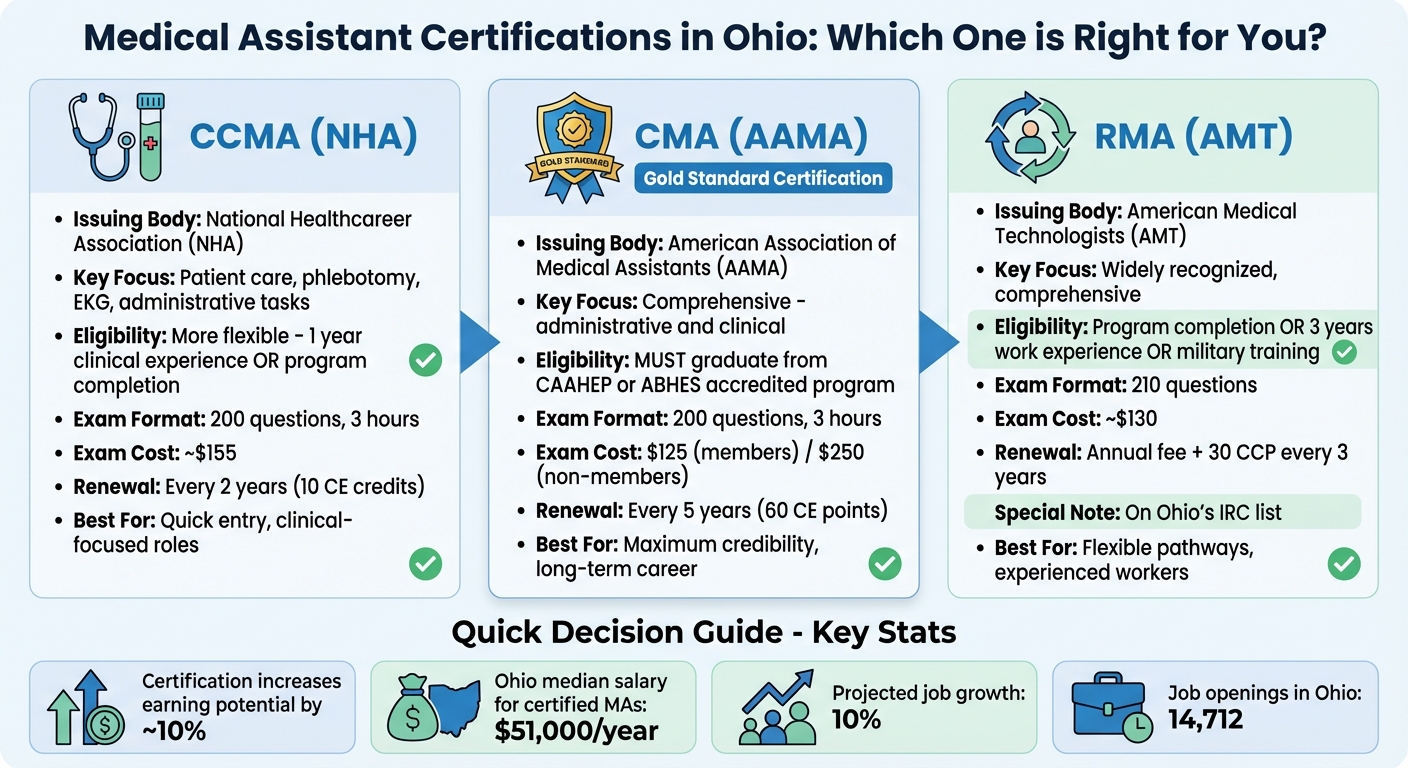
Ohio Medical Assistant Certification Comparison: CMA vs RMA vs CCMA
Ohio offers various medical assistant certifications, each with its own eligibility requirements and exam structure. While certification isn’t legally required in the state, many large healthcare providers and government positions expect candidates to hold one. Understanding these credentials can help you decide which one aligns with your career goals. These certifications help maintain consistent standards in healthcare across Ohio.
One of the most recognized certifications is the CMA (AAMA) from the American Association of Medical Assistants. This credential is often seen as the "gold standard" and requires candidates to graduate from a program accredited by either CAAHEP or ABHES. The RMA (AMT), offered by the American Medical Technologists, provides more flexible eligibility options, including program completion, three years of work experience, or military training. Meanwhile, the CCMA (NHA), issued by the National Healthcareer Association, has fewer entry barriers, allowing candidates with just one year of clinical experience to qualify. This certification focuses heavily on clinical tasks, such as phlebotomy and EKGs.
Obtaining certification can also boost your earning potential by about 10%. Exam fees vary, with the CMA costing $125 for AAMA members and up to $250 for non-members. The RMA exam fee is approximately $130, while the CCMA costs around $155.
Certification Comparison
| Certification | Issuing Body | Key Focus Areas | Exam Details |
|---|---|---|---|
| Certified Clinical Medical Assistant (CCMA) | National Healthcareer Association (NHA) | Patient care, phlebotomy, EKG, admin tasks | 200 questions, 3 hours; renew every 2 years (10 CE credits) |
| Certified Medical Assistant (CMA) | American Association of Medical Assistants (AAMA) | Accredited program graduates only | 200 questions, 3 hours; renew every 5 years (60 CE points) |
| Registered Medical Assistant (RMA) | American Medical Technologists (AMT) | Widely recognized | 210 questions; annual fee + 30 CCP every 3 years |
When deciding on a certification, it’s helpful to review job postings in your area to see which credentials are most in demand. Additionally, you can enhance your resume by adding specialty certifications in areas like Phlebotomy (CPT) or EKG (CET), which can make you more competitive and open doors to specialized roles.
Ohio Certification Guidelines and Resources
Recognized Exams and Credentials in Ohio
In Ohio, medical assistants aren’t required to hold state licensure. However, many employers prefer nationally recognized certifications like the CMA (AAMA) or RMA. These credentials are often seen as a benchmark for ensuring high skill levels, particularly as healthcare increasingly shifts toward outpatient and ambulatory care settings. This trend has made certified professionals more desirable than non-certified staff.
The RMA certification is included on Ohio’s official Industry Recognized Credential (IRC) list, making it a popular choice for employers statewide. Additional certifications, such as the CPT (Phlebotomy Technician) and CET (EKG Technician), can further enhance your qualifications for specialized roles within Ohio’s healthcare sector. For those interested in administrative roles, the CMAA (Medical Administrative Assistant) certification is also valued by employers, although it is not listed on the IRC.
To determine which certifications align best with your career goals, check local job postings for the credentials most frequently requested by employers. Additionally, consider Ohio-based training programs that cater to these certification standards.
Training Programs for Ohio Residents
Cuyahoga Community College (Tri-C) in Cleveland offers a Certificate of Proficiency in Medical Assisting. This program meets Ohio’s educational requirements and prepares students for the CMA (AAMA) exam. A key component of the program is a mandatory 160-hour supervised, unpaid practicum. Between 2019 and 2023, Tri-C reported a 69% certification exam pass rate and a 70% job placement rate, with 100% satisfaction ratings from both graduates and employers. Notably, Tri-C plans to phase out its Associate Degree program by August 2025 to focus entirely on the Certificate of Proficiency, addressing immediate workforce needs.
HealthCareer Certs offers a fully online CCMA certification program that is self-paced, typically completed in 4–12 weeks. The program includes one-on-one Zoom sessions and guarantees externship placements for hands-on training. The CCMA credential, issued by the National Healthcareer Association, is widely recognized by Ohio employers and prepares students for clinical roles in outpatient facilities and physicians’ offices.
The Ohio Department of Education and Workforce provides an updated list of industry-recognized credentials that meet state graduation and employment standards. Before enrolling in any program, verify that it aligns with Ohio’s educational requirements to ensure eligibility for your desired certification exam.
Conclusion
To become certified in Ohio, you’ll need to follow a clear pathway: complete an accredited education program, gain hands-on experience through clinical practicum hours, and prepare for a nationally recognized certification exam. These steps are essential for anyone looking to build a career as a medical assistant in the state.
Between 2019 and 2023, programs in Ohio, such as Tri-C, reported a 69% exam pass rate and a 70% job placement rate. With a median salary of around $51,000 per year and a projected 10% job growth, the data highlights the strong outcomes for graduates of these programs.
As emphasized, "In Ohio, medical assistants must possess a credential to administer medication or perform duties beyond the scope of an unlicensed healthcare professional". This requirement makes proper certification not just a formality, but a key to career progression.
When choosing a program, look for one that meets Ohio’s standards and prepares you for certifications like the CMA (AAMA). The 160-hour practicum is a vital component, bridging classroom learning with real-world practice, and is a requirement for program completion.
Whether you opt for a traditional classroom route or an online alternative like HealthCareer Certs’ self-paced CCMA program with guaranteed externship placement, ensure your program aligns with these standards. This alignment will help you confidently step into Ohio’s expanding healthcare industry.
FAQs
Which certification is best for jobs in Ohio (CMA, CCMA, or RMA)?
The right certification for medical assistant jobs in Ohio varies based on what employers are looking for and the role’s demands. The CMA (Certified Medical Assistant) stands out for its national recognition and is often a top choice among employers. The CCMA (Certified Clinical Medical Assistant) is another strong option, especially for positions that focus heavily on clinical tasks. The RMA (Registered Medical Assistant) is a valid certification but tends to be less frequently required. It’s important to pick a certification that matches the responsibilities and expectations of the job you’re aiming for.
Do I need an accredited program to take the certification exam?
Completing an accredited program is a must if you want to be eligible for the medical assistant certification exam in Ohio. These programs ensure you gain the required education and skills to meet certification standards and thrive in your career.
How do I complete the 160-hour externship if I train online?
To complete a 160-hour externship while training online, look for a program that combines online learning with a supervised externship placement. Many online programs partner with healthcare facilities in Ohio to help students meet this requirement. Work closely with your program’s externship coordinator to secure a placement that aligns with Ohio’s certification standards. If your program doesn’t include an externship, you’ll need to independently find an approved opportunity at local clinics or healthcare providers.