
Looking to start a healthcare career in 2026? These five entry-level roles offer strong job growth, competitive salaries, and clear pathways for advancement. Whether you’re a recent graduate, switching careers, or re-entering the workforce, these positions require minimal education and provide opportunities for long-term growth. Here’s a quick breakdown:
- Registered Nurse (RN): High demand with 189,100 annual openings. Earn $68,000–$92,000+ annually. Requires an associate’s or bachelor’s degree and NCLEX-RN certification.
- Radiologic Technologist (X-Ray Tech): Conduct diagnostic imaging with salaries around $70,000–$79,000. Requires a two-year associate’s degree and ARRT certification.
- Dental Hygienist: Focus on preventive oral care. Median pay is $94,260, with top earners making $120,000+. Requires a three-year associate’s degree and state licensure.
- Respiratory Therapist: Help patients with breathing issues. Median salary is $80,450, with 12% job growth through 2034. Requires an associate’s degree and CRT or RRT certification.
- Occupational Therapy Assistant (OTA): Assist patients in regaining daily independence. Median pay is $68,340, with 19% projected job growth. Requires a two-year degree and NBCOT certification.
Quick Comparison Table:
| Job Title | Median Annual Salary | Education Required | Certification/Licensure | Work Settings |
|---|---|---|---|---|
| Registered Nurse (RN) | $68,000–$92,000+ | Associate’s/Bachelor’s | NCLEX-RN | Hospitals, clinics, nursing homes |
| Radiologic Technologist | $70,000–$79,000 | Associate’s | ARRT | Hospitals, diagnostic centers |
| Dental Hygienist | $94,260+ | Associate’s | State licensure | Dental offices, public health |
| Respiratory Therapist | $80,450 | Associate’s | CRT/RRT | Hospitals, outpatient care |
| Occupational Therapy Asst. | $68,340 | Associate’s | NBCOT | Home care, nursing facilities, schools |
These roles are attainable with short-term training, making them ideal for anyone looking to enter healthcare quickly. Start with an accredited program to gain the skills and certifications needed to jumpstart your career.
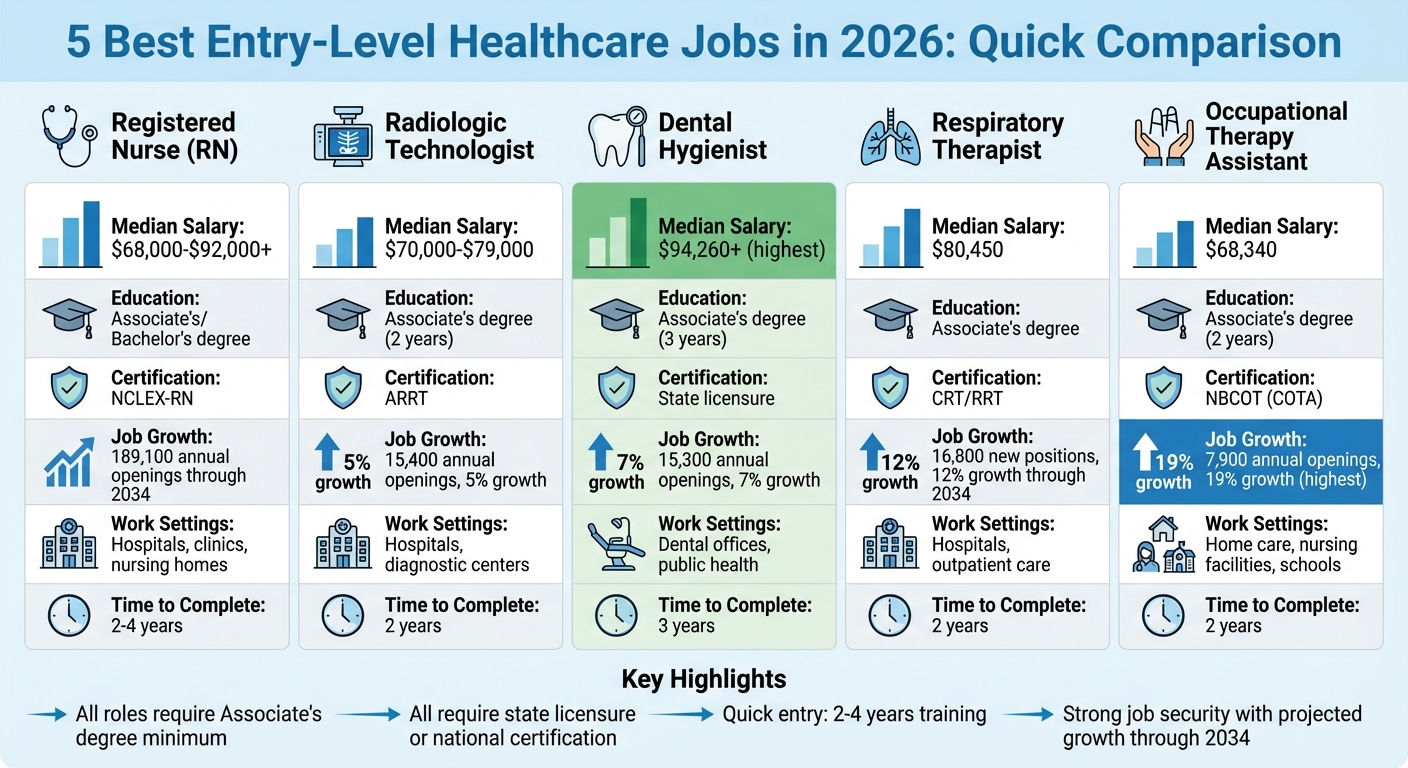
Entry-Level Healthcare Jobs Comparison: Salaries, Education & Growth 2026
1. Registered Nurse (Entry-Level RN)
Becoming a Registered Nurse (RN) offers a straightforward way to enter the healthcare field, with 189,100 job openings projected annually through 2034. While the educational requirements may be higher than some other entry-level roles, the combination of competitive pay, job stability, and opportunities for growth makes it a popular choice for those starting a healthcare career.
Average Salary (2025-2026 Data)
Entry-level RNs earn an average annual salary of about $68,000, with starting pay ranging from $58,910 to $90,623, depending on location and workplace setting. Hospitals typically offer the highest starting salaries, averaging $92,000, while outpatient clinics and long-term care facilities offer slightly lower averages of $78,000 and $75,000, respectively.
Compensation often includes additional perks. Many employers offer sign-on bonuses averaging $15,000 and student loan repayment benefits of around $350 per month. Shift differentials for working nights, weekends, or holidays can add $4-8 per hour for night shifts and $3-6 per hour for weekends. Geographic differences are also notable, with New York leading the way at $70,087 per year ($33.70/hour), followed by Washington at $68,831 and Massachusetts at $68,774.
This financial stability often supports further education and career development.
Required Education and Certifications
To become an RN, you’ll need to complete an accredited nursing program, either a two-year Associate Degree in Nursing (ADN) or a four-year Bachelor of Science in Nursing (BSN), and pass the NCLEX-RN licensing exam. While ADN graduates can secure entry-level roles, many hospitals now prefer or even require a BSN, making it a better long-term choice.
Most nursing programs combine online coursework with in-person clinical rotations. After obtaining licensure, new RNs can enhance their resumes with certifications like Basic Life Support (BLS), Advanced Cardiac Life Support (ACLS), or specialized credentials in areas like Emergency Nursing or Critical Care.
Primary Job Responsibilities
Entry-level RNs handle a range of essential duties, including assessing patient conditions, documenting medical histories, administering medications, and operating medical equipment. They work closely with physicians and specialists to create care plans, monitor treatment outcomes, and educate patients and their families on post-discharge care. Their work follows a five-step nursing process: assessment, diagnosis, planning, implementation, and evaluation.
These responsibilities provide a solid foundation for future career opportunities.
Career Growth Potential
"Nursing has consistently been ranked as one of the most rewarding and trustworthy professions, providing practitioners with remarkable career opportunities and financial stability." – Nurse.org
An RN license opens doors to a variety of advanced roles. With experience, nurses can move into management or pursue advanced practice positions such as Nurse Practitioner (median salary: $132,050) or Certified Registered Nurse Anesthetist (CRNA) (median salary: $223,210). Many institutions also offer clinical ladder programs designed to help nurses advance their careers more quickly.
sbb-itb-7a67ffa
2. Radiologic Technologist (X-Ray Technician)
Radiologic technologists play a vital role in healthcare by conducting diagnostic imaging exams like X-rays and CT scans. These professionals are essential for accurate patient diagnoses. The field is projected to see about 15,400 job openings annually through 2034, with a steady 5% growth rate in employment. With just an associate’s degree required, it’s a relatively straightforward way to step into the healthcare industry.
Average Salary (2025-2026 Data)
In May 2024, the median annual salary for radiologic technologists was $77,660, and this figure is expected to increase to roughly $79,760 by 2026. Entry-level hourly wages average $24.25, with overall hourly rates reaching $28.69. The top 10% of earners make more than $106,990 annually.
Salaries can differ significantly depending on the workplace. For example:
- Federal government roles average $93,970 annually.
- Outpatient care centers offer around $81,000 per year.
- Hospitals pay approximately $78,560 annually.
California stands out as the highest-paying state, with an average annual salary of about $112,120. Specializing in fields like MRI technology can further boost earnings, with median salaries nearing $88,180. Diagnostic imaging roles, particularly in MRI and mammography, saw a 30% growth in 2025 compared to the previous year.
Required Education and Certifications
To enter this field, an associate’s degree from a JRCERT-accredited program is typically required. These programs usually take two years and blend online classes with hands-on clinical labs and internships to build practical expertise. Certificate programs, lasting about a year, are also available, though many employers prefer candidates with an associate’s degree.
Most states require licensure or certification, and many employers look for certification from the American Registry of Radiologic Technologists (ARRT). Licensing exams generally cost between $200 and $400, while program costs range from $4,000 to $30,000 for associate’s degrees and $4,000 to $20,000 for certificate programs. High school students interested in this career should focus on anatomy, biology, chemistry, and physics courses.
Primary Job Responsibilities
Radiologic technologists handle imaging equipment and follow physician instructions to capture diagnostic images. Their duties include:
- Collecting patient histories and ensuring proper positioning.
- Protecting patients from unnecessary radiation exposure.
- Operating computerized imaging systems and calculating accurate radiation doses.
They also collaborate with physicians to assess image quality and maintain detailed patient records. This role often requires physical stamina, as positioning patients can be physically demanding. About 60% of radiologic technologists work in hospitals, which means shifts may include nights, weekends, or overnight hours to meet emergency imaging needs.
Career Growth Potential
This career offers strong opportunities for advancement. Specializing in areas like computed tomography (CT), magnetic resonance imaging (MRI), or mammography can lead to higher pay and expanded responsibilities. The growing demand for diagnostic imaging, fueled by an aging population needing more frequent screenings for conditions like cancer and age-related injuries, ensures a steady need for skilled professionals.
With additional training or a bachelor’s degree, technologists can move into administrative roles or other specialized positions. Online and hybrid training programs make it easier for professionals to pursue these advancements while continuing to work. These pathways demonstrate how an entry-level role can evolve into a long-term, fulfilling career.
3. Dental Hygienist
Dental hygienists play a crucial role in preventive dental care. With an expected 7% job growth from 2024 to 2034 and approximately 15,300 job openings each year, this career path offers steady opportunities. Additionally, 94% of dental hygienists work in dentists’ offices. Job satisfaction in this field is notably high, with professionals rating it 4.1 out of 5. Like other entry-level healthcare positions, this role provides a solid foundation for a stable career in a growing industry.
Average Salary (2025–2026 Data)
Dental hygienists earn a median annual salary of $94,260. Starting wages are about $35.93 per hour, with significant increases as experience grows. The top 10% of earners make over $120,060 annually. For those with 4–6 years of experience, the median salary rises to $111,000. Professionals with 10–14 years typically earn $135,000, and those with 15 or more years bring in around $152,000 annually. Location also affects salaries, with median earnings reaching $129,760 in Alaska, $127,900 in the District of Columbia, $125,370 in Washington, $121,080 in California, and $118,280 in Oregon.
Required Education and Certifications
To enter this field, an associate’s degree in dental hygiene is required. This program, completed in about three years, includes classroom learning and hands-on clinical practice. Programs must be accredited by CODA. While some coursework can be done online, clinical labs and internships require in-person participation. Licensure is mandatory in all states, requiring graduation from an accredited program and passing both written and clinical exams. The National Board Dental Hygiene Examination (NBDHE) costs about $150 to apply. Employers also typically require CPR certification. High school students aiming for this career should focus on biology, chemistry, and math to meet competitive program prerequisites.
Primary Job Responsibilities
Dental hygienists focus on preventive care, performing tasks such as removing tartar, stains, and plaque from teeth, and applying fluoride treatments or sealants to protect against decay. They also take and develop dental x-rays, screen for conditions like gingivitis, and report their findings to dentists. Another key part of the job involves educating patients on proper brushing and flossing techniques and the impact of diet on oral health. Depending on state regulations, they may also handle advanced tasks like administering topical anesthesia or placing temporary crowns. The role requires excellent manual dexterity for precision in tight spaces and strong interpersonal skills to ease patient anxiety.
Career Growth Potential
The demand for dental hygienists is on the rise, driven by an aging population retaining more natural teeth and growing awareness of the connection between oral health and overall wellness. Many states are expanding the scope of practice for hygienists, allowing them to fully utilize their training. Advancing education to a bachelor’s or master’s degree opens doors to specialized roles in research, education, and public health. Bachelor’s programs generally cost between $15,000 and $40,000, while master’s programs range from $35,000 to $60,000. These advanced opportunities reflect the broader career possibilities emerging in healthcare by 2026.
4. Respiratory Therapist
Respiratory therapists specialize in mechanical ventilation and advanced respiratory treatments, making them a critical part of the healthcare system. This profession is on the rise, with job growth projected at 12% to 12.1% between 2024 and 2034 – much faster than most other careers. By 2034, an estimated 16,800 new positions will be added, driven by the needs of 16 million U.S. adults with COPD and an aging population. With an unemployment rate of just 0.6% and a job satisfaction score of 3.8 out of 5, this role is both stable and rewarding. U.S. News ranks respiratory therapy as the #4 Best Health Care Job and #12 in their 100 Best Jobs overall. These trends point to competitive pay and strong job security.
Average Salary (2025–2026 Data)
Entry-level respiratory therapists typically start at $27.34 per hour, translating to annual salaries between $61,380 and $68,000. The median annual wage is $80,450. Those in the top 10% earn over $108,820, while the lowest 10% make less than $61,900. Location plays a big role in earnings. California leads with an average salary of $106,790, followed by New York at $105,740, and the District of Columbia at $102,460. Around 80% of respiratory therapists work in hospitals, but outpatient care centers offer the highest average pay, at $110,970 annually.
Required Education and Certifications
To enter the field, an associate’s degree in respiratory therapy (costing $5,000–$20,000) is the minimum requirement, though many employers prefer candidates with a bachelor’s degree, which can cost $15,000–$50,000. Programs must be accredited by the Commission on Accreditation of Respiratory Care (CoARC). While bachelor’s programs can be completed online, clinical rotations and internships are required in person. Licensure is mandatory in every state except Alaska. Certifications include the Certified Respiratory Therapist (CRT) for entry-level roles and the Registered Respiratory Therapist (RRT), which many employers require within a specific timeframe. Fees for state licensure exams range from $150 to $200, while national certification exams cost $40 to $100.
Primary Job Responsibilities
Respiratory therapists handle a variety of critical tasks, including performing pulmonary function tests to assess lung capacity and analyzing blood gas levels to evaluate oxygen and carbon dioxide levels. They also clear airways using chest physiotherapy, administer aerosol medications, and collaborate with physicians to create treatment plans. In critical care settings, RTs intubate patients and manage mechanical ventilators for those unable to breathe independently.
"From the very first breaths of a newborn to emergency transport to helping older patients manage their pulmonary disease, respiratory therapists are there to improve and save lives".
Additionally, they educate patients with chronic conditions like asthma or COPD on how to properly use nebulizers, inhalers, and home ventilators.
Career Growth Potential
The field is expanding beyond hospitals, with more opportunities emerging in specialized clinics and doctors’ offices. This shift is driven by efforts to reduce hospital readmissions. Advances in diagnostic tools and mechanical ventilation technology are also enabling respiratory therapists to treat patients in outpatient settings. Experienced therapists can pursue advanced certifications, such as Neonatal/Pediatric Respiratory Care (NPS), Adult Critical Care (ACCS), or Sleep Disorders (SDS), to boost their earning potential and career options. With strong prospects for advancement and salary growth, respiratory therapy offers long-term stability and opportunities in healthcare.
5. Occupational Therapy Assistant
Occupational Therapy Assistants (OTAs) work closely with patients, helping them regain independence in daily activities like dressing, cooking, or using assistive tools. This role provides a practical way to enter the healthcare field while making a meaningful impact on people’s lives. The demand for OTAs is growing quickly – employment is expected to rise by 19% between 2024 and 2034, adding about 7,900 job openings each year. This growth is largely due to an aging population dealing with conditions like strokes and arthritis, leading healthcare providers to hire OTAs as a cost-efficient alternative to occupational therapists. Beyond immediate job opportunities, this role can also serve as a stepping stone for career advancement in healthcare.
Average Salary (2025–2026 Data)
As of May 2024, OTAs earned a median annual salary of $68,340, with hourly wages expected to reach $29.44 by 2026. The highest earners make over $86,930 annually, while those in the lower range earn less than $49,070. Salaries vary depending on the work setting – home healthcare services top the list with a median salary of $76,800, followed by nursing care facilities at $75,860. Experience also plays a role; entry-level OTAs earn roughly 11% less than the average, whereas those with 10–20 years of experience can earn about 10% more.
Required Education and Certifications
To become an OTA, you need an associate’s degree from a program accredited by the Accreditation Council for Occupational Therapy Education (ACOTE). These two-year programs include coursework in areas like anatomy and kinesiology, along with supervised fieldwork. Many programs offer a mix of online classes and in-person clinical training, making them more accessible for students juggling other responsibilities. After completing the degree, graduates must pass the National Board for Certification in Occupational Therapy (NBCOT) exam to earn the title of Certified Occupational Therapy Assistant (COTA). Licensure is also required in all 50 states, as well as in the District of Columbia, Guam, and Puerto Rico, and must be maintained through ongoing education.
Primary Job Responsibilities
OTAs play a hands-on role in helping patients improve their motor skills and daily functioning. They might guide therapeutic exercises, engage children in activities to develop coordination, or teach practical techniques like buttoning a shirt after a stroke or using adaptive tools for conditions like Parkinson’s. OTAs also assist injured workers in developing strategies to reenter the workforce. Their work is essential to patient progress, as Alyson Stover, Associate Professor at the University of Pittsburgh, explains:
"The responsibility of the occupational therapy assistant is to ensure that they are really guiding the consumer of occupational therapy services on a path to be able to participate in those meaningful occupations in a way that they want to."
In addition to working directly with patients, OTAs track progress, document data, and provide feedback to occupational therapists for treatment adjustments. The job can be physically demanding, requiring long periods of standing, kneeling, and occasionally lifting or moving patients.
Career Growth Potential
The shift toward outpatient and home-based care is creating new opportunities for OTAs outside of traditional hospital environments. Professionals can enhance their skills and marketability by earning optional certifications in specialized areas, such as low vision. For those aiming to advance further, additional education – often available through online programs – can lead to becoming a licensed Occupational Therapist. With stable job prospects and pathways for growth, OTAs enjoy a career that offers both security and potential.
Job Comparison Table
Deciding on the right entry-level healthcare role comes down to factors like your education timeline, salary goals, and the type of work environment you prefer. Below is a side-by-side breakdown of key details for each role.
| Job Title | Median Annual Salary (2025-2026) | Education Required | Certification/Licensure | Typical Work Settings |
|---|---|---|---|---|
| Registered Nurse (Entry-Level RN) | $90,000+ | Associate’s or Bachelor’s degree in nursing | State licensure (NCLEX-RN exam required) | Hospitals, clinics, nursing care facilities, home healthcare |
| Radiologic Technologist | $70,000-$75,000 | Associate’s degree in radiologic technology | State licensure and national certification (ARRT) | Hospitals, diagnostic imaging centers, outpatient care centers |
| Dental Hygienist | $90,000+ | Associate’s degree in dental hygiene | State licensure and national board exams | Dental offices, clinics, public health facilities |
| Respiratory Therapist | $68,000-$72,000 | Associate’s degree in respiratory therapy | State licensure and national certification (CRT or RRT) | Hospitals, skilled nursing facilities, home healthcare |
| Occupational Therapy Assistant | $68,340 | Associate’s degree from an ACOTE-accredited program | State licensure and NBCOT certification (COTA) | Home healthcare, nursing care facilities, outpatient clinics, schools |
All these roles require at least an associate’s degree, along with state licensure or national certification, making them accessible entry points into healthcare. Registered Nurses and Dental Hygienists top the salary range, with median earnings exceeding $90,000. Meanwhile, Respiratory Therapists and Occupational Therapy Assistants offer solid mid-range salaries, typically between $68,000 and $72,000.
Work environments vary widely, allowing you to align your career with your preferences. Registered Nurses and Respiratory Therapists often work in hospital settings, engaging directly with patients in fast-paced environments. If you prefer a more structured schedule, Dental Hygienists usually work in private dental offices with standard business hours. Occupational Therapy Assistants, on the other hand, enjoy the flexibility of working in diverse settings like schools, outpatient clinics, or home healthcare.
Up next: Discover how online training programs can help you transition into these roles more efficiently.
How to Start with Online Training Programs
Pursuing a healthcare career no longer requires years of traditional college education. Online training programs now provide a quicker, more flexible way to enter the five roles discussed in this article, making it easier to balance learning with work or family responsibilities.
The first step is to verify your eligibility and choose accredited programs. Most programs simply require a high school diploma or GED. Accreditation is equally important – look for programs that meet recognized standards like those from the NCCA to ensure you earn a respected certification. For example, Occupational Therapy Assistant programs should be ACOTE-accredited, while Radiologic Technologists need ARRT-approved training.
Once you’ve confirmed eligibility and accreditation, consider programs like those offered by HealthCareer Certs. They provide fully online certification courses with features like self-paced learning, one-on-one Zoom sessions with instructors, and guaranteed externship placements. Their tools include interactive 3D demos and over 1,400 practice questions to prepare you for national exams. Plus, they offer a tuition refund guarantee if you can’t secure a healthcare job after completing your certification. Some certifications, like the Certified Clinical Medical Assistant (CCMA), can be completed in as little as 4–12 weeks, while others, like the Certified Phlebotomy Technician (CPT), range from 4 weeks to 6 months, depending on your pace.
Even with online coursework, hands-on clinical experience is essential for most roles. You’ll complete in-person externships at local facilities to develop practical skills like drawing blood and taking vital signs. These externships often lead to direct job offers – many students secure permanent roles at the same clinics where they trained. After finishing your coursework and clinical hours, you’ll register for your certification exam through platforms like the NHA. Testing can be done at certified centers or via live remote proctoring from home.
"Employers prioritize certification readiness, clinical competence, and job-specific training over academic credentials." – Stephanie Duncan, Marketing Director, CALRegional
With 1.9 million annual job openings and 69% of employers struggling to find qualified candidates, certified professionals are entering a job market eager for skilled talent. This streamlined pathway from online learning to clinical training allows you to step into your new healthcare role quickly and confidently.
Conclusion
The healthcare sector offers a variety of entry-level roles that not only provide quick entry into the workforce but also lay the groundwork for long-term career growth. Among the roles discussed – Registered Nurse, Radiologic Technologist, Dental Hygienist, Respiratory Therapist, and Occupational Therapy Assistant – each presents an opportunity to join a stable, ever-growing industry that remains resilient even during economic downturns. Requiring only an Associate’s degree or certification, these positions are accessible to those looking to start their careers without the time and financial investment of a four-year degree.
These roles also serve as stepping stones for career advancement. For instance, Registered Nurses can pursue further education to become Nurse Practitioners, a role expected to grow by 46% by 2031. Similarly, Occupational Therapy Assistants can advance to become Occupational Therapists with additional qualifications. Such pathways ensure that professionals in these fields remain in demand and have opportunities for upward mobility.
"Healthcare is one bright spot that is sure to continue… Demand is projected to surge for healthcare workers in the coming years." – Brett, Resource Author at CareBridge Academy
With high demand, job security, and accessible entry points, 2026 is shaping up to be an excellent time to begin a healthcare career. In fact, 69% of employers report difficulties in finding qualified candidates, making certified professionals especially sought after. Whether your interests lean toward patient care or technical expertise, these positions offer both a stable income and a pathway for growth.
Start by exploring accredited programs that align with your interests and career goals. With the right training, you can quickly join an industry that values your dedication and skills.
FAQs
What education or training do you need for entry-level healthcare jobs?
The qualifications for entry-level healthcare jobs in 2026 will vary based on the specific role. Many of these positions don’t require a college degree, but they often call for certifications or short-term training programs. For instance, becoming a medical assistant or a phlebotomy technician usually involves completing a certification course. These programs can often be finished in just a few weeks or months, either online or in person.
Some roles may only require a high school diploma or GED, paired with additional training to earn the necessary certifications. Take certified medical assistants, for example – they need to complete a training program and pass an exam to qualify. These jobs are designed to be accessible, providing an entry point into the expanding healthcare field without requiring years of formal education.
How do entry-level healthcare salaries differ by state?
Salaries for entry-level healthcare jobs can differ greatly depending on the state. Factors such as cost of living, demand for healthcare workers, and local economic conditions heavily influence these variations. For example, states like California, Massachusetts, and Alaska tend to offer higher starting salaries, often ranging between $36,000 and $42,000 annually. These higher wages are typically tied to elevated living costs and a stronger demand for healthcare professionals.
In contrast, states with a lower cost of living may offer starting salaries closer to $33,000 per year. These regional differences highlight the importance of researching local salary trends if you’re considering where to work or relocate. Having a clear understanding of these factors can help you make smarter career decisions and better plan for future opportunities.
What career growth opportunities are available in entry-level healthcare jobs?
Starting out in healthcare at an entry-level position can set you on a path to a rewarding and long-lasting career. Roles like medical assistant or dental assistant often act as stepping stones to more advanced positions, such as licensed practical nurse, dental hygienist, or even healthcare administrator. With the right mix of education, certifications, and hands-on experience, it’s possible to transition into higher-paying and more specialized roles.
The healthcare field is expanding rapidly, driven by an aging population and advancements in medical technology. This growth has created a rising demand for skilled professionals. Many entry-level roles provide a strong starting point for careers in areas like nursing, occupational therapy, or healthcare management. Plus, online training programs and continuing education have made it easier than ever to pursue these career paths.
If you’re looking for a career with room to grow, entry-level healthcare jobs open the door to a future full of potential for advancement and specialization.