Medical school admissions value clinical experience. Certifications not only enhance your resume but also provide hands-on skills that prepare you for patient care. Here’s a breakdown of top certifications:
- Basic Life Support (BLS): CPR and emergency response training in just 3–5 hours. Cost: $60–$100.
- Certified Nursing Assistant (CNA): Direct patient care, including hygiene and vitals. Completion: 4–12 weeks. Cost: $500–$2,500.
- Emergency Medical Technician (EMT): Emergency care and decision-making. Completion: 2–16 weeks. Cost: $1,000–$2,000.
- Certified Clinical Medical Assistant (CCMA): Clinical and administrative skills for outpatient settings. Completion: 4–12 weeks. Cost: $2,700+.
- Certified Phlebotomy Technician (CPT): Blood collection techniques. Completion: 4–8 weeks. Cost: $900.
- Certified Patient Care Technician (CPCT): Combines nursing, phlebotomy, and EKG skills. Completion: 8–12 weeks. Cost: $2,300.
- Certified Pharmacy Technician (CPhT): Focused on pharmacology and medication management. Completion: Up to 1 year. Cost: $2,700.
Quick Comparison:
| Certification | Time | Cost | Skills Gained | Experience Level |
|---|---|---|---|---|
| BLS | 3–5 hrs | $60–$100 | CPR, AED | Basic |
| CNA | 4–12 wks | $500–$2,500 | Patient care, vitals | High |
| EMT | 2–16 wks | $1,000–$2,000 | Emergency care | High |
| CCMA | 4–12 wks | $2,700+ | Clinical & admin tasks | Moderate |
| CPT | 4–8 wks | $900 | Blood collection | Moderate |
| CPCT | 8–12 wks | $2,300 | Nursing, EKG, phlebotomy | High |
| CPhT | Up to 1 yr | $2,700 | Medication management | Low |
Start with certifications like BLS or CNA to quickly gain clinical exposure. EMT, CCMA, or CPCT offer deeper experience for competitive applications.
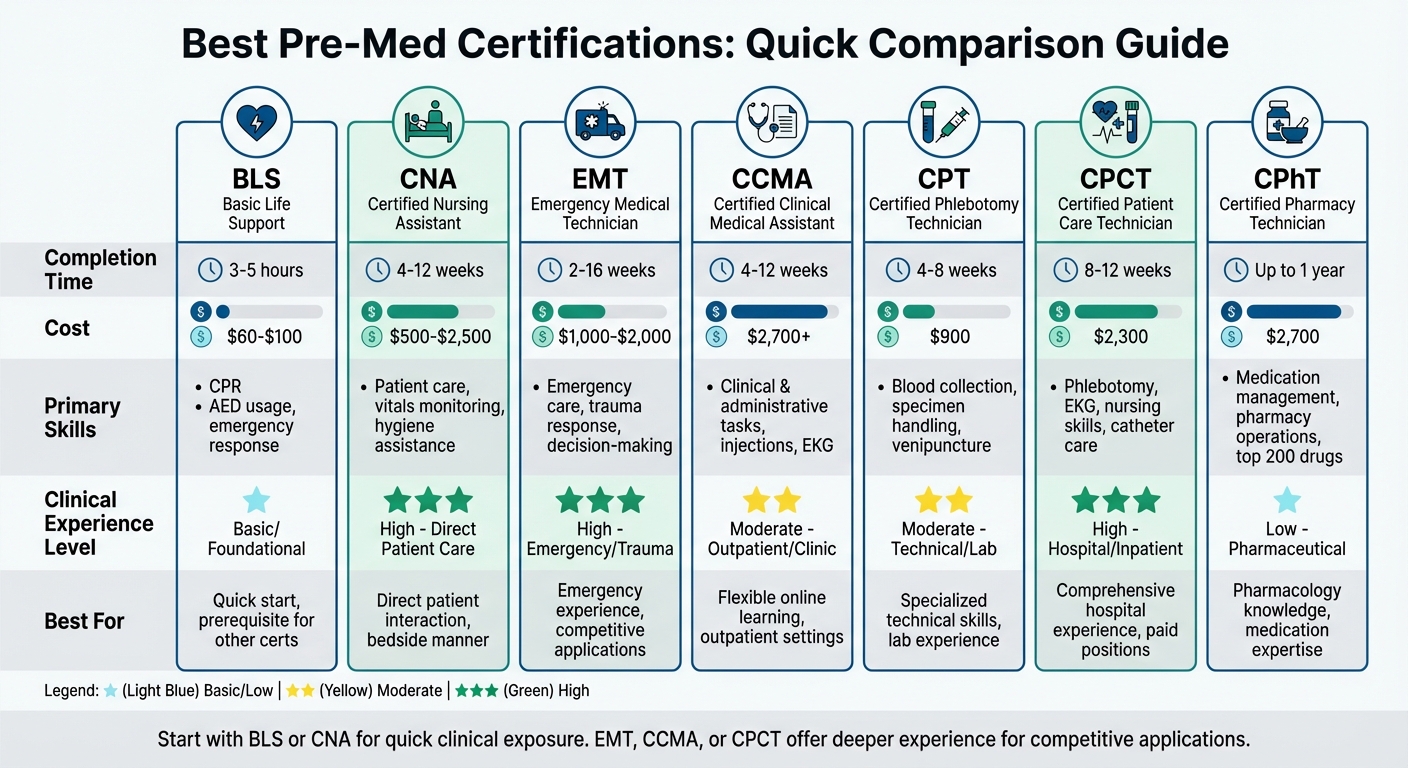
Pre-Med Certifications Comparison: Time, Cost, and Clinical Experience
🩺 Top 5 Careers for College Premeds to Get Clinical Experience for Medical School
sbb-itb-7a67ffa
1. Basic Life Support (BLS)
BLS certification trains you in performing CPR for all age groups, using an Automated External Defibrillator (AED), and managing choking emergencies. You’ll practice chest compressions at a rate of 100–120 per minute with a depth of 2 inches, learn airway management techniques, and focus on effective team coordination during resuscitations.
By mastering BLS, you’re not just preparing for emergencies – you’re demonstrating a proactive approach to clinical readiness.
Completion Time
BLS courses typically take 3–5 hours to complete. This includes 1–2 hours of online theory, followed by 1–2 hours of in-person skills training. The certification is valid for two years, and renewing it usually involves an additional 2–3 hours of training.
Skills Gained
You’ll learn to recognize critical emergencies like cardiac arrest, stroke, and respiratory distress – where every second matters. Training includes bag-valve-mask (BVM) ventilation and team-based response protocols. Studies show that formal life-support training can improve cardiac arrest survival rates from 28% to 53%.
Relevance to Pre-Med Applications
Many U.S. medical schools require students to have a valid AHA BLS for Healthcare Providers certification before starting clinical rotations, often in their second year. Having this certification strengthens your resume and makes you eligible for clinical volunteering and internships. With over 2.9 million professionals certified in the U.S., it’s a widely recognized qualification. Considering the average medical school acceptance rate is around 7%, earning this certification early shows your readiness for demanding clinical environments.
This hands-on credential positions you to take an active role in patient care from the start.
Hands-On Experience Opportunities
BLS certification is a must-have for roles involving direct patient interaction in hospitals and clinics. It allows you to move beyond observational roles, enabling active participation in outpatient procedures, health fairs, or even emergency medicine research projects that value clinical certifications. Training with manikins and receiving expert feedback ensures you’re prepared to act confidently in real-life emergencies.
2. Certified Nursing Assistant (CNA)
Earning a CNA certification places you right in the heart of patient care, offering plenty of direct interaction with patients. As a CNA, you’ll handle tasks like monitoring vital signs, assisting with personal hygiene, performing wound care, and collecting specimens. You’ll also gain experience using electronic health record (EHR) systems – a vital skill since 96% of U.S. hospitals now rely on them. This role serves as a solid starting point for advancing into more specialized clinical positions.
Completion Time
The time and cost of earning a CNA certification are key factors to consider. Most programs take between 4 to 12 weeks and must meet a federal minimum of 75 training hours. However, requirements can vary by state. For instance, Maine requires 180 hours of training, while California mandates 160 hours. Costs typically range from $500 to $2,500, with community colleges offering some of the most affordable options. Additionally, certain healthcare facilities provide tuition-free programs in exchange for a service commitment.
Skills Gained
Working as a CNA helps you build crucial skills like bedside manner and emotional resilience – qualities highly valued in medical fields. Dr. Shirag Shemmassian, Founder of Shemmassian Academic Consulting, highlights this benefit:
"If you want to improve your bedside manner, you’ll be hard-pressed to find a healthcare role that offers you better opportunities than working as a CNA does".
You’ll also develop expertise in sterile techniques, medical documentation, and teamwork. These abilities not only prepare you for medical school but also give you a head start during clinical rotations.
Relevance to Pre-Med Applications
The hands-on experience gained as a CNA can significantly boost your pre-med application. Medical schools value direct patient care hours, and CNAs can accumulate these quickly. This role showcases your dedication to the less glamorous but essential aspects of healthcare while providing practical, real-world experience. With around 211,800 CNA job openings projected annually and a median yearly salary of $38,200, this certification can also help support you financially. Beyond the skills, it highlights your commitment to patient care – a quality that stands out on any resume.
Hands-On Experience Opportunities
CNA programs include supervised clinical rotations in settings like hospitals, nursing homes, and long-term care facilities. These rotations are excellent for networking, shadowing, and securing strong letters of recommendation. Flexible scheduling options, such as evening or weekend shifts, make it easier to balance pre-med coursework while gaining valuable clinical exposure and building professional relationships to strengthen your medical school application.
3. Emergency Medical Technician (EMT)
After completing CNA training, pursuing EMT certification takes your clinical skills to the next level by placing you in fast-paced, emergency situations. Unlike shadowing, where you’re an observer, EMTs take on the role of primary caregiver, making quick decisions and managing emergencies firsthand. This hands-on responsibility is highly regarded by medical school admissions committees. In fact, 85% of 67 surveyed medical schools in the U.S. and Canada viewed EMT experience favorably in applicants.
Completion Time
EMT training typically involves 150 to 200 hours of instruction and costs between $1,000 and $2,000. Most courses are completed in about 16 weeks, but accelerated programs, such as boot camps, can finish in just 14 days. On top of this, expect to pay around $110 for the NREMT exam – broken down into $80 for the cognitive portion and $30 for the psychomotor portion – and an additional $50 to $100 for Basic Life Support (BLS) certification, which is a prerequisite. To ensure you’re eligible for national certification, choose a program accredited by the National Registry of Emergency Medical Technicians (NREMT).
Skills Gained
EMT training gives you a strong clinical foundation, which is crucial for medical school. You’ll develop practical skills like patient assessment for medical and trauma cases, measuring vital signs (blood pressure, pulse, respiratory rate), managing airways, controlling bleeding, splinting, and administering oxygen. You’ll also adopt a triage mindset, allowing you to quickly identify critically ill patients.
A 2014 study at Hofstra North Shore-LIJ School of Medicine found that 84% of students felt EMT training had a meaningful impact on their patient care skills. A medical student from the Medical College of Georgia shared:
"EMT training trained us how to do vitals very well, and that’s one aspect a lot of other students struggle with".
Relevance to Pre-Med Applications
EMT experience demonstrates your ability to handle stress and make critical decisions under pressure. According to a University of South Carolina School of Medicine Greenville study, 82% of students said EMT certification eased their transition into medical school, and 91% reported it improved their understanding of patients’ needs. This active role also highlights your determination and initiative, which stand out compared to passive experiences. Dr. Michael Minh Le, Co-Founder of Premed Catalyst, notes:
"EMTs walk into the room with stories that aren’t hypothetical. When you can say, ‘I was first on scene,’ that hits differently".
Starting early also helps you accumulate the 300 to 2,000 hours of clinical exposure that admissions committees value.
Hands-On Experience Opportunities
EMT work offers a wide range of clinical experiences. You can respond to 911 emergencies, handle inter-facility transports, or work as an Emergency Department technician in a hospital. EMTs are also needed at events like concerts, sporting events, and marathons. For the most diverse experience, prioritize 911 emergency response roles over patient transfers. As Julia Kim from Zucker School of Medicine shared:
"Being an EMT was the single best thing I did to prepare for medical school. You meet thousands of patients from every background and in every stage of health, and you learn how to connect with all kinds of people".
If you’re a full-time student, consider volunteering with local fire departments, which often offer more flexible schedules.
4. Certified Clinical Medical Assistant (CCMA) from HealthCareer Certs
The CCMA certification from HealthCareer Certs prepares you for a mix of clinical and administrative responsibilities, giving you well-rounded experience in healthcare. Unlike the fast-paced nature of EMT work, which centers on emergencies, this certification focuses on roles in outpatient facilities, physician offices, and clinics. It equips you with both clinical expertise and essential administrative skills, making it a strong foundation for advancing in patient care roles.
Completion Time
The program is self-paced and includes 18 modules, with 12 months of online access provided. You can enroll for $2,700 upfront or opt for flexible installment plans. The tuition also covers the National Healthcareer Association (NHA) certification exam and all necessary digital learning materials. While the course is designed to be flexible, most participants finish within 4–12 weeks.
Skills Gained
The CCMA curriculum spans topics like anatomy, medical terminology, and infection control. It prepares you for clinical tasks such as taking vital signs, performing injections, phlebotomy, EKG tests, and assisting with minor surgical procedures. On the administrative side, you’ll learn about electronic health record (EHR) management and patient scheduling. Tools like 3D animations, flashcards, and simulations help reinforce these skills before your externship, ensuring you’re ready for hands-on clinical duties. This practical training provides documented clinical exposure, which is a key asset for pre-med students.
Relevance to Pre-Med Applications
HealthCareer Certs guarantees a 100% externship placement for eligible students, allowing you to gain supervised, in-person clinical experience at a healthcare facility near you. This documented exposure demonstrates your dedication to healthcare, an important factor for medical school applications. The program also includes personalized career coaching and résumé assistance to help you highlight these experiences effectively.
Hands-On Experience Opportunities
Your externship bridges the gap between theory and practice, giving you real-world experience in a healthcare setting. This hands-on training builds both confidence and competence in clinical environments. With guaranteed externship placement and up to $2,000 in scholarship support, the program ensures you gain meaningful experience. Plus, with a median annual wage of $42,000 for CCMAs, this certification can serve as a valuable way to earn income while working toward your medical school goals.
5. Certified Phlebotomy Technician (CPT) from HealthCareer Certs
Adding to the broader clinical skills gained from earlier certifications, the Phlebotomy Technician certification zeroes in on a specialized area that can make your pre-med resume stand out.
The CPT certification through HealthCareer Certs focuses on blood collection techniques like venipuncture, specimen handling, and point-of-care testing. These skills not only enhance clinical expertise but also provide an opportunity to earn income while pursuing pre-med studies.
Completion Time
This fully online, self-paced program typically takes between 4 and 8 weeks to complete. You can choose to pay $900 upfront or opt for a split payment plan of two installments at $475 each. The tuition fee includes several key resources: the National Healthcareer Association (NHA) certification exam fee, digital learning materials, and a practice phlebotomy arm equipped with anatomically correct veins that reseal after use. Finishing the course quickly allows you to start accumulating clinical hours sooner.
Skills Gained
The course covers a range of topics essential for phlebotomy, including anatomy, medical terminology, infection control (OSHA), medical law, HIPAA compliance, and the "order of draw" for blood collection. Practical skills like venipuncture, capillary sticks, and specimen processing are taught through 3D animations and virtual lab simulations, helping you build confidence and muscle memory before working with live patients. With a 97% national certification pass rate and 96% of employers requiring or recommending certification, this program highlights your technical expertise.
Relevance to Pre-Med Applications
"The Phlebotomy Technician training is also a great learning opportunity for those who are looking to apply to medical school, PA school, and nursing programs." – HealthCareer Certs
This program not only provides the clinical experience that medical schools prioritize but also strengthens your understanding of anatomy, physiology, and therapeutic communication. Additional perks include graduate application assistance, mentorship opportunities with current medical students, and the chance to receive a Letter of Evaluation from healthcare professionals. With phlebotomist jobs expected to grow by 8% between 2023 and 2033 and an average annual salary of $38,259, this certification can enhance your resume while supporting your healthcare career aspirations.
Hands-On Experience Opportunities
To qualify for the NHA exam, you’ll need to complete 30 supervised venipunctures and 10 capillary sticks on live patients. HealthCareer Certs guarantees externship placement in settings like urgent care centers, hospitals, or doctors’ offices, ensuring you gain real-world patient experience. The program also offers up to $2,000 in scholarship support. Starting your externship search by module eight is recommended to maximize your clinical experience before applying to medical school. These hands-on opportunities not only build confidence but also provide the technical skills that medical schools value.
6. Certified Patient Care Technician (CPCT) from HealthCareer Certs
The Certified Patient Care Technician (CPCT) program offers a well-rounded clinical foundation by combining essential hands-on and administrative skills into one credential. For pre-med students looking to gain extensive clinical experience while earning an income, this certification is a solid choice.
Completion Time
The CPCT program from HealthCareer Certs is designed to fit busy schedules. You can complete it in just eight weeks thanks to its fully online, self-paced format. This flexibility makes it easier to juggle pre-med studies and clinical training. The tuition is $2,300 if paid upfront, but there are installment options: two payments of $1,200 or four payments of $625. The cost includes the National Healthcareer Association (NHA) exam fee and access to digital learning materials.
Skills Gained
This program equips you with a range of clinical skills, including:
- Phlebotomy procedures
- EKG interpretation
- Monitoring vital signs
- Catheter care
- CPR/Basic Life Support
It also covers foundational knowledge such as medical terminology, anatomy and physiology, infection control (OSHA), and medical law and ethics. To enhance your learning, the program includes interactive 3D demonstrations, Electronic Health Record (EHR) simulations, and laboratory exercises. The NHA CPCT exam, with an average pass rate of 71.2%, serves as a benchmark for your proficiency. These skills not only improve your clinical capabilities but also strengthen your pre-med application.
Relevance to Pre-Med Applications
"Doctors, nurses, and other healthcare professionals rely on patient care technicians to assist with the critical day-to-day care some patients require." – HealthCareer Certs
The CPCT certification highlights both your clinical exposure and administrative expertise, making your pre-med portfolio stand out. It reflects your ability to work closely with healthcare teams in hospitals and long-term care settings. The program’s focus on medical terminology and anatomy aligns with pre-med requirements, and the role offers a median annual salary of $39,430.
Hands-On Experience Opportunities
HealthCareer Certs ensures you gain practical experience through guaranteed externship placement. These externships provide real-world clinical exposure, such as assisting with daily living activities, offering emotional support, and performing safety checks. To help offset costs, the program offers an externship scholarship of up to $2,000. Before stepping into the externship, you can refine your skills with immersive virtual simulations. This paid role allows you to accumulate clinical hours while earning an income, offering a practical alternative to unpaid volunteer positions.
7. Certified Pharmacy Technician (CPhT) from HealthCareer Certs
The Certified Pharmacy Technician (CPhT) program offers pre-med students a detailed understanding of pharmacology and medication management. It’s designed to prepare you for advanced coursework in medication management while emphasizing key areas like the top 200 drugs, dosage calculations, and patient safety protocols. This program lays a strong groundwork in pharmacy-related concepts that are directly relevant to clinical environments.
Completion Time
The program is delivered through flexible, self-paced online learning, giving you 12 months of access to complete the curriculum. It includes 20 core modules, 8 study guide modules, and six practice exams to prepare for the national certification exam. Tuition costs $2,700 if paid upfront, but installment plans are available: two payments of $1,350, four payments of $695, or six payments of $495. The tuition also covers the cost of your nationally accredited certification exam (PTCB or NHA).
Skills Gained
Through this program, you’ll develop expertise in practical pharmacy operations, such as inventory management, prescription processing, and precise medication measurement. You’ll also learn to maintain patient records and handle insurance claims. Key areas of focus include:
- Pharmacology (emphasizing the top 200 drugs)
- Pharmacy law and ethics
- Pharmacy math (dosage calculations and concentrations)
- Sterile compounding for IV medications
- Patient safety protocols
Additionally, the program incorporates interactive lessons, labs, and simulations to help you master tasks like medication reconciliation through patient interviews. This hands-on approach ensures you’re well-prepared for externships and clinical settings.
Relevance to Pre-Med Applications
This certification not only demonstrates technical proficiency but also highlights your dedication to patient care and safety.
"Certification isn’t about passing a test. It’s about proving to employers, pharmacists, and patients that you are a dedicated professional committed to the highest standards of patient safety and care." – Rajat Sachdeva
The certification provides a solid foundation in medication management, a skill set that aligns closely with medical school curricula. It also underscores your attention to detail and professional accountability, as pharmacy technicians are often the last checkpoint before medication reaches a patient. The role offers an average salary of $43,460 as of 2024, with job growth projected at 6% from 2024 to 2034 – outpacing the average for most occupations.
Hands-On Experience Opportunities
HealthCareer Certs ensures externship placements with partner organizations like CVS and Walgreens. These placements offer invaluable patient-facing experience, particularly through medication reconciliation, which is a significant asset for a pre-med application. To help offset clinical training costs, an externship scholarship of up to $2,000 is available.
This hands-on training not only strengthens your skills but also enhances your medical school application. The PTCE exam, which has a 70% pass rate as of 2024, places heavy emphasis on medications (40% of the exam) and patient safety (26.25%) – further solidifying your readiness for clinical roles.
Certification Comparison
When deciding on a certification, consider your available time, the clinical skills you want to develop, and how quickly you need to enhance your resume. Below is a comparison table highlighting the time commitment, cost, skills gained, and clinical experience level for each certification. Use this side-by-side breakdown to guide your decision-making process.
| Certification | Completion Time | Cost | Primary Skills Learned | Clinical Experience Level |
|---|---|---|---|---|
| BLS | 4–5 Hours | $60–$100 | CPR, AED, choking relief | Foundational/Required |
| CNA | 3–6 Weeks | Free–$900 | Basic nursing, vitals, patient hygiene | High (Direct Patient Care) |
| EMT | 2–16 Weeks | $1,200–$1,400 | Emergency care, stabilization, transport | High (Emergency/Trauma) |
| CCMA | 8–12 Weeks | $2,200–$4,000 | Clinical & admin tasks, injections, EKG | Moderate (Outpatient/Clinic) |
| CPT | 4–6 Weeks | $750–$1,400 | Venipuncture, specimen handling | Moderate (Technical/Lab) |
| CPCT | 8–12 Weeks | $2,000–$2,500 | Phlebotomy, EKG, basic nursing | High (Hospital/Inpatient) |
| CPhT | Up to 1 Year | $2,700 | Medication management, pharmacy operations | Low (Pharmaceutical) |
If you’re looking for the quickest option, BLS certification can be completed in just 4–5 hours and is often a prerequisite for other clinical certifications. For those with a few weeks to spare, CNA (3–6 weeks) or CPT (4–6 weeks) programs are efficient ways to add credentials during breaks. If you’re up for an intensive experience, EMT boot camps can be completed in as little as 14 days, giving you hands-on exposure to emergency care.
For more flexibility, consider CCMA or CPCT programs. These are self-paced and available online, allowing you to fit training into your pre-med schedule. Both take 8–12 weeks and include guaranteed externships for clinical hours.
Certifications like CNA and CPCT focus on direct patient care, while EMT training immerses you in emergency and trauma environments. On the other hand, CCMA and CPT offer moderate clinical exposure in outpatient settings and labs, while CPhT emphasizes pharmaceutical knowledge with minimal patient interaction.
Conclusion
Certifications offer more than just a boost to your resume – they showcase your dedication to healthcare and provide the hands-on clinical experience that admissions committees value. These credentials not only fulfill the clinical hours most schools expect but also help you determine if medicine is genuinely the right path for you. Interestingly, nearly half of all medical school matriculants took a gap year after finishing their undergraduate studies.
"Clinical experience is such a solid indicator to admission committees of your commitment to the medical field." – Maggie, Medical Student and Blogger, itslifebymaggie.com
This type of experience not only enhances your application but also helps you make informed decisions about which certification aligns with your goals. If you’re short on time, starting with Basic Life Support (BLS) certification is a great option. For those with a few weeks to spare, programs like Certified Nursing Assistant (CNA) or Certified Phlebotomy Technician (CPT) offer meaningful patient interaction. And for a more flexible option that fits alongside coursework, certifications like Certified Clinical Medical Assistant (CCMA) or Certified Patient Care Technician (CPCT) from HealthCareer Certs provide self-paced online learning and guaranteed externship placements in just 8–12 weeks.
Another advantage of certified roles? They can be financially rewarding. Unlike unpaid volunteer work, these positions allow you to earn income while logging clinical hours. As Ally White, a CCMA graduate, shared:
"While the upfront cost is a lot, I was able to make it back in just one month of being an MA"
Start building your pre-med credentials today. The clinical skills you gain and the patient interactions you experience will not only enhance your application but also strengthen your personal statement, interview responses, and recommendation letters.
FAQs
Which certification should I get first as a pre-med?
Becoming EMT-certified is an excellent starting point for pre-med students. It offers practical clinical experience, helps build leadership abilities, and is well-respected by medical school admissions committees. This certification showcases your dedication to the healthcare field and equips you with essential skills for handling patient care.
How many clinical hours do med schools expect?
Medical schools typically look for applicants with 100 to 500 hours of clinical experience, though competitive candidates often fall within the 100 to 150-hour range. The key is to prioritize hands-on, meaningful interactions with patients. Admissions committees value the quality and relevance of your experience far more than the sheer number of hours you’ve logged.
Do online certifications include real patient experience?
Online certifications are designed to provide training and education that boost knowledge in patient care and clinical skills. However, most of these programs don’t offer direct, hands-on patient experience unless they include specific practical components or externships. It’s important to review the program details carefully to see if such opportunities are part of the curriculum.