How to Become a Patient Care Technician (PCT) in 2026: 4-Step Path
A 4-step path to becoming a patient care technician in 8 weeks: training program, clinical externship, NHA CPCT/A exam, and your first PCT job.


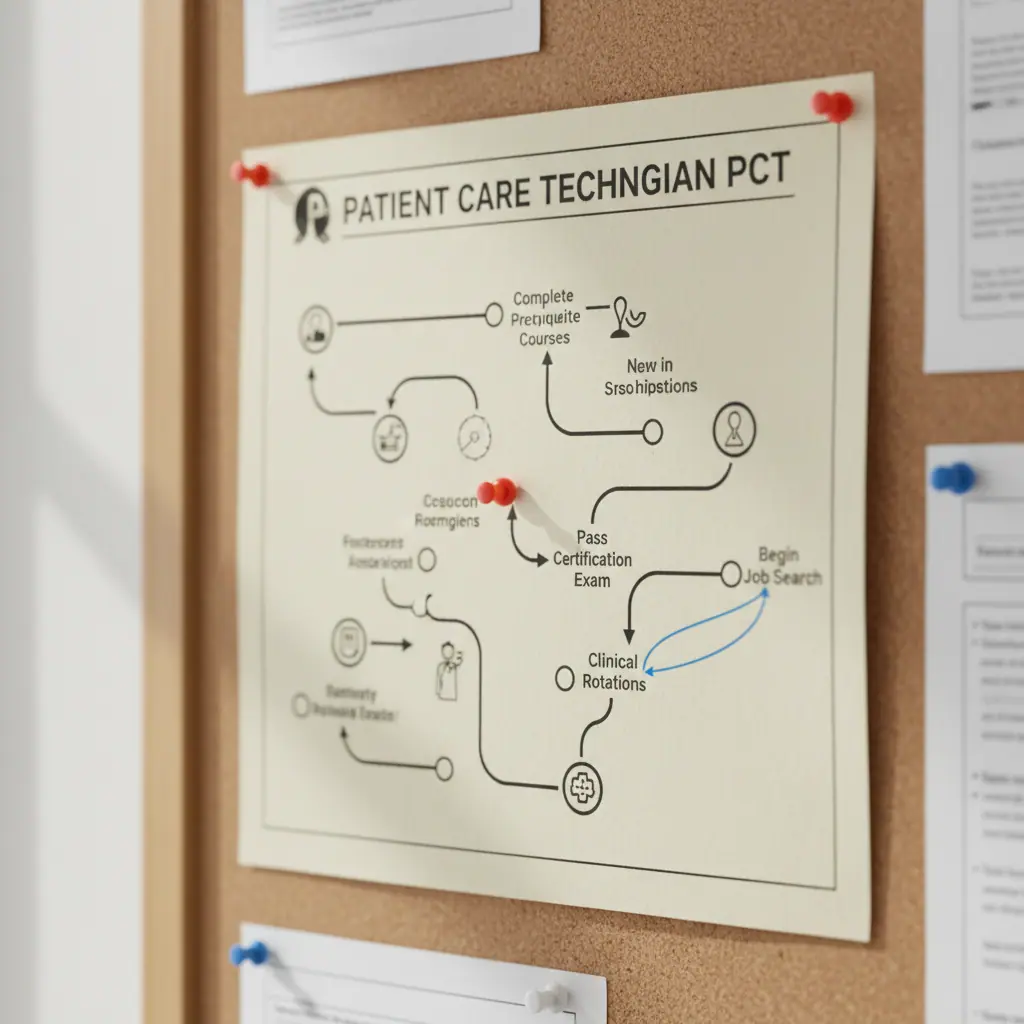
Becoming a Patient Care Technician (PCT) takes about 8-12 weeks from the moment you enroll in a training program to your first day on a hospital floor. The fastest path is online coursework + clinical externship + the NHA CPCT/A exam — a clear 4-step process that gets new healthcare workers from zero experience to a credentialed, employable PCT in under a quarter.
Here’s exactly how to become a patient care technician in 2026.
Want a faster path to your CPCT?
Earn your NHA CPCT in 8 weeks online — patient care, EKG, phlebotomy, and EHR. NHA exam fee, externship, and 6 practice tests included. Military spouses: SpouseWorks Scholarship (formerly MyCAA) funding may apply; confirm eligibility first.
Step 1 — Meet Basic Eligibility (Week 0) — How To Become A Patient Care Technician
Most accredited PCT programs require:
- High school diploma or GED
- 18+ years old
- Pass a background check (many externship sites require one)
- Up-to-date immunizations — Hepatitis B series, MMR, Tdap, varicella, recent TB test
- BLS/CPR certification — sometimes at enrollment, often required before externship
Get the immunizations and background check in motion before week 1 — they often delay candidates more than coursework does.
Step 2 — Complete an Accredited PCT Training Program (Weeks 1-8)
Choose a program that prepares you for a recognized certification and holds the licensing or accreditation your state expects. Common options:
- NHA (National Healthcareer Association) — the most common certification pathway
- Regional accrediting bodies (DEAC, ACCSC) for online programs
- State workforce boards for funded programs
Coursework typically covers:
- Anatomy and physiology basics (cardiovascular, respiratory, renal focus)
- Vital signs measurement and documentation
- Phlebotomy: order of draw, technique, common complications
- 12-lead EKG: electrode placement, normal rhythm recognition
- Bedside glucose monitoring
- Specimen collection (urine, stool, sputum)
- Infection control and OSHA bloodborne pathogen standards
- HIPAA, patient communication, scope of practice
- ADL support and patient transfers
Most online + externship programs run 8 weeks of coursework. Community college programs run 1 semester (15-16 weeks). Hospital-based programs (limited) run 4-8 weeks.
For our CPCT program, 8 weeks of online coursework is followed by externship placement with placement coordinator support.
Step 3 — Complete Clinical Externship (Weeks 9-12)
Most accredited PCT programs require 80-160 hours of clinical externship at a partner hospital, dialysis clinic, or outpatient setting. During the externship:
- You’ll log 40+ supervised venipunctures
- 15-25 12-lead EKGs
- Vital signs on 100-200 patients
- Glucose checks, specimen collection, ADL support
- Documentation in the actual EHR system the clinic uses
The externship isn’t optional theater — it’s where you log the supervised hours required for certification eligibility, and where about 30-50% of students get a job offer at the same site.
Step 4 — Pass the NHA CPCT/A Exam (Week 12-13)
The Certified Patient Care Technician/Assistant (CPCT/A) exam:
- 100 questions (sometimes 110 with pretest items)
- 2 hours
- Computer-based at PSI test centers or online proctored
- Cost: NHA lists the application at $169 in its public store
- Passing scaled score: 390 (range 200-500)
- Pass/fail result immediate; scaled scores within 2 business days
Pass rate: about 75% nationally, with 85%+ for graduates of accredited training programs that include externship hours.
Step 5 — Apply for Jobs (Weeks 13-20)
Once certified, apply to:
- Hospital systems — HCA, Tenet, Ascension, AdventHealth, regional health systems. Search “PCT,” “Patient Care Technician,” “Clinical Care Partner.”
- Dialysis chains — DaVita, Fresenius, U.S. Renal Care. Many run paid training programs for PCTs new to dialysis.
- Outpatient clinics and urgent care — generalist primary care, specialty practices.
- Long-term care + skilled nursing — easier entry barrier, lower pay.
- ER tech trainee programs — if you’re targeting eventual paramedic, RN, or PA paths.
Most newly-certified PCTs have a job offer within 4-8 weeks of certifying. About 30-50% of externships convert directly to job offers at the same site.
For more on entry-level options, see our PCT jobs no experience guide.
Step 6 — Maintain Certification (Ongoing)
NHA CPCT/A recertification:
- Every 2 years
- 10 CE credits required
- Renewal fee $195 (NHA)
- Most working PCTs accumulate CE credits through hospital in-service training without dedicated effort
Optional Enhancements
After your first PCT job, the credentials that boost pay fastest:
- CCMA (medical assistant) — adds outpatient + admin scope. ~$1-$3/hour bump.
- CHT or CCHT (dialysis) — opens dialysis specialty pay band. ~$2-$5/hour bump.
- EKG specialty (CET) — often a $1-$2/hour bump in cardiology and primary care.
- EMT-B — required for some ER tech programs.
See our PCT salary guide for a deeper look at how each affects pay.
Cost to Become a PCT
Total cost typically $1,500-$3,500:
| Item | Cost |
|---|---|
| Tuition | $1,200-$2,500 |
| NHA CPCT/A exam | $169 in NHA's public store (sometimes included in tuition) |
| BLS/CPR certification | $50-$120 |
| Immunizations | $0-$300 |
| Background check | $30-$80 |
| Total | $1,500-$3,500 |
Funding options: FAFSA + Pell Grant for community college, employer tuition reimbursement, MyCAA for military spouses, WIOA state workforce development funds.
Ready to stop studying alone? HealthCerts’ Certified Patient Care Technician (CPCT) program is built around an 8-week online course with externship placement — so you walk out with both the credential and the clinical hours employers want.
The bottom line on how to become a patient care technician: choose the path that matches your real-world constraints — schedule, financial aid eligibility, and target employer — rather than the cheapest or fastest option in isolation. how to become a patient care technician outcomes vary meaningfully by program quality, so verify accreditation and externship support before enrolling.
Frequently Asked Questions
How long does it take to become a Patient Care Technician?
8-12 weeks total: 8 weeks coursework + 2-4 weeks clinical externship + 1-2 weeks exam prep. Plus 4-8 weeks job search after certification.
What do I need to become a PCT?
High school diploma/GED, completion of an accredited PCT training program (8 weeks online or 15-16 week community college), passing the NHA CPCT/A exam, BLS/CPR certification, and up-to-date immunizations.
Do I need experience to become a PCT?
No. Most newly-certified PCTs have no prior healthcare experience. The certification + externship is what employers want to see.
How much does it cost to become a PCT?
Typically $1,500-$3,500 total — tuition, exam fee, BLS/CPR, immunizations, background check. FAFSA/Pell, MyCAA, and WIOA can fund eligible candidates.
Can I become a PCT online?
The didactic coursework can be completed online, but all accredited PCT programs require in-person clinical externship hours. There is no fully-online PCT certification.
What’s the fastest way to become a PCT?
Online coursework + clinical externship + NHA CPCT/A exam — typically 8-12 weeks. Faster than community college (15-16 weeks) and most vocational programs.
Is being a PCT a good job?
Yes — solid pay (nursing assistants, the nearest BLS occupation, had a $42,260 median in May 2025), nationwide demand, clear progression to nursing or specialty roles, and entry-level barrier is low for healthcare careers.
Do I need to be a CNA before becoming a PCT?
No. PCT and CNA are separate credentials. PCTs go through PCT-specific training; you don’t need to be a CNA first. Some PCTs do start as CNAs and add PCT certification later, but it’s not required.
Start Your CPCT Journey with HealthCerts
Reading about it is one thing — actually getting credentialed and into a clinical role is another. HealthCerts’ Certified Patient Care Technician (CPCT) program is the fastest, most-supported path: Earn your NHA CPCT in 8 weeks online — patient care, EKG, phlebotomy, and EHR. NHA exam fee, externship, and 6 practice tests included. Military spouses: SpouseWorks Scholarship (formerly MyCAA) funding may apply; confirm eligibility first.
Shahnaz Ghassemi Ph.D., is a co-founder of HealthCareerCerts and a dedicated educator, scientist, and workforce development leader. She holds a Ph.D. in Chemistry and brings extensive experience as both an educator and a research scientist in industry. As a co-leader of HealthCareerCerts, Shahnaz is deeply committed to making healthcare education accessible through affordable, flexible, and high-quality learning pathways. She works closely with academic institutions, healthcare partners, and workforce organizations to deliver certification programs that are practical, inclusive, and directly aligned with real-world healthcare needs. Since co-founding the organization, she has played a key role in building strategic partnerships that expand impact and opportunity, helping learners across the country gain essential skills, confidence, and meaningful careers in healthcare. Seeing hundreds of students thrive within the supportive learning community she helps lead continues to inspire and drive her mission forward.