Medical assistant certification in California is not legally required, but most employers prefer or require it. Certification helps demonstrate your skills, increases job opportunities, and often leads to better pay. Here’s what you need to know:
- Certification Benefits: Higher salaries (e.g., median $42,000 in 2023), more autonomy, and eligibility for leadership roles.
- Steps to Certification: Complete an accredited program (9 months to 2 years), gain clinical experience, and pass a certification exam.
- Eligibility Requirements: Must be 18+, hold a high school diploma or GED, have CPR certification, and complete required training.
- Certifying Organizations: Options include CCBMA, AAMA, and AMT.
- Exam Details: Covers medical knowledge, administrative tasks, and clinical skills. Costs $160 on average.
- Renewal: Certifications typically need renewal every 2–5 years, with continuing education credits required.
Certification boosts your career prospects and positions you for long-term growth in California’s growing healthcare sector.
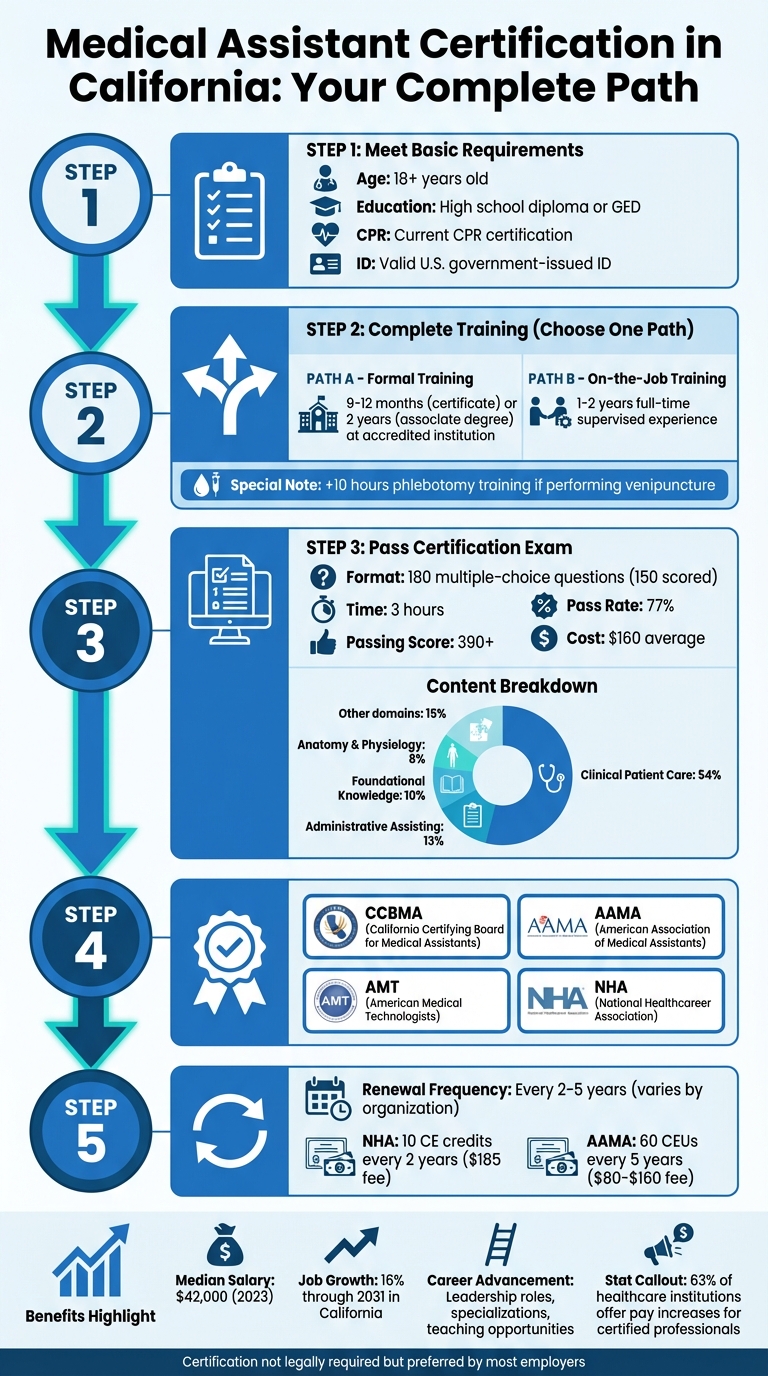
Medical Assistant Certification Process in California: Steps and Requirements
CCBMA Practice Test 2026 California Certifying Board Medical Assistants Preparation Exam
sbb-itb-7a67ffa
Who Can Apply for Certification
In California, medical assistants aren’t legally required to have certification, but most employers and insurance providers look for it. If you’re planning to get certified, you’ll need to meet the criteria set by certifying organizations recognized by the Medical Board of California.
Education and Training Requirements
There are two main ways to qualify:
- Formal Training Programs: You can complete a program at an accredited institution, such as a community college or a postsecondary school approved by recognized agencies or the Bureau for Private Postsecondary Education. These programs typically take 9–12 months for a certificate or around two years for an associate degree.
- On-the-Job Training: Another option is to gain supervised training while working under a licensed healthcare professional, like a physician, podiatrist, registered nurse, licensed vocational nurse, or physician assistant. For national certification, this pathway usually requires 1–2 years of full-time experience. The exact experience needed depends on the certification body, with most requiring verifiable work experience within the last 10 years.
If you plan to perform phlebotomy, you’ll also need to complete at least 10 hours of training in venipuncture and skin puncture. A supervising physician must confirm your proficiency in these procedures.
Once you’ve met the educational or training requirements, make sure you also fulfill the age, residency, and other conditions.
Age, Residency, and Other Requirements
In addition to training, there are a few other qualifications to meet. To apply for certification through organizations like the California Certifying Board for Medical Assistants (CCBMA), you must:
- Be at least 18 years old
- Hold a high school diploma or GED (required for most national certifications)
- Provide a valid U.S. government–issued ID (driver’s license, state ID, or passport) that matches the name on your application
- Have current CPR certification, which is a standard requirement for most certifying boards
If you’re a foreign physician or registered nurse, you can apply for the National Certified Medical Assistant (NCMA) credential, provided you supply proof of U.S. equivalency within the past 10 years.
"Medical assistants are unlicensed individuals who perform non-invasive routine technical support services under the supervision of a licensed physician and surgeon, podiatrist, physician assistant, nurse practitioner, or nurse midwife in a medical office or clinic setting without the need of receiving a certification."
- Medical Board of California
It’s important to note that certification doesn’t exempt you from the legal obligation to work under a licensed supervisor. Completing these steps will ensure you’re ready to take on the certification exam and advance in your career.
Certification Exam Information
Once you meet the eligibility requirements, the next step is passing a certification exam. Understanding the exam’s format and the role of certifying organizations can help you prepare effectively for this career-boosting credential.
Exam Format and Content
The certification exam evaluates your skills in three main areas: basic medical knowledge, administrative procedures, and clinical skills. Most of these exams are computer-based and follow a multiple-choice format. For example, the California Certifying Board for Medical Assistants (CCBMA) oversees the California Certified Medical Assistant (CACMA) exam, which focuses on essential patient care skills. The CCBMA also monitors exam performance data, including pass rates (updated as of January 2024). Familiarizing yourself with these exam topics and the purpose of certifying bodies can make a big difference in your preparation.
Certifying Organizations in California
In California, the primary certifying body is the California Certifying Board for Medical Assistants (CCBMA). They offer the CACMA credential, specifically designed to align with the state’s healthcare standards. As of December 2024, the CCBMA maintains records of all active certificants and tracks annual application data to ensure high-quality standards. Gaining a clear understanding of these exam components and the certifying organization’s role is essential for advancing your healthcare career in California.
How to Prepare for the Exam
Study Materials and Practice Resources
Getting ready for the NHA CCMA exam starts with using the right study materials and understanding the test structure. The exam includes 180 multiple-choice questions (150 scored and 30 unscored pre-test items) and must be completed in three hours. To pass, you’ll need a score of at least 390, with about 77% of test-takers meeting this benchmark.
The exam is heavily weighted toward the Clinical Patient Care domain, which accounts for 54% of the questions. This section covers key topics like general patient care, infection control, lab procedures, phlebotomy, and EKG. The rest of the exam breaks down as follows:
- Administrative Assisting: 13%
- Foundational Knowledge: 10%
- Anatomy & Physiology: 8%
- Patient Care Coordination, Communication & Customer Service, and Medical Law & Ethics: 5% each
A solid study plan should focus on Clinical Patient Care while also allocating extra time to Anatomy & Physiology, as many students find this section particularly challenging despite its lower weight. Use a mix of resources like expert video lessons, ebooks, competency assessments, and practice exams that mirror the computer-based format.
For budgeting, keep in mind the exam fee is $160, though some training programs may bundle this cost into their tuition.
HealthCareer Certs CCMA Program
HealthCareer Certs provides a well-structured program designed to help you succeed on the CCMA exam. The 28-week curriculum is divided into four core courses:
- Professionalism in Allied Health
- Human Anatomy and Medical Terminology
- Medical Office Procedures and Administration
- Clinical Medical Assisting
The program offers flexibility with self-paced learning and one-on-one Zoom sessions with instructors. It also includes interactive tools like 3D demonstrations and access to over 1,400 practice questions that closely resemble the exam format. To ensure you stay on track, the program provides student success advisors and regular competency assessments.
Payment plans start at $239 per month, making it easier to manage costs while preparing for the exam.
Keeping Your Certification Active and Growing Your Career
How to Renew Your Certification
Renewing your certification depends on the specific requirements set by your certifying organization. For instance, the National Healthcareer Association (NHA) mandates renewal every two years. This involves earning 10 continuing education credits and paying a $185 renewal fee. If your certification lapses, you’ll face a reinstatement fee of $376.50 if you renew within a year – beyond that, you’ll need to retake the exam.
The American Association of Medical Assistants (AAMA), on the other hand, operates on a five-year recertification cycle. To renew, you’ll need 60 continuing education units (CEUs). Members pay $80, while non-members pay $160. However, if your credential has expired for more than three months, you’re no longer eligible to renew with CEUs and must retake the exam instead. This costs $125 for members and $250 for non-members.
"Recertification demonstrates your commitment to ongoing learning and effective patient care."
- American Association of Medical Assistants
Staying on top of your continuing education credits is easier when you use your certifying organization’s online tools. For example, the NHA provides a free online CE library to help you meet requirements. Plus, maintaining your certification can have financial perks – 63% of healthcare institutions offer pay increases to employees who keep their certifications current.
Renewing your certification is more than just a requirement; it keeps your credentials valid and opens doors to advanced career opportunities.
Career Growth Options
Keeping your certification active is a stepping stone to exploring a variety of career paths. Many certified medical assistants move up to leadership roles like Lead Medical Assistant or Clinic Manager, where they oversee staff and manage daily operations. This is especially important in states like California, where medical assistant employment is expected to grow by 16% through 2031, increasing the demand for skilled professionals.
Specializing in a specific area is another way to advance. For example, you could become a Podiatric Medical Assistant, Certified (PMAC), if you work in a podiatry office, or pursue a Certified Ophthalmic Assistant (COA) credential through the Joint Commission on Allied Health Personnel in Ophthalmology. These specialized certifications can lead to higher-paying positions in niche fields.
Adding skills like Phlebotomy and EKG certifications can also boost your adaptability and appeal in the job market. Some certified medical assistants even transition into teaching, sharing their expertise at community colleges or private training institutions. In California, "Qualified Medical Assistants" with Board-approved certifications are eligible to train others. Others use their experience as a stepping stone into nursing or physician assistant programs.
Conclusion
Earning your medical assistant certification is a crucial step toward starting a successful healthcare career in California. By completing the necessary education, obtaining CPR certification, and passing a board-approved exam through organizations like the NHA, AAMA, or CCBMA, you set yourself up for professional growth and opportunities.
California’s thriving healthcare job market makes certification even more rewarding. With medical assistant employment expected to grow by 16%, certified professionals are in high demand. While certification isn’t legally required for every role, many employers and malpractice insurance providers see it as essential. Certification not only demonstrates your skills and expertise but can also increase your earning potential and qualify you to train other medical assistants – a role reserved for certified individuals in California.
Certification opens doors to long-term career growth. Certified medical assistants often enjoy more independence, greater trust from employers, and better compensation. It also allows you to specialize in fields like podiatry or ophthalmology, pursue teaching opportunities, or use it as a foundation for advancing into nursing or physician assistant programs. From rigorous training to career flexibility and ongoing development, certification plays a key role in supporting California’s healthcare system.
For those ready to take the next step, HealthCareer Certs offers a 100% online CCMA program tailored to California’s requirements. The program includes a self-paced format, personalized support, guaranteed externship placements, and access to over 1,400 practice questions. With a completion timeline of just 4–12 weeks, it’s designed to help you quickly transition into the workforce.
FAQs
Which certification should I choose in California?
In California, the Certified Medical Assistant (CMA) credential stands out as the most recognized and is frequently preferred by employers. To achieve this certification, you usually need to complete an accredited medical assisting program and pass an exam administered by a reputable organization such as the AAMA.
Selecting a certification that is accredited, aligns with your career aspirations, and meets employer requirements can significantly improve your job opportunities and potential earnings.
Can I get certified without a formal program?
Yes, you can work as a medical assistant in California without completing a formal certification program. The state does not require certification for medical assistants, as they are considered unlicensed professionals. However, earning a certification can help improve your job prospects and open up more career opportunities, making it easier to stand out in the competitive healthcare field.
How do I keep my certification from expiring?
To keep your medical assistant certification active, you need to recertify every five years. This can be done by earning 60 continuing education units (CEUs) or by passing the certification exam. However, if your certification has been expired for more than three months, the option to recertify with CEUs is no longer available – you’ll have to retake the exam. Be sure to stay updated on the exact requirements to maintain compliance.