Becoming a certified medical assistant in Minnesota is essential for anyone looking to break into the state’s growing healthcare industry. Here’s a quick summary:
- Certification Requirement: Minnesota mandates certification, registration, or licensure for medical assistants to meet state regulations.
- Salary Advantage: Certified medical assistants in Minnesota earn about $44,720 annually – 10% more than non-certified professionals.
- Job Growth: Medical assistant roles are projected to grow by 15% nationally over the next decade.
- Certification Path: Complete an accredited training program and pass a national exam like CCMA, CMA, or RMA.
- Training Costs: Programs range from $1,400 to $2,700, with exam fees between $119 and $250.
- Online Options: Flexible, self-paced courses are available, some offering externship placements and scholarships.
Certification not only boosts your earning potential but also ensures compliance with state standards, making you a preferred candidate for healthcare employers. Start by enrolling in an accredited program and preparing for the certification exam to secure a stable career in Minnesota’s healthcare sector.
Minnesota Medical Assistant Certification Requirements
Education Requirements
To begin your journey as a medical assistant in Minnesota, the first step is earning a high school diploma or GED. From there, you’ll need to complete an accredited training program that teaches both clinical and administrative skills. These programs cover essential topics like medical terminology, phlebotomy, EKG, and HIPAA regulations. They also prepare you for national certification exams, such as the Certified Clinical Medical Assistant (CCMA), by focusing on key areas like HIPAA Privacy and Security Rules, medical asepsis, venipuncture, patient scheduling, assisting with lab procedures, and managing Electronic Health Records (EHR). Meeting these educational benchmarks ensures you’re ready to move on to the next steps required by Minnesota’s regulatory framework.
Minnesota State Requirements
In Minnesota, practicing as a medical assistant involves meeting specific state criteria beyond your foundational training. The Minnesota Department of Health (MDH) requires practitioners to hold valid certification, registration, or licensure, which employers must verify to comply with state regulations. To satisfy these requirements, you’ll need to complete an accredited program and pass a recognized competency exam. Minnesota acknowledges certifications such as the Certified Medical Assistant (CMA) from the American Association of Medical Assistants and the Registered Medical Assistant (RMA) from American Medical Technologists as professional benchmarks. Additionally, certifications like the CCMA from the National Healthcareer Association are accepted for clinical practice, provided your program is accredited by CAAHEP or ABHES.
It’s also important to check with the MDH for any additional requirements, which may include background checks or proof of immunizations for working in healthcare settings. Since many employers now use real-time tracking systems to monitor certification status, staying up-to-date with your credentials is crucial for maintaining compliance and employability.
sbb-itb-7a67ffa
How To Become a Certified Medical Assistant
How to Get Medical Assistant Certification in Minnesota
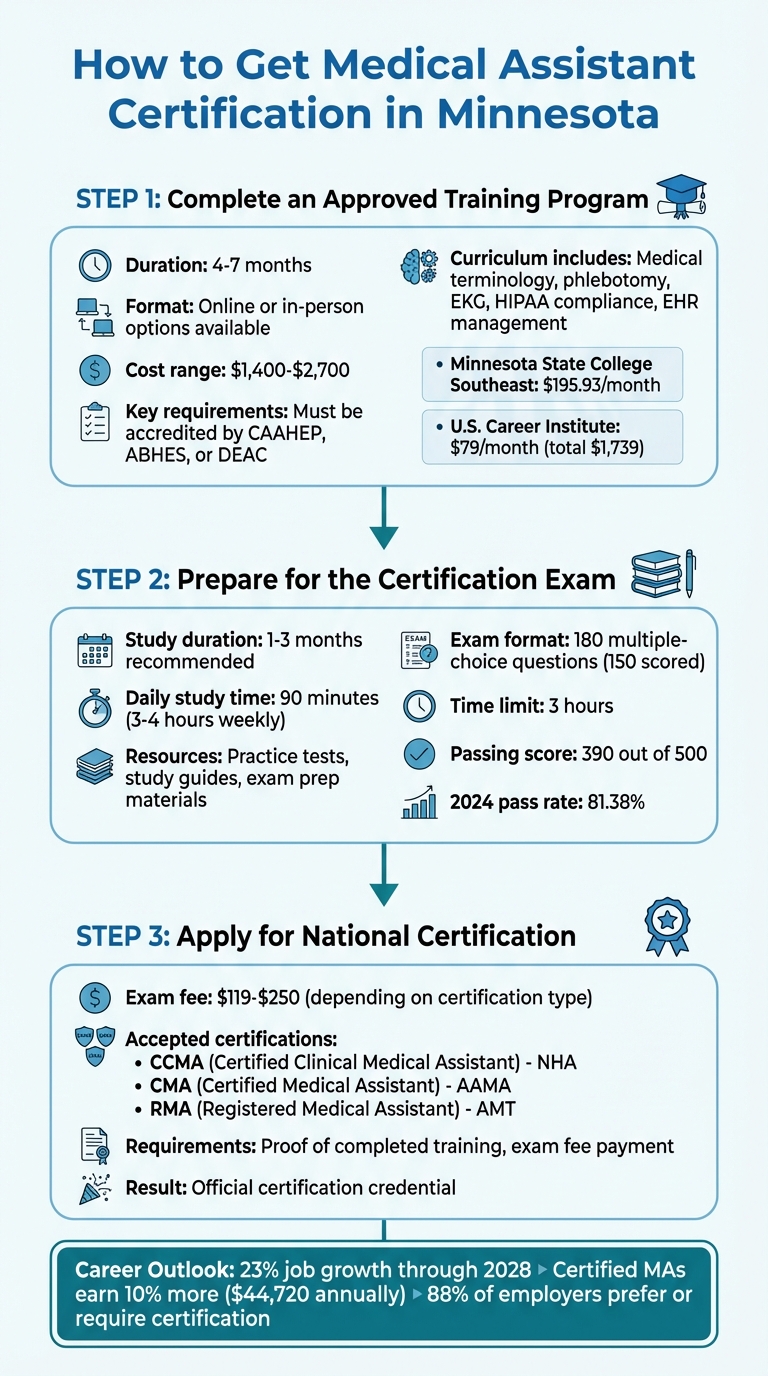
3-Step Process to Become a Certified Medical Assistant in Minnesota
Step 1: Complete an Approved Training Program
Start by enrolling in an accredited training program that aligns with national standards and prepares you for certification exams. In Minnesota, you can choose from local institutions or national online providers. For example, Minnesota State College Southeast offers an online Clinical Medical Assistant course starting at $195.93 per month. This program includes textbooks, 24/7 support, and guaranteed externship placements through their "Ready to Work" program. Alternatively, the U.S. Career Institute provides a self-paced online program for $79 per month (total cost: $1,739) or a discounted pay-in-full option for $1,439.
When selecting a program, ensure it is accredited by organizations like the Distance Education Accrediting Commission (DEAC) or recognized by the National Healthcareer Association (NHA). These accreditations ensure eligibility for certification exams. Programs typically last 4 to 7 months and cover both clinical skills, such as venipuncture and EKG, and administrative tasks like HIPAA compliance and managing Electronic Health Records (EHR).
Pay attention to what tuition covers. Some programs include the CCMA certification exam fee (around $259), study guides, and practice tests, which can help reduce out-of-pocket costs. For instance, the U.S. Career Institute boasts a 95% CCMA exam pass rate – higher than the national average of 84% – and has an A+ rating from the Better Business Bureau, with 97% of its students recommending the program.
Once you’ve completed your training, it’s time to focus on preparing for the certification exam.
Step 2: Prepare for the Certification Exam
After completing your training, dedicate time to preparing for the certification exam. Many programs include study materials, practice tests, and other exam prep tools as part of their curriculum. The CCMA exam covers essential topics like medical terminology, patient care procedures, infection control, and administrative operations.
To prepare effectively, create a structured study plan that allows you to review each topic systematically. Practice tests are especially useful – they help you get comfortable with the exam format and pinpoint areas where you may need more review. Instead of cramming, aim for consistent daily study sessions over several weeks. This approach helps reinforce your knowledge and boosts confidence.
Once you feel ready, it’s time to apply for certification.
Step 3: Apply for National Certification
The next step is to apply for certification through a recognized national organization. In Minnesota, the Certified Clinical Medical Assistant (CCMA) credential from the National Healthcareer Association is widely accepted. Other recognized certifications include the Certified Medical Assistant (CMA) from the American Association of Medical Assistants and the Registered Medical Assistant (RMA) from American Medical Technologists.
To apply, you’ll typically need to provide proof of your completed training program, pay the exam fee (unless it’s included in your tuition), and schedule your test date. Be mindful of deadlines and processing times to ensure there are no delays in beginning your job search. Once you pass the exam, you’ll officially earn your certification, opening the door to a variety of career opportunities.
Online CCMA Training with HealthCareer Certs
Program Features and Benefits
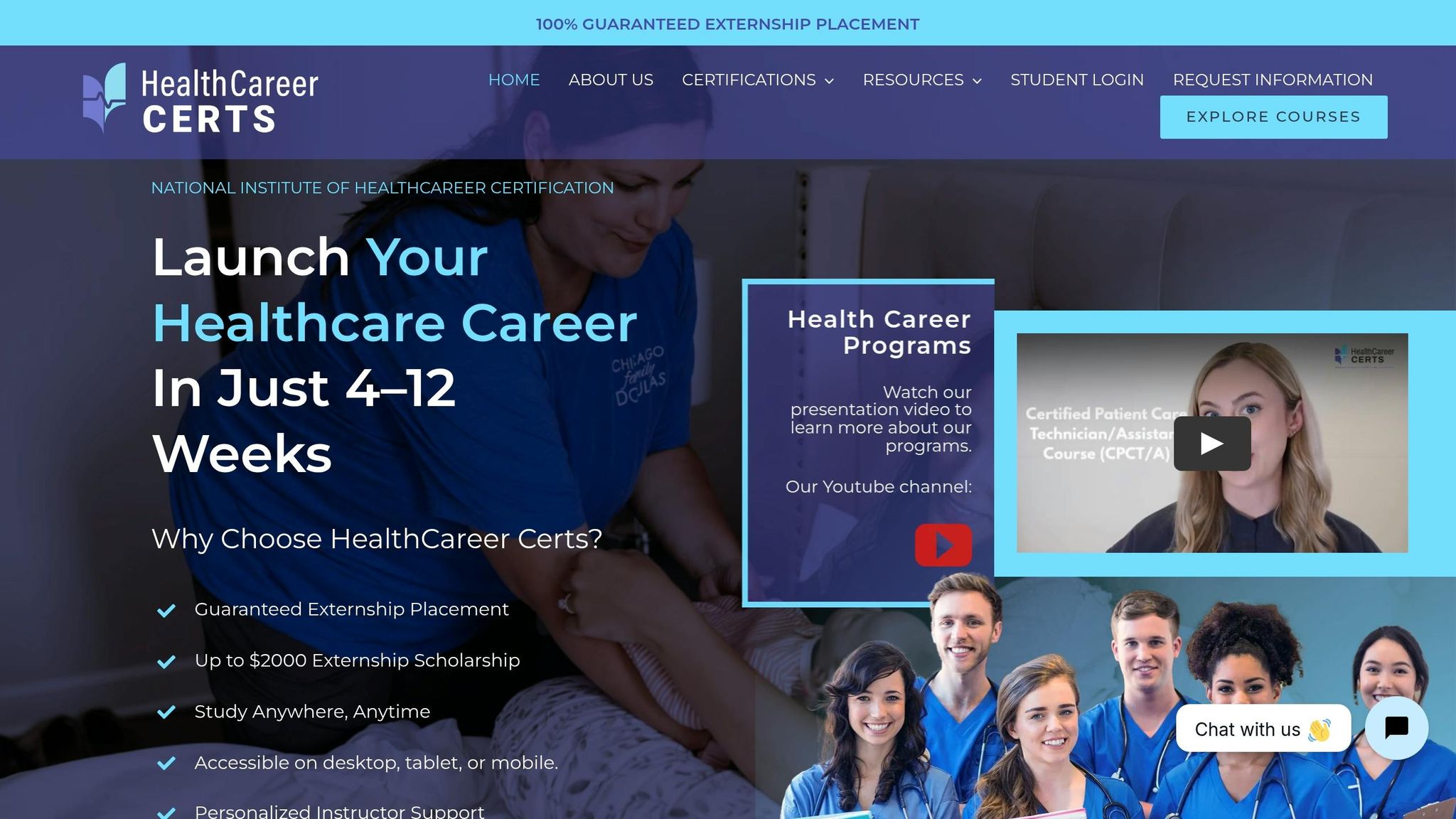
HealthCareer Certs offers a fully online, self-paced CCMA training program designed to align with certification standards. You can access the course from any device and complete it within 4 to 12 weeks, with materials available for a full year after purchase.
The curriculum features 18 chapters and 91 lessons, covering key areas like anatomy, phlebotomy, EKG, medical law, ethics, and pharmacology. To enhance learning, the program incorporates interactive tools such as 3D animations, lab simulations, and over 1,400 practice questions. Plus, it includes six practice exams to boost your readiness for the certification test.
Students who qualify are guaranteed an externship placement at a local Minnesota hospital or clinic, providing invaluable hands-on experience. To make this clinical training more affordable, an externship scholarship of up to $2,000 is available. Personalized support is also a key feature, with one-on-one Zoom sessions, tutoring, and career coaching to help with résumé writing and interview preparation.
The tuition fee includes the NHA exam voucher (worth about $259), study materials, and interactive tools. Payment options are flexible, allowing for a one-time payment of $2,700.00 or installment plans (2×$1,375.00, 4×$695.00, or 6×$495.00). The program also provides a 24-hour full money-back guarantee from the time of purchase. Additionally, passing the CCMA exam earns you 5 ACE credits, which can be transferred to over 2,000 colleges and universities.
"I was able to get certified and pass the NHA exam on the first try in only 6 weeks, and I appreciated the ease of the entire process." – Olivia, Student
Program Comparison Table
| Feature | HealthCareer Certs CCMA Program |
|---|---|
| Completion Time | 4–12 Weeks |
| Learning Format | 100% Online (Self-Paced) |
| Externship Guarantee | Yes (100% Guaranteed Placement) |
| Exam Fee Included | Yes (NHA CCMA Exam Voucher) |
| College Credits | 5 ACE Credits |
| Support Tools | 1-on-1 Zoom, 3D Demos, 1,400+ Practice Questions |
| Tuition Refund Policy | 24-Hour Full Refund |
| Externship Scholarship | Up to $2,000 Available |
These features provide a strong foundation for preparing for the CCMA exam, as discussed in the following section.
How to Prepare for the CCMA Exam
Once you’ve completed your training, it’s time to focus on thorough exam preparation. The CCMA exam includes 180 multiple-choice questions – 150 of these are scored, while 30 are unscored pre-test questions. You’ll have 3 hours to complete the test, and you need a score of at least 390 out of 500 to pass. In 2024, the passing rate for this exam was 81.38%.
To start, download the NHA’s detailed test plan. This document outlines all the topics covered in the exam. Pay special attention to the Clinical Patient Care section, as it accounts for 54–56% of the test. Topics in this domain include infection control, phlebotomy, EKG procedures, and lab work. Other sections to study include:
- Administrative Assisting (8–13%)
- Foundational Knowledge (10%)
- Anatomy & Physiology (5–8%)
- Medical Law & Ethics (5%).
Using official NHA study materials is a smart move. These include an interactive online study guide ($69) and practice tests ($49), or you can get both in a bundle for $94. These resources align with the exam’s seven domains, helping you pinpoint and strengthen weak areas. Full-length, timed practice tests are especially useful for building the stamina needed to complete the exam successfully. Incorporate these tools into your daily study routine for the best results.
Create a structured study plan starting 1–3 months before your exam date. Aim for daily sessions of 90 minutes, totaling 3–4 hours of study time. Focus on mastering medical terminology – learning prefixes and suffixes can make understanding complex concepts much easier. Additionally, use practice tools that allow you to tag and revisit difficult questions.
If you don’t pass on your first attempt, you can retake the exam after 30 days for the first two retakes. After three failed attempts, you’ll need to wait a year before trying again. The exam fee ranges from $160 to $165 per attempt.
Career Benefits of CCMA Certification in Minnesota
Earning a CCMA certification can unlock opportunities that might otherwise be out of reach for non-certified medical assistants. In fact, about 88% of employers in the healthcare field either prefer or require medical assistants to have certification. This trend is especially relevant in Minnesota, where the healthcare industry continues to expand, making certification a practical step for securing competitive roles.
One immediate perk of certification is a higher paycheck. Certified medical assistants typically earn around 10% more, and 63% of employers offer additional pay incentives to those with credentials. Over time, this can translate into significant financial gains.
Certification doesn’t just improve your earning potential – it also validates your expertise in key clinical skills like phlebotomy, EKG procedures, and infection control. These are precisely the competencies Minnesota employers prioritize. Holding a CCMA credential reassures physicians and supervisors that you meet national safety standards, making them more likely to trust you with complex tasks. In fact, many large healthcare organizations and specialized clinics in Minnesota require certification for clinical roles. This credibility not only enhances your day-to-day responsibilities but also paves the way for career growth within the state’s healthcare system.
The CCMA can also serve as a springboard for leadership roles, including positions like Lead Medical Assistant, office manager, or clinical trainer. Additionally, you can pursue further certifications, such as Certified Phlebotomy Technician (CPT) or EKG Technician (CET), to qualify for specialized jobs and boost your professional appeal. With medical assistant roles projected to grow by 23% through 2028 – a rate four times faster than the national average for all jobs – certification gives you a distinct edge in a competitive job market.
Conclusion
Becoming a certified medical assistant in Minnesota opens doors to a thriving healthcare industry. The process is simple: complete an accredited training program and pass a national certification exam like the CCMA, CMA, or RMA. With medical assistant roles expected to grow by 23% by 2028 – four times faster than the average for all occupations – this is an ideal time to earn your credential.
Certification showcases your skills in areas like phlebotomy, EKG procedures, and patient care, making you a standout candidate for Minnesota employers. In fact, about 88% of healthcare employers either prefer or require certification.
Flexible online courses allow you to prepare for certification at your own pace. Whether you opt for a five-month accelerated certificate or a two-year Associate degree, you’ll gain the expertise that Minnesota’s healthcare facilities need. These programs not only teach critical skills but also make certification more attainable.
Exam fees range from $119 to $250, depending on the certification path you choose. It’s a small investment for a career with big potential.
Start your journey today by exploring accredited programs, identifying the certification that aligns with your goals, and connecting with local hospitals or clinics to learn about their specific requirements. A rewarding career in Minnesota’s growing healthcare field is within reach.
FAQs
Which medical assistant certifications are recognized in Minnesota?
Minnesota accepts certifications like CMA (Certified Medical Assistant), RMA (Registered Medical Assistant), and CCMA (Certified Clinical Medical Assistant) for medical assistants. These credentials align with the state’s standards for certified medical assistants and can open doors to better career prospects in healthcare.
Do I need an externship to get certified in Minnesota?
No, completing an externship is not mandatory to become a certified medical assistant in Minnesota. However, most certification programs do require some form of relevant work experience or recognized professional credentials. It’s important to carefully review the specific requirements for the certification you’re pursuing to ensure you meet all the necessary qualifications.
How do I keep my medical assistant certification active in Minnesota?
To keep your medical assistant certification active in Minnesota, you can renew it online starting two months before it expires. Make sure to complete any necessary continuing education (CE) credits, if required, and pay the renewal fee. It’s a good idea to keep records of your CE credits and renewal activities for your own documentation. Once you’ve completed the renewal process, your updated certification card is usually mailed within two weeks. Staying on top of these requirements ensures your certification remains valid.