- What CPCTs Do: Provide hands-on care like monitoring vital signs, performing EKGs, drawing blood, and assisting patients with daily activities in hospitals, rehab facilities, and more.
- Why It’s a Good Career: With over 211,800 annual job openings and a median annual salary of $39,530 (up to $50,140 in hospitals), CPCT certification offers job security and growth opportunities.
- How to Get Certified:
- Meet Eligibility: High school diploma or GED required. Training or work experience is needed for the CPCT/A exam.
- Enroll in Training: Learn skills like patient care, phlebotomy, and EKG. Programs often include clinical externships.
- Pass the Exam: The NHA CPCT/A exam covers patient care, compliance, phlebotomy, infection control, and EKG.
- Maintain Certification: Renew every two years by completing continuing education credits.
Becoming a CPCT opens doors to healthcare roles while providing a solid foundation for advancing into nursing or other medical professions.
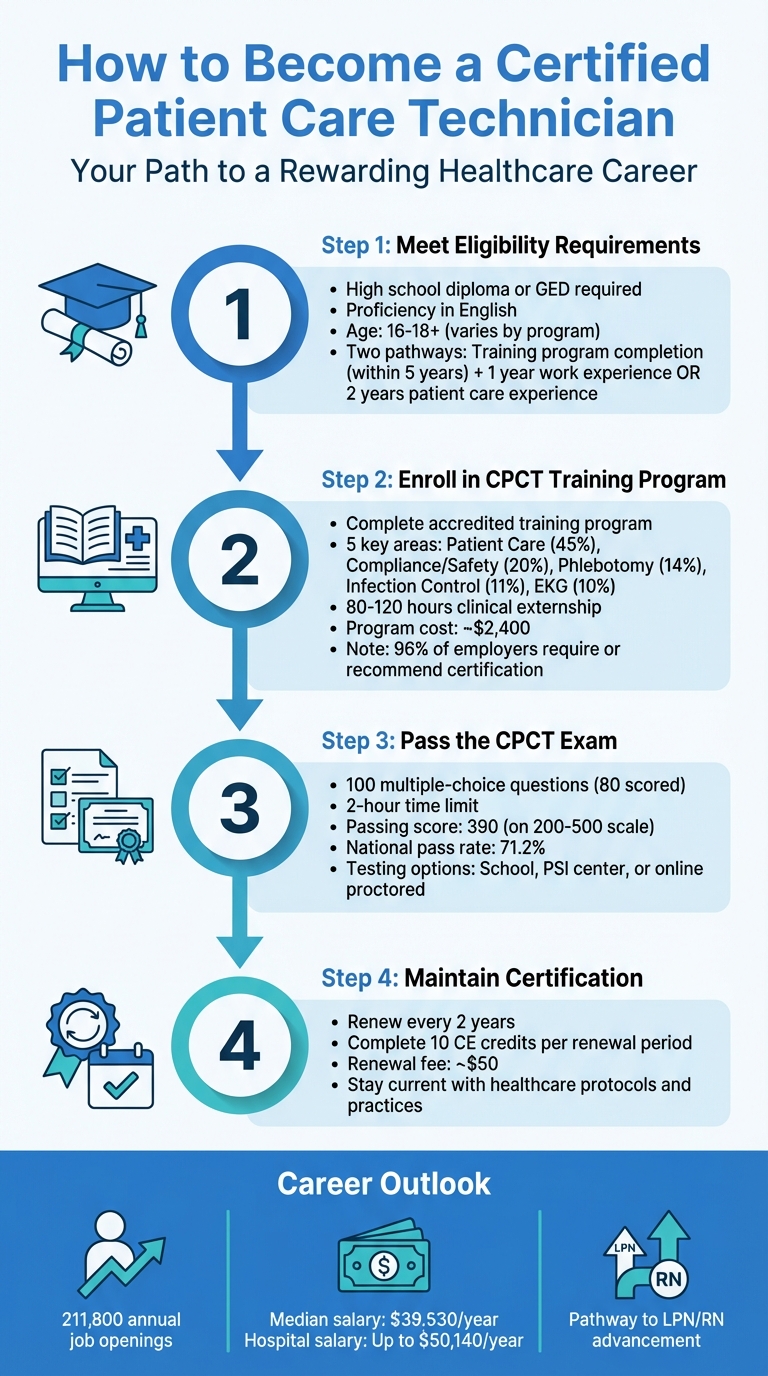
4 Steps to Become a Certified Patient Care Technician (CPCT)
PCT Test Training Tips 2026 Patient Care Technician Certification Exam – ALL You Need to Know
sbb-itb-7a67ffa
Who Can Become A CPCT: Eligibility Requirements
To pursue CPCT certification, most candidates need a high school diploma or GED and must be proficient in English. Age requirements differ depending on the certifying body. Some programs allow students as young as 16, while others set the minimum age at 18. For those considering the National Healthcareer Association (NHA) certification, there are two main pathways to eligibility.
The NHA, which oversees the well-known CPCT/A exam, outlines these paths:
- Completion of a CPCT training program within the last five years, along with one year of supervised work experience in the past three years.
- Alternatively, two years of patient care experience within the last five years qualify as well.
Interestingly, the U.S. Career Institute highlights that no prior medical experience is needed to begin the certification process.
High school students taking part in health science programs can also get a head start. They may sit for the exam early and receive provisional certification, valid for up to 12 months.
For international candidates and military personnel, foreign training or education obtained through service may meet the requirements. Be sure to check that your program is DEAC-accredited and confirm any local licensing rules. Knowing these details upfront will help you navigate the certification process smoothly.
Step 1: Enroll in a CPCT Training Program
To qualify for the CPCT/A exam and meet the hiring criteria of most healthcare employers, you’ll need to complete a CPCT training program within the last five years. This is crucial, as around 96% of healthcare employers either require or strongly recommend PCT certification for new hires.
A good training program will equip you with the knowledge and skills to ace the exam by focusing on five key areas: Patient Care (45%), Compliance/Safety (20%), Infection Control (11%), Phlebotomy (14%), and EKG (10%). Beyond theory, these programs also offer hands-on experience, including 80 to 120 hours of supervised clinical externships to help you build practical skills.
Before starting your clinical rotations, there’s some prep work involved. You’ll need to provide vaccination records for Hepatitis B, MMR, Varicella, and TB. Since verifying these documents can take weeks, it’s smart to gather them early. HealthCareer Certs simplifies this process with a program that’s designed to make sure you’re ready for every step.
What HealthCareer Certs Offers in Their CPCT Program

HealthCareer Certs’ CPCT program is built for flexibility, offering self-paced, on-demand learning that you can access anytime on your phone or tablet. The curriculum is divided into three sections covering foundational knowledge, professional skills, and clinical patient care, all spread across 15 modules. Topics include everything from anatomy and medical terminology to phlebotomy, EKG, and CPR training.
To make learning interactive, the program includes tools like 3D demos, quizzes, and flashcards. You’ll also get personalized support through one-on-one Zoom sessions with instructors. For exam prep, you’ll have access to over 1,400 practice questions and 700 self-checks.
The program guarantees externship placement, with scholarships of up to $2,000 available for eligible students. Plus, if you don’t land a healthcare job after completing the program, HealthCareer Certs offers a full tuition refund. Priced at $2,400, the program includes exam fees and provides 12-month access, allowing you to work at your own pace without deadlines or due dates.
Step 2: Prepare for the CPCT Exam
Once you’ve enrolled, it’s time to dive into exam preparation. The NHA CPCT exam includes 100 multiple-choice questions (20 of which are unscored pretest items) and must be completed within 2 hours. To pass, you’ll need a scaled score of at least 390 on a 200–500 scale. The national pass rate stands at 71.2%. The exam is divided into these key areas: Patient Care (45%), Compliance and Safety (20%), Phlebotomy (14%), Infection Control (11%), and EKG (10%).
Structure your study plan to reflect these categories. For example, if EKG or phlebotomy feels challenging, dedicate extra time to mastering those topics early on. A targeted approach will help ensure you’re ready for all aspects of the test.
Study Strategies That Work
Instead of passively reading, focus on active recall. Techniques like the free-recall method – where you write down everything you can remember about a topic from memory – are great for identifying weak areas quickly. To improve retention, use the 2357 method, which suggests reviewing new material on Day 1, then revisiting it on Days 2, 4, and 7. This approach helps combat the natural forgetting curve.
Flashcards can be a lifesaver for memorizing at least 150 technical terms related to medical law, ethics, and terminology. Try creating concept maps to visualize connections between topics. For instance, link Infection Control to PPE protocols and isolation procedures to see how these ideas fit into real-world clinical practices.
Study Tools and Practice Exams You Should Use
Your training lays the groundwork, but effective study tools can make all the difference in reaching certification. HealthCareer Certs provides an extensive suite of resources to help you prepare.
Their program offers over 1,400 practice questions and 700 self-checks, along with six competency test assessments designed to mimic the exam format. 3D animated demonstrations and interactive flashcards simplify complex procedures while keeping you engaged with game-based learning. Practice exams are invaluable for tracking your progress and fine-tuning your study plan based on your results.
Step 3: Register and Take the CPCT Exam
When you’re ready to take the CPCT exam, start by registering through the NHA website. Other certifying organizations, like National Performance Specialists (NPS) or American Allied Health (AAH), also offer CPCT exams. Before signing up, make sure you meet the eligibility requirements. You can qualify through one of three pathways: completing a training program, having documented work experience, or military service with proof of relevant education or experience. During registration, you’ll need to provide personal identification and supporting documents, such as training certificates, employer verification letters, or military records.
The exam itself is structured with time limits and includes unscored items. You can take it at your school, a PSI testing center, or even online through live remote proctoring. If you choose the online option, you’ll typically receive your results within an hour after finishing.
The test focuses on scenario-based questions designed to measure how well you can apply your clinical knowledge. For instance, you might encounter a question about the appropriate response if a patient experiences distress during a blood draw. Key topics on the exam include phlebotomy, EKG basics, vital signs measurement, infection control, and patient care skills. Certification is a big deal – around 96% of employers either require or strongly recommend it, so it’s definitely worth pursuing.
If you don’t pass on your first attempt, there’s a 30-day waiting period, and you’ll need to pay the full exam fee again. After the test, you’ll receive a domain proficiency report that highlights areas where you need to improve. Use this information to tweak your study plan, whether that means brushing up on phlebotomy techniques or focusing on vital signs measurement. Some providers, like NPS, offer packages for $200 that include three exam attempts, study materials, and unlimited practice tests, which can be a great option.
Once certified, keep in mind that CPCT certification needs to be renewed every year. The renewal fee is about $50, and you’ll need to complete continuing education units (CEUs). If your certification lapses, reinstatement fees are $99 if it’s been expired for less than a year, and $199 if it’s been between one and two years. Planning ahead can help you avoid any interruptions in your credentials.
Step 4: Maintain Your CPCT Certification
Your CPCT certification isn’t forever – it needs to be renewed every two years to stay valid. To meet the renewal requirements set by the National Healthcareer Association (NHA), you’ll need to complete 10 continuing education (CE) credits during each renewal period. This ongoing education ensures you’re up to date with the latest protocols, technologies, and treatment practices, all of which are critical for maintaining patient safety. Renewing on time is essential for keeping your career on track.
The National Healthcareer Association highlights the importance of staying informed:
"The material evolves as health care changes and helps ensure you stay informed about the constantly changing world of healthcare." – National Healthcareer Association (NHA)
Start tracking your CE credits early – ideally within the first few months of your renewal cycle – to avoid any gaps in your certification that could affect your job.
To make continuing education easier, HealthCareer Certs offers 12 months of access to interactive learning tools and support through Zoom, text, and email. These resources cover essential skills like EKG monitoring, phlebotomy, and infection control, which are frequently updated to reflect new research and compliance standards.
Beyond just meeting renewal requirements, continuing education can open doors to career growth. Many CPCTs use additional training to move into specialized roles or even as a foundation for advancing to licensed nursing positions like LPN or RN. By keeping your certification current, you demonstrate a commitment to professional development, which can lead to higher pay and better job prospects.
Career Benefits of CPCT Certification
Earning a CPCT certification lays the groundwork for a stable and growing career in healthcare. With 96% of employers either requiring or strongly recommending national certification, having this credential gives you a noticeable edge over non-certified candidates competing for the same roles. It also opens doors for career growth and higher earning potential.
If you’re willing to consider location, states like California, Massachusetts, and Alaska offer salaries well above the national median. Additionally, bilingual CPCTs are in high demand, as healthcare facilities increasingly seek staff who can communicate effectively with diverse patient populations. Beyond the paycheck, certification can lead to expanded clinical responsibilities.
The CPCT credential is a stepping stone to advanced roles such as Licensed Practical Nurse (LPN), Registered Nurse (RN), or Physician Assistant (PA). The financial rewards are substantial – becoming an LPN can raise your annual income by about $20,000, while transitioning to an RN role could mean nearly $50,000 more per year. Even without pursuing a nursing degree, CPCTs can specialize in high-demand areas like dialysis, emergency care, or intensive care units.
But the benefits go beyond salary and career advancement. CPCTs play a critical role in patient care, often spending more time with patients than other healthcare professionals. This close interaction allows them to notice key changes in a patient’s condition, which can lead to improved recovery outcomes and higher hospital satisfaction scores. As Chevella Williams, MSN and Healthcare Program Manager at Midlands Technical College, puts it:
"I wish the public understood how integral patient care technicians are to the healthcare team… They are the backbone of patient care, performing vital tasks that contribute to patients’ overall well-being and recovery".
HealthCareer Certs supports CPCT candidates every step of the way, from training to securing externship placements. You may even qualify for an externship scholarship of up to $2,000, making clinical training more accessible. After passing the CPCT exam, you’ll earn 1 ACE credit, recognized by over 2,000 colleges and universities, which can be applied toward future degree programs. With personalized instructor support via Zoom and dedicated career coaching, you’ll be well-prepared to land positions at leading healthcare organizations like Mayo Clinic, Cleveland Clinic, Johns Hopkins Medicine, and Kaiser Permanente.
Conclusion
Becoming a Certified Patient Care Technician is a clear and manageable process when you follow the right steps. First, ensure you meet the basic eligibility requirements, such as having a high school diploma or GED. Next, enroll in a training program that covers essential topics like medical terminology, anatomy, phlebotomy, and EKG. After completing your training, gain hands-on experience through a clinical externship to build practical skills. From there, focus on preparing for the national certification exam. Once certified, stay on top of your credential by completing continuing education every two years.
HealthCareer Certs is here to support you every step of the way. Their program offers an on-demand curriculum, guaranteed externship placement, and access to personal advisors who can help with exam prep and career guidance.
Earning your certification not only opens doors to a variety of healthcare environments but also sets you up for long-term career growth. Passing the certification exam earns you 1 ACE credit, which is accepted by over 2,000 colleges and can be applied toward advancing into roles like LPN or RN.
The demand for skilled patient care technicians is strong, with approximately 211,800 job openings annually. Certification can lead to opportunities in hospitals, long-term care facilities, and dialysis centers nationwide. With career coaching and resume assistance, you’ll be well-positioned for a stable and rewarding career in healthcare.
FAQs
How long does it take to become a CPCT?
Becoming a Certified Patient Care Technician (CPCT) usually takes between 6 months to 1 year. Most programs require about 600 hours of training, though some can be finished in as little as 5 months, especially if you already have sufficient clinical experience. The exact duration will depend on the specific program you choose and how much time you can dedicate to it.
What’s the difference between a PCT and a CPCT?
The key distinction between a PCT (Patient Care Technician) and a CPCT (Certified Patient Care Technician) lies in certification. While a PCT is trained to deliver patient care, they might not have formal certification. On the other hand, a CPCT has obtained certification – commonly through organizations like the NHA – that confirms their expertise in tasks such as phlebotomy and EKG monitoring. This certification not only enhances job prospects but also highlights a higher level of skill and proficiency.
What happens if I fail the CPCT exam?
If you don’t pass the CPCT exam, you can try again after a 30-day waiting period, but keep in mind that you’ll need to pay the exam fee for each attempt. If you decide not to retake a specific skill, there may be other options available to explore. Failing isn’t the end – it just means you’ll have another chance to prepare and succeed after the waiting period.