
Renewing your healthcare certification is essential to maintain your professional qualifications and ensure patient safety. Missing renewal deadlines can lead to penalties, suspension, or even the need to retake exams. Here’s a quick summary of the five tips to simplify the process:
- Start Early: Begin the renewal process 90–120 days before your certification expires to avoid delays, penalties, or lapses in your credentials.
- Understand Requirements: Review your certification board’s specific renewal guidelines, including required credits, fees, and deadlines.
- Break Down Coursework: Spread your continuing education (CE) hours over time to avoid last-minute stress.
- Choose Accredited Providers: Verify that your CE courses are from approved providers to ensure they count toward your renewal.
- Organize Documents: Maintain a digital system for storing certificates, receipts, and other records to streamline audits and application submissions.
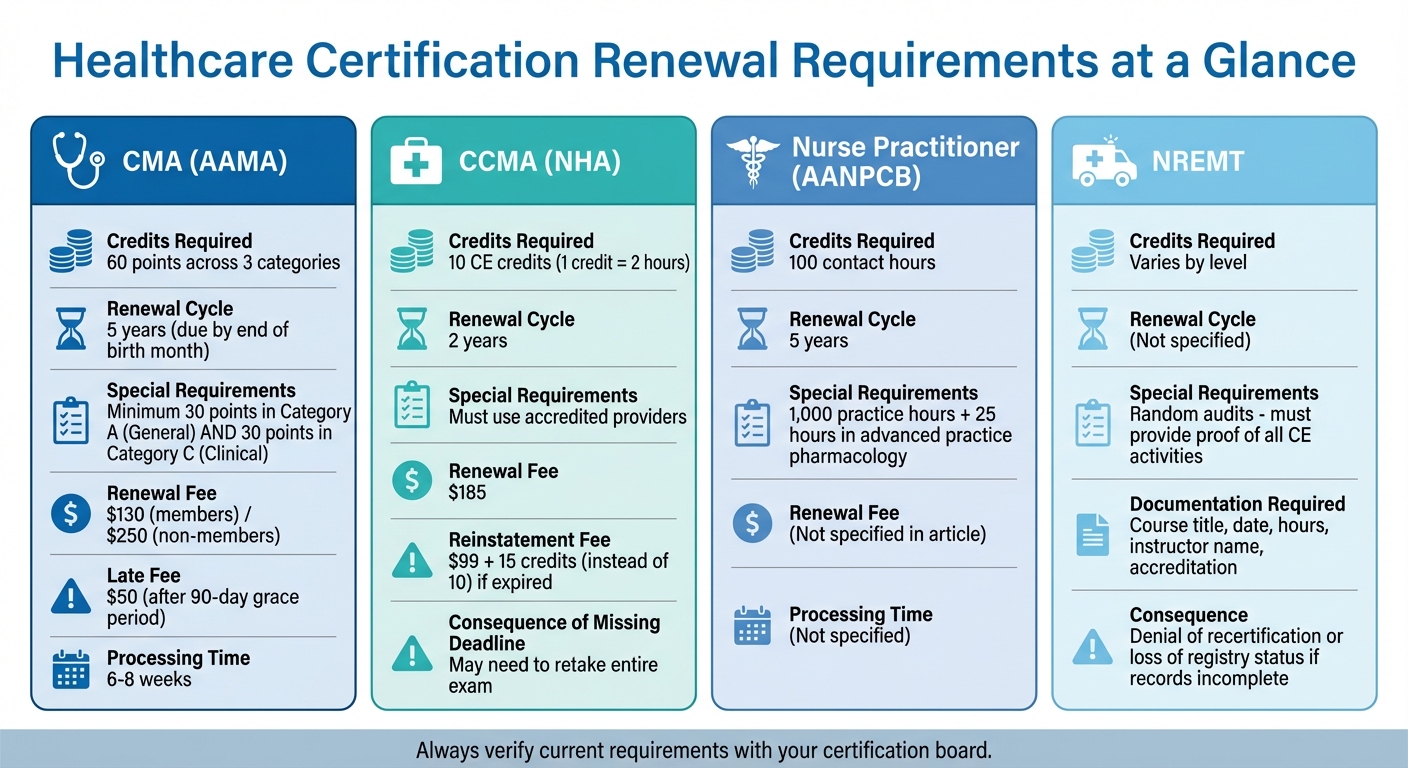
Healthcare Certification Renewal Requirements Comparison Chart
how to renew your clinical medical assistant certification through NHA

sbb-itb-7a67ffa
1. Begin the Renewal Process 90-120 Days Early
Starting your renewal process 90–120 days before your certification expires can save you from unnecessary stress, delays, and even costly penalties. Certifications like the CMA typically take 6–8 weeks to process. Waiting until the last minute could mean your updated credential arrives after your current one has already expired.
If you delay, you risk being flagged with an "expired" status. Even during a grace period, this status could result in being temporarily removed from clinical duties. For NHA certifications, letting your credential expire comes with added hurdles: you’ll need 15 CE credits instead of the usual 10 and will also face an extra $99 reinstatement fee. In some cases, like with the CCMA certification, missing the renewal deadline entirely might mean retaking the entire exam instead of simply completing a renewal course. Clearly, starting early avoids these complications.
"The AAMA doesn’t send reminders until 90 days before expiration, and by then, you might be rushing to fulfill requirements."
– AllCMA
An early start also gives you time to resolve potential issues with your documentation. For example, some continuing education providers only keep records for 2–3 years, so you might discover missing certificates. Additionally, not all courses meet specific renewal requirements, and verifying this takes time. High traffic on renewal platforms, especially near national deadlines, can also cause technical glitches or slowdowns. Addressing these problems is far easier when you’re not racing against the clock.
To stay on track, set reminders as soon as you receive your certification. Use your work calendar, phone alerts, or a planner to keep everything organized. Spread your required CE hours evenly over the year, turning what could be a last-minute scramble into a manageable, steady process. This approach not only helps you avoid penalties but also ensures you stay sharp and competent in your clinical role.
2. Review Your Certification’s Renewal Requirements
Once you’ve started the renewal process, it’s time to dive into the specifics of your certification’s renewal requirements. These guidelines can vary widely depending on the certification. For instance, the CMA certification requires 60 points spread across three categories, all due by the end of your birth month. On the other hand, the NHA’s CCMA certification mandates 10 continuing education credits every two years, with one credit equaling two hours. Nurse Practitioners certified through AANPCB need to complete 1,000 practice hours and 100 contact hours, including 25 hours focused on advanced practice pharmacology. Skipping this step or assuming the requirements are the same across certifications can lead to costly mistakes.
The best way to stay on top of these details is by logging into your certification board’s portal. There, you can check your expiration date, track your required credits, and review your progress. Many organizations, like NHA, AAMA, and ONCC, offer user-friendly dashboards or "Learning Plans" to help you stay organized. For example, PTCB frequently updates its policy documents (the current version is 3.4) to ensure accuracy. To avoid surprises, download the most recent renewal handbook from your board to confirm you’re following the latest rules.
Some certifications have additional specific requirements. For example, CMA certification demands at least 30 points in both Category A (General) and Category C (Clinical). Meanwhile, ONCC requires candidates to complete an "Authorization to Assess" form by January 31 of their expiration year.
Renewal fees also vary by organization. NHA charges $185 for renewal, but if your certification has lapsed, you’ll need to pay $99 plus earn extra credits to reinstate it. AAMA’s renewal fee is $130 for members and $250 for non-members. They offer a 90-day grace period, but if you miss that window, a $50 late fee applies. Beyond that, you might even need to retake the exam.
3. Break Coursework Into Smaller Sections
Balancing 100 contact hours or 60 recertification points alongside work and personal responsibilities can feel daunting. But there’s a straightforward way to tackle it: break your requirements into smaller, manageable chunks that fit seamlessly into your routine. Let’s say you need 100 hours over five years – that’s just 20 hours per year, or about five hours every three months. Suddenly, what seemed like an insurmountable task turns into a series of achievable goals.
You can make it even easier by using short pockets of time throughout your day. Instead of dedicating entire weekends to coursework, try completing modules during lunch breaks, while commuting, or after a shift. As Hannah Herold, MPH, MA, MCHES®, CVF, PMP, NCHEC DBPD Director, aptly says:
"It’s much easier to catch up on a few CECH at the end of a quarter than 50+ CECH at the end of five years!".
By breaking things down, you replace last-minute cramming with a steady, manageable learning routine.
| Total | Cycle | Yearly | Quarterly |
|---|---|---|---|
| 100 Hours | 5 Years | 20 Hours | 5 Hours |
| 60 Points | 5 Years | 12 Points | 3 Points |
| 24 Hours | 2 Years | 12 Hours | 3 Hours |
Keep track of your progress using a spreadsheet or your certification board’s online tools. Log details like course titles, providers, categories, and points earned as you go to avoid mistakes when submitting credits. Many boards let you submit credits as you complete them, saving you from the stress of entering everything at the last minute. This approach also helps you stay aware of your progress throughout the renewal cycle.
Choose mobile-friendly, self-paced courses to fit learning into your schedule. Flexibility is key when unexpected work demands or personal emergencies pop up. Spreading your coursework over the entire renewal period ensures steady progress, turning what could be a scramble into meaningful learning. Breaking your workload into smaller, consistent efforts not only reduces stress but also reinforces your dedication to professional growth.
4. Choose Accredited Continuing Education Providers
Not every course will meet the standards required for certification renewal. Accredited providers are officially recognized by authoritative organizations, meaning the credits you earn will actually count toward your certification requirements. If you opt for non-accredited providers, you risk having your credits rejected, which could lead to delays in renewing your license, possible suspension, or even disciplinary action.
Accreditation is more than just a label. For example, ACCME oversees 1,550 providers offering 230,000 educational activities each year. These programs are rigorously reviewed to ensure they are accurate, relevant, and based on current best practices – free from commercial bias. As Graham T. McMahon, President and CEO of ACCME, puts it:
"Accreditation standards ensure independence from commercial influence and foster public trust in the integrity of medical education."
Before enrolling in any course, make sure to verify the provider’s accreditation. Many accredited providers use systems like CE Broker, which automatically report your completed credits to state boards. This eliminates the need for manual data entry and saves you time.
For instance, HealthCareer Certs (https://healthcareercerts.org) offers accredited online courses that include interactive tools and one-on-one instructor sessions. Their programs are approved by respected organizations like NHA and the New Hampshire Department of Education. With a 5/5 Google Score from over 5,000 students, HealthCareer Certs has helped countless professionals maintain their certifications while advancing their careers.
Taking the time to confirm a provider’s accreditation upfront can save you from major headaches later. It’s a small step that ensures your efforts – and your credits – are recognized, protecting your time, money, and professional standing.
5. Keep All Renewal Documents Organized
Staying on top of your certification renewal isn’t just about completing the required steps – it’s also about keeping your records in order. Misplacing certificates or other important documents can throw a wrench in the process. Certifying organizations like the NREMT often conduct random audits, requiring you to provide proof of every continuing education activity you’ve completed. Without proper records, you risk being denied recertification or even losing your registry status, which could jeopardize your career.
To avoid this, set up a centralized digital system for your records. Use a consistent file naming format, such as "2025-03_CardiacEmergencies_CAPCE_Cert.pdf", to make retrieving documents during audits quick and stress-free. Store these files in reliable cloud services like Google Drive or Dropbox, and consider emailing copies to yourself for added backup. On average, healthcare professionals spend around 192 hours annually managing credentials manually. A well-organized system can save you significant time and energy.
| Document Type | Required Details | Purpose |
|---|---|---|
| CE Certificates | Course title, date, hours, instructor name, and accreditation (e.g., CAPCE) | Verifies completion of education requirements for recertification and audits |
| CPR Certification | Provider (e.g., AHA, ARC), course type (e.g., BLS), and expiration date | A mandatory component for most healthcare certifications , including roles like a Certified Clinical Medical Assistant |
| Skills Verification | Signed confirmation from a training officer or medical director | Validates hands-on competency in clinical skills |
| Receipts & Confirmations | Payment receipts and application submission confirmations | Serves as proof of timely application and fee payments |
To stay ahead, upload your certificates immediately after completing a course. Set calendar reminders 3–6 months before any expiration dates. You can also use tools like CerTracker or MyCert (starting at $9.99 per month) to automate reminders, with notifications at 90, 60, 30, and 14 days before deadlines. By adopting these practices, you’ll ensure your professional credentials remain intact without unnecessary stress.
Conclusion
Renewing your certification doesn’t have to be overwhelming. By starting early, understanding the specific requirements, and keeping your documents in order, the process becomes far more manageable. Spreading out your continuing education efforts across the renewal cycle – rather than rushing at the last minute – helps protect both your credentials and your peace of mind.
"Renewing credentials is important for professional growth, career advancement, and improving healthcare quality. Not just a regulatory obligation." – Pyramids Global
The key to success lies in staying organized and taking action early. Simple steps like creating a "Clinical Pearl" calendar with multiple reminders, double-checking your CE provider’s accreditation, and uploading certificates as soon as you complete a course can make all the difference.
Your certification is more than just a formality – it’s your gateway to career stability and professional growth. By staying proactive and organized, you not only secure your career but also contribute to patient safety.
FAQs
What happens if my certification expires?
If your healthcare certification lapses, you must stop using the credential right away. To restore it, you’ll likely need to meet certain requirements, such as paying renewal fees, completing continuing education courses, or documenting practice hours. These tasks usually need to be finished within a three-year timeframe to reactivate your certification.
How do I know if a CE course will count for renewal?
To determine if a CE course counts toward your renewal, make sure it aligns with your certifying organization’s requirements. Generally, courses need to be at least one hour long, directly related to your profession, and completed within your renewal period. Confirm that the course is provided or approved by accredited organizations, and keep records like certificates or transcripts for proof. Always review your certifying body’s specific rules to ensure the course qualifies.
What documents should I save in case of an audit?
To get ready for a healthcare certification renewal audit, make sure to keep all supporting documentation for your application. This includes continuing education certificates dated within the certification period, proof of practice hours, completed renewal logs, and any related correspondence. Having these records on hand ensures you’re prepared to demonstrate compliance with the renewal requirements if requested.