Becoming a certified medical assistant in Georgia can boost your career in healthcare. While certification isn’t legally required in the state, most employers prefer candidates with national credentials like CMA, CCMA, or RMA. Here’s what you need to know:
- Eligibility: High school diploma or GED, age 17+, and health clearances (background check, drug test, TB test, immunizations, BLS/CPR certification).
- Training: 27 accredited programs in Georgia offer the required education. Online and in-person options range from $1,439 to $3,000.
- Certification Exam: The CCMA exam covers clinical and administrative skills. Costs range from $125 to $250.
- Externships: Programs often include hands-on training at healthcare facilities, a key step to gaining practical experience.
- Job Outlook: Georgia employs 26,800 medical assistants, with 4,200 annual openings. Certified professionals earn around $40,890/year on average.
Certification enhances job prospects, salary potential, and career growth opportunities. Whether you choose online or in-person training, getting certified is a straightforward process that opens doors in Georgia’s growing healthcare field.
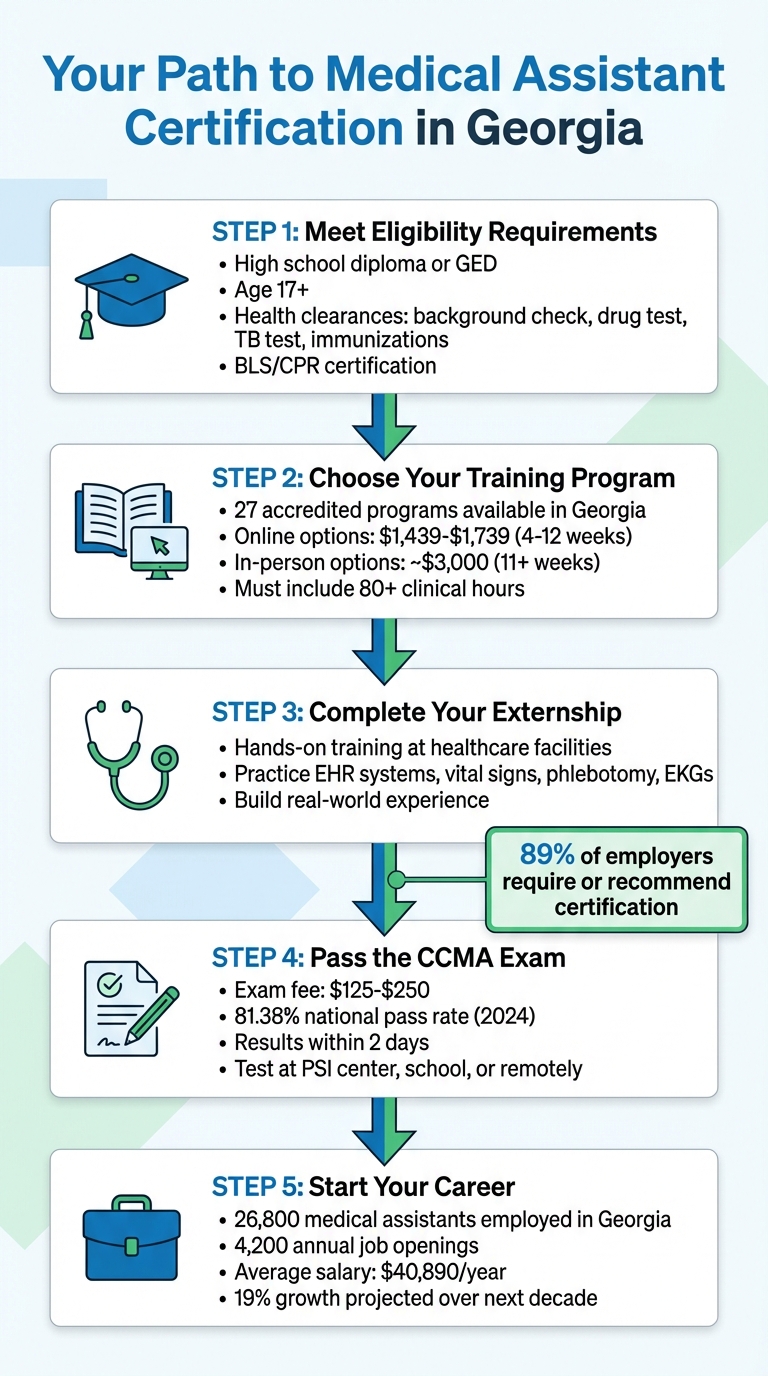
Steps to Become a Certified Medical Assistant in Georgia
Georgia Requirements and Eligibility for Medical Assistant Certification
Basic Eligibility Requirements
If you’re looking to start a career as a medical assistant in Georgia, there are some initial requirements to meet before diving into training or certification. First, you’ll need a high school diploma or GED and must generally be at least 17 years old.
Before beginning your externship, you’ll go through a series of health and safety clearances. These include a criminal background check, drug screening, physical exam, TB test documentation, and immunization records. Additionally, having a current BLS/CPR certification is essential for both training and employment.
Certification is highly valued in the field, with about 89% of healthcare employers either requiring or recommending it. Keep in mind that there are extra costs involved – like uniforms, malpractice insurance, and exam fees. If you’re aiming for credentials such as the CMA (AAMA), make sure your program is accredited by CAAHEP or ABHES. Georgia offers 27 accredited programs to choose from.
These foundational steps help prepare you for Georgia’s medical assistant practice standards.
Georgia-Specific Requirements
Georgia doesn’t have a state licensing or certification process for medical assistants, and formal training isn’t legally required. However, under the Georgia Medical Practice Act, medical assistants must perform clinical duties only under the direct, on-site supervision of a physician, physician assistant, or advanced practice registered nurse. For specific tasks like giving injections, performing nebulizer treatments, or removing sutures, the supervising physician must be physically present and ensure the assistant is properly trained.
Because of these guidelines, many healthcare employers in Georgia prefer or require national certification to confirm an assistant’s skills and training.
sbb-itb-7a67ffa
CCMA Certification Exam Guide
Exam Format and Structure
The Certified Clinical Medical Assistant (CCMA) exam, offered by the National Healthcareer Association (NHA), evaluates your skills in both clinical procedures and administrative tasks. It’s designed to assess your readiness to work in healthcare settings across Georgia.
To take the CCMA exam in Georgia, you’ll need a high school diploma or GED. Additionally, you must either complete a medical assisting program with at least 80 clinical hours or have one year of supervised work experience within the last three years. Training programs for the exam can last anywhere from 18 weeks to two years, depending on the intensity and format you select.
Once you complete the online exam, the NHA typically posts your results to your account within two days of scoring. With your results in hand, you’ll be ready to move forward. The next section explains how to register for the exam.
How to Register for the Exam
When you’re ready to register for the CCMA exam, head over to the NHA website. There, you’ll create an account, submit your application, and verify your eligibility. You’ll also need to pay the exam fee and schedule your test date.
The exam fee ranges from $125 to $250 and is separate from any training program costs. You can choose to take the exam at your school, a PSI testing center, or even from home through live remote proctoring.
Before registering, make sure to gather all necessary documents, like proof of your diploma/GED and training completion. Having these ready will make the process quicker and easier.
Main Topics Covered on the Exam
The CCMA exam focuses on both clinical and administrative skills, reflecting the responsibilities that Georgia physicians often assign to medical assistants.
On the clinical side, you’ll be tested on areas like phlebotomy (including three venipuncture methods), EKG procedures, administering injections, obtaining vital signs, infection control, hematology, microbiology, pharmacology, and first aid.
The administrative portion evaluates skills in telecommunications, patient scheduling, medical billing and coding, electronic health records (EHR) management, and financial practices. Additionally, you’ll need a solid understanding of medical terminology, anatomy and physiology, HIPAA Privacy and Security Rules, and ethical standards in healthcare.
The exam ensures you’re equipped to handle tasks that Georgia law permits physicians to delegate, such as administering subcutaneous and intramuscular injections, performing nebulizer treatments, and removing sutures.
Training Programs Available in Georgia
Online Training with HealthCareer Certs
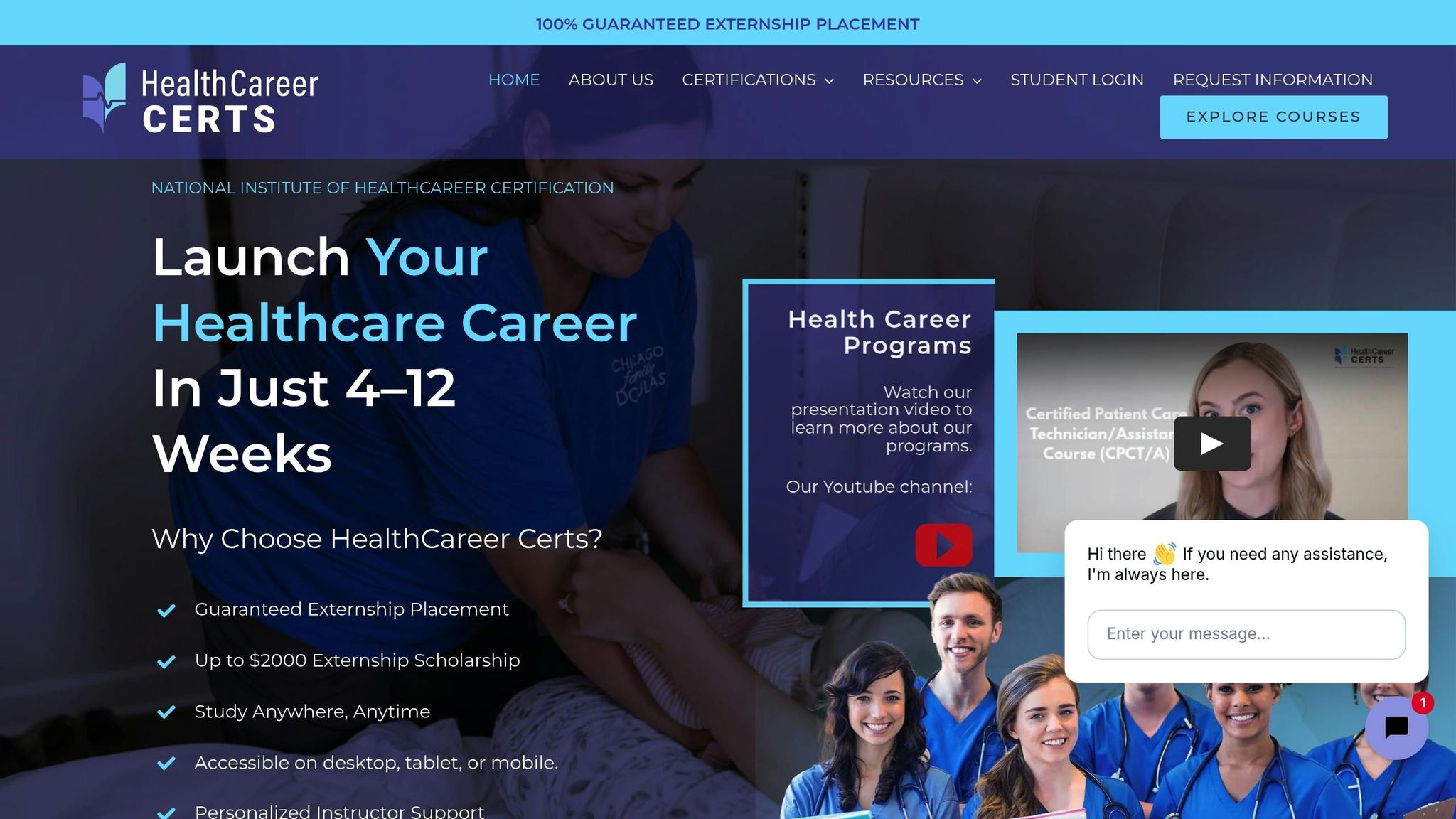
HealthCareer Certs provides an online CCMA program that you can complete entirely from home. The program is self-paced, allowing you to study whenever it fits into your schedule. Most students wrap up their coursework within 4 to 12 weeks.
What sets this program apart is the support and resources it offers. You’ll have access to one-on-one Zoom sessions with instructors to tackle challenging topics. The curriculum includes interactive tools like 3D demonstrations, quizzes, and flashcards to help solidify your understanding. Plus, you’ll get over 1,400 practice questions and 700 self-check quizzes to gear up for the CCMA exam.
The program also ensures externship placements for your required clinical hours within Georgia. It’s mobile-friendly, so you can study on the go using your phone or tablet. And here’s a standout feature: a 100% tuition refund guarantee if you don’t land a healthcare job after completing the program.
In-Person Training Options in Georgia
If you prefer hands-on learning, in-person programs offer a more structured approach. For instance, Atlanta Career Institute in Norcross runs an 11-week program priced at about $3,000, with a passing rate exceeding 90%. Other options include Woodruff Medical Training in Duluth and Gainesville, as well as programs through technical colleges like Atlanta Technical College and Gwinnett Technical College.
These programs are ideal for those who thrive in a traditional classroom setting. They follow fixed schedules with set class times, which can provide more routine but less flexibility. The cost is another factor to consider – while online programs range from $1,439 to $1,739, in-person options typically cost around $3,000.
How to Prepare and Pass the CCMA Exam
Study Materials and Practice Tools
The CCMA exam has a clear format and scoring criteria, which should guide your preparation strategy. With a national passing rate of 81.38% in 2024, most well-prepared candidates pass on their first try.
To help you prepare, HealthCareer Certs offers an extensive set of resources, including 1,400 practice questions and 700 self-check quizzes. These tools mimic the computer-based exam format, giving you a feel for the actual test. Additionally, they provide flashcards for medical terminology and 3D demonstrations for anatomy and clinical procedures, making them particularly useful for visual learners. Since the materials are accessible on mobile devices, you can study during commutes or breaks, maximizing your time.
Focus your study on key areas: Clinical Patient Care (≈55%), Administrative Tasks (≈10%), and Foundational Knowledge (≈10%). Concentrating on these high-weighted sections ensures you’re prioritizing the most impactful topics. This thorough preparation not only improves your chances of passing but also equips you for the challenges of working in healthcare, especially in a state like Georgia.
Creating a Study Schedule
Approach your exam prep like a professional commitment. Set aside dedicated study time and minimize distractions. While most students complete the HealthCareer Certs program in 4 to 12 weeks, your timeline will depend on how much time you can invest each day.
Start by downloading the free NHA test plan, which outlines the exam content in detail. Use your practice test results to pinpoint weak areas early and allocate extra time to improve them. Avoid last-minute cramming – beginning your studies well in advance allows for steady progress and better retention. Even short daily sessions of 30 to 45 minutes can lead to significant improvement over time. Revisit topics regularly to keep them fresh in your mind.
Once your study schedule is set, shift your focus to preparing for a smooth and stress-free exam day.
What to Do on Exam Day
After weeks of preparation, follow these steps to ensure you’re ready on exam day.
The CCMA exam can be taken at a PSI testing center, an accredited school, or remotely through proctoring at home. If you’re testing in person, arrive early to complete the check-in process. For remote testing, carefully follow the NHA’s setup instructions to avoid technical issues or disqualification.
Since no breaks are allowed during the exam, handle personal needs like using the restroom beforehand. Bring all required identification documents and double-check the list of what’s needed well in advance. If you require accommodations, such as extended time, submit your request to the NHA ahead of your test date.
In case you don’t pass, you’ll have to wait 30 days before attempting a first or second retake. After a third failed attempt, the waiting period increases to one year. The NHA provides a detailed diagnostic report after each attempt, highlighting areas that need improvement.
Externships, Job Placement, and Career Growth in Georgia
Externship Placement Guarantee
HealthCareer Certs ensures every student secures an externship as part of its certification program. This practical training is not just a program requirement – it’s your chance to bring classroom knowledge to life in a real medical environment. Typically requiring at least 80 clinical hours, externships allow you to master skills like patient check-in, appointment scheduling, and navigating Electronic Health Record (EHR) systems such as Epic, Cerner, or Athena. You’ll also gain hands-on experience in taking vital signs, performing phlebotomy, conducting EKGs, and adhering to infection control protocols. Many healthcare facilities across Georgia use externships as a stepping stone to permanent roles.
"A hands-on clinical externship is essential to the development of the skills needed to enter the workforce." – Medical Assistant Programs
In Georgia, externship opportunities abound. Major health systems in the Atlanta metro area, like Emory Healthcare, Piedmont Clinic, Northside Physician Network, and WellStar Medical Group, offer excellent training environments. Additionally, primary care offices, specialty clinics, and urgent care centers such as FastMed and Concentra provide diverse clinical experiences. These opportunities help you explore different settings and identify the best fit for your career aspirations. By the end of your externship, you’ll be well-prepared to transition into the job market and begin your professional journey.
Job Search Support and Resources
Once you’ve completed your externship and earned your CCMA certification, HealthCareer Certs provides a wealth of resources to help you start your career in Georgia’s thriving healthcare sector. Their career services team and Student Success Specialists assist with resume building, application guidance, and interview preparation. Be sure to emphasize your EHR training, adaptability, and ability to enhance patient flow when applying for roles. With approximately 26,800 medical assistants currently employed in Georgia and the field expected to grow by 19% over the next decade, certified professionals are entering a strong job market.
Advancing Your Medical Assistant Career
The experience you gain during your externship serves as a solid foundation for career advancement in Georgia. Medical assistants in the state earn an average annual salary of $40,890, with certified individuals typically commanding higher starting pay and better raises. To stand out even more, consider earning additional certifications in areas like phlebotomy or EKG. Over time, many medical assistants move into leadership roles such as Medical Office Manager, Practice Manager, or Health Services Manager. Others choose to guide the next generation of professionals by becoming clinical supervisors or instructors.
For those aiming to further their education, pursuing an Associate of Science (AS) degree can pave the way for a Bachelor’s degree in Medical Administration, Allied Health, or Nursing. With approximately 4,200 job openings annually in Georgia due to retirements, turnover, and growth, the opportunities to grow your career are plentiful.
"Employers are offering substantial benefits that include educational reimbursement, savings plans, and incentives, and the demand for healthcare professionals has contributed to competitive salaries." – Christina McRee, President of the Hall County Chapter of the Georgia Society of Medical Assistants
GNTC | The Medical Assisting program
Conclusion
Earning your certification as a medical assistant in Georgia opens doors to a rewarding career in healthcare. While the state doesn’t mandate certification, most employers prefer candidates with national credentials like the CCMA, CMA, or RMA. With strong job growth and competitive salaries, certified medical assistants are stepping into a field that values formal training and hands-on expertise.
Getting certified is a straightforward process: confirm your eligibility, select the right credential, complete an accredited program, and pass the exam. This investment in your future pays off with better starting salaries, more job options, and the flexibility to work in a variety of healthcare settings across Georgia and beyond. HealthCareer Certs makes this journey even easier with their comprehensive and flexible programs tailored for your success.
HealthCareer Certs offers 100% online, self-paced programs that fit into your busy life, whether you’re balancing work or family. Their curriculum is specifically designed to prepare you for the CCMA exam through the National Healthcareer Association. Plus, they guarantee an externship placement, giving you valuable hands-on experience in Georgia’s healthcare facilities.
One standout feature is their tuition refund guarantee: if you don’t land a healthcare job after completing the program, you’ll get a full refund. This certification not only showcases your skills but also positions you perfectly to thrive in Georgia’s growing healthcare industry.
With the healthcare field in Georgia expanding rapidly, now is the time to take the first step. Start your certification journey with HealthCareer Certs and begin building a stable, fulfilling career in one of the state’s fastest-growing professions.
FAQs
Which medical assistant credential should I choose in Georgia?
In Georgia, medical assistants aren’t legally required to hold national certification. However, many employers lean toward hiring candidates who have it – or even make it a requirement. One commonly sought-after credential is the Certified Clinical Medical Assistant (CCMA), offered by the National Healthcare Career Association (NHA). While state law doesn’t mandate certification, completing an accredited program and earning this credential can strengthen your job applications and validate your expertise in the field.
How do I confirm a program is accredited for certification eligibility?
To verify if a program is accredited, start by checking if it aligns with the standards set by recognized accrediting organizations, such as the Commission on Accreditation of Allied Health Education Programs (CAAHEP). Most programs will include clear accreditation information on their official website. If you don’t find it there, reach out to the institution directly for confirmation. Accreditation is crucial because it ensures the program meets industry requirements and often plays a key role in qualifying for certifications.
What should I expect during a Georgia medical assistant externship?
During a Georgia medical assistant externship, you’ll step into real medical environments where you’ll handle both administrative and clinical responsibilities. This means you’ll get practical experience with tasks like scheduling appointments, checking in patients, assisting doctors, working with electronic health record (EHR) systems, and even conducting lab tests. Most programs require you to complete 40–80 hours of externship work, giving you plenty of time to sharpen your skills and build professional connections that could open doors to future job opportunities.