
Becoming a certified medical assistant in Tennessee can boost your career in healthcare. While certification isn’t legally required for most roles, it’s often preferred by employers and is mandatory for certain clinical tasks, like administering medications and vaccines in outpatient clinics. Certified medical assistants in Tennessee earn an average annual salary of $40,070, and demand for these professionals is expected to grow by 16% between 2021 and 2031.
Key Steps to Certification:
- Eligibility: Be 18+, have a high school diploma or GED, and pass a background check.
- Certification Options: Choose from five national certifications, including CMA (AAMA), RMA (AMT), or CCMA (NHA).
- Training Programs: Enroll in accredited programs, available online or in-person, costing $2,295–$9,500.
- Exam Prep: Study using official guides, practice tests, and online tools.
- Renewal: Certifications require renewal every two years with continuing education.
Certification not only increases job opportunities but also qualifies you for advanced clinical roles in Tennessee’s thriving healthcare sector. Start your journey today and secure a rewarding career in a high-demand field.
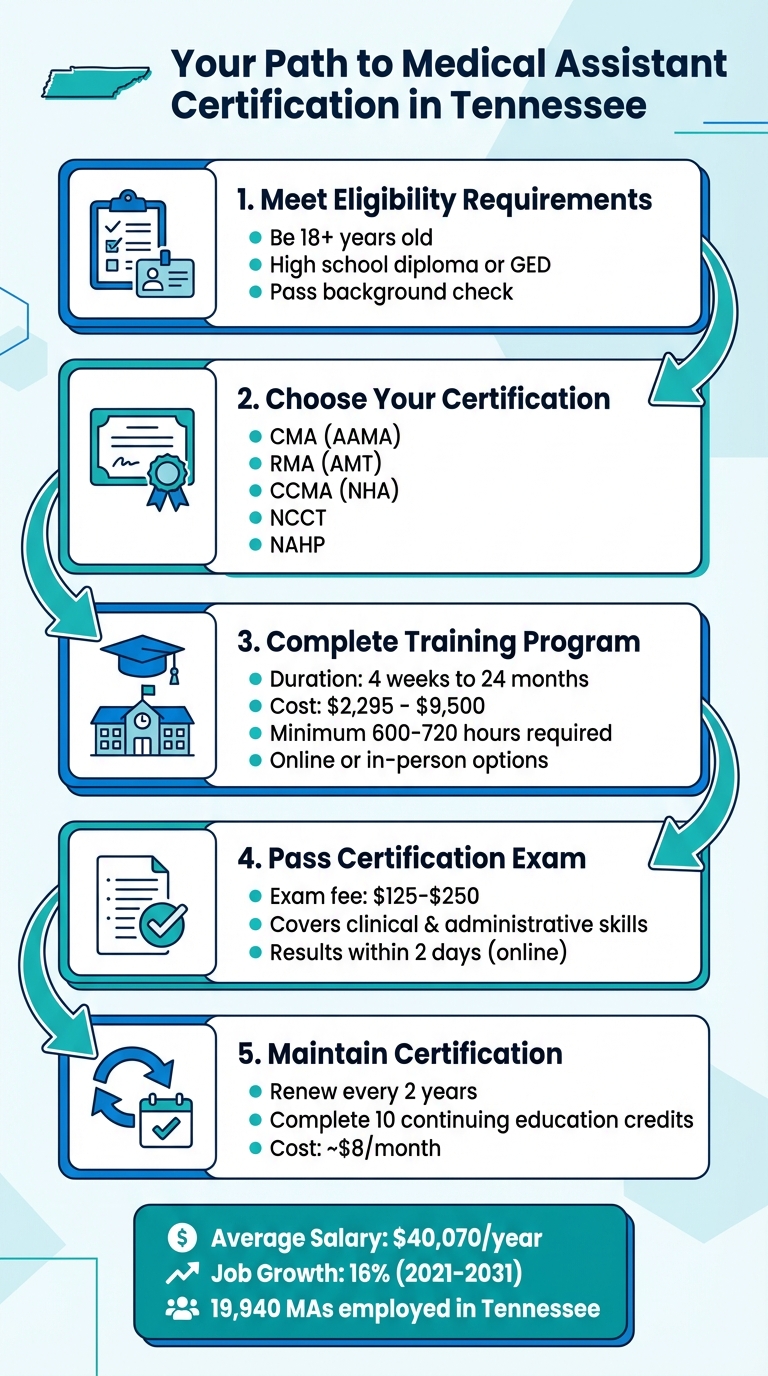
5 Steps to Become a Certified Medical Assistant in Tennessee
MA Exam Practice Part 2 | CCMA RMA CMA AAMA
sbb-itb-7a67ffa
Tennessee Medical Assistant Certification Requirements
Here’s a closer look at what Tennessee requires for medical assistant certification and how it impacts your career.
In Tennessee, medical assistants aren’t legally required to hold a license or certification to work in most healthcare settings. However, under Tennessee Code § 68-11-244, certification becomes mandatory for those administering medications in ambulatory outpatient hospital clinics. The state accepts certifications from five organizations: American Association of Medical Assistants (AAMA), American Medical Technologists (AMT), National Center for Competency Testing (NCCT), National Healthcareer Association (NHA), and National Association for Health Professionals (NAHP). Additionally, certified medical assistants in these settings must wear a visible name tag that clearly identifies their certification status.
If you’re considering certification, it’s important to understand the general eligibility requirements.
Eligibility Criteria
Most certification programs share a few basic requirements. Candidates must:
- Be at least 18 years old
- Have a high school diploma or GED
- Pass a background check
Beyond these basics, specific certifications come with their own requirements:
- Certified Medical Assistant (CMA): Offered by the AAMA, this requires graduation from a program accredited by CAAHEP or ABHES and taking the exam within 12 months of completing the program.
- Registered Medical Assistant (RMA): The AMT certification requires either 720 hours of formal training (including 160 hours of externship), three years of full-time work experience, or equivalent military training.
- Certified Clinical Medical Assistant (CCMA): Provided by the NHA, this certification requires either completing a training program in the last five years or one year of supervised work experience within the past three years.
Meeting these criteria not only makes you eligible for certification but also positions you for more advanced clinical roles.
Why Get Certified
Earning certification can make a big difference for your career in Tennessee. Many employers prefer or require certification, especially for positions with expanded clinical responsibilities. Without it, you may be limited in your ability to perform tasks like administering medications or vaccines in outpatient hospital clinics. Certification not only broadens your job opportunities but also sets the stage for specialized roles and career growth in Tennessee’s healthcare sector. It’s a step worth taking for those looking to advance in this fast-growing field.
Medical Assistant Certification Options in Tennessee
Tennessee recognizes five national certifications under Code § 68-11-244, which allow certified medical assistants to administer medications under supervision. Certification not only meets state requirements but also opens up opportunities for advanced clinical roles and potentially higher salaries. Your choice will depend on your education, work experience, and career goals. Here are the main certification options that align with Tennessee’s standards and cater to various career paths.
Certified Clinical Medical Assistant (CCMA)
The CCMA, offered by the National Healthcareer Association (NHA), is a popular choice in Tennessee due to its flexible eligibility criteria. You can qualify by completing an approved training program within the last five years or through one year of supervised work experience in the past three years. Schools like Columbia State Community College and TCAT Knoxville provide preparation for this certification.
The CCMA exam focuses on clinical skills, including vital signs, EKGs, phlebotomy, and managing electronic health records. Certification renewal is required every two years, which involves completing 10 continuing education credits. This averages out to about $8 per month. According to the 2025 Industry Outlook, 96% of employers either require or recommend certification for medical assistants.
Other National Certifications
- Certified Medical Assistant (CMA): Offered by the AAMA, this certification requires graduation from a CAAHEP- or ABHES-accredited program and taking the exam within 12 months of program completion. Exam fees are $125 for AAMA members or recent graduates and $250 for non-members. The test includes 200 multiple-choice questions covering clinical (59%), administrative (20%), and general (21%) topics.
- Registered Medical Assistant (RMA): Administered by AMT, this certification has flexible eligibility pathways, including 720 hours of formal training (with 160 hours of externship), three years of full-time work experience, or qualifying military training. The application fee is $135. The RMA exam evaluates both clinical and administrative skills, making it a good option for those with diverse backgrounds.
Each of these certifications meets Tennessee’s requirements for expanded clinical duties. Choosing the right one will depend on your current qualifications and how it aligns with your long-term career plans.
Medical Assistant Training Programs in Tennessee
Tennessee offers a variety of medical assistant training programs designed to equip students with both the theoretical knowledge and practical skills needed for success in healthcare. These programs come in different formats, durations, and price points, allowing you to choose what best fits your schedule and budget. Whether you prefer attending classes in person or learning from home, there’s something for everyone.
Program Structure and Curriculum
Medical assistant programs in Tennessee blend administrative and clinical training to prepare students for the demands of healthcare work. On the administrative side, you’ll gain skills in medical billing, electronic health records (EHR) management, and patient scheduling. Clinical training covers topics like anatomy, phlebotomy, EKG technology, pharmacology, and patient care techniques.
Accredited programs typically require at least 600 hours of combined classroom and practical training. For those pursuing the Registered Medical Assistant (RMA) certification, the requirement increases to 720 hours, including a 160-hour externship. Many programs align their curriculum with national certification exams, such as the CCMA or CMA, and often include exam vouchers valued between $160 and $218.
If your goal is to earn the CMA (AAMA) credential, it’s important to choose a program accredited by CAAHEP or ABHES, as this is a mandatory eligibility criterion. For example, South College in Knoxville holds CAAHEP accreditation, enabling graduates to sit for the AAMA certification exam immediately after completing their program.
Online and In-Person Training Options
Tennessee’s training programs offer flexibility with various learning formats, including fully online, hybrid, and traditional in-person options.
Online programs provide convenience for those with busy schedules. The University of Memphis offers a fully asynchronous 6-month program for $4,500. Middle Tennessee State University features a self-paced 380-hour course priced at $2,295, while the University of Tennessee‑Martin provides a 12-month online program for $2,795, covering 540 hours of coursework. Impressively, the US Career Institute boasts a 95% CCMA exam pass rate among its graduates, well above the national average of 83%. Their program costs $1,439 if paid upfront or $1,739 with installment payments.
Many online programs include clinical kits for at-home practice, featuring tools like stethoscopes, blood pressure cuffs, and venipuncture trainer arms.
For those who prefer face-to-face learning, campus-based programs offer structured instruction. TCAT Jackson provides a comprehensive 12-month program with 1,296 clock hours for under $6,100. Hybrid options, such as the University of Tennessee‑Chattanooga’s 18-week program, combine online coursework with scheduled on-campus sessions and cost $3,245. This program also boasts a 100% certification pass rate.
Key Program Types in Tennessee
| Program Type | Duration | Best For | Cost Range |
|---|---|---|---|
| Fast-Track | 4 Weeks | Rapid job entry | Varies |
| Certificate/Diploma | 6–12 Months | Entry-level clinical roles | $2,295–$6,100 |
| Associate Degree | 15–24 Months | Career advancement | $4,800–$9,500 |
Practical externships are a vital part of these programs, ensuring students gain the hands-on experience employers value.
Externships and Hands-On Training
Externships are a cornerstone of medical assistant training in Tennessee, offering students the chance to apply their skills in real healthcare settings. Most programs require 80 to 180 hours of clinical placement.
During an externship, you’ll handle tasks like measuring vital signs, performing phlebotomy, applying dressings, and preparing patient care areas. This hands-on experience is particularly important in Tennessee, where certified medical assistants may be authorized to administer medications, such as vaccines, in outpatient settings.
To qualify for an externship, you’ll usually need to pass a background check and drug screening. Many schools provide placement services to make the process easier. For example, Tennessee State University’s "Ready to Work" (RTW) program guarantees externship placement at no extra cost once you’ve completed your coursework and passed the necessary screenings. Cleveland State Community College also reports a 78.57% job placement rate for its program, which includes an externship component.
Some online programs, like those offered by the University of Tennessee‑Martin and Middle Tennessee State University, treat externships as optional rather than mandatory. Completing an externship not only strengthens your resume but also ensures you’re well-prepared for certification exams.
How to Prepare for the CCMA Certification Exam
Exam Eligibility and Registration
Before diving into exam prep, make sure you meet the eligibility criteria for the CCMA exam. To qualify, you need a high school diploma or GED, or you must be on track to earn one within the next 12 months. Additionally, you’ll need to complete a training program within the last five years or have recent supervised work experience.
Registration is a simple process. Start by creating a free account on the NHA website and submit your application through their candidate portal. To confirm your qualifications, use the "Check Your Eligibility" tool available on the NHA website. Once approved, you can select your testing option: at your school, a PSI testing center, or even from home with live remote proctoring. For online exams, you’ll typically receive your results within two days through your account.
After registering, take some time to understand the exam format so you’ll know what to expect on test day.
Exam Format and Content
The CCMA exam evaluates both clinical and administrative skills. Clinical topics include tasks like taking vital signs, performing EKGs and phlebotomy, administering injections, and assisting with exams and procedures. On the administrative side, you’ll be tested on duties like patient check-in and check-out, scheduling, answering calls, and managing electronic health records (EHR). Beyond these technical skills, the exam also focuses on soft skills such as professionalism, critical thinking, and communication – qualities that employers value highly.
Knowing the exam content will help you focus your preparation efforts effectively.
Study Resources and Tips
The NHA provides several resources to help you prepare. These include a CCMA Study Guide priced at $69, Practice Tests for $49 (which come with three tests and two attempts per test), and a Preparation Package for $94 that combines the guide and practice tests. You can also download the free CCMA Test Plan from the NHA website to get a detailed overview of the exam topics.
For more personalized study help, the Focused Review® tool offers recommendations based on your performance on practice tests. If you’re often on the go, the NHA Mobile app provides flashcards that align with the exam material – perfect for quick reviews during downtime. To build confidence and stamina, try simulating the test environment by regularly completing full-length practice exams. This not only helps you get comfortable with the format but also highlights areas where you need improvement.
Once you pass the exam and earn your certification, keep in mind that you’ll need to renew it every two years. This involves completing 10 continuing education credits and paying a recertification fee of about $8 per month. Following these steps will position you for better job opportunities and career growth in healthcare, especially if you’re pursuing roles in Tennessee.
Career Opportunities for Certified Medical Assistants in Tennessee
Job Market Overview
Tennessee employs around 19,940 medical assistants, placing it 14th in the U.S. for employment in this field. The profession is expected to grow by 23% through 2030, a rate far exceeding the national average.
Nashville plays a pivotal role in driving this demand. Known as the "Silicon Valley of Health Care", the city is home to over 500 healthcare companies, including major employers like HCA Healthcare and Vanderbilt University Medical Center. These organizations generate a wealth of job opportunities. Certified Medical Assistants (CMAs) in Tennessee earn an average of $42,872 annually, equating to roughly $21 per hour. In the Nashville-Davidson–Murfreesboro–Franklin metro area, the median salary is approximately $41,500.
Outside of urban hubs, rural and underserved areas across Tennessee show a strong need for medical support staff. This demand stems from efforts to enhance healthcare access in these communities. Employers increasingly prioritize certification when hiring, offering certified medical assistants better pay and more stable employment.
Where Medical Assistants Work
The robust job market for CMAs in Tennessee translates into opportunities across various healthcare settings. Approximately 57% of medical assistants work in physicians’ offices, 17% in hospitals, and 10% in outpatient care centers. Other common workplaces include urgent care facilities, specialty clinics, assisted living centers, and nursing homes.
Certified medical assistants juggle both clinical and administrative responsibilities. On the clinical side, they assist in tasks like measuring vital signs, aiding with examinations, administering medications, conducting lab tests, and performing procedures like phlebotomy and EKGs. Administratively, they handle Electronic Health Records (EHR), schedule appointments, manage insurance and billing, and communicate with patients.
Tennessee’s major healthcare employers include HCA Healthcare, Vanderbilt University Medical Center (which sees over 2 million patient visits annually), Covenant Health in East Tennessee, CHI Memorial Hospital in Chattanooga, the University of Tennessee Medical Center in Knoxville, and Baptist Memorial Health Care in Memphis. These organizations offer a variety of roles, ensuring a broad range of work environments for CMAs.
Career Advancement Opportunities
Certification not only enhances job prospects but also opens pathways for career growth. Many CMAs pursue specialized certifications in areas like phlebotomy, EKG technology, or EHR management, increasing their value in the job market and qualifying them for specialized roles within larger healthcare systems. Experienced medical assistants often step into administrative management, medical billing and coding, or office leadership positions. For those aiming to advance clinically, the CMA role can serve as a launchpad for Physician Assistant (PA) programs or even medical school. Additionally, earning an Associate of Science in Medical Assisting can pave the way for management roles.
Tennessee’s business-friendly environment further enhances its appeal. The state boasts no income tax and a cost of living that’s about 9.5% below the national average. Organizations like the Tennessee Society of Medical Assistants (TSMA) provide additional support through networking, advocacy, and continuing education, making Tennessee an excellent place to establish a long-term healthcare career.
Conclusion
Earning your medical assistant certification in Tennessee sets you up for success in a growing healthcare industry. Certification not only aligns with employer expectations but also gives you the legal authority to administer certain medications and vaccines under Tennessee law.
Here’s how to get started: enroll in an accredited training program – costs typically range from $2,795 to $9,500 – gain practical experience through a clinical externship, and pass a national certification exam like the CCMA. Many programs offer flexible learning options, including fast-track courses as short as four weeks or fully online formats. Certification exam fees usually range from $125 for members to $250 for non-members.
Tennessee offers a variety of healthcare environments, from busy urban hospitals to smaller rural clinics, all of which depend on certified professionals to deliver quality care. Certified medical assistants in the state benefit from competitive pay and job security. Keep in mind, certification renewal is required every two years, along with continuing education. This credential also paves the way for future opportunities in advanced roles.
Whether you’re entering healthcare for the first time or moving up from an uncertified position, certification can be a game-changer. About 32% of medical assistants eventually move into roles like nursing, healthcare management, or other advanced positions, making this a strong starting point for long-term career development. With high demand, accessible training, and employers actively looking for certified professionals, now is a great time to take this step. Start your certification journey today and take your healthcare career in Tennessee to the next level.
FAQs
Do I need certification to work as a medical assistant in Tennessee?
In Tennessee, you don’t need certification to work as a medical assistant. That said, getting certified is a smart move. Many employers either prefer or require certification, which can open the door to better job opportunities. Plus, it can help you stand out and grow your career in the healthcare industry.
Which certification should I choose for my career goals?
The right certification for your medical assistant career in Tennessee largely depends on your personal goals and what employers in your area are looking for. While Tennessee doesn’t require medical assistants to be certified by law, earning a credential like the Certified Medical Assistant (CMA) or Registered Medical Assistant (RMA) can make a big difference. The CMA, in particular, is well-known and frequently favored by employers, making it an excellent choice if you’re aiming to enhance your job opportunities and earning potential.
How can I get certified if I want to give shots or medications?
To administer shots or medications as a medical assistant in Tennessee, you can aim for voluntary certification through organizations like the AAMA (American Association of Medical Assistants) or AMT (American Medical Technologists). While Tennessee law doesn’t mandate certification, earning credentials such as CMA (Certified Medical Assistant) or RMA (Registered Medical Assistant) can boost your career prospects and demonstrate your expertise.
To qualify, you’ll need to complete an accredited training program and pass the certification exam. This process ensures you’re equipped with the knowledge and skills needed to perform these clinical tasks safely and competently.