Certified Clinical Medical Assistants (CCMAs) are essential in healthcare, handling both clinical tasks like taking vital signs and administrative duties such as managing electronic health records (EHR). Certification, offered by the National Healthcareer Association (NHA), boosts job prospects, with 96% of employers requiring or encouraging it. Certified medical assistants often earn higher wages, averaging $21.64 per hour, and enjoy access to more advanced roles. The field is growing rapidly, with a 15% increase in demand projected through 2033, driven by an aging population and expanded healthcare services. To become certified, candidates need a high school diploma or GED and either formal training or relevant work experience. The certification exam covers clinical care, patient education, and medical law, among other topics. Passing it not only validates skills but also opens doors to specialized or leadership roles in healthcare.
How To Get Your CCMA Certification Online With HealthCareerCERTS
What CCMAs Do: Core Responsibilities
Certified Clinical Medical Assistants (CCMAs) balance their time between patient care and administrative tasks, seamlessly combining clinical responsibilities with office management. They play a key role in ensuring patients have a smooth experience from start to finish. Here’s a closer look at what their day-to-day responsibilities involve.
Clinical Duties
CCMAs handle a variety of hands-on tasks that directly contribute to patient care and diagnosis. One of their primary responsibilities is recording vital signs like blood pressure, temperature, pulse, and respiration. They also perform procedures such as phlebotomy (drawing blood), electrocardiograms (EKGs), and administering injections or vaccinations under a physician’s guidance. During exams and minor procedures, CCMAs assist by preparing necessary equipment, positioning patients, and ensuring everything runs smoothly. Additional tasks include performing point-of-care tests, preparing lab specimens, and maintaining a sterile environment by cleaning instruments and exam rooms.
Patient Interaction and Education
CCMAs are often the first point of contact for patients, gathering medical histories and addressing initial questions. Acting as a communication link between patients and healthcare providers, they ensure concerns are relayed and instructions are clear. Their role requires excellent interpersonal skills, professionalism, and the ability to think critically. Educating patients is another crucial aspect – CCMAs explain medications, treatment plans, and follow-up instructions to ensure patients fully understand their care. Many use techniques like the “teach-back” method to confirm comprehension.
Administrative Tasks
Beyond clinical responsibilities, CCMAs handle vital administrative duties that keep healthcare operations running smoothly. They schedule appointments, manage patient check-ins and check-outs, and ensure Electronic Health Records are accurate and up-to-date. CCMAs also take on medical coding and billing tasks, helping healthcare providers secure insurance reimbursements. By coordinating communication within the healthcare team, they help maintain a seamless flow of care for every patient.
sbb-itb-7a67ffa
How to Become a CCMA
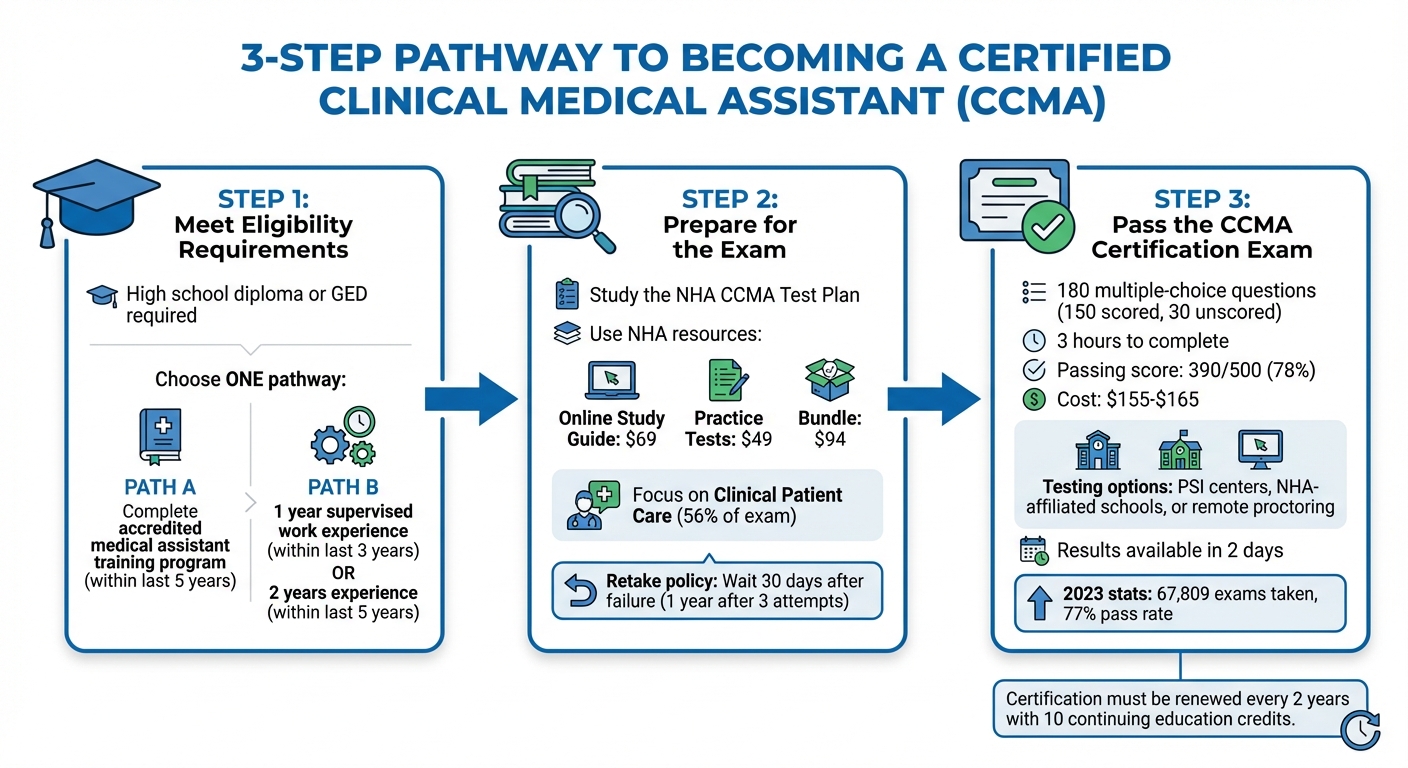
How to Become a Certified Clinical Medical Assistant (CCMA) in 3 Steps
If you’re considering a career as a Certified Clinical Medical Assistant (CCMA), here’s a breakdown of the steps to get there.
Eligibility Requirements
To sit for the CCMA certification exam, you need a high school diploma or GED. High school students nearing graduation can also apply for provisional certification, which becomes official once they provide proof of graduation.
There are two main ways to meet the eligibility criteria:
- Training Program: Complete a medical assistant program from an accredited or state-recognized institution within the last five years. This includes programs through registered apprenticeships or U.S. Military medical training.
- Work Experience: Show relevant experience in the field. This could be at least one year of supervised medical assisting work within the past three years or two years of experience within the last five years.
These pathways ensure candidates have the necessary skills and knowledge to excel in the role.
Preparing for the CCMA Exam
Preparation is key, and creating a solid study plan is your first step. Start with the free NHA CCMA Test Plan to guide your studying. Set up a quiet, distraction-free workspace to focus.
NHA offers helpful resources, including:
- Online Study Guide: Includes interactive quizzes and flashcards for $69.
- Practice Tests: Three unique exams with two attempts each for $49.
- Bundle Option: Get both the study guide and practice tests for $94.
- NHA Mobile App: Access flashcards on the go.
Focus on the most critical areas of the exam. Clinical Patient Care makes up 56% of the test, covering essential topics like patient intake, vital signs, phlebotomy, and EKG procedures. Other areas include administrative assisting, anatomy and physiology, communication, and medical law. If you don’t pass on your first attempt, you can retake the exam after 30 days. After three failed attempts, there’s a one-year waiting period before you can try again.
About the Certification Exam
The CCMA exam consists of 180 multiple-choice questions, with 150 scored and 30 unscored. You’ll have 3 hours to complete it, including two optional breaks. To pass, you need a scaled score of 390 out of 500, which equals about 78%.
You can take the exam at PSI testing centers, NHA-affiliated schools, or through live remote proctoring. The cost ranges from $155 to $165, depending on the testing option you choose. Results are typically available in your NHA account within two days of completing the test. In 2023, 67,809 CCMA exams were taken nationwide, with a 77% passing rate.
Here’s a breakdown of the exam domains:
| Exam Domain | Percentage of Exam | Number of Scored Questions |
|---|---|---|
| Clinical Patient Care | 56% | 84 |
| Foundational Knowledge & Basic Science | 10% | 15 |
| Patient Care Coordination & Education | 8% | 12 |
| Administrative Assisting | 8% | 12 |
| Communication & Customer Service | 8% | 12 |
| Anatomy & Physiology | 5% | 8 |
| Medical Law & Ethics | 5% | 7 |
| Total | 100% | 150 |
Career Benefits of CCMA Certification
Once you’ve taken the steps to become a Certified Clinical Medical Assistant (CCMA), it’s time to consider how this certification can elevate your career.
Job Market Demand
The healthcare field has a growing need for certified medical assistants. In fact, demand is expected to rise by 15% through 2033, which translates to around 119,800 new job openings annually. Certification not only confirms your qualifications but can also make you a more appealing candidate to employers, who see certified professionals as better equipped to reduce risks like malpractice claims.
This demand also impacts salaries. About 63% of employers offer higher pay to certified employees. The median annual salary for medical assistants is approximately $42,000, with top earners making up to $45,900. States like Alaska, Washington, and California often offer even higher earning potential. CCMAs also enjoy flexibility in their work environments, with opportunities in physician offices (57% of positions), hospitals (15%), urgent care centers, specialty practices, diagnostic labs, and even telehealth roles.
In addition to a strong job market, CCMA certification can open doors to specialized roles and leadership positions.
Specialization and Advancement Opportunities
With CCMA certification, you can build on your clinical and administrative skills to pursue specialized areas or leadership roles. Many certified medical assistants move into specialty practices like pediatrics, gerontology, dermatology, or cardiology, where expert clinical support is in high demand. The certification can also act as a stepping stone toward advanced careers, including Licensed Practical Nurse (LPN), Registered Nurse (RN), or roles in Healthcare Administration.
For those who prefer to stay in medical assisting, additional certifications in areas like phlebotomy or EKG testing can enhance your resume and increase earning potential. Leadership roles, such as Medical Office Manager, offer even greater rewards, with average annual salaries of $64,283.
| Role | Average Annual Salary | Job Growth (2023-2033) |
|---|---|---|
| Clinical Medical Assistant | $42,000 | 15% |
| Medical Office Manager | $64,283 | Much faster than average |
| EKG Technician | $56,482 | 11% |
| Phlebotomy Technician | $39,834 | 8% |
CCMA certification not only lays the groundwork for immediate career growth but also positions you for long-term success. As the healthcare field evolves, CCMAs are taking on more responsibilities – 35% of employers report that medical assistants now handle more tasks than before. To stay competitive and ready for new opportunities, make sure to renew your certification every two years by completing 10 continuing education credits.
Conclusion
Becoming a Certified Clinical Medical Assistant (CCMA) is a smart step for anyone looking to build a career in healthcare. With 96% of employers either requiring or recommending certification, earning this credential is quickly becoming a must. It showcases your ability to handle both clinical and administrative tasks, making you stand out in a field expected to grow by 15% through 2033.
The process to get certified is clear-cut: confirm your eligibility, complete the necessary training or gain relevant work experience, and pass the certification exam. This certification doesn’t just improve your chances of landing a job – it also opens doors for future growth. Certified professionals often enjoy better pay, stronger job security, and access to a variety of roles, from specialized practices to leadership positions.
Keeping your certification active through continuing education is key to staying relevant. With a requirement of 10 continuing education credits every two years, you’ll ensure your skills keep pace with the evolving needs of the field – something 35% of employers prioritize.
With demand for CCMAs on the rise and new opportunities emerging, there’s no better time to take this step and secure your place in the growing healthcare industry.
FAQs
What is the difference between the clinical and administrative responsibilities of a Certified Clinical Medical Assistant (CCMA)?
The role of a Certified Clinical Medical Assistant (CCMA) is a mix of clinical responsibilities and administrative tasks, each playing a vital part in healthcare settings.
On the clinical side, CCMAs are hands-on with patient care. This includes measuring vital signs, giving injections, performing venipuncture, assisting with diagnostic procedures, and preparing patients for exams. These duties are key to helping physicians deliver effective care.
Administrative tasks, meanwhile, keep the healthcare facility running smoothly. This involves scheduling appointments, managing electronic medical records, handling patient intake, and overseeing basic office operations. Together, these responsibilities ensure that both patient care and daily operations are handled efficiently.
How does earning a CCMA certification affect salary and career opportunities?
Obtaining a Certified Clinical Medical Assistant (CCMA) certification can give your career a solid push forward. On average, certified professionals in the U.S. earn about $42,000 annually, with the potential to earn even more based on experience, location, and the type of healthcare facility you work in.
But it’s not just about the paycheck. A CCMA certification highlights your skills in both clinical and administrative duties, setting you apart as a strong candidate for healthcare positions. Employers often seek certified individuals, which means this credential can lead to better job prospects and opportunities for career advancement in the healthcare field.
What do I need to do to become a Certified Clinical Medical Assistant (CCMA)?
To earn your Certified Clinical Medical Assistant (CCMA) credential, there are a few steps you’ll need to follow. First, you must hold a high school diploma or GED. After that, you’ll need to either complete a formal medical assisting training program that includes hands-on experience or have at least one year of relevant work experience under your belt.
Once you’ve met these initial requirements, the next step is passing the certification exam offered by the National Healthcareer Association (NHA). This exam is designed to assess your knowledge and skills, ensuring you’re ready for the responsibilities of the role. Using study tools and strategies specifically geared toward the CCMA exam can make a big difference in helping you prepare and move forward in your healthcare career.