Becoming a certified doula involves gaining skills to support families during childbirth and beyond. Certification builds trust, opens career opportunities, and ensures recognition by hospitals and insurers. Here’s a quick overview:
- Why Certification Matters: Boosts credibility, expands job options, and meets insurance/hospital requirements.
- Steps to Certification:
- Research requirements (e.g., CPR certification, scope of practice).
- Complete training (workshops, courses, and required readings).
- Gain hands-on experience (support at least three births).
- Pass assessments and submit documentation.
- Career Insights:
- Average salary: $49,220/year.
- Job settings: Hospitals, agencies, nonprofits, or private practice.
- Doula care saves families $929–$1,360 per birth by reducing medical interventions.
Costs range from $100 to $3,500, but scholarships, payment plans, and early bird discounts can help. Training typically takes 6–12 months, with flexible options like online, in-person, or hybrid programs.
Certification not only prepares you for a fulfilling career but also allows you to make a real impact on families’ lives. Start your journey today!
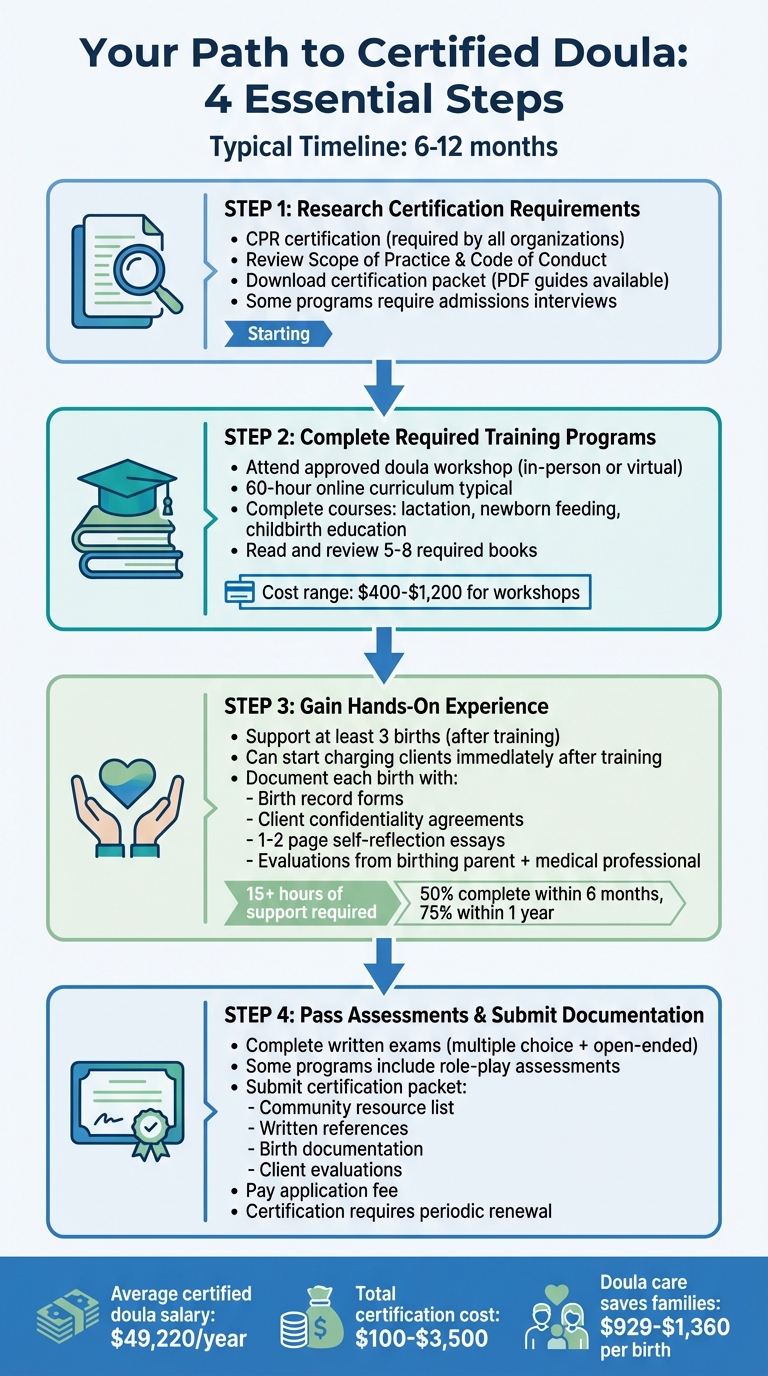
4 Steps to Become a Certified Doula: Training Timeline and Requirements
sbb-itb-7a67ffa
How to Become a Certified Doula
Becoming a certified doula typically involves four main steps that help you develop the skills and expertise needed for the profession. This process usually takes six months to a year, depending on how quickly you progress. Here’s how you can go from aspiring doula to certified professional.
Research Certification Requirements
Before diving into a program, it’s important to understand the requirements of different certifying organizations. Most will ask you to agree to a Scope of Practice, Code of Conduct, and Disciplinary Standards. Some also conduct admissions interviews to ensure you’re a good fit for the role. Additionally, a current CPR certification is a universal requirement across all major organizations.
Start by downloading the certification packet from your chosen organization. Groups like DONA International and the International Doula Institute offer detailed guides in PDF format that outline all forms, deadlines, and requirements. This documentation is your roadmap, helping you see what lies ahead and ensuring you’re prepared for every step of the process.
Complete Required Training Programs
The first major step is to attend an approved doula workshop. These workshops, available in both in-person and virtual formats, cover essential topics like the benefits of doula support, the history of childbirth, and hands-on techniques. For example, the International Doula Institute offers a 60-hour online curriculum, while BirthWorks combines online learning with a three-day in-person or virtual workshop.
"Your journey starts by choosing a DONA Approved Birth Doula Training Workshop." – DONA International
In addition to the primary workshop, you’ll need to complete courses in areas like lactation, newborn feeding, and childbirth education. Most programs also require you to read and review five to eight books on topics related to childbirth and postpartum care.
Meet Hands-On Experience Requirements
Once your training is complete, the next step is gaining practical experience by supporting at least three births. These births must occur after your training to count toward certification. The good news? You can start working with paying clients right away.
"You can start working with paying clients as soon as training ends. The timeline to full certification varies, but… more than half finished within six months and 75% certified within one year." – Robin Elise Weiss, DONA-Approved Trainer
For each birth, you’ll need to document your role thoroughly. This includes completing birth record forms, securing client confidentiality agreements, and writing self-reflection essays (typically one to two pages) about the experience. Additionally, both the birthing parent and a medical professional present at the birth – such as a nurse or midwife – must evaluate your performance. Some organizations even offer Provisional Certification for those who can’t immediately fulfill the hands-on requirement. Recently, DONA International began allowing one virtual support experience to count toward certification.
Once you’ve met the hands-on requirements, you’ll move on to the final phase by submitting all necessary documentation.
Pass Assessments and Submit Documentation
The last step involves completing written exams and submitting your certification packet. Testing methods vary – some organizations rely on traditional multiple-choice and open-ended questions, while others include practical assessments like role plays to evaluate your skills.
"Our certification exam includes multiple choice and open-ended questions; however, we do not rely only on those methods in our examination." – International Doula Institute
Your certification packet will need to include several key elements: a community resource list for client referrals, written references from clients or healthcare professionals, thorough documentation of your birth support experiences, and evaluations from the families you assisted. Don’t forget that most organizations require an application fee before you can submit your packet.
Once approved, you’ll receive your certification. Keep in mind that certifications often require periodic renewal through continuing education. With your certification in hand, you’ll be ready to take the next steps in advancing your career as a doula.
Selecting a Certification Program
Choosing the right certification program is a key step in shaping your career as a doula. Once you understand the certification process, it’s important to find a program that aligns with your professional goals and learning preferences. Look for programs that meet established industry standards and fit how you learn best.
Accredited Doula Certification Organizations
In the United States, several respected organizations set the standard for doula certification. Here are some of the most recognized options:
- DONA International: Known as the largest doula organization worldwide, DONA requires candidates to support three births and adhere to evidence-based standards.
- CAPPA (Childbirth and Postpartum Professional Association): This organization offers specialized tracks for labor, postpartum, and lactation support through its online CAPPA Academy. Certification must be renewed every three years.
- ICEA (International Childbirth Education Association): ICEA provides both traditional and online training options, focusing heavily on maternity education.
- International Doula Institute (IDI): IDI offers a fully online, self-paced 60-hour curriculum with performance-based assessments instead of multiple-choice exams.
Most programs require you to have an up-to-date CPR certification and maintain professional memberships as part of their standards.
What to Consider When Choosing a Program
When selecting a certification program, keep these factors in mind:
- Cost and Timeline: Training workshops generally cost between $400 and $700, with an additional $110 for certification packets. Recertification fees average around $80 every three years. Completion timelines vary – some programs can be finished in as little as one month, while others allow up to four years to meet hands-on requirements.
- Learning Format: Your learning experience can differ depending on the format. In-person workshops, typically lasting two to four days, offer immediate hands-on practice and networking opportunities. On the other hand, online programs provide flexibility, letting you learn at your own pace. For example, IDI’s platform features lessons from professionals like doctors and midwives that you can complete on your schedule. Hybrid models, which combine online theory with virtual workshops, are also becoming more common.
- Support and Mentorship: Strong support systems can make a big difference. Programs like DONA International offer mentorship and access to private community groups like DONA Connect for ongoing guidance. Additionally, check how long your training remains valid – DONA workshops, for instance, are valid for four years.
By weighing these factors, you can find a program that fits your needs and sets you up for success.
Online Training Options Through HealthCareer Certs
HealthCareer Certs offers a flexible, self-paced approach to doula certification, similar to their other healthcare training programs. Their online platform includes interactive tools like 3D demonstrations, quizzes, and flashcards to help you master key techniques at your own speed. Whether you want to complete your training in four weeks or take several months, the program adjusts to your schedule.
The program also provides personalized instructor support through Zoom, allowing you to ask questions and get feedback as you progress. With mobile-friendly access, you can study from anywhere, making it even easier to stay on track.
To prepare you for certification exams and client work, HealthCareer Certs includes comprehensive exam prep. This includes hundreds of practice questions and self-check assessments to ensure you’re confident in your skills. The program follows evidence-based standards, aligning with the expectations of major certifying organizations. Once you’ve completed the online training, you’ll be ready to tackle hands-on requirements and meet documentation standards with ease.
Costs and Financial Planning
Pursuing certification requires more than just time and effort – it also demands thoughtful financial planning. Balancing the costs of education, certification, and hands-on experience is essential to smoothly transition into your new career.
Certification Cost Breakdown
The cost of certification can range from $100 to $3,500, depending on the program you select. These expenses typically include workshop or tuition fees, certification packets, application processing fees, required reading materials, annual membership dues, and CPR certification.
Here’s a closer look at typical costs for traditional programs:
- Workshops: $400–$1,200
- Certification packets and application fees: $40–$155
- Required reading materials: $50–$200
- Annual membership dues: Around $100
- CPR and First Aid certification: $50–$100
Some programs, like HealthCareer Certs, provide flexible pricing options to accommodate different budgets while maintaining high training standards. Additionally, for those who prefer a printed certificate, a physical copy may cost around $10.
Financial Planning Tips for Aspiring Doulas
Once you understand the costs, there are several ways to make financing your certification more manageable. Many programs offer scholarships and flexible payment plans to help reduce upfront expenses. For example, early bird discounts for workshop registrations can save you up to $100.
Another option is exploring internship programs. Some doula agencies may cover part or all of your training costs in exchange for a commitment to serve a specific number of families. If you’re unsure about payment options, reaching out to the admissions office can often lead to a customized plan that fits your budget.
Here’s a way to start earning sooner: Many organizations allow you to charge for doula services as soon as you complete the initial workshop, even before obtaining full certification. Certification is also becoming increasingly relevant for Medicaid reimbursement. States like Oregon now require certification for doulas to qualify for Medicaid or private insurance payments. This means your investment in certification could translate into structured income opportunities.
Don’t forget to account for additional costs, such as travel expenses and potential lost wages while completing the 15+ hours of support for at least three births. Despite these initial expenses, the career potential is promising. With an average annual salary of $49,220 for certified birth doulas, your investment could lead to a fulfilling profession. Plus, your work can help families save between $929 and $1,360 per birth by reducing complications.
Conclusion
Becoming a certified doula follows a straightforward process: attend an approved training workshop, complete the required reading, gain hands-on experience in birth or postpartum support, and submit your documentation for certification. While specific requirements can differ between organizations, the core steps are similar across programs like DONA International, BirthWorks, and the International Doula Institute.
Your choice of certification program plays a key role in shaping your career. It influences your professional approach, provides mentorship opportunities, and connects you with resources that can support your long-term success. As Robin Elise Weiss, PhD, a doula trainer, explains: "You don’t need a medical background. You don’t need to have given birth yourself. What you do need is training that teaches evidence-based birth support, real business skills, and ongoing mentorship".
The timeline for certification is flexible. Some programs can be completed in as little as 12 weeks for those who work quickly. Additionally, completing the initial workshop allows you to start charging for services even before full certification is achieved.
Becoming a certified doula offers both financial and personal rewards. With an average annual salary of $49,220 for certified birth doulas, this career path provides stability while allowing you to make a meaningful difference in the lives of families.
To get started, explore accredited programs that align with your personal values and budget. Use tools like "Chart Your Course" guides to set clear goals for each step of the process, and seek out mentorship opportunities that offer consistent support through office hours or alumni networks. Families are ready for the compassionate care and expertise that certified doulas provide – begin your certification journey today.
FAQs
What are the advantages of becoming a certified doula?
Becoming a certified doula can open doors for both your career and personal development. Certification shows that you’ve received professional training and follow ethical guidelines, which helps establish trust with both clients and healthcare professionals. This trust can lead to more opportunities, whether you’re working in hospitals, birth centers, or running your own practice.
Through certification programs, you gain evidence-based knowledge, practical skills, and mentorship, all designed to prepare you for supporting families during labor and postpartum. Many programs also offer tools and guidance for building and managing your own doula business, making it easier to turn your passion into a thriving career. Ultimately, certification reflects your dedication to providing high-quality care and allows you to play a meaningful role in families’ lives during such a significant moment.
How long does it take to become a certified doula?
The time required to become a certified doula varies based on the program type and your availability to dedicate to the coursework. Self-paced online programs tend to be the fastest option, with many students completing them in just 2 to 8 weeks. If you can devote more time, you might wrap up even sooner.
On the other hand, in-person or hybrid programs usually take a bit longer, often spanning 3 to 6 months. Some more extensive certifications may even provide a few years to fulfill all the necessary requirements. The timeline is flexible, allowing you to tailor it to your schedule and preferred learning pace.
What are the financial aid options for certified doula training?
Doula training can feel like a big financial commitment, but there are several ways to make it more manageable. Many training organizations offer scholarships, which can either cover the full cost or a portion of it. Some scholarships are tailored specifically for BIPOC or LGBTQ+ individuals, while others are open to anyone. It’s a good idea to check the details, especially application deadlines, so you can plan accordingly.
Another option is payment plans, which let you break up the tuition into smaller, more manageable payments over time. Some organizations also provide grants or internship opportunities. These might cover training fees in exchange for commitments like volunteering or working with families who need support. If you’re experiencing financial hardship, certain programs may offer extra assistance to help make training accessible for everyone.