Choosing between online and in-person healthcare training depends on your needs and goals. Here’s a quick breakdown:
- Online Training: Offers flexibility with self-paced learning, lower costs (no travel or housing expenses), and accessibility for remote learners. However, it requires strong self-discipline and often lacks immediate feedback for hands-on skills.
- In-Person Training: Provides direct access to labs, real-time instructor feedback, and networking opportunities. But it’s more expensive, less flexible, and may require commuting or relocation.
Quick Comparison
| Factor | Online Training | In-Person Training |
|---|---|---|
| Flexibility | High; self-paced | Low; fixed schedules |
| Cost | Lower; no commuting or housing costs | Higher; includes travel and facility fees |
| Accessibility | High; internet access required | Limited by location |
| Hands-on Experience | Requires local externships | Direct lab access and supervision |
| Interaction | Virtual; online discussions | Face-to-face; immediate feedback |
Both formats can prepare you for careers like Certified Clinical Medical Assistant (CCMA) or Certified Phlebotomy Technician (CPT). Online programs often include externships to ensure practical skills, while in-person programs excel at hands-on learning.
Key takeaway: Choose online if you need flexibility and lower costs. Opt for in-person if you value structured schedules and direct interaction.
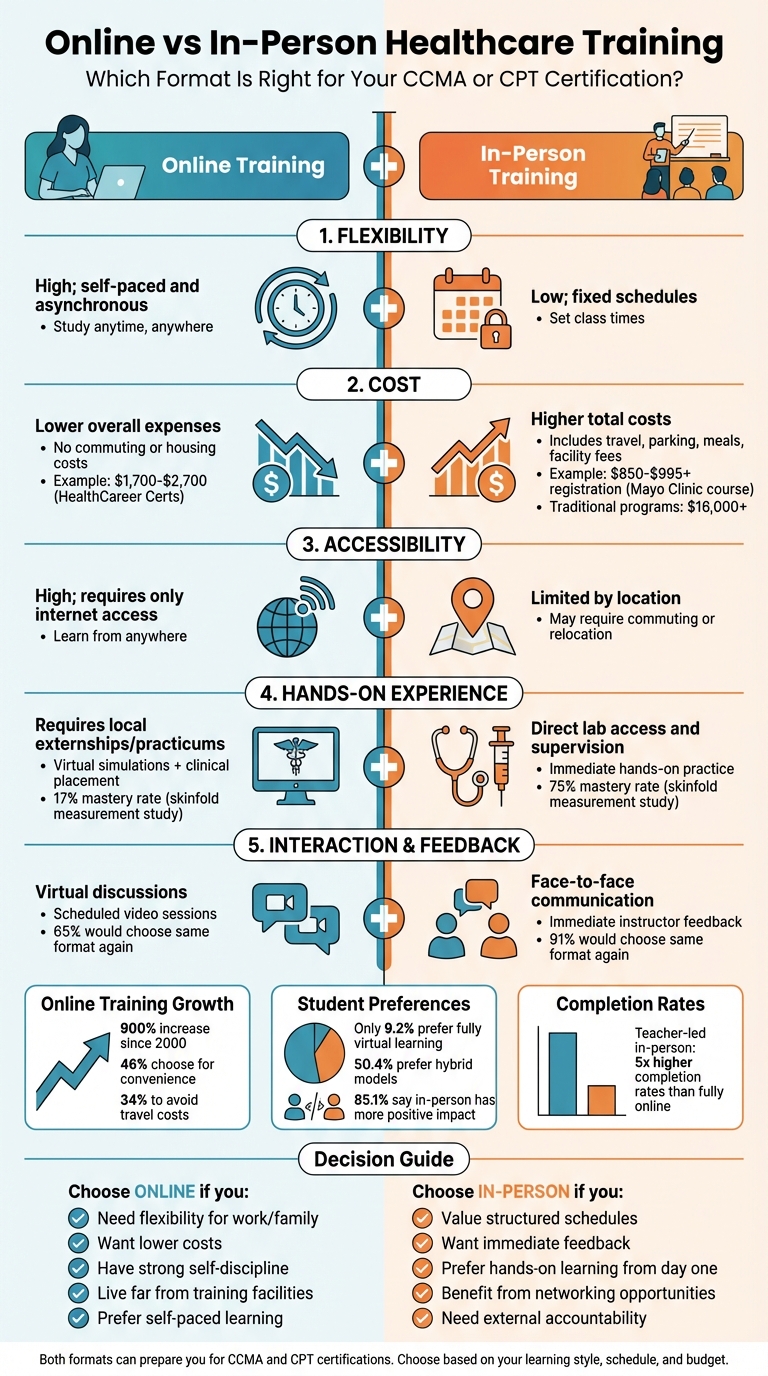
Online vs In-Person Healthcare Training: Complete Comparison Guide
Online Healthcare Training: Pros and Cons
The rise of online healthcare training has been nothing short of dramatic, with a 900% increase since 2000. This shift has transformed how future medical assistants and phlebotomy technicians prepare for certification. But like any educational approach, virtual programs come with both advantages and challenges that shape the learning journey and career preparedness.
Benefits of Online Training
The standout feature of online training? Flexibility. A 2021 survey of healthcare professionals attending virtual continuing medical education revealed that 46% chose online learning for its convenience, while 32% valued the ability to manage their time more effectively. For students pursuing certifications like CCMA or CPT, self-paced modules make it easier to juggle work, family, and education.
Cost savings are another big win. Online programs cut down on tuition and travel expenses, removing barriers for rural students or those with mobility constraints. In fact, 34% of virtual learners specifically opted for online training to avoid travel costs.
Modern technology has also elevated the online learning experience. Gone are the days of static PDFs – today’s programs feature interactive 3D demonstrations, virtual simulations, and live video sessions with instructors. These tools bring clinical scenarios to life, making complex anatomical concepts easier to grasp. Research even shows that online training can be just as effective as in-person instruction for building foundational knowledge. For CCMA and CPT students, these features are invaluable in mastering the theoretical groundwork needed for certification.
However, online training isn’t without its hurdles, especially when it comes to skills that require hands-on practice.
Drawbacks of Online Training
One of the biggest challenges with online healthcare training is the difficulty in developing practical, hands-on skills. For example, a study at Trinity College Dublin‘s School of Medicine found that only 17% of fully online students mastered skinfold measurement, compared to 75% in face-to-face groups and 89% in blended learning setups. Tasks like locating veins for blood draws or properly placing a blood pressure cuff demand in-person feedback, which virtual formats often lack – an issue that directly impacts CCMA and CPT certification readiness.
Another hurdle is the need for self-discipline. Without the structure of a physical classroom, students must take full responsibility for managing their schedules. Research shows that teacher-led, in-person courses have nearly five times higher completion rates than fully online programs. Staying focused and motivated in a virtual setting requires extra effort to minimize distractions and stick to a study plan.
Lastly, online formats can limit spontaneous interaction. While many programs include scheduled video sessions with instructors, the organic Q&A and peer discussions of a traditional classroom are harder to replicate. A 2021 study of medical students found that only 9.2% preferred fully virtual learning, while 50.4% leaned toward hybrid models that combine online theory with in-person practice.
sbb-itb-7a67ffa
In-Person Healthcare Training: Pros and Cons
Traditional in-person healthcare training has long been the gold standard for clinical education. While online programs are gaining traction, in-person training continues to offer distinct advantages – especially for hands-on roles like Certified Clinical Medical Assistant (CCMA) and Certified Phlebotomy Technician (CPT). However, it’s not without its challenges, particularly when it comes to accessibility and cost.
Benefits of In-Person Training
One of the biggest advantages of in-person training is the opportunity to develop hands-on skills. A 2024 study revealed that 75% of students trained face-to-face mastered skinfold measurement, compared to just 17% of those trained exclusively online. For example, CCMA students practicing blood pressure techniques or CPT students learning venipuncture gain invaluable experience through direct, supervised practice.
Another key benefit is immediate feedback. When an instructor observes your technique – like how you position a blood pressure cuff – they can correct mistakes in real time. This kind of guidance helps learners build confidence faster, especially for tasks that require a tactile understanding, which can be hard to grasp through video tutorials alone.
The collaborative environment of in-person training is another draw. In a 2021 survey, 25% of healthcare professionals chose in-person training for this reason, and 91% of those attendees said they’d opt for the same format again, compared to 65% of virtual learners. The relationships built with instructors and peers can lead to clinical placements, job opportunities, and lasting professional networks.
On-campus resources further enhance the learning experience. Structured schedules, dedicated labs, and access to professional-grade equipment provide a level of discipline and immersion that’s hard to replicate in self-paced programs.
Despite these strengths, in-person training does come with some significant hurdles.
Drawbacks of In-Person Training
The cost of in-person training is often a major barrier. Beyond tuition, students must account for expenses like transportation, parking, meals, and possibly housing if the program isn’t local. For instance, the Mayo Clinic’s August 2021 medical education course in Marina del Rey, California, charged registration fees between $850 and $995, not including travel or lodging. In fact, 34% of participants who chose virtual attendance cited avoiding travel-related costs as their primary reason.
Fixed schedules can also be a challenge, particularly for working professionals or those with family responsibilities. Set class times make it difficult to juggle full-time jobs or childcare, and healthcare organizations may struggle to release multiple employees for training at the same time. Unlike online programs, which allow for flexible pacing, in-person classes follow a uniform schedule that might leave quicker learners feeling bored and slower learners overwhelmed.
Geographic limitations further restrict access. Students living far from training facilities may face long commutes or need to temporarily relocate, which can be especially difficult for those with mobility issues.
| Challenge | Impact on Students |
|---|---|
| Higher Costs | Expenses like travel, housing, and meals add financial pressure. |
| Fixed Schedules | Rigid timing conflicts with work and family responsibilities. |
| Limited Accessibility | Long commutes or relocation needs create barriers. |
| Workplace Conflicts | Employers may find it hard to accommodate training schedules. |
When deciding between in-person and online training, it’s important to weigh these pros and cons against your own circumstances and career objectives. Both formats have unique advantages and challenges, so the best choice depends on what aligns with your personal and professional needs.
Side-by-Side Comparison: Online vs In-Person Training
After examining the pros and cons of online and in-person training, this comparison breaks down the key differences for CCMA and CPT candidates. By focusing on flexibility, cost, and hands-on learning, you can better decide which option suits your goals.
Flexibility is a standout feature of online programs. With asynchronous learning, you can access course materials anytime, making it easier to juggle work shifts or family responsibilities. You can speed through content you already know or take extra time to master challenging topics. On the other hand, in-person programs follow a fixed schedule set by instructors, which can limit your ability to adapt the pace of your learning. Online training offers a self-paced experience that many learners find convenient.
Cost is another area where online training often wins. Without the need for physical classrooms or additional support staff, online programs tend to be more affordable. Plus, you avoid extra expenses like commuting, parking, housing, and meals. In contrast, in-person training usually involves higher costs, including travel, facility fees, and materials.
Hands-on learning is where in-person training shines. These programs provide immediate access to labs and real-time instructor feedback, which is essential for mastering clinical skills like venipuncture or blood pressure measurement. Most online CCMA and CPT programs address this gap by requiring local clinical externships or practicums to ensure students gain practical experience.
"Most [online] programs still require an onsite component, particularly for hands-on practical training and clinical experiences".
| Factor | Online Training | In-Person Training |
|---|---|---|
| Flexibility | High; self-paced and asynchronous | Low; fixed schedules |
| Cost | Lower; no commuting or housing costs | Higher; includes travel and fees |
| Accessibility | High; requires only internet access | Limited by location |
| Hands-on Experience | Requires local externships | Direct access to labs and supervision |
| Interaction | Virtual; online discussions | Face-to-face; immediate feedback |
These distinctions reveal how each training format caters to different needs. For example, a Mayo Clinic study showed that 91% of in-person participants would choose the same format again, compared to 65% of livestream participants. Interestingly, a meta-analysis found no major difference in clinical behavior outcomes between online and in-person training. This suggests that when online programs include proper externships, they can deliver comparable results. Ultimately, the choice impacts not just your learning experience but also your readiness for a healthcare career.
HealthCareer Certs Online CCMA and CPT Programs
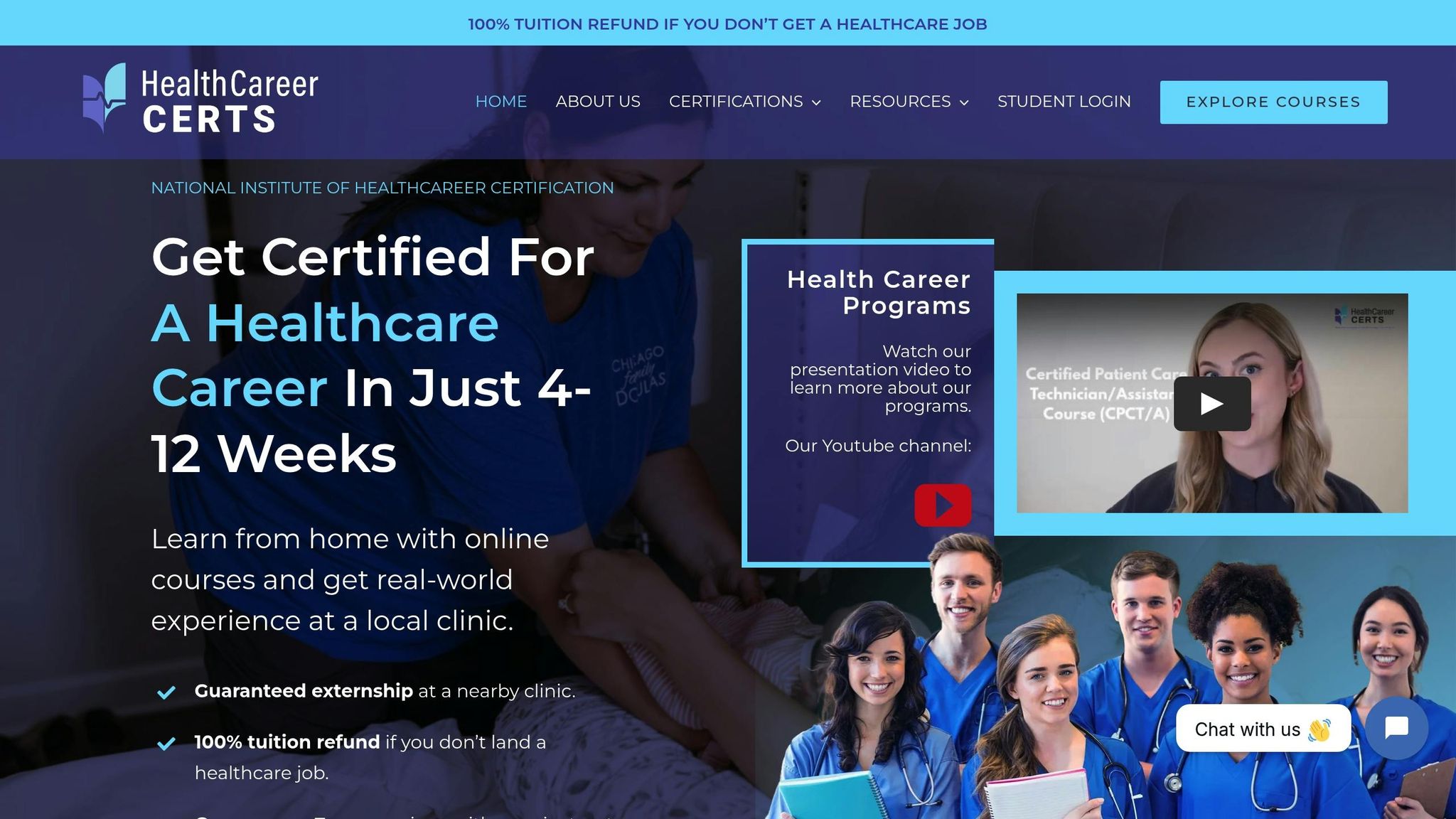
Let’s dive into a standout example of online training: HealthCareer Certs. This platform provides fully online, self-paced courses for CCMA (Certified Clinical Medical Assistant) and CPT (Certified Phlebotomy Technician) certifications. You can access materials anytime, anywhere, on any device. The CCMA program takes 4 to 12 weeks to complete, while the CPT program can be finished in as little as 4 weeks. Tuition costs are $2,700 for CCMA and $1,700 for CPT – far more affordable than traditional in-person programs, which can cost over $16,000. Both programs are licensed by the New Hampshire Department of Education and approved by the National Healthcareer Association (NHA) and the American Medical Certification Association (AMCA).
Practical Experience and Personalized Support
HealthCareer Certs ensures you gain hands-on experience through an unpaid externship at a local clinic or hospital. To address the challenges of online learning, they also provide one-on-one Zoom sessions with instructors.
Comprehensive Exam Preparation
The program includes over 1,400 practice questions, 700 self-checks, and interactive 3D demos, all covered by the tuition fee. Graduates can even earn American Council on Education (ACE) credits, which transfer to more than 2,000 colleges and universities – 5 credits for CCMA and 2 credits for CPT. With over 5,000 students trained and a perfect 5.0 Google review score, many participants have passed the NHA exam on their first try.
"I was able to get certified and pass the NHA exam on the first try in only 6 weeks, and I appreciated the ease of the entire process/course and the other support/resources I received." – Olivia, Student
Job Placement Guarantee
HealthCareer Certs also stands out with its risk-free tuition policy: if you don’t secure a healthcare job within six months of passing your exam and completing your externship – and can show proof of an active job search – you’ll receive a full tuition refund. This policy highlights their dedication to helping students achieve employment success.
How to Choose Between Online and In-Person Training
When deciding between online and in-person training for CCMA and CPT career paths, start by evaluating your learning style and level of self-discipline. Online programs often require a strong ability to manage your time and stay motivated without external reminders. If you find it challenging to meet deadlines independently, an in-person program might suit you better. As Jenna Liphart Rhoads, Ph.D., RN, explains:
"Nursing is a tactile skill and critical thinking discipline which are simply better developed in an in-person environment".
This perspective is echoed by data: 85.1% of medical students in one study reported that in-person learning had a more positive impact on their education compared to virtual formats.
Think about your current responsibilities and how they align with the program’s demands. If you’re juggling work and family, the flexibility of online training can be a game-changer. A 2021 Mayo Clinic study found that 46% of physicians opted for livestreamed training specifically because of its convenience. Linda Joyce Gunn, Ph.D., from Western Governors University, highlights the challenges of in-person learning for some students:
"The disadvantage for students in a face-to-face environment is travel, life, job, and other obligations that may not allow the student to be present (i.e. both physically and emotionally)".
Online programs allow you to study during evenings or weekends, making it easier to fit education into your life.
Consider your preference for feedback and networking opportunities. In-person training offers immediate instructor feedback and fosters stronger connections with peers – 86.8% of students reported better faculty relationships in face-to-face settings. However, many online programs now include local clinical rotations or externships to provide hands-on experience. Be sure that any online program you consider supports these opportunities.
Finally, take practical factors into account, like technology requirements and overall costs. Online learning requires reliable high-speed internet and a computer that meets specific software needs. Before enrolling, ensure your setup can handle these demands. When comparing costs, remember that in-person training often involves additional expenses such as gas, parking, professional attire, and potential lost wages due to fixed class schedules. Online programs typically eliminate costs for room, board, and transportation, which can significantly lower your financial burden.
Conclusion
Deciding between online and in-person training ultimately comes down to what works best for you. If juggling a full-time job or family commitments is part of your reality, online programs let you study at your own pace. On the other hand, if you thrive with structure, real-time feedback, and face-to-face networking, in-person training might be the better fit.
Your career goals should also play a key role in your choice. Think about what matters most – whether it’s flexibility, cost, or hands-on experience. For roles that require advanced clinical skills, look for programs offering strong hands-on components, like labs or guaranteed externships. As CPR123 puts it:
"There is no solid answer as to whether online or in-person learning is better for healthcare training… It all comes down to your resources, your preferred method of learning, and what you’re capable of".
Before enrolling, take a hard look at your learning style, schedule, finances, and technical setup. For in-person training, factor in hidden costs like commuting, parking, and potential lost wages. For online programs, make sure they include clinical hours and hands-on practice if required for certification.
Healthcare professionals come from all kinds of training paths. The key is choosing the one that aligns with your lifestyle and learning preferences.
FAQs
What are the main advantages of choosing an online healthcare training program?
Online healthcare training programs make it easier to learn on your terms. With the ability to study at your own pace, these programs are ideal for busy professionals balancing work and personal responsibilities. Plus, with 24/7 access to course materials, you can learn from anywhere – no need to commute or attend physical classes.
Another advantage is the potential to save money. Online programs cut out costs like travel, housing, and classroom fees. On top of that, they often include modern, engaging tools such as videos, virtual simulations, and interactive assessments. These resources not only keep the learning experience engaging but also help you retain knowledge and build practical skills. For healthcare professionals aiming to grow in their careers, online training offers a convenient and effective solution.
How does in-person training improve hands-on healthcare skills?
In-person training delivers hands-on experience that online programs often struggle to match. Working with real or high-quality simulated equipment allows learners to grasp techniques more effectively – like applying the right amount of pressure or using tools properly. This kind of tactile practice not only sharpens skills but also boosts confidence, both of which are critical for performing healthcare procedures accurately.
Another advantage is the immediate, tailored feedback from instructors. They can watch your technique as you work, point out errors, and offer specific guidance to help you improve. This blend of practical experience and expert input ensures students are well-equipped to handle clinical scenarios with competence and precision.
What should I consider when deciding between online and in-person healthcare training?
When deciding between online and in-person healthcare training, several factors come into play, including flexibility, cost, and your preferred learning style. Online programs are great for those who need the freedom to study at their own pace or juggle work and personal responsibilities. On the other hand, in-person training offers a structured environment with hands-on supervision, which is especially helpful for developing practical clinical skills.
Cost and accessibility are also worth considering. Online programs often cut down on travel and material expenses, making them a more budget-friendly option – especially for those living in remote areas. However, certain skills, like clinical procedures, might require in-person practice to ensure you’re fully prepared. It’s also important to think about your career goals and any certification requirements for roles like CCMA or CPT, as these can influence your decision.
The best choice ultimately depends on your needs and preferences. Some people thrive with the flexibility of online learning, while others do better with the structure and real-world practice that in-person training provides. If you’re torn, hybrid programs might offer the perfect mix of both.