Becoming a certified phlebotomy technician opens doors to a growing career in healthcare. Here’s a quick summary of the steps to get certified:
- Check State Certification Rules: Some states, like California and Washington, require certification by law.
- Meet Basic Eligibility: You need a high school diploma, be at least 18, and pass background checks.
- Choose an Accredited Program: Ensure your training program is recognized by major certification bodies.
- Complete Training and Clinical Hours: Programs typically require coursework and hands-on practice.
- Gain Experience Through Externships: Perform supervised blood draws to meet certification requirements.
- Prepare for the Exam: Study with official guides and pass the certification exam.
- Apply and Maintain Certification: Submit your application and renew credentials every two years.
Certification is often required by employers and can boost your job prospects, salary, and career growth in the healthcare industry.
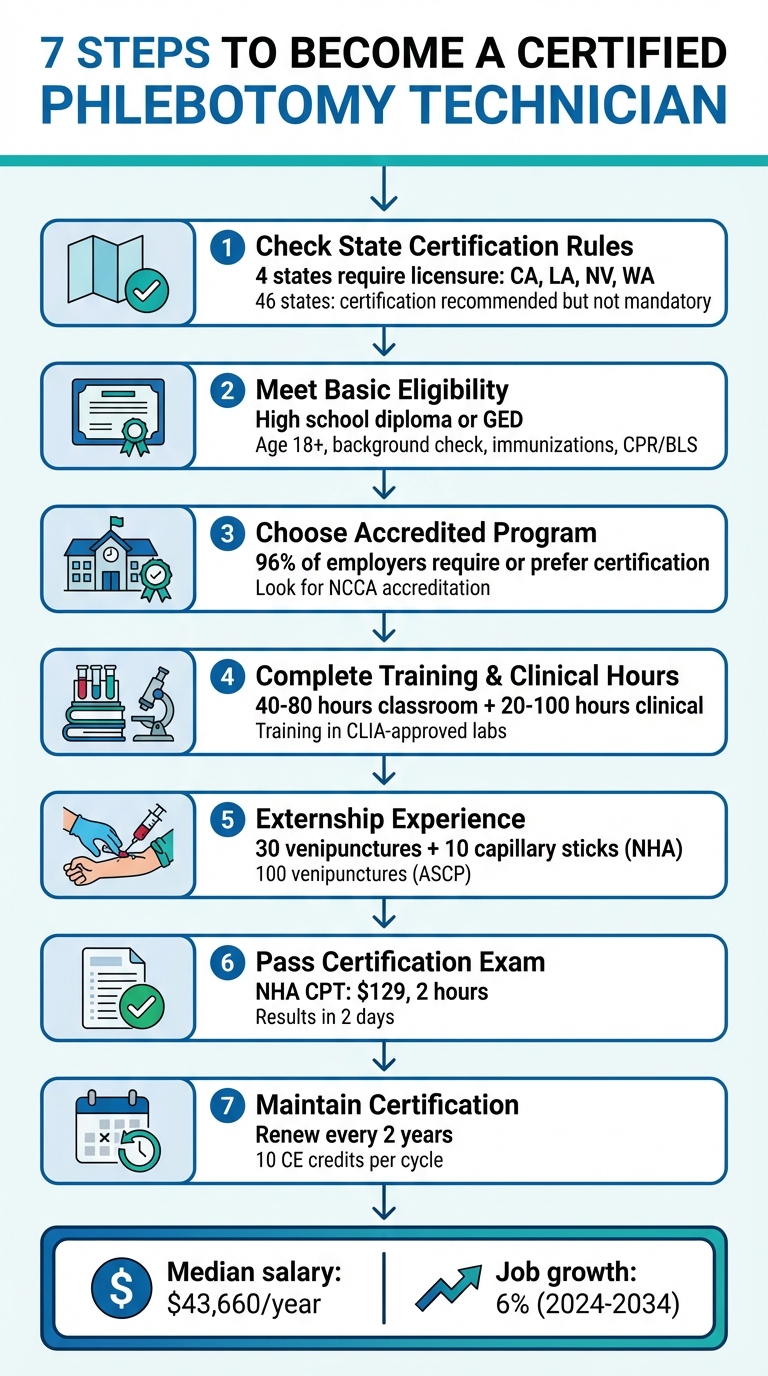
7 Steps to Become a Certified Phlebotomy Technician
Step 1: Check Your State’s Certification Requirements
Before diving into training, it’s crucial to understand your state’s specific certification rules. In the U.S., phlebotomy regulations differ significantly from state to state. While most states don’t regulate the profession, four states – California, Louisiana, Nevada, and Washington – have strict licensing laws that you must follow to work legally.
In these four states, holding a state-issued license or certificate is non-negotiable. Even if you have national certifications, you cannot legally perform blood draws without the proper state credentials. For instance, California implemented rigorous licensure requirements after past incidents highlighted the importance of proper certification. To achieve the CPT I level in California, you’ll need to complete 40 hours of classroom instruction, 40 hours of clinical training, 50 venipunctures, and 10 skin punctures. Washington also has unique requirements, such as a mandatory 7-hour AIDS education and training course for all phlebotomy applicants.
Although only these four states require licensure, certification is highly recommended across the country. In the remaining 46 states, certification might not be legally required, but it’s often a must for employment. For example, Illinois doesn’t mandate a license but does require phlebotomists to have a high school diploma and proof of completing a training program. Even in states without formal licensure laws, most employers expect certification as a baseline qualification.
To ensure you meet your state’s requirements, reach out to the appropriate regulatory agency. Here’s a quick guide:
- California: Contact the CDPH, Laboratory Field Services.
- Louisiana: Reach out to the LSBME.
- Nevada: Check with the Nevada State Board of Nursing or the Division of Public and Behavioral Health.
- Washington: Consult the Washington State Department of Health.
In states without mandatory licensure, it’s wise to check with potential employers or national certifying bodies to understand the credentials they require.
If you’re pursuing certification in California, make sure your training program is CDPH-approved. Otherwise, your application will be denied. Starting in 2026, California will also require annual certificate renewals, including 3 hours of continuing education, even if your card shows a later expiration date. Knowing these details from the start can help you avoid costly mistakes and set you on the right track.
sbb-itb-7a67ffa
Step 2: Meet the Basic Eligibility Requirements
To start, you’ll need a high school diploma or GED equivalent – this is a baseline requirement for most phlebotomy training programs. From there, make sure you meet other criteria, including age and background checks.
Applicants must be at least 18 years old, pass a criminal background check, and complete a drug screening.
In addition to academic qualifications, you’ll need to meet certain health and professional standards. Ensure your immunizations are current – this typically includes vaccines like Hepatitis B, MMR, and Tetanus – before starting clinical training. Many programs also require Basic Life Support (BLS) or CPR certification as a condition for externships.
If you have relevant experience, there may be alternative ways to qualify. For example, military personnel who have received formal medical training in any branch of the U.S. Military may use that experience to meet program requirements. Similarly, licensed healthcare professionals such as RNs, LPNs, PAs, or MDs can sometimes qualify for certification exams based on their existing credentials. The Bureau of Labor Statistics explains:
Phlebotomists typically enter the occupation with a certificate from a postsecondary phlebotomy program, but some qualify with a high school diploma and on-the-job training.
For those relying on work experience, proper documentation is critical. Certification agencies like the NHA require proof of completing 30 successful venipunctures and 10 capillary sticks on live patients, while the ASCP sets the bar at 100 successful unaided venipunctures. Additionally, most agencies expect around 1,040 hours of supervised work experience within the last three to five years.
To prepare, gather supporting documents early. Letters from supervisors – on official company letterhead – can confirm your responsibilities and verify the number of successful blood draws you’ve completed. These records are essential for your certification exam application.
Step 3: Choose an Accredited Phlebotomy Training Program
When selecting a phlebotomy training program, make sure it’s accredited – 96% of employers either require or prefer certification. Look for programs recognized by the National Commission for Certifying Agencies (NCCA), which ensures quality and industry standards. It’s also important to choose a program aligned with major certification bodies like the National Healthcareer Association (NHA). This ensures the program provides the right study materials and exam access to meet certification requirements.
A good program should cover essential topics like anatomy and physiology, blood collection techniques, specimen processing, infection control, and legal/ethical guidelines. Additionally, clinical training is crucial. Verify that the program includes hands-on experience, as this is a requirement for certification.
One example is HealthCareer Certs, which offers a fully online, self-paced phlebotomy program. It features interactive 3D tools, extensive practice questions, one-on-one Zoom sessions, and guaranteed externship placement. With NCCA accreditation, this program meets the industry’s quality standards.
The guaranteed externship placement is a major advantage. It eliminates the hassle of finding a clinical site on your own, ensuring you complete the hands-on training required for certification. This also prepares you for interacting with patients in real-world settings.
Most phlebotomy programs take 4 to 8 weeks to complete, though some may extend to 16 weeks depending on clinical rotations. HealthCareer Certs offers flexibility, allowing you to finish in as little as 4 weeks or take up to 6 months, depending on your schedule. They even provide a 100% tuition refund guarantee if you don’t secure a healthcare job after certification. Once you’ve selected an accredited program, the next step is to focus on completing your training and clinical hours.
Step 4: Complete Your Training and Clinical Hours
Once you’ve selected an accredited program, your next step is to complete both the classroom instruction and clinical training components. The classroom portion typically includes 40 to 80 hours of coursework covering essential topics like anatomy, physiology, blood collection techniques, infection control, and specimen handling. Alongside this, you’ll need to complete a clinical externship, which generally involves 20 to 100 hours of hands-on practice, depending on the program. These hours are a must if you want to qualify for your certification exam.
Clinical hours are non-negotiable for national certification. Without them, you won’t meet the eligibility criteria to sit for certification exams. During your externship, you’ll gain direct, supervised experience performing venipunctures and capillary punctures on actual patients. These sessions typically take place in hospitals, outpatient clinics, or diagnostic laboratories.
Certification agencies set specific clinical benchmarks that you must meet. For instance:
- National Performance Specialists (NPS): Requires 30 successful venipunctures and 10 capillary sticks.
- American Society for Clinical Pathology (ASCP): Mandates 100 unaided venipunctures in a CLIA-approved lab.
- National Healthcareer Association (NHA): Requires 30 successful venipunctures and 10 capillary or finger sticks on live patients.
Training in a CLIA-approved lab is crucial. These labs adhere to strict quality control standards for specimen collection and processing, ensuring your training meets certification requirements. Before starting your externship, confirm that the facility holds a valid CMS CLIA certificate. This step guarantees your clinical hours will count toward certification.
A real-world example highlights how structured this process can be. D’Vaughn House, a phlebotomist at the University of Cincinnati Medical Center, shares a typical timeline:
Typically, a phlebotomist takes classes over a four- to six-month period to learn basics, then there is a 10-day training where you draw blood for eight hours a day.
Additionally, most programs require you to meet certain prerequisites – such as immunizations for MMR, Hepatitis B, and TB testing – as well as pass a background check before beginning your clinical rotations.
Step 5: Get Hands-On Experience Through an Externship
Once you’ve completed your training and clinical hours, the next step is your externship. This phase is where everything you’ve learned comes alive, bridging the gap between theory and practice while meeting the documentation requirements for certification. Simply put, without this hands-on experience, certification isn’t an option.
During your externship, you’ll perform venipunctures and capillary punctures under supervision in real healthcare settings like hospitals, outpatient clinics, or diagnostic labs. This is where you’ll pick up skills that textbooks can’t teach – like finding veins in tough cases, calming nervous patients, and managing unexpected issues like hematomas or fainting. You’ll also get a feel for working in a fast-paced clinical environment, all while following strict infection control measures and ensuring accurate specimen labeling.
Equally important is documenting your work. Every venipuncture and capillary puncture needs to be recorded and signed off by a supervisor to meet certification standards. Make sure your externship site has CMS CLIA accreditation to ensure compliance.
Finding an externship placement can be tricky, but programs like HealthCareer Certs make it easier by guaranteeing placements for their students. They partner with approved healthcare facilities, so you don’t have to stress about securing a spot. Once you’re placed, focus on programs that combine online coursework with required in-person training.
An externship isn’t just a certification requirement – it’s your chance to build the real-world skills and confidence employers look for in a certified phlebotomy technician.
Step 6: Prepare for and Schedule Your Certification Exam
Once your externship is complete, it’s time to gear up for your certification exam. The certification you choose should align with your state’s requirements. Some of the most recognized options include the NHA Certified Phlebotomy Technician (CPT), the ASCP Phlebotomy Technician (PBT), and the NCCT National Certified Phlebotomy Technician (NCPT). According to the 2025 Industry Outlook, 96% of employers either require or prefer certification, so this step can significantly impact your job opportunities.
To get started, download the official test plan for your chosen exam. This will help you zero in on the key topics you’ll need to study. For example, the NHA CPT exam costs $129, lasts two hours, and can be taken at your school, a PSI testing center, or even remotely from home using live proctoring. Following the test plan ensures that your preparation is focused on what matters most for success.
When it comes to studying, interactive tools can be a game-changer. Use resources like study guides, quizzes, and practice tests to reinforce your knowledge. Practice tests start at $49, while bundled study packages, which include guides and allow up to six practice attempts, are available for $84. These tools often include features like Focused Review, which highlights areas where you need improvement after each practice test. Mobile-optimized flashcards are another handy option, letting you study wherever you are.
To register for your exam, create an account with your certifying organization. Submit your application along with proof of clinical hours – this typically includes at least 30 venipunctures and 10 capillary sticks for the NHA certification. Pay the exam fee and, once your application is approved, schedule your test date and location. If you’re opting for a remote exam, make sure to complete a system compatibility check ahead of time. Keep in mind that mobile devices are not supported for remote testing.
After completing your online exam, NHA will post your results to your account within two days. Passing the exam officially earns you the title of certified phlebotomy technician, marking the start of your new career in the field.
Step 7: Apply for Certification and Keep Your Credentials Current
After successfully passing your exam, the next step is to apply for certification and ensure your credentials stay valid. This process involves submitting an application to your chosen certifying organization. Most certifying bodies require you to create an online account, fill out an application, and pay a non-refundable fee. For example, the American Certification Agency (ACA) charges $100.00, the ASCP Board of Certification requires $155.00, and the National Healthcare Certification Organization (NHCO) charges $125.00. Applications are typically processed within about five business days. Once approved, you officially become a certified phlebotomy technician.
To complete your application, you’ll need to provide key documents such as your high school diploma or GED, training transcripts, and clinical competency forms. Be sure to gather all required materials ahead of time, as application fees won’t be refunded if your documentation is rejected.
Keeping Your Certification Valid
Certification isn’t a one-time achievement – it requires ongoing maintenance. To keep your credentials active, you’ll need to renew them every two years. This renewal process includes completing 10 continuing education (CE) credits within each two-year cycle. According to the NHA, this can cost about $8 per month, and they even offer free CE courses for active members. Staying on top of renewals ensures you maintain your professional standing and career growth opportunities. As Priscilla Greenwell, PBT(ASCP)CMMLACM, MLTCM, highlights:
An ASCP BOC credential provides immense value by enhancing professional credibility and showcasing a commitment to high standards in laboratory practice.
California-Specific Requirements
If you’re working in California, additional steps are required to renew your CPT I license through the California Department of Public Health (CDPH). Renewal notices are sent out 75 days before your license expires, and the renewal window opens 60 days prior. To avoid any lapses, make sure to submit your renewal application at least 30 days before expiration. Once approved, the CDPH issues digital certificates, which you can print directly from their website.
Handling Expired Certifications
If your certification expires, don’t panic – you have a one-year grace period to reinstate it without retaking the exam. To avoid this situation, keep track of your CE credits throughout the renewal cycle and plan ahead to ensure there are no interruptions in your certification status.
Conclusion: Begin Your Career as a Certified Phlebotomy Technician
The path to becoming a certified phlebotomy technician is straightforward and achievable. By following the steps – reviewing state requirements, completing accredited training, gaining clinical experience, passing the certification exam, and maintaining your credentials – you’ll be well on your way to a rewarding career. With 93% of phlebotomy positions requiring certification and 96% of employers either mandating or strongly favoring it, earning your certification is a crucial step toward professional success.
Certification leads to a wealth of career possibilities. The median annual wage for phlebotomists is $43,660, and the field is expected to grow by 6% between 2024 and 2034. From hospital laboratories to outpatient care centers and even travel phlebotomy roles, your credentials will open doors to a variety of opportunities and career advancements.
HealthCareer Certs provides a 100% online, self-paced phlebotomy certification program tailored to help you succeed. The program includes guaranteed externship placements, personalized instructor support, interactive learning tools, and thorough exam preparation. Plus, they offer a tuition refund if you’re unable to secure a healthcare job after completing the program.
Take the first step with an accredited program and join the ranks of professionals making a meaningful difference in patient care and diagnostics every day.
FAQs
What are the certification requirements for phlebotomy in states without licensing laws?
In states where licensure isn’t mandatory, the path to becoming a certified phlebotomy technician generally includes completing a formal training program, acquiring practical clinical experience, and passing a recognized certification exam such as the Certified Phlebotomy Technician (CPT). Certification organizations often ask for proof of education and relevant work experience as part of the process.
Even though state requirements differ, following these steps helps you meet national standards and sets you up for a rewarding career in phlebotomy.
How can I find a phlebotomy training program with guaranteed externship placement?
To locate a phlebotomy training program that offers a guaranteed externship, begin by exploring accredited programs that clearly state externships are included in their curriculum. Pay close attention to details about hands-on training and clinical experience, as these are crucial for both certification and preparing for a career in the field.
When comparing programs, directly verify with the admissions staff that externship placement is indeed guaranteed. Well-established programs often provide this to ensure students gain practical, real-world experience. Take the time to carefully review program descriptions and don’t hesitate to ask questions to confirm the program aligns with your goals.
How do I renew my phlebotomy certification to prevent it from expiring?
To maintain an active phlebotomy certification, you’ll need to renew it every two years before it expires. Many certifying organizations let you begin the renewal process as early as six months prior to the expiration date. Renewal often involves completing continuing education units (CEUs) or, in some cases, passing a re-examination – requirements vary depending on the certifying organization.
Keeping track of renewal deadlines is essential to ensure your certification stays valid and to avoid any interruptions in your career. Be sure to review the specific renewal guidelines provided by your certifying body.