
Medical assistants and phlebotomists are two entry-level healthcare roles with distinct responsibilities, training, and career paths. Here’s a quick breakdown:
- Medical Assistants: Handle both administrative (scheduling, billing) and clinical tasks (taking vitals, assisting in procedures). Training takes 9 months to 2 years, and they often work in physician offices or outpatient clinics. Median salary (2024): $44,200. Job growth: 12% by 2034.
- Phlebotomists: Specialize in drawing blood and managing lab samples. Training is shorter, typically 4 to 8 months. They work in hospitals, labs, or blood donation centers. Median salary (2024): $43,660. Job growth: 6% by 2034.
Both roles are in demand due to the aging U.S. population. Medical assistants offer more varied career opportunities, while phlebotomists focus on precision and patient interaction during blood collection.
Quick Comparison
| Feature | Medical Assistant | Phlebotomist |
|---|---|---|
| Primary Role | Clinical + Administrative tasks | Blood collection + Lab work |
| Training Length | 9 months to 2 years | 4 to 8 months |
| Median Salary (2024) | $44,200 | $43,660 |
| Job Growth (2034) | 12% | 6% |
| Work Settings | Physician offices, outpatient clinics | Hospitals, labs, donation centers |
This guide will help you decide which career fits your goals.
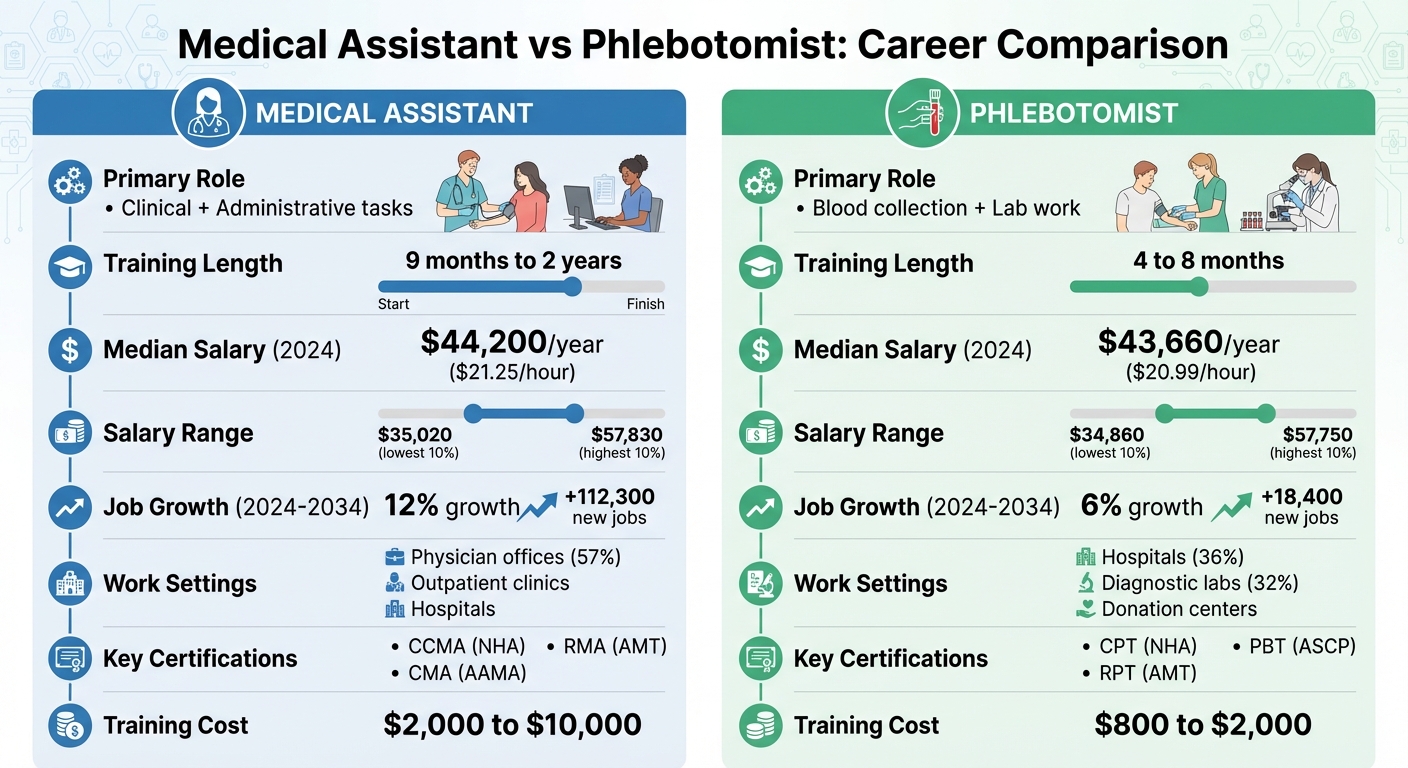
Medical Assistant vs Phlebotomist Comparison Chart: Salary, Training, and Career Growth
What Medical Assistants Do
Medical assistants juggle both administrative and clinical responsibilities, making them essential in various healthcare environments like physician offices, hospitals, and outpatient clinics. In fact, about 57% of medical assistants are employed in physician offices.
The role is anything but repetitive. One moment, you might be updating electronic health records, and the next, you’re checking a patient’s blood pressure or helping with a minor procedure. Kaitlyn Howard, a Licensed Practical Nurse and former medical assistant, sums it up well:
"Having a good understanding of medical terminology and great time management skills will help in the daily flow and how many patients are seen throughout the day."
This dynamic role demands excellent organizational skills and the ability to adapt to a mix of tasks. Let’s take a closer look at the administrative and clinical aspects of the job.
Administrative Tasks
Medical assistants are often the first point of contact for patients. They greet visitors, verify insurance details, and manage appointments, ensuring schedules run efficiently. They’re also responsible for financial tasks like processing insurance claims, handling medical billing and coding, collecting co-pays, and following up on unpaid balances. Maintaining accurate and confidential electronic health records is another crucial part of their job.
In addition, medical assistants handle communications – answering phones, directing calls, and responding to patient emails. They also coordinate referrals to specialists, obtain prior authorizations for procedures, and manage inventory by ordering medical and office supplies. In specialized practices, such as OB/GYN offices, they may focus on scheduling specific tests like PAP smears or pregnancy tests.
While administrative tasks keep the office running smoothly, clinical duties focus on patient care.
Clinical Duties
On the clinical side, medical assistants interview patients to document their medical histories and routinely measure vital signs like blood pressure, temperature, pulse, and weight.
They prepare exam rooms, sterilize instruments, and set up equipment before the physician arrives. During exams, medical assistants support doctors with procedures such as removing sutures, performing skin biopsies, or conducting allergy tests. In some cases, they may perform diagnostic tests, like EKGs.
Medical assistants also handle specimen collection, including drawing blood under supervision. Depending on state regulations, they may administer medications or give injections under a physician’s direction. Afterward, they educate patients about medication use, special diets, or post-procedure care. Throughout all clinical tasks, medical assistants ensure safety by disposing of contaminated supplies and adhering to strict safety protocols.
This balance of administrative and clinical duties makes medical assistants vital to the healthcare team. Their contributions ensure both the smooth operation of medical facilities and quality care for patients.
sbb-itb-7a67ffa
What Phlebotomists Do
Phlebotomists are healthcare professionals who focus on blood collection and related lab procedures. Unlike medical assistants, who juggle both administrative and clinical responsibilities, phlebotomists dedicate themselves entirely to mastering the art of drawing blood safely and accurately. In 2024, hospitals employed 36% of phlebotomists, while 32% worked in medical and diagnostic laboratories.
According to the Bureau of Labor Statistics, "in medical and diagnostic laboratories, patients sometimes interact only with the phlebotomist". This means they often represent the lab to patients, requiring both technical expertise and strong interpersonal skills. This singular focus sets them apart from the broader duties of medical assistants.
Blood Collection and Patient Interaction
Phlebotomists perform procedures like venipuncture and capillary punctures (finger sticks) to collect blood samples for testing, transfusions, research, or donations. Before drawing blood, they confirm patient identity and explain the process to reduce anxiety. This step is critical, as highlighted by Aaron Sweeney from Northeast Technical Institute:
"A single mistake during the blood collection process can lead to inaccurate test results, patient discomfort, or even serious complications".
Their role goes beyond technical skills; phlebotomists must also monitor patients for immediate reactions and respond appropriately. Precision and attention to detail are non-negotiable in this field.
Needle anxiety is common, so phlebotomists rely on compassion and clear communication to put patients at ease. The Bureau of Labor Statistics emphasizes that "Phlebotomists talk with patients and donors so they are less nervous about having their blood drawn". In some cases, they also guide patients on collecting other specimens, such as urine, ensuring proper procedures are followed.
Specimen Handling and Safety Protocols
Once samples are collected, phlebotomists take meticulous steps to ensure each specimen’s safety and accuracy. Proper labeling is crucial, as all blood samples look the same, and errors could lead to misdiagnoses. They also handle the storage and transportation of specimens, ensuring they remain viable for testing.
Safety is a top priority in this role. The American Society for Clinical Pathology explains: "Safety and sanitation are an important part of a phlebotomist’s job for infection control, as phlebotomists are dealing with blood and other bodily fluids". Phlebotomists adhere to strict CDC guidelines for handling diseases like HIV/AIDS and Hepatitis B. This includes proper needle disposal, wearing personal protective equipment (PPE), and maintaining sterile environments. However, the job comes with risks – phlebotomists experience one of the highest rates of injuries and illnesses among all occupations due to their exposure to bloodborne pathogens.
Education and Certification Requirements
The paths to becoming a medical assistant or a phlebotomist differ significantly in terms of time commitment and the range of skills involved. Medical assistant programs are more extensive, covering both clinical and administrative functions – topics like pharmacology, medical billing, and clinical procedures. These programs usually take between 9 months and 2 years, depending on whether you’re pursuing a certificate or an associate degree. Phlebotomy training, on the other hand, focuses almost entirely on blood collection and specimen handling. Programs are shorter, typically lasting 4 to 8 months, with some accelerated options completed in just weeks. Below, we’ll break down the specific training and certification requirements for each role.
Training for Medical Assistants
Medical assistant programs are designed to prepare students for a versatile role that combines administrative and clinical responsibilities. The coursework includes anatomy, pharmacology, medical terminology, administrative tasks, and hands-on clinical skills. Most programs also require a supervised practicum or internship in a healthcare setting, which is essential for graduation and certification eligibility.
Certifications commonly pursued by medical assistants include:
- Certified Clinical Medical Assistant (CCMA) from the National Healthcareer Association (NHA)
- Certified Medical Assistant (CMA) from the American Association of Medical Assistants (AAMA)
- Registered Medical Assistant (RMA) from American Medical Technologists (AMT)
Although certification isn’t a legal requirement in most states, employers often prefer hiring certified candidates. Certified medical assistants can also earn around 10% more compared to their non-certified counterparts.
Training for Phlebotomists
Phlebotomy training is highly specialized, focusing on techniques for blood collection and specimen management. The curriculum includes venipuncture, capillary punctures, infection control, safety procedures, and proper specimen handling. Hands-on practice is a key component, with certification exams requiring documented experience. For example:
- The Certified Phlebotomy Technician (CPT) exam requires candidates to complete at least 30 venipunctures and 10 capillary punctures.
- The Registered Phlebotomy Technician (RPT) credential from AMT requires proof of 50 venipunctures and 10 capillary punctures.
Certification requirements vary by state. In places like California, Louisiana, and Washington, certification or licensure is mandatory. However, in many other states, it’s not required. That said, 96% of employers either require or strongly encourage certification, as highlighted in the 2025 Industry Outlook.
Side-by-Side Certification Comparison
| Feature | Medical Assistant | Phlebotomist |
|---|---|---|
| Program Length | 9 months to 2 years | 4 to 8 months (some as short as a few weeks) |
| Credential Type | Certificate, Diploma, or Associate Degree | Certificate or Postsecondary Nondegree Award |
| Primary Certifications | CCMA (NHA), CMA (AAMA), RMA (AMT) | CPT (NHA), PBT (ASCP), RPT (AMT) |
| Clinical Requirement | Supervised practicum or internship | 30–50 successful venipunctures |
| Estimated Cost | $2,000 to $10,000 | $800 to $2,000 |
Both certifications can be obtained by taking exams at approved testing centers or through live remote proctoring. The National Healthcareer Association (NHA) typically provides official results within two days of scoring. If you’re looking to maximize your qualifications, consider enrolling in a medical assistant program that includes phlebotomy training. This way, you can qualify for both the CCMA and CPT exams, expanding your career opportunities.
Keep in mind, certification exams usually require about 1 to 2 months of preparation after completing your training. These comparisons highlight the distinct skillsets and training paths for each profession.
Skills Needed: Medical Assistants vs Phlebotomists
The skills required for medical assistants and phlebotomists highlight the core difference between the two roles: medical assistants are healthcare generalists, while phlebotomists are focused specialists. These distinct skill sets also influence their training and certification paths.
Medical assistants juggle a mix of clinical and administrative duties, from taking vitals and administering injections to handling billing and scheduling. Their role demands flexibility and the ability to switch seamlessly between patient care and office management. Key skills include interpreting medical charts, managing electronic health records, performing EKGs, assisting with minor procedures, and educating patients about medications or treatment plans.
Phlebotomists, on the other hand, focus on mastering venipuncture techniques for diverse patient groups. Their responsibilities require strict adherence to infection control protocols and maintaining the chain of custody for blood samples. Precision, attention to detail, and the ability to reassure nervous patients are crucial in this role.
These differing skill sets also shape how each professional interacts with patients. Medical assistants often act as a bridge between patients and physicians, staying involved throughout the entire visit – from intake to discharge. In contrast, phlebotomists engage in shorter, high-pressure interactions, focusing on calming patients and monitoring for any signs of distress during blood collection.
The broader training of medical assistants opens doors to more varied career paths, including specialization in fields like dermatology or cardiology. Phlebotomists, while more specialized, can pursue roles in areas like mobile phlebotomy or trauma care. In some states, such as California, medical assistants may need additional certifications to perform blood draws at the same level as phlebotomists.
Recognizing these skill differences can help you choose a career path that aligns with your strengths and interests.
Salary and Career Growth
Salary Comparison
Medical assistants and phlebotomists have distinct roles, and their salaries reflect these differences. As of May 2024, medical assistants earned a median annual wage of $44,200 ($21.25 per hour), while phlebotomists earned $43,660 ($20.99 per hour) – a difference of about $540 per year. The lowest 10% of medical assistants earned below $35,020, compared to phlebotomists at $34,860. On the higher end, experienced medical assistants could earn up to $57,830, while phlebotomists reached $57,750.
Earnings also depend on the work environment. In outpatient centers, medical assistants earned $47,560, slightly less than phlebotomists at $48,450. However, in physician offices – where 57% of medical assistants are employed – medical assistants earned $43,880, compared to $40,480 for phlebotomists.
Geography plays a big role, too. For example, medical assistants in Washington earned an average of $53,780, while phlebotomists in California made around $47,230 – both significantly higher than the national averages.
These salary differences are relatively modest but highlight the varying career paths and opportunities in each field.
Career Advancement Opportunities
Medical assistants tend to have more opportunities for growth. Their employment is projected to grow by 12% between 2024 and 2034, adding approximately 112,300 new jobs. Meanwhile, phlebotomist roles are expected to grow by 6%, creating about 18,400 new positions.
Medical assistants’ broader training opens doors to diverse career paths. Many transition into roles like medical office management or health information management. Others leverage their clinical experience to advance into nursing or even physician assistant positions. As Donald Jacobsen, MSN, MBA, RN-BC, explains:
"Medical assistants may take additional training to become medical office managers or health information management specialists."
Phlebotomists often follow a more specialized route, focusing on laboratory expertise. They may advance to lead phlebotomist roles, donor center supervisors, or laboratory assistants. With further education, they can become clinical laboratory technicians or technologists, which typically come with higher salaries. Specialized certifications, such as those in arterial blood collection or pediatric phlebotomy, can also boost their career potential.
Choosing the Right Career Path
Deciding between a career as a Medical Assistant or a Phlebotomist comes down to your strengths, interests, and long-term goals. Medical assistants take on a variety of responsibilities, from answering phones and checking vitals to assisting with minor procedures. On the other hand, phlebotomists focus on the specialized task of drawing blood and handling specimens with precision.
Training duration and cost are also important considerations. Phlebotomy training is typically shorter and more affordable, making it a quicker path to entering the workforce. Medical Assistant programs, while requiring a greater time and financial commitment, open doors to broader career opportunities, such as nursing, office management, or even becoming a physician assistant.
Think about your comfort level with different types of work. Medical assistants juggle a wide range of tasks, requiring solid knowledge of medical terminology and strong time management skills. Phlebotomists, however, need to be skilled and confident in handling needles and blood while also calming patients who may have needle anxiety.
Your preferred work environment is another factor to weigh. Medical assistants often work in physician offices or outpatient clinics, typically during regular daytime hours. These settings allow for more consistent schedules and the chance to build longer-term relationships with patients. Phlebotomists, by contrast, are more likely to work in hospitals, diagnostic labs, or blood donation centers. These roles may involve night, weekend, or holiday shifts, with patient interactions that are usually brief and task-focused.
Both career paths offer strong job security, with demand for both professions expected to grow in the coming years. No matter which path you choose, earning a national certification – like the Certified Clinical Medical Assistant (CCMA) or Certified Phlebotomy Technician (CPT) – can enhance your job prospects, increase earning potential, and open doors to future career advancement.
FAQs
What’s the difference between a medical assistant and a phlebotomist?
The key difference between the two roles lies in their focus and responsibilities. Medical assistants juggle both administrative and clinical tasks. They might schedule appointments, maintain patient records, take vital signs, assist during exams, and sometimes even handle blood draws. Their role spans across various functions, making them integral to both the front and back ends of healthcare operations.
Phlebotomists, in contrast, are specialists in drawing blood. Their work centers on blood collection, ensuring samples are labeled correctly, and preparing them for lab analysis. While medical assistants have a wide range of duties, phlebotomists concentrate on mastering the art of blood collection and providing care specifically related to that process.
What is the difference in training time between medical assistants and phlebotomists?
The time it takes to train as a medical assistant can vary widely, typically spanning anywhere from 4 months to 2 years. This extended period is necessary because the training covers a mix of both clinical tasks and administrative responsibilities.
On the other hand, phlebotomist training is much shorter. Many programs can be completed in just a few months, with some even offering certification in as little as one month. This makes phlebotomy an appealing option for those eager to jump into the healthcare field quickly.
For those who want to start working sooner, phlebotomy is the faster route. However, medical assisting offers a broader skill set, opening doors to a more diverse range of responsibilities.
What are the career growth opportunities for medical assistants and phlebotomists?
Medical assistants often enjoy a wider range of career advancement options, thanks to their blend of clinical and administrative skills. With further education or certifications, they can step into roles like medical office managers, health information specialists, or even move into specialized clinical positions. This versatility provides opportunities to grow in numerous areas within healthcare.
Phlebotomists, on the other hand, typically focus on roles centered around blood collection and laboratory work. Advancing in this field might involve becoming a clinical laboratory technician or earning certifications like a CPT-1 license. These qualifications can lead to more independent roles, especially in states where specific licensing is required.
While both careers offer room for growth, medical assistants tend to have a broader range of pathways compared to the more focused progression available to phlebotomists.