Becoming a medical assistant in just six months is achievable with the right training program and preparation. These professionals handle both clinical and administrative tasks in healthcare settings like hospitals and clinics. With demand for medical assistants expected to grow by 12% from 2024 to 2034, this career offers promising job prospects and a median annual salary of $44,200 as of May 2024.
Here’s how you can fast-track your path:
- Enroll in an Accredited Program: Look for a 4–6 month program accredited by CAAHEP or ABHES. Many online options offer flexibility and affordability, with costs ranging from $1,200 to $4,500.
- Complete a Clinical Externship: Hands-on experience (160–204 hours) is crucial for building skills and meeting certification requirements.
- Earn Certification: Choose from credentials like CMA (AAMA), CCMA, RMA, or NCMA to stand out to employers. Certification is required or preferred in most states.
- Prepare for the Certification Exam: Use practice tests, study guides, and consistent study routines to pass on your first attempt.
- Polish Your Resume: Highlight your certification, externship experience, and relevant skills like phlebotomy, EKGs, and medical billing to secure a job.
With accelerated programs and strong demand, you can start a rewarding healthcare career quickly and efficiently.
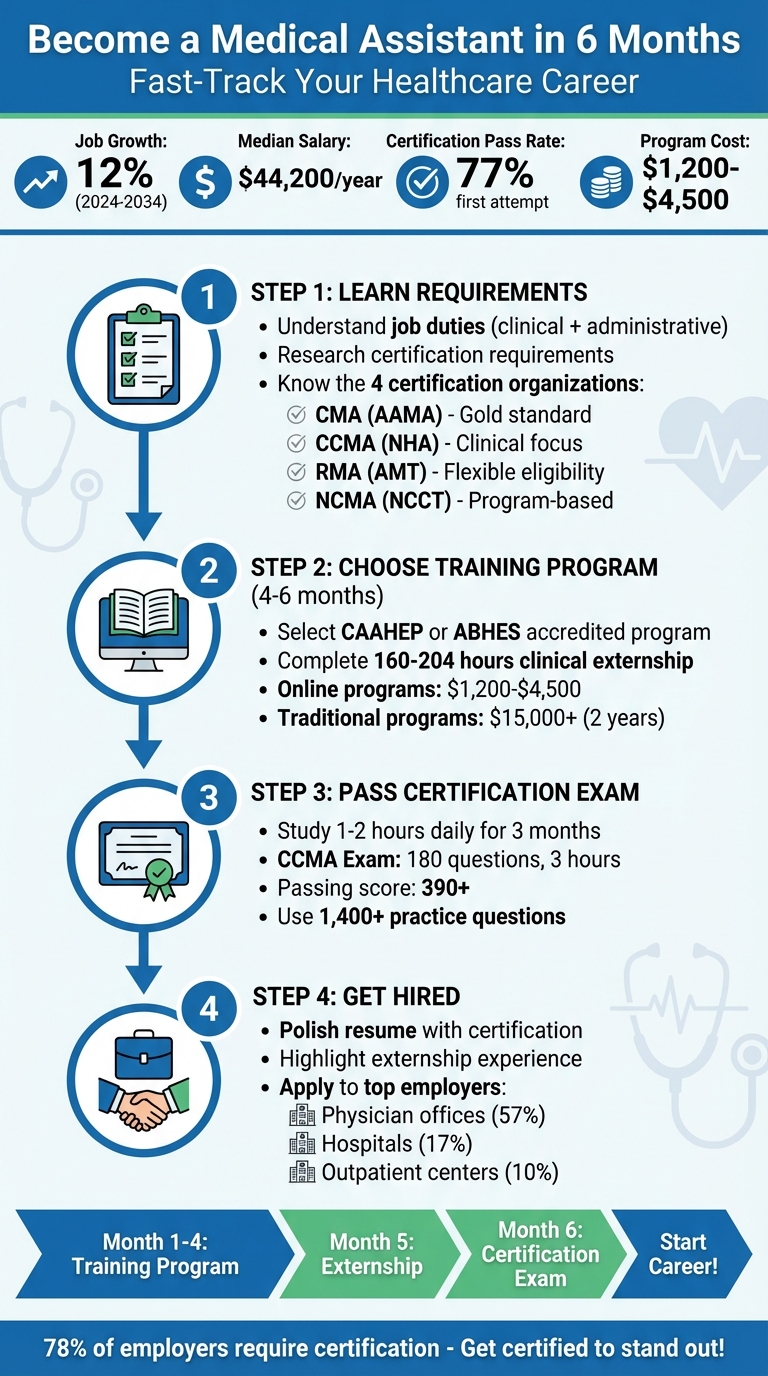
How to Become a Medical Assistant in 6 Months: 4-Step Career Path
Step 1: Learn What Medical Assistants Do and What You Need
Medical Assistant Job Duties
Medical assistants play a crucial role in keeping healthcare facilities running smoothly by managing both administrative and clinical tasks. On the administrative side, they handle phone calls, schedule appointments, greet patients, update electronic health records, and manage billing and insurance claims. Clinically, their responsibilities include measuring vital signs, recording patient histories, preparing patients for exams, assisting physicians during procedures, and performing tasks like administering medications, drawing blood, conducting EKGs, changing wound dressings, and educating patients about medications or dietary needs – depending on state regulations. To excel in this role, you’ll need strong analytical skills, excellent communication, compassion, and sharp attention to detail. Interestingly, about 57% of medical assistants work in physicians’ offices, while 17% are employed in hospitals. These varied duties underscore why certification is so important for proving your skills and jumpstarting your career.
Why You Need Certification
Because medical assistants juggle such a wide range of responsibilities, certification plays a key role in ensuring you meet national standards and stand out to employers. While not all states require certification, most healthcare facilities either mandate or strongly prefer it. Certification demonstrates your competence in both clinical and administrative areas, making you a more appealing candidate and potentially increasing your earning potential. In some states, like Washington, certification is required for licensure, while states like New Jersey and South Dakota demand it for specific tasks.
"My NHA certification has helped me financially advance my career. Most importantly it has given me opportunity to get a job that allows me to be a better mom by being home in the evenings and on the weekends." – Jessica Aponte, CCMA
Certification Organizations You Should Know
If you’re looking to get certified, there are four main organizations offering nationally recognized medical assistant credentials. Each one is designed to help you enter the field quickly:
- American Association of Medical Assistants (AAMA): Offers the CMA (AAMA) credential, often seen as the gold standard. To qualify, you must graduate from a CAAHEP- or ABHES-accredited program.
- National Healthcareer Association (NHA): Provides the Certified Clinical Medical Assistant (CCMA) credential, which focuses on clinical patient care. You can qualify by completing a training program within the last five years or having one year of supervised work experience.
- American Medical Technologists (AMT): Offers the Registered Medical Assistant (RMA) certification. Eligibility requires either completing an accredited program or having three years of work experience.
- National Center for Competency Testing (NCCT): Certifies medical assistants through the NCMA credential. This requires graduation from an NCCT-approved program or two years of relevant experience.
Each certification has its own renewal requirements and fees to maintain active status, so it’s important to stay on top of those details.
sbb-itb-7a67ffa
Step 2: Choose a 6-Month Training Program
Key Program Requirements
When selecting a training program, make sure it’s accredited by organizations like CAAHEP, ABHES, or DEAC. Accreditation ensures that your certification exams will be recognized by employers and that you’ll meet eligibility requirements. Some programs even include certification exam fees in their tuition, which can save you anywhere from $150 to $259. Look for programs that offer comprehensive support, such as study materials, practice tests, and one-on-one guidance from instructors. These resources will help you develop both administrative skills (like billing, coding, and managing electronic health records) and clinical abilities (such as EKGs, pharmacology, and phlebotomy).
Another key feature to prioritize is a supervised clinical externship ranging from 160 to 204 hours. Be wary of programs that claim to be entirely online without requiring hands-on experience, as this is a red flag.
Online programs, in particular, stand out for their convenience and affordability, making them an excellent choice for many students.
Why Online Programs Work Well
For those juggling work or other responsibilities, online programs offer unmatched flexibility. For example, HealthCareer Certs provides a fully self-paced option with 24/7 access, so you can study whenever it fits your schedule – whether that’s during your lunch break or late at night. Unlike traditional associate degree programs, which can take two years and cost over $15,000, accelerated online programs are faster and more budget-friendly. These programs typically cost between $1,200 and $4,500 and can be completed within four to eight months.
Mobile-friendly platforms make it even easier to keep up with coursework, allowing you to learn on your phone. Many programs also offer virtual office hours, interactive demos, and an array of practice questions to help you prepare for certification exams.
While online learning is convenient, practical externships are crucial for building real-world skills.
Getting Hands-On Experience Through Externships
Clinical externships provide the hands-on experience you need to feel confident and job-ready. These supervised experiences, which fit into your six-month training schedule, allow you to apply what you’ve learned in a real healthcare setting. Certification boards like the National Healthcareer Association (NHA) and American Medical Technologists (AMT) require documented externship hours – typically 160 to 204 hours – before allowing you to take their exams. During this time, you’ll gain experience with essential tasks such as drawing blood, administering injections, performing EKGs, and measuring vital signs, all under professional supervision.
"By completing the externship, students become genuinely patient-ready, confident, and aligned with employer expectations." – Montes Healthcare College
To ensure a seamless experience, choose a program that guarantees or helps arrange externship placements. For instance, HealthCareer Certs offers guaranteed externship opportunities, so you won’t have to find a clinical site on your own. Some programs even provide medical equipment kits – like venipuncture practice arms – so you can start practicing at home before stepping into a clinical setting. This combination of online learning and supervised hands-on training ensures you’re fully prepared to transition from student to professional medical assistant.
Step 3: Study for Your Certification Exam
Study Materials and Practice Tests
Start by reviewing the test content outline provided by your certification board, whether it’s NHA, AAMA, or AMT. This outline spells out the topics covered on the exam, helping you focus on what matters most. For example, the CCMA exam includes 180 multiple-choice questions (150 scored and 30 unscored) to be completed in three hours. To pass, you’ll need a score of 390 or higher. On average, 77% of test-takers pass on their first try.
HealthCareer Certs can be a great resource, offering over 1,400 practice questions and 700 self-checks built into its program. Full-length practice exams are especially helpful because they mimic the actual test environment, building your endurance for the three-hour session. Tools like NHA’s Focused Review® take it a step further by analyzing your practice test results and giving tailored recommendations to address weak areas. For added convenience, you can use NHA Mobile for flashcards, making it easy to study during breaks or on your commute.
Interactive tools like MA Skillsbuilder™ are also worth exploring. They use simulations and virtual patients to help you practice clinical skills like phlebotomy and EKGs, as well as administrative tasks like billing and scheduling. Keep a "frequent misses" notebook to track and correct recurring errors – this method is a proven way to strengthen weaker topics. Combining these tools with a consistent study routine will set you up for success.
How to Manage Your Study Time
Consistency is your best ally. Instead of cramming, aim to study 1–2 hours daily, five days a week. A steady three-month plan might look like this:
- Month 1: Build a strong foundation in anatomy, pharmacology, and medical terminology.
- Month 2: Focus on applying your knowledge with practice tests.
- Month 3: Sharpen your test-day strategies and time management skills.
"Consistency is key. Develop a study schedule that dedicates at least 1–2 hours per day, five days per week, to exam preparation." – Health Tech Academy
Since Clinical Patient Care makes up 54% of the CCMA exam, devote two full weeks to mastering this domain. For the remaining sections – Administrative Assisting (13%), Foundational Knowledge (10%), Anatomy & Physiology (8%), Patient Care Coordination (5%), Communication & Customer Service (5%), and Medical Law & Ethics (5%) – spend about a week on each. Studying at the same time daily can help you establish a routine that fits around your other responsibilities. Breaking your study material into smaller, manageable chunks and setting short-term goals will keep you motivated throughout your preparation period.
What to Do on Exam Day
As the exam approaches, prioritize both your physical and mental well-being. Skip the all-nighters – getting enough sleep, eating balanced meals, and staying hydrated will help far more than last-minute cramming. Confirm your testing location, arrival time, and required identification a few days in advance. Since the three-hour CCMA exam doesn’t include scheduled breaks, make sure to eat a hearty meal and use the restroom before starting.
"A calm and rested mind will serve you far better than last-minute cramming." – Shamsah Noorani, Health Tech Academy
During the test, use strategies like the elimination method to narrow down multiple-choice answers. If you hit a tough question, flag it and move on – don’t waste too much time on a single item. Answer every question, even if you have to guess, as there’s typically no penalty for incorrect answers. If you don’t pass on your first attempt, you’ll need to wait 30 days before retaking the exam, with a $160 application fee. By preparing thoroughly and using these strategies, you’ll be in a strong position to succeed.
Step 4: Get Hired as a Certified Medical Assistant
How to Write Your Resume
Your resume is a key tool in landing your first medical assistant job. Keep it concise – one page is ideal – and stick to professional fonts like Arial or Times New Roman (10–12 pt) with 1-inch margins. A chronological format works best for most candidates since it highlights your career progression and is compatible with Applicant Tracking Systems (ATS). However, if you’re short on experience, a functional format can emphasize your skills instead.
Make sure your certification – whether it’s CCMA or CMA – stands out. Include it prominently in your header or professional summary to grab recruiters’ attention immediately. Your summary should be a short, punchy introduction (3–4 sentences) that showcases your certification, any hands-on experience (like an externship), and a standout achievement. For example:
"Certified Clinical Medical Assistant (CCMA) with 120 hours of clinical externship experience in a high-volume urgent care setting. Proficient in phlebotomy, EKG administration, and EHR systems. Reduced patient check-in time by 15% through streamlined intake procedures."
To ensure your resume passes ATS screenings, incorporate keywords like "Phlebotomy", "EKG", "Vital Signs", "Electronic Health Records (EHR)", and "HIPAA Compliance". When describing your externship or work experience, detail your tasks and quantify your achievements wherever possible. For instance, instead of saying you "assisted with patient care", specify that you "managed vital signs for 25+ patients daily" or "processed insurance claims with 98% accuracy".
Organize your skills into two categories: Hard Skills (e.g., phlebotomy, EKG administration, medical billing, CPR/BLS certification, EHR software like Zocdoc or CollaborateMD) and Soft Skills (e.g., empathy, multitasking, attention to detail, communication). Use bullet points that begin with action verbs like "administered", "assessed", or "streamlined." Lastly, proofread carefully – mistakes can be a red flag in a field where precision is crucial.
Once your resume is polished, use your certification to stand out and secure interviews.
Using Your Certification to Get Interviews
Your certification doesn’t just make your resume look good – it gives you a competitive edge. Certified medical assistants are often preferred by employers, earn higher salaries, and take on more responsibilities. In Washington, certification is even a legal requirement. Additionally, with a CMA (AAMA) exam pass rate of 58% between July 2021 and July 2022, certification demonstrates a level of expertise that sets you apart.
Feature your certification prominently at the top of your resume and mention it in the opening paragraph of your cover letter. Tailor your resume for each job by emphasizing specific skills, such as EHR proficiency or experience in specialties like pediatrics or cardiology. Set up job alerts on platforms like LinkedIn, Indeed, SimplyHired, and Monster, and explore openings on local hospital and clinic websites.
Networking can also open doors. Reach out to former instructors, classmates, and externship supervisors for referrals. Attend career fairs to connect with recruiters directly. Joining professional groups like the American Association of Medical Assistants (AAMA) can provide access to job boards and networking opportunities. In many cases, your externship could even lead to a job offer after graduation.
When you secure an interview, use the STAR method (Situation, Task, Action, Result) to answer behavioral questions effectively. Follow up with a thank-you email within 24 hours, and if you don’t hear back after a week, a polite follow-up message is appropriate.
Where Medical Assistants Work
Medical assistants work in a variety of healthcare settings, each offering unique opportunities. Physician’s offices are the largest employers, accounting for 57% of all medical assistant jobs. These roles, which include primary care and specialty clinics (like cardiology, OB/GYN, and pediatrics), come with a median annual wage of $43,880.
Hospitals employ 17% of medical assistants, with a slightly higher median annual wage of $45,930. These positions often involve working in specialized departments or providing inpatient care support.
Outpatient care centers, which focus on procedures that don’t require overnight stays, employ 10% of medical assistants and offer the highest median wage at $47,560. Other common workplaces include urgent care centers, known for their fast-paced environments, as well as offices of other health practitioners, such as chiropractors and diagnostic labs. These account for 7% of medical assistant jobs. Some medical assistants also find roles in insurance companies or fertility clinics.
As of May 2024, the median annual wage for medical assistants was $44,200. Salaries can be up to 14% higher in high-demand regions like Los Angeles.
How To Get NHA Medical Assistant Certification In 6 Months
Conclusion
Becoming a certified medical assistant in just six months is entirely doable with the right approach. Start by selecting an accredited, fast-track program, complete your externship, pass the certification exam, and refine your resume to showcase your qualifications. This focused path not only saves time but also sets you up for immediate success in a growing field.
Medical assisting is projected to grow by 16% by 2031, with a median annual salary of $44,200. Plus, with 78% of employers now requiring certification, earning yours gives you an edge from the start. Accelerated programs typically range from $1,200 to $4,000, making them a cost-effective alternative to traditional degree programs.
Take HealthCareer Certs as an example. Their 100% online program can be completed in as little as 4 to 12 weeks, offering flexibility, self-paced learning, and personalized instructor support. They also provide guaranteed externship placements and thorough exam prep with over 1,400 practice questions. Approved by the National Healthcareer Association, the program even includes a tuition refund guarantee if you don’t land a healthcare job.
The demand for skilled medical assistants is high, and this fast-track pathway gives you the tools, experience, and confidence to step into the field quickly. Now’s the time to take the first step toward a fulfilling career in healthcare.
FAQs
What are the advantages of enrolling in an online medical assistant program?
Online medical assistant programs come with several perks that make them a great option for many aspiring healthcare professionals. One of the biggest advantages is flexibility – you can study at your own pace and fit your education around your work, family, or other responsibilities. Plus, many programs can be completed in just 2 to 6 months, making them a quick pathway to launching your career in healthcare.
These programs offer well-rounded training that covers both clinical and administrative skills, ensuring you’re prepared for a variety of tasks on the job. Many also prepare you for certifications like the CCMA (Certified Clinical Medical Assistant), which can boost your credentials. To bridge the gap between online learning and hands-on experience, some programs include clinical hours or externships, giving you practical skills to hit the ground running.
Another big plus? Online courses are often more affordable than traditional in-person programs. They also eliminate the need for commuting, saving you time and money. This combination of convenience, affordability, and comprehensive training makes online medical assistant programs an excellent choice for starting your healthcare career.
Why is certification important for medical assistants, and how does it affect job opportunities?
Certification plays a key role in a medical assistant’s career. It proves that you have the skills and knowledge to meet industry standards, which can make you stand out to employers in a competitive job market.
Certified medical assistants often enjoy better opportunities, higher pay, and greater job stability. Many employers actively seek or require certified candidates because it reflects a commitment to professionalism and quality care. If you’re aiming to advance your healthcare career, earning a recognized certification is a powerful move.
What should I consider when choosing a medical assistant training program?
When choosing a medical assistant training program, there are a few key factors you should keep in mind to ensure you’re making the right decision. First, accreditation is crucial. Opt for a program that’s recognized by reputable accrediting bodies – this guarantees the education meets industry standards and prepares you for certification exams.
Another important consideration is hands-on training. Programs that include clinical practice or externships can give you invaluable real-world experience, making you better equipped for the workplace.
It’s also essential to ensure the program prepares you for well-known certifications like the CCMA (Certified Clinical Medical Assistant) or NCMA (National Certified Medical Assistant). These credentials are highly regarded by employers and can significantly boost your job prospects.
For those considering accelerated programs, check that the timeline aligns with your goals. Most reputable accelerated options take 4 to 8 months and cover both clinical and administrative skills. Lastly, look into the program’s track record. Factors like student reviews, job placement rates, and career support services can provide insight into whether the program will set you up for success in your healthcare career.